Category Archives: Television

“I hope they make it dark”

That line is bound to surface anytime a new spin-off of a comic book is announced for television and film.  I don’t know where it started, perhaps following the success of Tim Burton’s Batman, but it’s one line that drives me crazy.

First of all, what does it really mean when fans say they hope an upcoming project is “dark”?  Do they want a visually dull image?  A bleak, depressing atmosphere?  Hardcore violence?  Or all of the above?

Spider-Man is a teenager who goes through lots of ups and downs, but to call the tone of the book dark is inaccurate.

I think the word has become interchangeable for a lot of people with the word mature.  And in some ways, it makes sense.  Typically, when a comic is translated over to the world of television it is done so as a cartoon and marketed towards children.  When that happens some elements are understandably lost.  Most mainstream comics trend towards an audience a little older than the target demographic of a cartoon series.  That and a cartoon costs a lot more to create than a book and television producers are forced to hit as a broad of an audience as possible.  So while Marvel or DC may think it’s okay to show death in a book catered more towards teenagers, Disney television probably wants to avoid the subject in order to please the parents of six-year olds.

I’ve always found it odd how kid’s shows handle death, which is to say, few ever die.  The idea for this post sprung up as a result of seeing a user comment posted on a story about the upcoming Ultimate Spider-Man cartoon.  The word “dark” and the user hoping the cartoon is that way was beyond stupid, since the comic is pretty light-hearted and colorful (or at least it was when I read it in the mid 2000’s), though it did get me to think about a certain character.  In the comic, the character Gwen Stacy is killed by the villain Carnage (in the Ultimate version, I’m aware it’s traditionally Green Goblin that gets her) off screen, but Peter is shown stumbling upon her corpse.  Carnage kills by sucking out the life force from its victims in the Ultimate-verse, and Gwen’s corpse looks almost mummified when Peter finds it and the artist gives us a full-page shocking view of her grim visage and contorted limbs.  I don’t know what network is looking to air the cartoon, but I suspect this won’t be included.  That is understandable, but what I’m curious about is if the networks will even go as far as to even kill the character?

TMNT #1

That was sort of a tangent, but to get back to the post’s initial premise, I most often see this particular subject line associated with the Teenage Mutant Ninja Turtles.  Whenever a new television series or film is either announced or speculated upon, there’s always a vocal group of fans wishing the new iteration would be dark like the comic books.  The turtles began as a black and white comic book where most of the characters spoke little and actually used their weapons.  It was a modest success for creators Peter Laird and Kevin Eastman but turtle-mania didn’t kick off until it was adapted for television and a younger audience.  The original TMNT was kind of a spoof comic, one need only read the ridiculous title, so the fact that it became this big hit is rather amazing.  The creators behind it were able to get kids to take it serious, and as a result made boat-loads of cash.

The television version of the turtles from the series that started in 1987.

The TMNT cartoon was noticeably lighter in tone.  Raphael, a mean-spirited bad ass in the comic, was made sarcastic and jokey while Michelangelo was more of a goof ball.  Donatello, smart in the books, was made into some kind of super scientist while Leonardo mostly maintained his persona from the books, though with less overall intensity.  The cartoon would have never worked in black and white, so it was made appropriately bright but the streets and sewers of New York were given a little grime.  The turtles were also given individual colored bandanas and pads instead of all sporting red bandanas with brown pads.  Shredder was chosen as the main antagonist and he was pared with a personified alien brain-like creature named Krang, who was loosely based off a race of aliens from the comic called Utroms.  Shredder was given an army of robotic foot soldiers (so that the turtles could freely hack them up) as well as a pair of mutants of his own, Bebop and Rocksteady, who served as comedic relief.

The show started off as a five-episode mini series adapted from the plot from the books about how reporter April O’Neil (now sporting a yellow jumpsuit and a more fashionable hairstyle) is introduced to the TMNT.  Shredder is shown as a legitimate threat and his origins are revealed as Hamato Yoshi’s rival.  Yoshi would be banished from Japan as a result of Shredder’s, where he would mutate into Splinter (in the books, Splinter was Yoshi’s pet and Yoshi ends up getting murdered by Shredder, the networks understandably didn’t want murder in their cartoon).  The mini series proved a success, and a series was launched but changes were made.  Michelangelo’s nunchaku were deemed too violent (but Leonardo’a katanas apparently were not) so the character was rarely seen with them.  Eventually they would be removed and the character sported the “Turtle Hook” instead.  This weapon was just a grappling hook and was as lame as it sounds.  Shredder was also dumbed-down and made a comedic villain.  He was of little threat and the main theme for the program was four turtles having a good time, kicking butt, and eating pizza.

The designs for the 2003 cartoon series struck a nice balance between the original looks of the comic book and the 1987 approach of the original cartoon series.

I don’t necessarily find the mass-market turtles more appealing than the grim and gritty originals, but this was the iteration of the turtles that morphed them into media giants as opposed to indie heroes.  Any network or film house looking to do something with the TMNT is not interested in making an R-rated, or even PG-13, product to satisfy a vocal minority.  The best fans can hope for is something more in-line with the first film based off the TMNT, which returned the old personalities of the turtles while keeping the colored masks.  Most of the film took place at night and all of the sci-fi elements of the cartoon were removed.  The following films were more hokey and kid-friendly, but that first one was actually pretty spot-on.  That said, I think most want to appeal to families and hoping for that much may be out of the question.  The last film released, simply titled TMNT, definitely went for the kids though there was some edge kept to the characters.  The movie was mostly undone by a terribly boring plot and slightly off-putting character designs (the turtles looked more like frogs than turtles).

I suppose the statement I am trying to make is that darker isn’t always better.  It’s also terribly overdone when every superhero has to be some sort of fly-by-night bad ass in every film.  Dark is a terrible direction for a character like Spider-Man or Superman, and the term shouldn’t be interchangeable with mature.  Yes, there are a few story-lines within the Spider-Man canon that are darker than others, but the overall mood of the franchise has always been kind of happy.  Spidey wears a colorful costume and cracks jokes while knocking bad guys around.  Sam Raimi turned him into a moody cry-baby for Spider-Man 3 and we all saw how well that worked.

Bucky O’Hare’s on DVD

The title card for Bucky O'Hare and the Toad Wars.

During the late 80’s and much of the 90’s many anthropomorphic characters came along to ride the wave of popularity launched by the Teenage Mutant Ninja Turtles.  There were many imitators, most of them failures, but Bucky O’Hare was different.

Bucky could at least boast that he was conceived before the famed heroes in a half-shell.  Created in the late 70’s by comic artist Larry Hama, Bucky pre-dates the turtles by almost a decade though he never saw print until the mid 80’s so who knows how much he changed in between.  Like the turtles, Bucky was green and the hero of his own book.  Unlike the turtles, Bucky’s world existed in a parallel universe and his adventure was a space opera, not unlike a certain movie created by George Lucas.

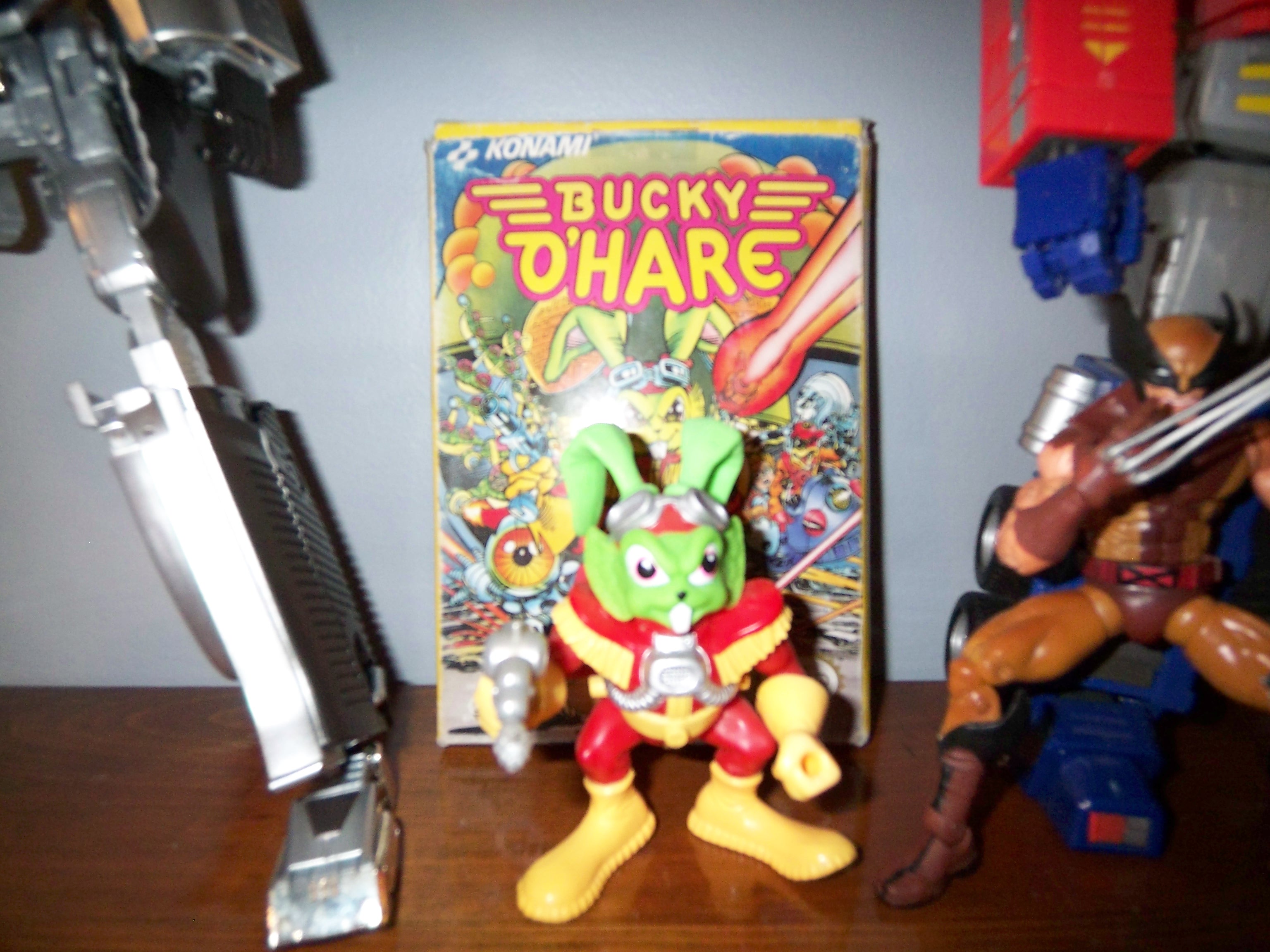
The funky fresh rabbit himself along with his video game.

The Star Wars parallels are actually quite numerous.  A small and perhaps arrogant government is overthrown by an evil empire.  Here that empire is composed entirely of toads.  Instead of a Death Star, their main source of offense is the bulbous toad mother ship (which also gets destroyed after the series’ first major story arch before being re-built) which houses an army of storm troopers and Tie fighter-like toad double bubbles.

Humans do not exist in this “Aniverse,” but unlikely hero Willy DuWitt finds himself accidentally transported to the Aniverse when his home-made photon accelerator malfunctions.  Willy is the stereotypical nerd.  He’s picked on by bullies and mostly an outcast even though he’s a smart and good kid.  Smart would be an understatement as his IQ passes the line of absurd on more than one occasion during the course of the animated series as he’s able to repair pretty much anything.

The animated series is where most of my Bucky acumen lies.  I do have a copy of the original trade paperback that spawned the series.  The two mediums are pretty similar to one another.  There are a few character differences here and there, most notably the characters of Bruiser and Toadborg (the series’ Darth Vader) who were added for television.  The cartoon also caters more to its target demographic, children, to the detriment of older viewers.

That approach may be what doomed the series to only one season of 13 episodes.

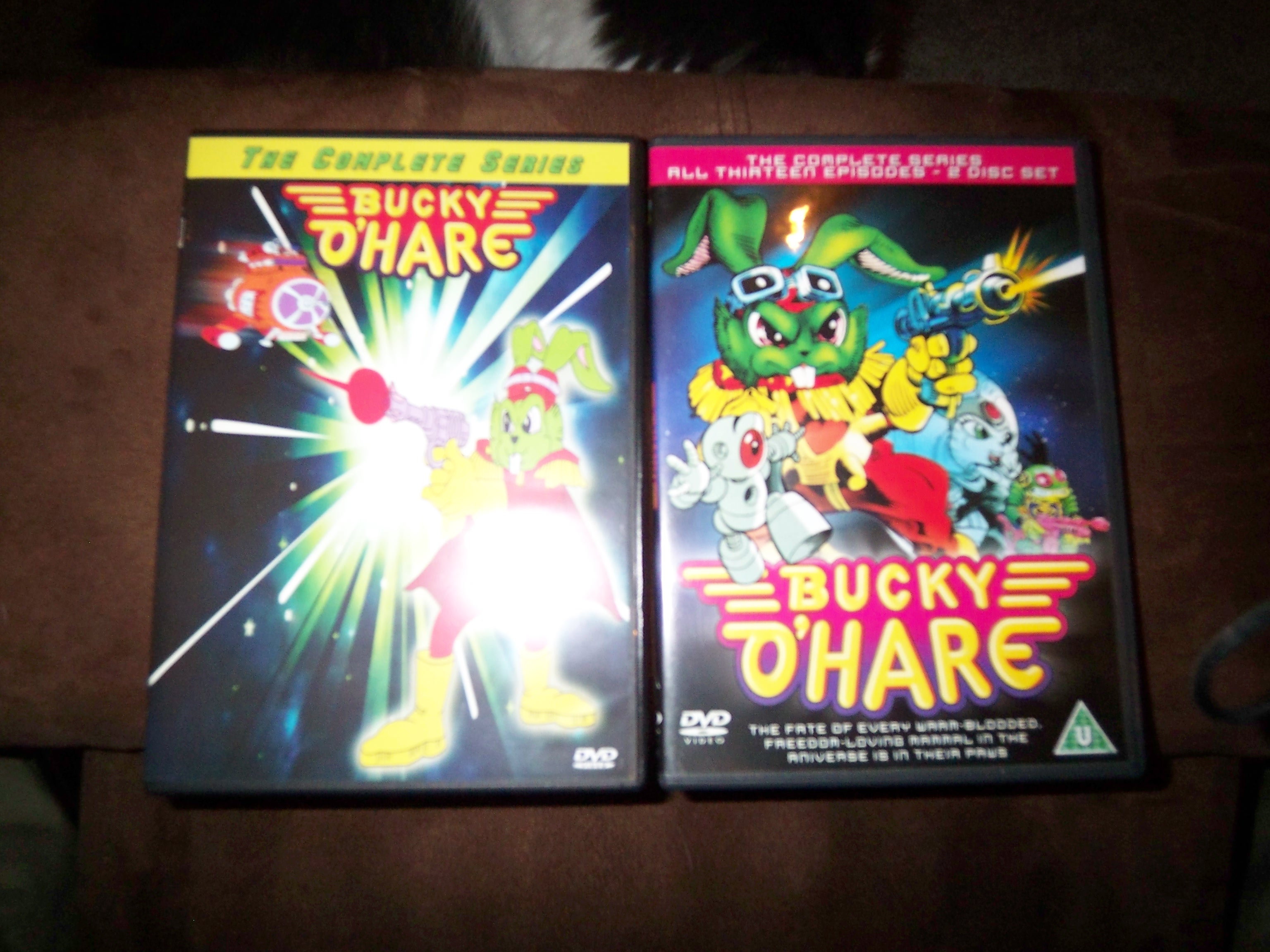
Side by Side, the two DVD releases. Region 1 on the left, 2 on the right.

The plot lines were fairly mature for a cartoon with a dose of politics thrown in that must have been boring for most kids.  At the same time, the short running time of each episode forced the writers to cram a lot into each episode, in effect, dumbing things down in the process.  Even the opening story line which occurs over the series’ first three episodes feels rushed at many points.  In episode 4, “Home, Swampy, Home,” Bucky journeys to see his mentor with the visit culminating in one not so subtle line and no on screen appearance.

The back covers for both releases. 1 on the left, 2 on the right.

Perhaps this was a case of the writers and directors making do with what they had.  They tried to cut out the superfluous stuff to keep things moving and to give each episode its own beginning, middle, and end.  At the same time, it would be interesting to see how someone else would tackle the source material if given the chance.

At any rate, Bucky O’Hare really appealed to me as a kid and I was devastated when the series was quietly cancelled.  I had every action figure and vehicle put out by Hasbro, as well as other assorted pieces of merchandise.  Bucky even had a fairly popular NES game that was affectionately referred to as the Konami Mega Man.  Though like most games of its era, it was brutally difficult.

Bruce, we hardly knew ye.

The series made use of what I always considered a great gimmick to hook new viewers, and that is to kill off a character in the first episode.  That sacrificial lamb here is the ship’s engineer, Bruce, the Beetlejuician Beserker Baboon.  The berserker baboons are a race of ape-men that strike fear into the hearts of toads everywhere.  One of the series’ better episodes has an amusing and clever plot device where the toads develop special goggles that make all baboons look pathetic to help them overcome their crippling fear.  Anyway, Bruce’s death is a Saturday morning kind of death in that no one ever says he’s dead and the circumstances were vague.  Here he gets sucked into the ship’s photon accelerator (its engine) which partially exists in another dimension.  Bruce makes an appearance in a later episode as a pseudo ghost existing between two worlds.  Either way, the gimmick works to attract new viewers because it creates a sense of danger that doesn’t exist in most cartoons.  X-Men also did this extremely well with the death of Morph in its second episode.

A portion of the show's cast, minus Blinky and Willy.

The cast of characters is standard fare.  There’s first mate Jenny, the telekinetic cat,who’s a pseudo romantic interest for Bucky though there isn’t much chemistry between the two.  She, along with Deadeye, are really the only characters given fully fleshed out back stories in their own episodes.  Her powers are also a secret to everyone except Willy.  Deadeye is the ship’s gunner and a former pirate.  He also has four arms, which I guess makes him twice as cool.  He’s a typical shoot first and ask questions later character which gives him a rough persona, an easy one for young boys to gravitate towards.  Blinky is the ship’s robot (actually, android first class, or AFC for short) distinguished by his large, lone eye that takes up most of his “face.”  Bruiser is a space marine and younger brother to Bruce who joins the crew to avenge him by squishing some toads.  I already talked about Willy, but he takes over as the crew’s engineer after Bruce’s departure.  He is able to travel between worlds at will, though in the comic he was trapped in the Aniverse.  The creators also don’t let him wield a real gun, he has to make do with a squirt gun.  It’s a tough life.

Bucky is the captain of the Righteous Indignation, one of only two ships in the United Animal Front’s underfunded fleet, though a third is added in one episode.  Bucky is the hero of his people, the hares of Warren, who is well known for his incredible jumping ability.  One of my favorite moments in the series occurs in episode 4, where after masquerading as a broken down old man to gain entry to a toad slave camp, Bucky outs himself to make a daring leap to a control tower to the shock and delight of his peers.

The Toad Air Marshall, along with Frix and Frax, are typical inept villains.

What’s a hero without a colorful cast of villains?  The Toad Air Marshall is the bumbling commander of the toad forces who’s schemes seem to always be thwarted by O’Hare and his crew.  He answers to Komplex, a toad computer program gone rogue who exists almost exclusively on a computer monitor.  Toadborg is a cyborg and the favored servant of Komplex.  Once a normal toad he was converted to machine.  He towers over the rest and is seemingly indestructible.  He may not be as brainless as the Air Marshall, but he consistently under-estimates Bucky and Co. which ultimately dooms him to failure just like his peer.  The twins Frix and Frax are the Air Marshall’s incompetent subordinates.  Instead of doing their boss’s bidding they spend most of their time watching Toad TV and drooling over the girls of “Warts Illustrated.”  Lastly, there’s Al Negator the sleazasaur (a purple bi-pedal crocodile-like race) who’s a mercenary for hire, though seemingly only the toads are interested (he does briefly get hired by Bucky to be the ship’s new engineer, but he quickly betrays them).

Bucky O’Hare has mostly vanished since his show was axed.  There was a limited

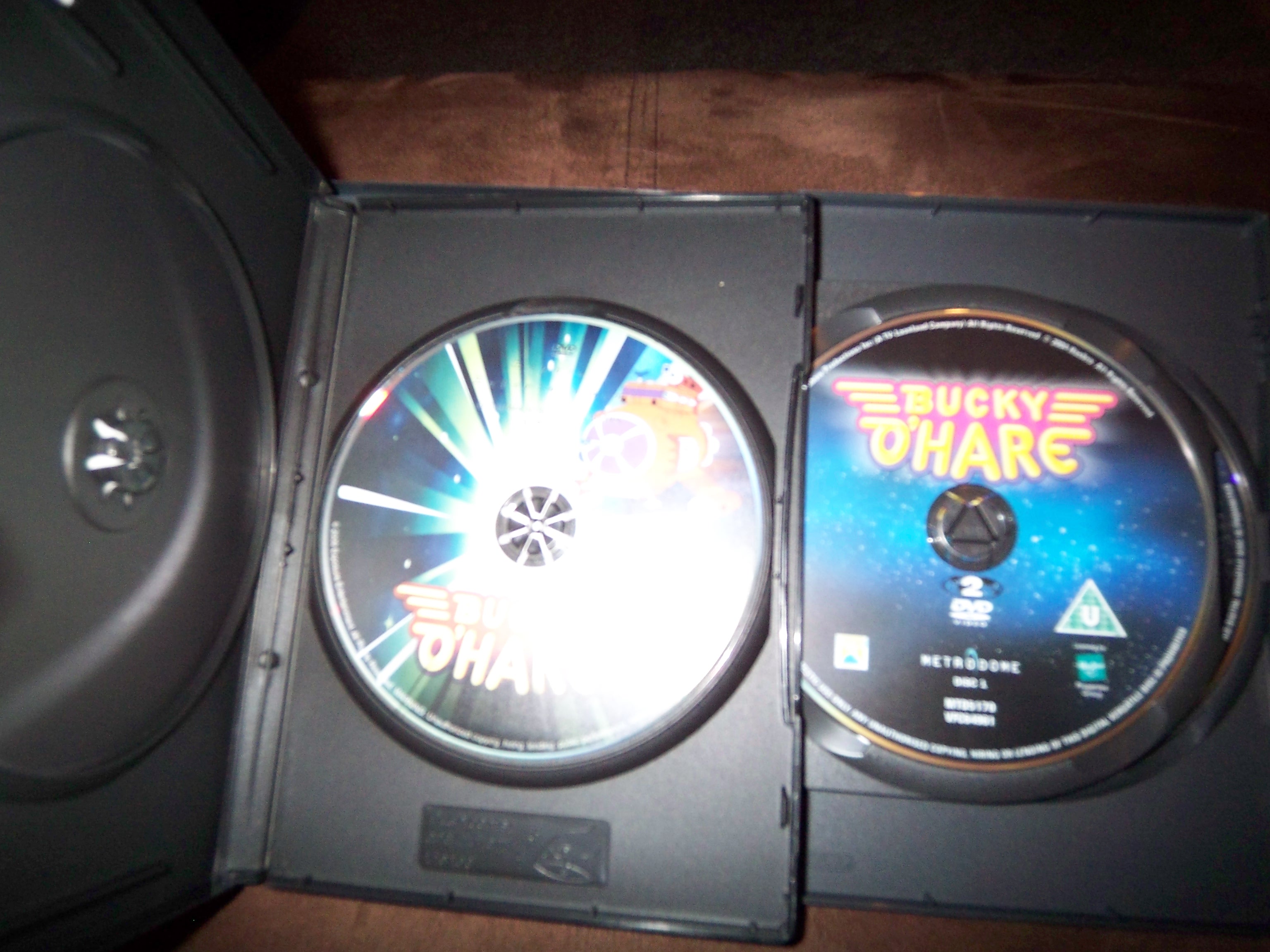
A comparison of the disc artwork, Region 1 left, 2 right.

comic run in Europe but nothing in the US.  Some of the episodes from the series, formally titled Bucky O’Hare and the Toad Wars, were released on VHS but the entire series was missing in action for a long time.  The series was released several years ago on DVD for those in the Region 2 market, but the rights for Region 1 distribution were tied up in disinterest until last year when a 2-disc set was very quietly released by Exposure Entertainment.  And by quiet I mean as quiet as possible.  Good luck finding the set in stores or even online.  There’s a few sellers on amazon.com selling copies for jacked-up prices.  I was able to score one on eBay for twenty bucks, which is probably an over-pay but I’m a sucker.

Toadborg may be purple, but believe me, you don't wanna mess with this guy (toad).

I am so bitten by the nostalgia bug when it comes to Bucky O’Hare that I actually own both versions of the DVD.  I bought a cheap DVD player a few years ago with an easy to bypass region code for the sole purpose of watching Bucky O’Hare.  In terms of packaging, the European release is by far the more attractive of the two.  It contains artwork from the TPB on the front and back covers and is all together more professional looking.  The American release looks like something created in clip art.  When I first saw it I thought it was a bootleg.  Bucky adorns the cover and is squished to fit inside its borders.  There’s a very plain and unattractive yellow bar at the top of the cover that reads “The Complete Series” in green block font.  The discs of the American release feature the show’s logo amongst a star burst with the Righteous Indignation at 2 o’clock.  The Euro release is a much simpler, but more professional looking, logo on a space background.  Neither one contains the subtitle. “and the Toad Wars,” which I found kind of odd.  The menus are not very interesting looking on either, but again, the Region 2 release comes across as being a bit more professional looking.  Neither one contains any bonus features or even an insert.  It’s just the episodes.  The menus also make liberal use of the show’s catchy theme song, probably the part of the show most people remember the best, almost to the point of ruining it.

Ultimately, this is a show only worth pursuing by those that have fond memories of it.  In re-watching them I’m able to see why I liked the show as a kid, and for me, that’s enough to make it enjoyable.  If I had not seen it and remembered it so fondly I’d probably be bored.  It’s not very intellectually stimulating, though it is smarter than a lot of its peers but not enough to hold the attention of an adult.  There is a heart to the show that does give it some charm.  I’d like to think that makes it the kind of show you can tolerate if your kid loves it and would consider it one of the better shows you have to endure for the sake of your children.  There is a definite drop-off in quality on disc two.  Not literally as all the episodes are pretty drab looking, just in writing.  The first few episodes flow together nicely while the remainder are more of the stand-alone variety.

The show did not get a proper final episode as it was cancelled before getting that chance.  An arcade beat-em-up was released following the show’s demise which served as an end for the series though it was hardly satisfying for those willing to spend the quarters to see it through.  The final episode did however wrap-up the lone season’s main plot line of Bucky’s quest to save his home planet of Warren, so there is a pay-off for those willing to see it through.

CG was not a good look for Captain O'Hare.

I would love to see Bucky get a shot at a comeback but he represents one of the longest of long shots.  Shocker Toys tried to put out a line of Bucky Shockini-styled action figures a few years ago.  They acquired the license and even released some promising prototypes but then quietly scrapped the whole thing.  Neal Adams, one of Bucky’s co-creators, has tried in vane to stir-up interest in either a new cartoon series or for a film.  He even self-financed a CGI short to use as an advertisement.  It was not well received.  And it certainly can’t be a good sign if Bucky’s DVD is nearly impossible to get a hold of.   In an era where even the most obscure and forgotten cartoons of yesterday are easy to come by Bucky is still forgotten.  No matter, Bucky’s popularity (or lack there of) won’t ruin my good memories of the show.  I’m glad I have these DVD’s, suspect quality and all, so I can revisit the season anytime I wish.