Category Archives: Music

Queen – The Crown Jewels

Queen - The Crown Jewels (1998)

Queen – The Crown Jewels (1998)

My blog, affectionately titled The Nostalgia Spot, is definitely centered towards video games and movies.  Every now and then though, I like to post about music.  Here is one such post.  Queen is a band most are likely quite familiar with, even if it’s just for a song or two.  The “Bohemian Rhapsody” scene from Wayne’s World may be the best rock-inspired scene ever created and “We Are the Champions” basically concludes every major championship in America.  I always knew The Beatles were more popular in the US than they were in the UK, but I was still surprised to find out that Queen can boast having the all-time best-selling album in the UK (though I think it’s only fair to point out, Queen’s top album is Greatest Hits, while an actual album, Sgt. Pepper’s Lonely Hearts Club Band represents The Beatles).  The point being, Queen has a claim as one of the biggest acts in the world, though the band is definitely bigger outside of the US than it is within.  Queen is a band that I’ve always had a fondness for, and yet up until recently I only owned compilation albums by them.  I set out to remedy this and was a bit disappointed to find out that current CD releases for the band are a bit pricey, as are the recently remastered box sets.  I dug a bit deeper though and was able to find a brand new copy of their box set The Crown Jewels and I couldn’t be happier.

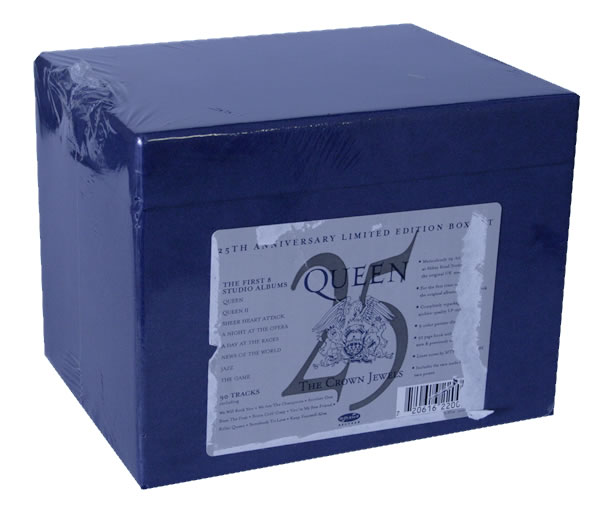
The Crown Jewels was first released in 1998 to commemorate the band’s 25th anniversary dated back to the release of the first Queen album.  I don’t know how long it was in production for but considering I was able to find a still sealed version in 2013 I would guess it was in production for at least a few years.  Box sets aren’t always huge sellers so it’s not shocking to find some hanging around years after release.  I imagine it’s no longer in production now, having been replaced with a new line of remastered sets titled Queen 40.  Those new sets seem pretty cool, but The Crown Jewels was the best way to get as many Queen albums at once in one purchase.  It contains the first 8 studio albums from the band:  Queen, Queen II, Sheer Heart Attack, A Night at the Opera, A Day at the Races, News of the World, Jazz, and The Game.  Each disc comes packaged in a cardboard sleeve to replicate the original vinyl release, albeit in a smaller form (that’s what the label claims, anyways, it’s entirely possible this was the most cost-effective way to package each disc).  There’s also a booklet containing the lyrics from each album as well as a brief bio from Matt Pinfield (remember him?).  The whole thing is housed in a blue, velvet-trimmed box that makes for a sturdy and attractive way to store everything.  Everything sounds great too.  I’m no audiophile, but Queen were masters of production and often ahead of the game so these albums have aged well.  The remastering of these albums didn’t knock anything out of whack and all of the levels sound appropriate.

Queen is John Deacon, Brian May, Roger Taylor, and Freddie Mercury.

Queen is John Deacon, Brian May, Roger Taylor, and Freddie Mercury.

It’s nice that packaging is solid but really it’s rather extraneous because the works within speak for themselves.  The music is what matters most and was the only thing I particularly cared about.  These eight albums represent the band’s best work, though the late entry Innuendo may be worthy of inclusion in that discussion.  At any rate, most agree the band dropped off for a bit with the album Hot Space, which arrived after The Game (I’m ignoring the soundtrack Flash Gordon) when their music embraced a bit too much of the current pop scene.  The albums here are wonderfully varied leading to many people having a different opinion on which one is best.  I’m not sure I can pick one, though there are a few that definitely feel like they’re lesser than their brothers.  I figured I’d do a quick rundown of each album presented here before wrapping things up:

Queen – The debut, and one that failed to find much success.  Queen’s first two albums were mostly ignored by the press, but they’re both worth listening to.  Queen’s first effort is the lesser of the two as the band had yet to find it’s true calling.  The lyrics are mostly fantasy inspired and this was before Queen had a robust production budget as well.  There’s some decent tracks here, but this is definitely the album I’ve listened to the least since purchasing the set.

Queen IIQueen II was mostly maligned by the press.  I can’t tell if they preferred the first album or if they just expected bigger things.  Regardless, I actually like the album quite a bit.  It’s not their best, but it has some interesting arrangements.  “The March of the Black Queen” is a cool little number and I’m practically begging for 3 Inches of Blood to cover “Ogre Battle.”  This album is Queen’s most prog-like which probably makes it more acceptable now than it was when originally released.

Sheer Heart Attack – This is the album that kick-started everything.  It contains the band’s first hit “Killer Queen” as well as other now recognizable tracks like “Now I’m Here” and “Stone Cold Crazy.”  This also is probably the band’s heaviest and most rock-oriented release.  It’s a great album to listen to while driving and a good one to keep coming back to because of the variety in the tracks, something that would become a hallmark for just about every Queen release.

A Night at the OperaSheer Heart Attack put the band on the map, while A Night at the Opera catapulted it to number 1.  Casual fans will recognize several tracks from this release including “I’m in Love With My Car,” “You’re My Best Friend,” and of course “Bohemian Rhapsody.”  There are some other, lesser tracks that stand out too such as the opener “Death on Two Legs” and the ballad “Love of My Life.”  A very good album, but I couldn’t help but feel it’s a tad overrated.  I find other albums in this set work better as complete albums.  The presence of “Bohemian Rhapsody,” one of the all-time best songs ever conceived, definitely helps this album out a lot.

A Day at the Races – It’s tough to follow-up a mega-success like A Night at the Opera, and it sounds like Queen basically tried to create a sequel.  In style, the two albums are very similar right down to the cover artwork.  Sequels are rarely as good as their predecessors though, and the same is true for A Day at the Races.  While it contains perhaps Queen’s best opening number, “Tie Your Mother Down,” the rest of the album fails to live up to expectations.  By any standard, this is still a good album, but by Queen’s it’s a bit lesser.

News of the World – This is one of the more interesting albums in the set, or at least, I found it to be.  Perhaps the band felt the production on the previous albums was too glossy, because this one is fairly bare-bones.  There’s less vocal layers, fewer complex melodies, and some songs just sound like they could have been done in one take.  This helps it to stand out amongst a collection like this and for the better.  Not because this approach is necessarily better than the others, but because it suits the material.  This album contains some familiar tunes as well as a few less-heralded songs that stand out such as “Spread Your Wings” and “It’s Late.”  It also contains the punky “Sheer Heart Attack” which lives up to it’s name-sake.  This one turned out to be one of my favorite albums in the set and is one not to be missed.

Jazz Jazz brings things back to the sound of A Night at the Opera and A Day at the Races  but fails to capture the magic of the former.  It’s a touch better than the latter though, and more casual fans will be happy to find “Fat-Bottomed Girls” and “Bicycle Race” among the songs on this set.  “Don’t Stop Me Now” is another classic and the band’s best party song, but other tracks just fall a bit flat for me.  And good luck making sense of “Mustapha.”  This album just might be the band’s silliest.

The Game – If there was a surprise album for me in this set, it was The Game.  For whatever reason, I didn’t expect much of this album but ended up finding a delightful little gem.  It’s a bit softer than the other albums but the melodies the band made use of are, at times, pristine.  Basically, the first six tracks are just killer and complement each other well.  The album stutters a bit in the last act, but the closing number “Save Me” makes up for it and sets up a nice bookend with the opener.  This one is also one of Queen’s shortest albums as it comes in at under 36 minutes.  At least it makes good use of those 36 minutes.  It’s also the only Queen album to reach number 1 in the US, so maybe it isn’t as overlooked as I thought.

All in all, this is a great collection of music.  If you’re someone looking to get into the band, this would be a worthwhile set to track down.  I suppose digital distribution might be cheaper, but I’m the type that needs a tangible copy of any music, movie, or game that I buy.  Nonetheless, Queen is awesome; this set is awesome; listen to Queen!


Kamelot – Silverthorn

Kamelot – “Silverthorn” (2012)

It was over two years ago when Kamelot cancelled its North American tour.  This came as a surprise because Kamelot had just released its latest album, Poetry for the Poisoned, and appeared to be a band on the rise.  The reason for the cancellation was singer Roy Khan who had to bow out due to an extreme case of exhaustion or burn-out.  Months would pass and eventually Kamelot would hit the road in Europe with Rhapsody of Fire vocalist Fabio Lione filling in for Khan, but everyone who loved the band was concerned for its future.  Eventually, the fears of fans were confirmed when Khan announced he was leaving the band in early 2011.  Rumors flew around the internet regarding why Khan chose to leave, but in the end it didn’t matter why:  Kamelot had lost its voice.

After months of searching for a new vocalist, Kamelot finally settled on Swedish singer Tommy Karevik.  Karevik was a popular choice amongst the internet community.  He has spent the last several years fronting the progressive metal act Seventh Wonder where he displayed impressive range and a powerful voice.  In many ways, he’s very similar to a young Roy Khan but different enough that fans won’t feel as if the band is pulling a Ripper Owens on them.  Karevik is also no stranger to the Kamelot back catalog as he had joined the band for several gigs here and there over the past year.  The fact that the band was able to keep Karevik’s joining the band a secret all throughout the recording of its latest album is pretty impressive.  Kamelot is obviously not going to attract the sort of attention popular acts will but in today’s 24/7 media coverage it’s still a challenge to keep anything under wraps.

Now with a new album under its belt, Kamelot is ready to unveil its new frontman to the metal community.  Much to my surprise, it appears that Karevik wasn’t just brought in at the last moment to belt out some tunes.  He receives a writing credit for each song on the new album and apparently is already an integral part of the band.

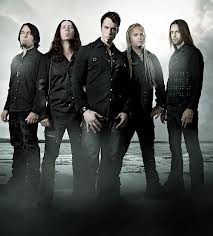
Kamelot with new vocalist Tommy Karevik front and center.

The new album is Silverthorn, and if any fans were worried about how Kamelot would fair without the melodious tones of Roy Khan their fears should be allayed.  For even those who fail to connect with the new material should be able to concede that Karevik fits in nicely and is a welcomed addition.  Longtime fans of Kamelot will probably feel right at home anyway as Silverthorn is equal parts new and familiar.  It plays like a culmination of Kamelot’s prior works with elements of the complex melodies of Epica and low-end of Poetry.  There’s also plenty of new, with the song “My Confession” sounding like nothing in the band’s back catalog and a stronger emphasis is placed on the keys and general orchestration present in many songs.

Like Epica and The Black Halo, Silverthorn is a concept album.  The tale here is of little importance when it comes to enjoying the record, but knowing it does add another layer.  As the cool tones of the cover suggest, it’s not a happy tale.  Listening and reading the lyrics are sufficient enough to get a basic understanding for the story (or viewing the video for the lead single “Sacrimony”) but for those willing to spend a little extra dough on the special edition, a booklet containing the album’s story is included.  The inclusion of a story helps to act as a glue for the songs which flow and complement each other well.

After being a regular in the live show over the past two years, Elize Ryd got to add her vocals to a Kamelot album for the first time.

There are some throwback style tracks and some big moments.  Kamelot long ago ceased to be a straight up power metal act.  The band still finds itself classified as such, but that’s mostly out of routine.  There’s symphonic elements to their sound as well as some traditional down-tuned strumming.  The first single is one of the album’s more spectacular moments.  “Sacrimony (Angel of Afterlife)” is both typical and atypical for the band.  It sounds like a Kamelot song but has a pretty big presence.  It features the album’s most infectious chorus which makes it the logical choice for lead single.  “Solitaire” is another catchy track that’s short and sweet while “Ashes to Ashes” is a bit more rudimentary and heavy.  “Veritas” is very reminiscent of some of the heavier numbers on Epica and “Prodigal Son” is the required long one.  It’s a bit more demanding of the listener as it’s composed of three distinct parts.  They work well together and the structure is very similar to Karma’s “Elizabeth” with the more up-tempo part saved for last.

I was a bit surprised to see that Silverthorn did not feature any guest vocals from long-time collaborator Simone Simons of Epica.  Simons had been featured on each of the past three albums in some capacity but perhaps the band wanted this album to feel new.  Or they just wanted to reward their recent touring vocalist Elize Ryd of Amaranthe by giving her the role of Jolee, the Angel of Afterlife.  Ryd’s a strong vocalist and a natural fit for the band.  She has a more conventional sound than Simons but it works.  She’s featured most prominently on the single but has some other small parts.  The rest of the album is not short on guest work.  Joining Ryd on “Sacrimony” is Alissa White-Gluz of The Agonist who does some screams.  Album producer Sascha Paeth does some heavy vocals and plays guitars through-out the album and noted keyboardist Miro does some work as well. For string arrangements Kamelot recruited the quartet Eklipse who certainly fit the Kamelot style.  The box set version of the album contains the bonus track “Grace” which features vocals from Apollo Papathanasio (Firewind) and guitars by Niclas Engelin (In Flames).

The box set comes with a lot of stuff, none of which is really all that essential. For the collector only.

The album features sterling production by Paeth who has developed a strong relationship with Kamelot.  His glossy, clean approach suits the band’s sound very well.  This is an album that’s easy to digest with well placed slow moments to counter-balance the up tempo tracks.  The length is just enough that it doesn’t feel short-changed but leaves the listener wanting more.  The box set contains a second disc of instrumental versions of all of the album’s standard tracks, plus two additional ones:  the instrumental “Kismet” and the previously mentioned “Grace.”  “Grace” is just an okay track and once heard it becomes obvious why it was selected as kind of a throw-away bonus track (the Japanese version of the album is said to contain a bonus track as well, “Leaving Too Soon,” that I have yet to hear) and isn’t anything that should be considered required listening.  The instrumental versions of the songs are also non-essential making the box set more of a collector’s item than anything else.  It does come in a nice, sturdy box with two hard-bound books inside, one housing the album and the other the story (with some pictures).  The bonus disc is housed in a paper sleeve which is kind of odd as they could have put it in with the album.  There’s also a poster but that’s likely to only appeal to younger fans, possibly female ones.

What it all comes down to is this is a nice album and a new beginning for the band.  It doesn’t reinvent the band’s sound but does move it forward in a logical fashion.  And no matter who is fronting the band, fans only care about one thing:  is it any good?  And the answer is a resounding yes!  The high points on Silverthorn may not shine quite as bright as some of the ones from Karma or The Black Halo but it fits in nicely with the back catalog and is likely to please new and old fans alike.  The departure of Khan was certainly a bump in the road for Kamelot who’s star was on the rise, but there’s no reason why the band can’t resume its climb with Tommy Karevik leading the charge.

Top Tracks

  • Sacrimony (Angel of Afterlife)
  • Torn
  • Veritas

Devin Townsend Project – By A Thread: Live in London 2011

Devin Townsend Project – By A Thread: Live in London 2011

2011 for me was the year of Devin Townsend.  After being a casual fan of Townsend’s work for a few years, I dove in headlong into his back catalog while also enjoying the two albums he put out in 2011 under the Devin Townsend Project moniker:  Deconstruction and Ghost.  Those were two albums that could not be more different from one another, which is something Townsend is known for.  After establishing his name with Strapping Young Lad as a destructive force in heavy metal, he felt secure enough to branch out and really get experimental with his sound.  There probably is a traditional Devin Townsend sound, but for the most part his stuff is all over the place.

One of Townsend’s most creative outlets is with his latest band, The Devin Townsend Project.  Prior to creating this outfit, Townsend was touring and releasing music as The Devin Townsend Band.  After resolving some items in his personal life (namely getting sober) he decided to focus his efforts on a new project.  He envisioned it spanning four albums and decided it would be different enough from what he was currently doing to change the name of his band.  The lineup of musicians that would appear on these albums would be fluid and feature several guests and no two albums would sound alike.  The first of these albums was released in 2009 and titled Ki, the second would follow that year and is called Addicted!  To celebrate the release of the third and fourth albums last year, Townsend decided to do a special series of concerts in London.  The shows would span four days and each night a different album would be featured.  Naturally, the shows went in order of release and lasted four nights.  Not wanting this experience to go to waste, Townsend had each show recorded and the end result is the new CD/DVD box set By A Thread:  Live in London 2011.

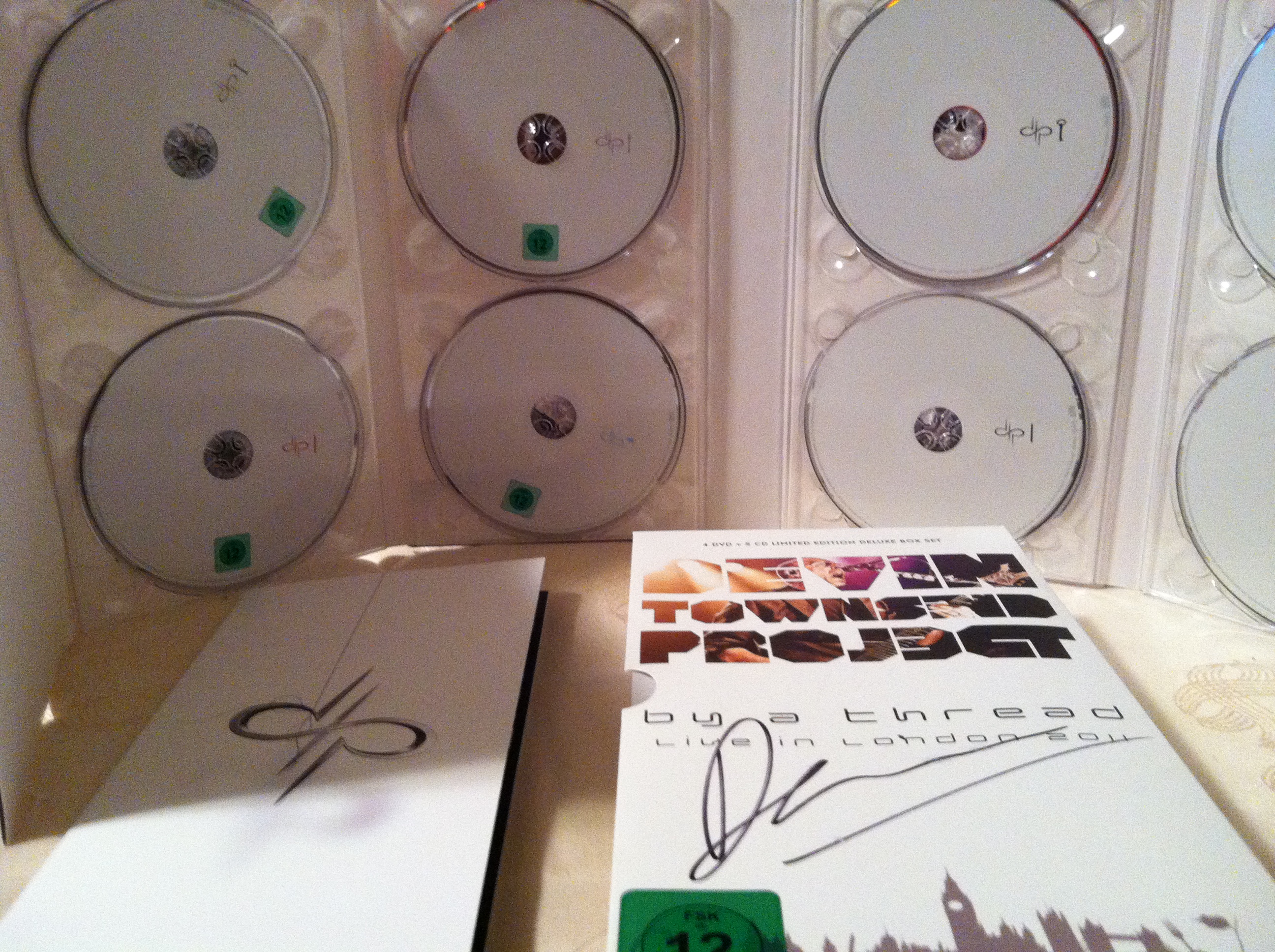
The contents of the release which comes housed in a sturdy booklet style holder and cardboard sleeve.

By A Thread was released this past month in both Europe and North America.  The box set includes 4 DVDs and 5 CDs.  Each concert is on its own DVD, while the CDs are arranged by albums with a fifth disc comprising all of the encore tracks played over the course of the four days.  The first three shows were held at the University of London, while the Ghost set was done at The Union Chapel.  I’m guessing this was done to give the more intimate Ghost record a different feel.  Despite the change in venue, the audio quality is consistent across the board and is quite clear and crisp.  The audio wasn’t optimized for 5.1 though, which has left some fans disappointed.  They also aren’t intended for playback in a PC DVD drive, if that’s something that is important to you.

Visually, the DVDs are okay but nothing spectacular.  The venues are modest in size and the image sometimes feels a bit cramped.  The image also won’t be confused with an HD one, but as far as concert DVDs go it gets the job done.  The menu graphics are interesting and fun to look at.  They also contain loads of hidden easter eggs for the curious type.  Most of which are sound-checks and other behind-the-scenes shots.

As for which concert is best, well that’s a matter of opinion.  Chances are, whatever you favorite DTP album is will be the star here.  Where possible, Devin tried to recruit the musicians that actually played on the album, but some were unavailable.  The star-studded Deconstruction suffers the most as none of the guest musicians could contribute.  Rather than use someone else, Devin opted to use recordings to fill the gap as it would seem he went to great lengths to try and recreate the album sound live.  This means instead of hearing someone else sing Floor Jansen’s parts, for instance, you just hear her track from the actual album.  A lot of the backing vocals are also richened with audio samples from the albums, especially some of the songs from Addicted!  I’m the sort of person who prefers as little of that as possible, but it doesn’t harm the experience for me.  Even with that element, the Addicted! set is my favorite.  That’s due in part to it being my favorite of the four albums, and also because Townsend was able to assemble the key contributors from that album (basically Anneke).  The encores are also some of my favorites.

The image quality on the DVDs won’t blow you away, but it gets the job done.

Speaking of which, Townsend took a different approach to each encore.  For the Ki and Ghost sets, the band mostly did bonus tracks from those albums that didn’t make the original release.  For Deconstruction, Townsend reached deep into his back catalog to pull out some tracks from the Punky Brüster LP.  The reasoning behind this, as explained by Devin, is that since Deconstruction was such a nightmare to learn they’d follow it up with a bunch of stuff they didn’t know!  He flubs some of the lyrics too, but it’s all good.  The Addicted! set features some songs selected just to take advantage of Anneke van Giersbergen and includes the tracks “Pixilate,” “Life,” and “Kingdom.”  There’s also some Ziltoid appearances, which is to be expected.

The crowd is pretty good for most of the sets.  They seem particularly into the Ki and Addicted! sets, though slightly flat for the Deconstruction one.  I’m pretty disappointed they didn’t play along with the Ziltoid campaign speech, but maybe by then they were pretty drained.  That album is punishing.  They also didn’t seem too interested in the Punky Brüster tracks, though I enjoyed their inclusion.

All in all, this is a nice set but it’s definitely for the Devin Townsend Project enthusiast as opposed to the casual fan.  It’s cool to have live versions of these four albums, but not really necessary since how often are you really going to opt to listen to the live version over the studio one?  Probably not all that often.  The videos are cool though and Devin and the boys make it fun to watch (especially the previously mentioned Ziltoid campaign speech).  Devin did a commentary track for each set too that gets into more of the nuts and bolts of the production for you gear-heads out there.  The physical package is attractive and makes for a nice display piece.  A word of caution though, the North American edition apparently has a defect with the Addicted! DVD.  I’m not certain what it is exactly as I bought the European edition, so if you have a choice, go for that one.  Apparently the production company is issuing replacements so it’s more of an inconvenience than anything.

Devin Townsend is one of the most interesting musicians around, so even if this set isn’t for you, check out some of his other works.  There’s pretty much something for everyone in his rather diverse catalog.


Danzig: The Lost Tracks of Danzig

The Lost Tracks of Danzig (2007)

At this point I have now blogged about every Danzig studio album as well as the few live recordings that exist.  The only two albums I haven’t touched on are the two Glenn Danzig releases under the Black Aria title.  Those two albums are classical pieces and I don’t intend to post about them in any great depth. All I will say on the subject is that the first Black Aria is worth checking out, but the second isn’t.  Even without talking about those records, that’s still a lot of content I’ve covered and there’s still one more to go.

Without question, the most anticipated Danzig release for me since I became a fan in ’98 has been The Lost Tracks of Danzig.  It might sound kind of odd on the surface, as how could a collection of songs deemed not worthy of an album release generate so much excitement?  Credit for that goes to former Danzig bassist Eerie Von who had a short-lived telephone hotline in the 90’s following his departure from the band.  Fans who called up were sometimes treated to clips of unreleased Danzig material that Von had held onto.  I can’t precisely recall just how many songs Von featured, but I do know a track called “Cold, Cold Rain” was one and I needed to hear the rest of it.  “Cold, Cold Rain” is a ballad and one with an old 50’s sound to it.  It was recorded for the album Danzig II: Lucifuge but was omitted, likely in favor of “Blood and Tears.”  It features these awesome Danzig wails that still sounded excellent over a telephone line and I was positively despondent over the fact that I couldn’t hear the whole thing, and perhaps never would.

When Glenn Danzig was doing press for the Samhain Box Set released in 2000 he started talking about doing a Danzig one.  The Danzig one would come in a box shaped like an inverted cross and would contain a bunch of unreleased stuff.  At this time, Glenn had just got the rights to his unreleased stuff from American Recordings, his old label and home to the first four Danzig albums.  It had taken years to get all of that stuff back, but now Glenn knew he was sitting on a bunch of songs that he could probably make some money off of.  Unfortunately for fans, Danzig decided to focus on the home video type stuff at first and put out two DVDs featuring the old music videos from Danzig III and Danzig IV.  Glenn would be asked and would comment on the potential box set for years and years.  Not until he became burned out on touring and album making did he finally focus his attention on what would become The Lost Tracks of Danzig.

The cover for the booklet with artwork by Joe Chiodo is very tongue-in-cheek.

The Lost Tracks of Danzig compilation was finally released in the summer of 2007.  Along the way, the idea of a box set was dropped and instead the album was released on an oversized digibook.  The packaging was kind of like the old CD long-boxes that were around in the 80’s and it housed two discs stored vertically as opposed to a more traditional fold-out design.  On the inside cover was a booklet glued in.  Within that booklet was a bunch of photos of the band through-out it’s existence as well as liner notes for almost every song by Glenn.  These notes are fairly minimal, but most exist for Glenn to offer his opinion on the track and why it never was released in the first place.  There’s also some original artwork on the cover of the booklet by Joe Chiodo.  The exterior design was done by long-time collaborator Simon Bisley.

Not all of the tracks ended up being previously unreleased.  There were a couple that once appeared as B-sides or on non Danzig releases.  “When Death Had No Name” is one such track which was originally released as a B-side for the “Dirty Black Summer” single.  It also appears on this collection twice as it was recorded for both Danzig I and Danzig III (and supposedly, it was recorded for Danzig II as well) with the Danzig III version being the superior one.  The track “Deep” from the X-Files show compilation also appears here, as do a couple of remixes at the end of disc two for “Belly of the Beast” and “Unspeakable.”

Even with a couple of previously released tracks occupying space on this collection, there’s still a ton of stuff that is new to fans.  Both discs are packed pretty much to capacity with 13 tracks apiece.  Disc one spans from 1988 thru 1996, while disc two covers the rest.  Most fans were probably really looking forward to hearing the oldest stuff, but a lot of the songs from the 2000’s are pretty enjoyable as well.

Disc one opens up with a really crunchy, rocking track titled “Pain is Like an Animal.”  Written and recorded for the first Danzig album, it’s easy to see how this up-tempo number didn’t quite fit.  The quality of the recording is a bit lo-fi, but still enjoyable.  This track is somewhat controversial amongst the Danzig fan-base as Glenn’s vocals make it sound like this one was recorded later, perhaps during the Danzig III sessions, but Glenn says otherwise.  It’s quite possible that this one was recorded several times, like “When Death Had No Name,” and Glenn just forgot which recording was which.

This is a mighty fine release, Mr. Danzig, but why did you have to make us wait so damn long?!

The Danzig II tracks are pretty sweet, further cementing my opinion that Danzig II is the band’s best album.  “Angel of the Seventh Dawn” is another rock-heavy tune with some nice blues elements.  It would not sound out of place at all on Danzig II, but maybe Glenn just thought he had better tracks.  “Cold, Cold Rain” did not disappoint me, and it’s a great old-school Danzig ballad.  It’s slow but with a big sound.  It probably would have clashed with “Blood and Tears,” though Glenn says he always liked the song, but producer Rick Rubin did not.  “You Should Be Dying” is unfortunately one of the collection’s low points.  It has a cool “Sabbathy” intro but doesn’t go anywhere with it.  The vocals also sound like they were re-recorded for the collection as that’s just not how Glenn’s voice sounded in 1990.  According to him, though, the only vocals that had to be re-recored for this release were for the song “Come to Silver.”  Even though it’s basically a bad song, the chorus will get stuck in your head.  You have been warned!

Apparently there were few holdovers from Danzig III, or Glenn didn’t see fit to release any others, because it’s one of the more under-represented albums on this compilation.  The previously mentioned “When Death Had No Name” is present from that session, but it’s the same version as the one from the “Dirty Black Summer” single.  A good song, just nothing new.  “Buick McKane” is the only other track from Danzig III and it’s a cover of a T. Rex song.  It’s a pretty standard rock track but it has a cool jam quality to it that makes it stand out amongst Danzig songs.  It was likely intended to be a B-side somewhere down the road or was recorded just for fun.

The Danzig IV era brings about some interesting tracks for this collection.  There’s the joke song “Satan’s Crucifiction” that actually ends up being one of the best songs on this collection.  It was recorded for the sole purpose of messing with the executives at American who wanted to capitalize on the band’s recent break-out success with a record that wasn’t too “satanic.”  It’s a dark and menacing track with great atmosphere.  The lyrics are appropriately cheesy but the song’s a lot of fun.  “The Mandrake’s Cry” is a song best described as filler.  Neither strong nor weak, it was likely an easy omission from the 4p record.  It’s also another track where the vocals sound like they may have been re-recorded, or were just recorded with substandard quality.  “White Devil Rise” is a song recorded in response to Louis Farrakhan and his labeling of the white race as The White Devil.  It’s about  a race war and has a very apocalyptic feel to it.  The song is under-developed though and the chorus is fairly banal and kind of annoying.  It’s one of my least liked tracks on this collection.

The error “groovy” font edition of the album. It’s unclear how many of these were printed off, but they seem fairly rare from what I’ve noticed.

Danzig 5:  Blackacidevil is probably Danzig’s least liked record amongst fans, but the tracks from it on this collection are actually pretty good.  “Come to Silver” isn’t a new song, but this version removes the vocal distortion and other effects and strips it down to just Glenn and an acoustic guitar.  These vocals were re-recorded for this collection as the original masters weren’t usable.  The vocal performance could be described as understated, but it works.  I still prefer the original from Blackacidevil, but this a cool track.  “Deep” is not a new track, as mentioned earlier, but “Warlok” is. It borrows the simple chord progression from “Mother” but adds some fuzz and other effects.  Glenn’s vocals are free of distortion and he sings in a quasi-falsetto voice which works really well.  Short and sweet, “Warlok” is a nice surprise for this collection.

Danzig 6:66 Satan’s Child had over twenty tracks recorded for it but only twelve made it to the final LP.  It’s no surprise that a few tracks made it to this collection.  Kicking off disc 2 is “Lick the Blood Off My Hands” which is a bluesy track but with some industrial elements.  I’m not sure if it’s ever been confirmed if this was a Danzig 5 holdover or one from Danzig 6, it’s not a bad song though.  “Crawl Across Your Killing Floor” is from Danzig 6, though the guitars on this track were done by Todd Youth who would join the band after Danzig 6 was completed.  I’m assuming the song was done, but Glenn wanted to re-do the guitars for an eventual release and had Youth step in.  It’s a pretty bad ass song and one of Glenn’s longest.  Youth’s leads are excellent too.  This is a stand-out track and the only one to receive a music video clip from this collection (the concept for the video was pretty cool, but the execution laughable).  “I Know Your Lie” is another holdover that Glenn claimed he just plain got sick of during the recording of the album.  It’s a decent song, but I can see how Glenn could get annoyed with it.  Rounding out the 6:66 sessions is a cover of The Germs’ “Caught in My Eye.”  Some industrial effects were added and Glenn delivers his vocals with that whisper track adding an eerie quality to the atmosphere.  It works, and the punk vibe is still present for those looking for it.

“Cat People” follows, which was recorded during the Danzig: 777 I Luciferi sessions.  It was intended as a B-side, but was never released until now.  It’s a David Bowie cover that most people probably know today as the song from the film Inglourious Basterds.  It’s quite effective and the song exists mostly to build-up to an explosive second act.  “Bound by Blood,” per Glenn, was a tough omission from Danzig 7 and it’s clear why once heard.  One of my favorites from this collection, it’s an uncharacteristically sweet number from Danzig with some dynamite lead work by Youth once again.  It starts off slow, but rises to explosive levels fairly quickly.  “Who Claims the Soulless” is a pleasant enough track.  The guitar has a nice groove to it, and Joey Castillo’s drums work quite well for this one.  “Malefical” is a brooder.  Not a stand-out number, but not really a weak effort either.  “Dying Seraph” closes things out for I Luciferi and it’s a nice one too.  It has a bit of a jazz feel to it with some nice vocals by Glenn.  The big chorus serves as the cherry on top.

Circle of Snakes has just one representative on here and it’s “Lady Lucifera.”  It’s kind of a typical modern era Danzig track, though the production just doesn’t do it for me.  It’s muddy, like Circle of Snakes, and Glenn’s vocals just aren’t crisp.  Apparently he likes the track a lot, but I could do without.  The last two tracks are likely here just to fill space.  “Underbelly of the Beast” is from The Crow:  Salvation soundtrack and is a remix of “Belly of the Beast” that doesn’t really add much to the original.  “Unspeakable (Shango Mix)” is another remix, though this one was done for the adult film Grub Girl which was based on a character from Glenn’s Verotik publication.  The best thing that can be said for this one is it sounds like background music for a porn film.

In the end, The Lost Tracks of Danzig comes across like a greatest hits collection, even if few of the tracks were ever released!  It’s a great compilation with a surprising amount of quality.  I played the Hell out of this thing when it first came out, and even though there’s a few tracks I don’t particularly care for, it’s still something I like to come back to.  I’d love to hear a few more of these tracks live, but as far as I know, only “Pain is Like An Animal,” “Satan’s Crucifiction,” and “Lady Lucifera” have been played live, and none are played presently.  The collection was released as a two disc CD and also as a 4 LP on 180 gram vinyl and colored vinyl.  The vinyl release contains liner notes for one additional track over the CD version, “Cat People,” and the colored edition sort of varies from a blue to a light purple.  A small number of the CD version were released with an incorrect “groovy” Danzig font that was quickly changed to the traditional one so there’s some items out there for collectors to go after.  This is a set any Danzig fan should pick up, and even fans that checked out following the break-up of the original lineup will probably find material on disc 2 to enjoy.  This was one release that proved to be worth the wait!

Top Tracks

  • Cold, Cold Rain
  • Warlok
  • Bound by Blood

Record Store Day!

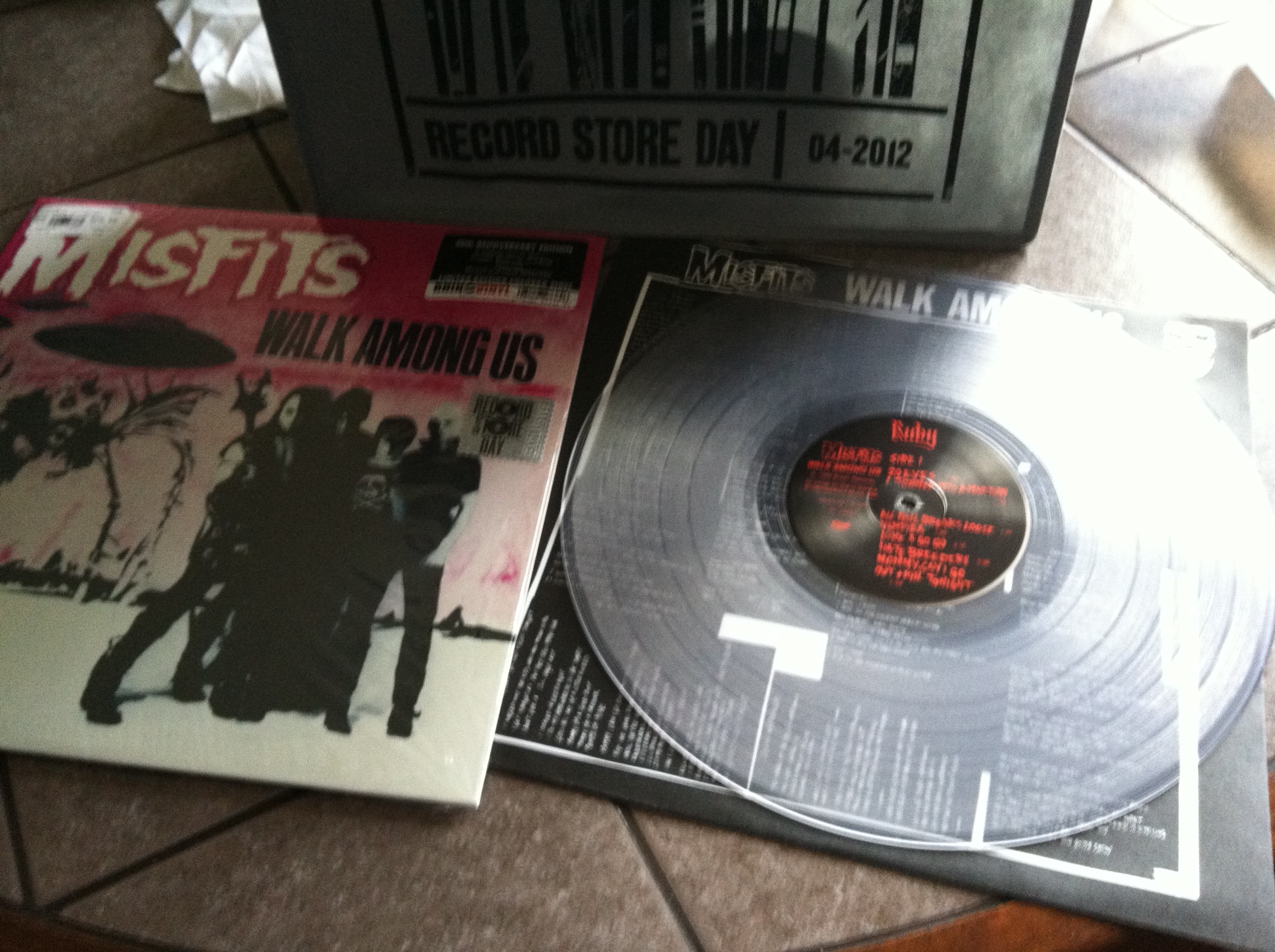
My target for today.

Today is Record Store Day!  A day that hasn’t been around for too long but intends to celebrate the good old fashioned record store.  As a means of celebration, several labels and bands participate by releasing limited edition twelve and seven inch records (go here for a full list of what’s available today) to get people into the stores which usually are offering sales of their own.  Only independently owned stores are allowed to participate and the organizers of the event take a mostly hands off approach.  This leads to swings in pricing from one store to the next and certain records are only available in certain stores.  Unfortunately, this also leads to some stores forgoing the event and just hawking the limited releases on eBay for inflated prices.  This is also the type of event that attracts scalpers of all kinds only interested in making a quick buck, which takes some of the fun out of it.  It’s become a pretty big deal these past few years and the amount of stuff released each year seems to grow and grow and get more and more interesting.

Last year was my first time taking part.  I was more interested in the spectacle than the actual albums released on that day.  I went over to my local Newbury Comics, one of the few small chains to really break thru and thrive in this day and age.  I got there a little after they opened and found the place pretty packed.  I ended up snatching an Opeth 7″ single released for RSD, “The Throat of Winter,” and picked up some odds and ends taking advantage of the sales.  This year was different though.

There's some black streaks on the record as well, though they don't show up in the picture.

Just a few weeks ago Rhino Records announced that they would be releasing a limited edition of The Misfits’ debut record Walk Among Us to commemorate the 30th anniversary of the release.  This version is limited to 3000 copies:  1250 on red vinyl, 1250 on blue, and 500 clear.  They’re packaged in a blind style, meaning you don’t know what color you have.  Overseas, a purple copy is being released.  The stores that participate in RSD have adopted a 1 copy per person policy to give more people a shot at the record they covet.  This unfortunately means the completist collectors out there either need to round up some friends or take to eBay to get one copy of each.  I was content to get just one, but I had to have it!  Given the vast number of retailers participating and the limited nature, I figured each store would only receive two or three copies, meaning I had to get there early if I wanted one.  Complicating things is the fact that not every store gets a copy of every release.  My local shop didn’t know what it was getting as of Thursday so I was taking a shot in the dark this morning when I jumped in my car and headed over.

I got there early; 7:15.  The store is located in a shopping mall and the doors for the mall open at 8 while the store doesn’t open until 10.  I was going to sit in my car for awhile but became too eager to just sit there so before 7:30 even hit I was up in front of the door just waiting outside.  Once the mall opened its doors I was the first to the store (ended up walking in with the manager) and took a seat right outside to begin the 2 hour wait.  It wasn’t too bad as I brought my Vita with me and had my phone too.  By the time 9:30 came around I was too excited to play games any longer and stood and waited anxiously.  I was the first one there, but by the time the doors opened I was one of 50+ and the first inside.  The manager knew what record I was after and made sure to point it out to me before the doors even opened.  I snatched the first copy and then proceeded to mill around poking at the other exclusives.  A wave of people washed over me with hands darting and grabbing at each release.  It was frantic, but fairly orderly.  No one was pushy or rude at all and it seemed like the crowd was mostly record enthusiasts just hoping to score something from a favorite artist.

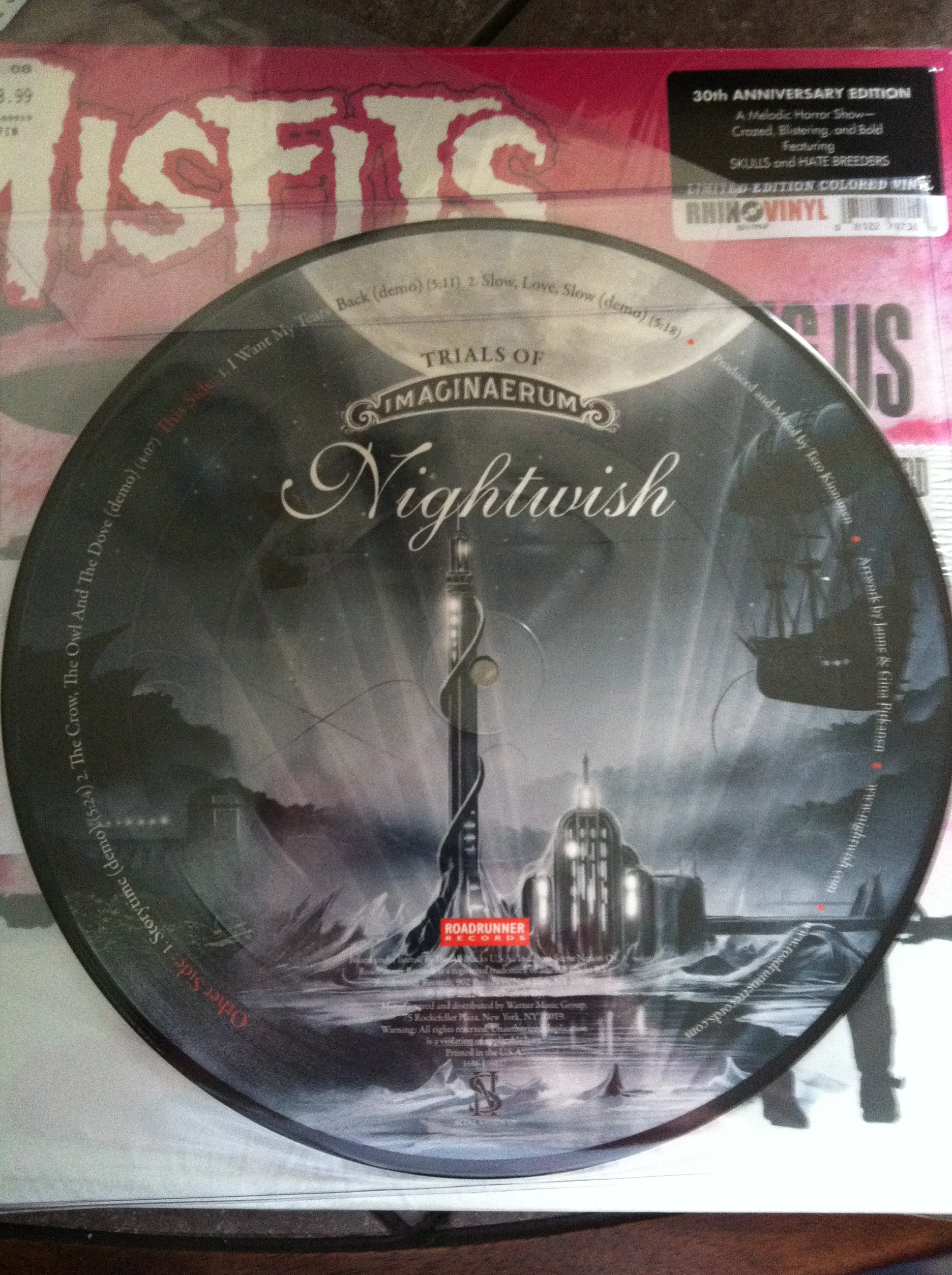
Side A of the Nightwish disc.

I ended up grabbing the Nightwish picture disc as well, along with a super cheap copy of Batman:  Sub-Zero since it was the only Batman film I didn’t own (other than the wretched Schumacher films I want no part of).  My purchases came with a tote bag and a ton of freebies I have yet to go thru.  They’re mostly CD samplers and some stickers and stuff.  I don’t know if there will be anything good on them, but it will be fun to find out.

Once I got home I was pretty eager to check out my new Misfits record to see what version I ended up with.  This release is designed to mimic the original first edition release right down to the insert it comes with.  It’s pretty cool, and I actually don’t have a first edition of Walk Among Us as I have so far stuck to the 7″ releases.  I didn’t really care what version I got, but certainly I was hoping for the more limited clear, especially since I don’t own any clear vinyl.  My elation was certainly audible when I did indeed pull a clear piece of vinyl from the packaging.  My day could not have gone any better!

And side B.

The Nightwish picture disc is also quite nice too.  Titled Trials of Imaginaerum, it’s a 10″ release and contains four demo tracks from their last album.  It also comes with a download code to get an .mp3 version of a fifth track.  Currently, the web address doesn’t appear to be up and running yet so I’ll have to try again later*.   The artwork is nice and this release is limited to 1500 copies.

*I tried the download address on Sunday with no success, but it worked tonight(Monday).  It took me to a page that asked for my email address, and then a download link was sent there.  The fifth track is titled “The Heart Asks Pleasure First” (previously released on the single “The Crow, The Owl, and The Dove”) and it’s a folky little number that’s quite pleasing.

All in all, a good day to hit the record store!  Record Store Day is fun, but the getting up early to wait in line for hours does sap a little fun out of it.  I don’t mind it when there’s something I really want, but I certainly wouldn’t do that for most releases.  Turns out I probably could have strolled in at 10 and have been fine, though I probably wouldn’t have ended up with the clear version of Walk Among Us.  I encourage everyone who’s into  vinyl to check out their local record store today.  You might stumble upon something truly special!


Epica – Requiem for the Indifferent

Epica - "Requiem for the Indifferent" (2012)

I love Epica!  I have all of their studio albums, (except the instrumental one) plus their live album The Classical Conspiracy, and each one is fantastic.  The band is a relatively new obsession for me but that doesn’t mean I wasn’t looking forward to their latest effort, Requiem for the Indifferent, which was released this past week in the US.  Oh, and if you hadn’t heard, it’s good!

Probably like a lot of the band’s fans, I was introduced to Epica through Kamelot.  The band actually began as Sahara Dust, but changed it to Epica after several of the members heard Kamelot’s album of the same name.  This must have got back to the members of Kamelot, as soon they were taking Epica on the road with them.  Epica’s primary vocalist, Simone Simons, did a guest spot on Kamelot’s follow-up to Epica, The Black Halo, on the song “The Haunting.”  Simons would join the band on stage for live performances of the song, and Epica’s other vocalist and primary song composer Mark Jansen, would also show up to do the death growls featured in the song “March of Mephisto.”  Kamelot’s then vocalist Roy Khan would also appear on Epica’s sophomore release, Consign to Oblivion, on the track “Trois Vierges.”

This relationship has continued on to this day.  Simons even began dating Kamelot’s keyboard player, Oliver Palotai, which has made working together fairly easy.  Palotai has even played with Epica when their keyboard player Coen Janssen was unavailable.  Simons has had a vocal part on all of Kamelot’s albums ever since The Black Halo and was part of the band’s most recent tour where she not only sang her parts from various songs but also performed lead vocals for the Kamelot song “Don’t You Cry” at several shows.

Simone became a regular part of the Kamelot live experience following her appearance on the band's album "The Black Halo."

It was love of Simone Simons’ vocals that got me to ultimately pursue Epica.  Her early appearances with Kamelot mostly added color and character to the tracks she appeared on.  Her voice was basically in the background, but on Kamelot’s latest effort, Poetry for the Poisoned, she was moved into more of a duet type of role and really shined.  I had checked out some of the band’s stuff on youtube and had a muted experience.  Epica is a symphonic metal act at it’s core but adds dashes of death metal as well, mostly through the vocals of Mark Jansen.  I like all metal to some degree and have written about acts that use death growls with great admiration like Opeth and Children of Bodom.  That said, I found Jansen’s vocals off-putting.  They sometimes sound like they exist just because someone in the band feels that they must.  There’s usually little melody to how they’re presented and are very monotone.  It didn’t help that I was checking out Epica primarily because I enjoyed the work of Simone Simons with Kamelot and mostly wanted to hear her front a band.  Eventually I decided I needed to give the band a real chance though, and picked up their album Design Your Universe.

As with most things, repeated exposure to Jansen’s vocals softened my opinion of them.  I gravitated towards the tracks that featured them minimally, but then I started to enjoy the others as well.  Design Your Universe is a great, fantastic album.  I’m still not a big fan of the use of death growls, as they sometimes just don’t fit, but they don’t bother me.  The musicianship and composition of the songs stood out to me, as well as the work of Simons.  I soon sought out the album that preceded DYU, The Divine Conspiracy, and found it hard to decide which I enjoyed more.  I stopped there for awhile, as Epica’s other albums are a pain to locate in the US, but eventually I ordered the remaining ones off of amazon and have enjoyed them all.  I really can’t pick a favorite, though the debut album The Phantom Agony is probably my least favorite.  Not because it’s bad or anything, it’s quite good, it just sounds like a band still finding its voice.

Which brings me to the latest effort from this Dutch outfit, Requiem for the Indifferent.  At it’s heart, Requiem is a natural extension of the last album, Design Your Universe.  There’s a metal base to the record that’s accentuated with classical and Hollywood style orchestration.  There’s a bit more ambition this time out in terms of song structure.  Even the album’s lead single, often the album’s “safest” track, experiments with interesting time signatures.  It’s a bit more of an aggressive lead over something like “Never Enough” from The Divine Conspiracy, but also a superior track.  This lead single, “Storm the Sorrow,” is arguably the album’s best song which is a rarity for a single.  This makes the album a more challenging listen, but a very rewarding one.  Epica is the rare band that seems to get slightly heavier in sound with each subsequent album.

The album begins in the same fashion as the last few, with an instrumental that leads into a soaring epic.  “Monopoly on Truth” is an excellent choice for an album opener as it serves as a pseudo preview of the whole, but still is a viable song on its own merit.  It’s one of the heavier tracks, and there are quite a few of other such tracks.  “Internal Warfare,” dedicated to the victims of the terrorist attack in Norway last year, is another heavy and bold track that gives the head-bangers something to get excited over.  There’s also plenty of softer moments.  “Delirium” is the token ballad of the bunch where a pleasant composition is content to stay in the background while Simons does her thing upfront to really drive the song along.  The US exclusive track “Twin Flames,” is another similar ballad though distinct enough from “Delirium,” and a very capable ballad at that.

The band is often at it’s best though when it can intertwine the heavy and the serene.  The title track is one such instance.  It begins with an unusual (for Epica) “jangly” guitar riff that soon introduces a sitar before the song gets going.  There’s a soaring chorus and lots of extension as the song finds a

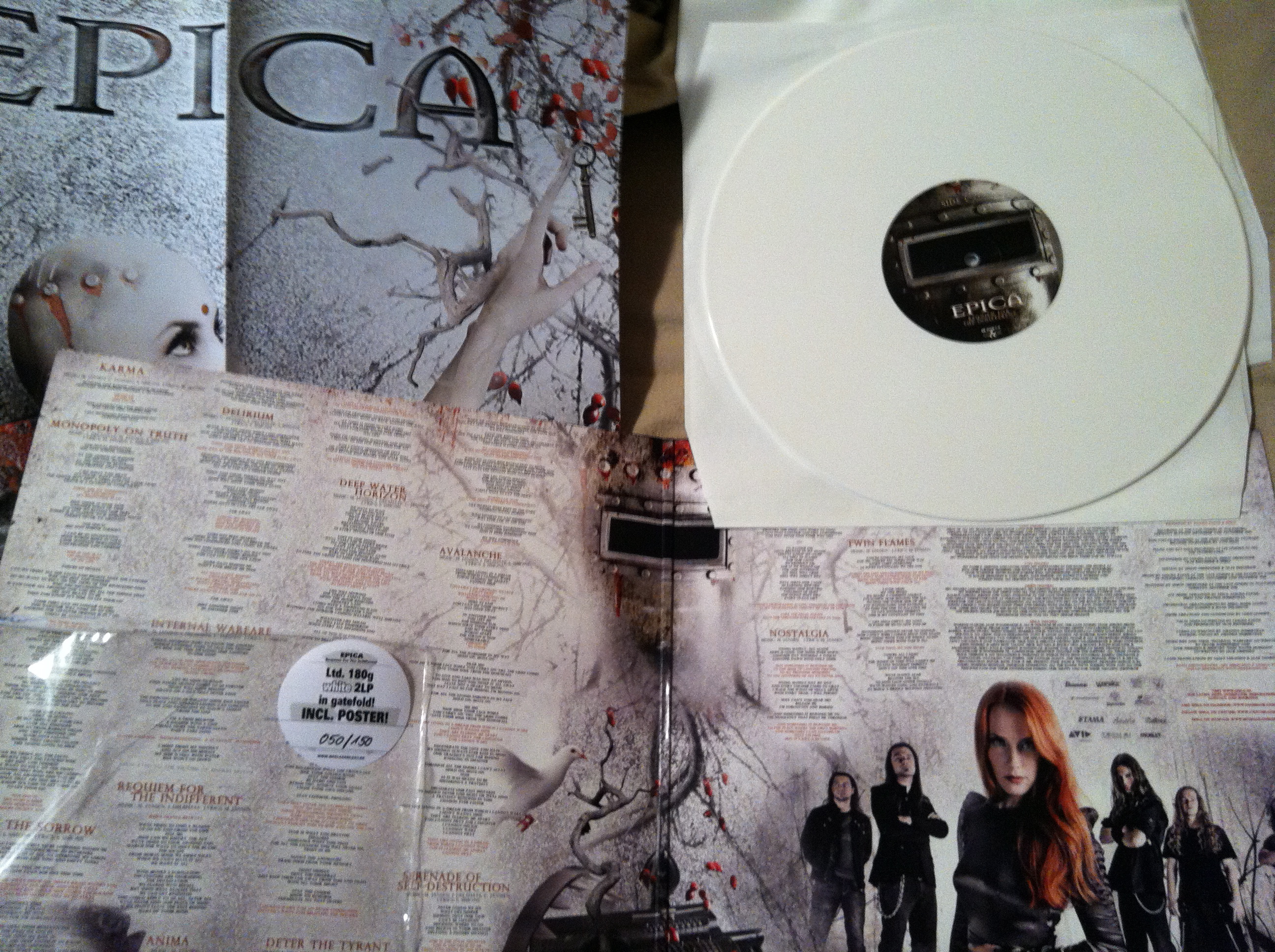
There are a few special releases for this album. Pictured is the double LP on white, 180 gram vinyl which is limited to 150 copies. It contains both bonus tracks, "Nostalgia" and "Twin Flames" plus a poster of the album cover.

way to fill eight minutes without feeling long.  Epica is quite fond of exceeding the six minute mark with its songs, and usually does so capably.  “Deep Water Horizon” is a song most will probably find stuck in their head.  It contains an almost out of place chorus, but it’s so good that the song makes it work.  It intertwines the dark and the light and is the kind of song that temps the listener to immediately “rewind” and listen to again upon completion.  The closing number (not including bonus tracks), “Serenade of Self-Destruction,” is the album’s most ambitious song and possibly it’s brightest moment.  Every aspect of the song works well in it’s favor and the chorus has an appropriately “epic” feel to it.  For the track, Epica makes liberal use of choirs and Simon’s more operatic vocals while Jansen adds some brutal undertones with his grunts.  There’s even a spoken word section, something Epica would probably do well to make less use of, that doesn’t derail the song’s momentum as it doesn’t stop to let the speaker speak.  The CD version of the album was actually released without the final version of this track and the lead vocal tracks are missing.  Nuclear Blast, the label for Epica, wisely corrected this error by releasing the song for free over the internet in both .mp3 and .wav formats.  Future pressings will most likely include the full version of the song, but the instrumental version is still an engaging listen and allows the listener to appreciate the composition.  The chorus is so expertly crafted that it works just as well without the lead vocals.

Requiem for the Indifferent is another excellent release from this now firmly established Dutch outfit.  There are moments that do not shine as bright as others, but there is not a single bad composition here.  The production from noted producer Sascha Paeth is fantastic.  The drums are full, the guitars distinct, and the bass audible where it needs to be.  This is Epica’s best album in terms of guitar playing and composition.  There are some great lead riffs and just a ton more variety than their previous albums.  Vocally, Simone Simons is excellent, as always.  There is slightly less ambition as most songs are content to keep her in mid-ranges.  There’s no “Tides of Time” moment, but she stays within herself and when she does push her range it’s with great effect.  It’s much too soon to declare if this latest release is Epica’s best, but the fact that it’s already in the discussion is a very good thing.  Don’t sleep on this one, folks!

Top Tracks:

  • Storm the Sorrow
  • Deep Water Horizon
  • Serenade of Self-Destruction

Danzig: Thrall-Demonsweatlive +

Danzig: Thrall-Demonsweatlive (1993)

Last weekend I posted my final review for the Danzig LP’s, but that doesn’t mean I’m done with Danzig!  Far from it, as there’s still a few more items that require attention.  If you’ve been keeping track, I’ve posted a review for all nine studio albums plus a summary of the soundtrack only songs that have seen release over the last 20+ years.  That still leaves the EP’s, The Lost Tracks compilation, and the Black Aria releases; all to be addressed in good time.  This post will take a look at live releases and the EP’s, specifically Thrall-Demonsweatlive.

It might surprise you to know that the two best selling Danzig releases (and the only two to reach gold status) are the 1988 self-titled album and the 1993 EP Thrall-Demonsweatlive.  This is, of course, due to the popularity of the “Mother” track which saw a re-release for radio and MTV when Thrall hit stores.  “Mother” was originally released as a single for the first album, but it struggled to find airplay on mainstream rock radio stations.  It had an even harder time finding an audience with MTV and the network determined the video was “too Satanic” and refused to play it without some editing done.  Danzig balked at censoring the video, so the label instead released a home video (simply titled “Danzig”) that contained all of the music videos shot for the first album as well as some behind the scenes interviews with the band.

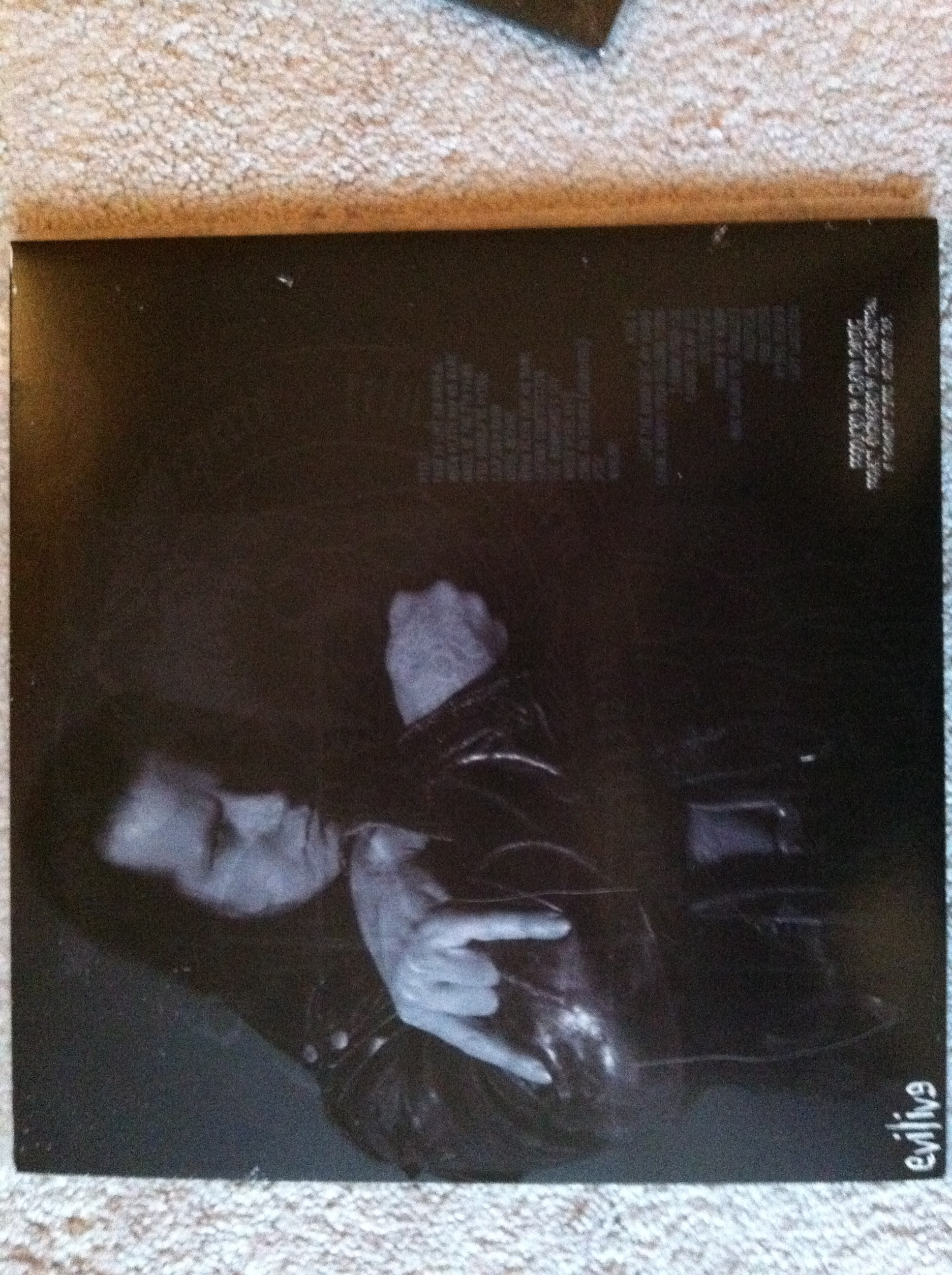
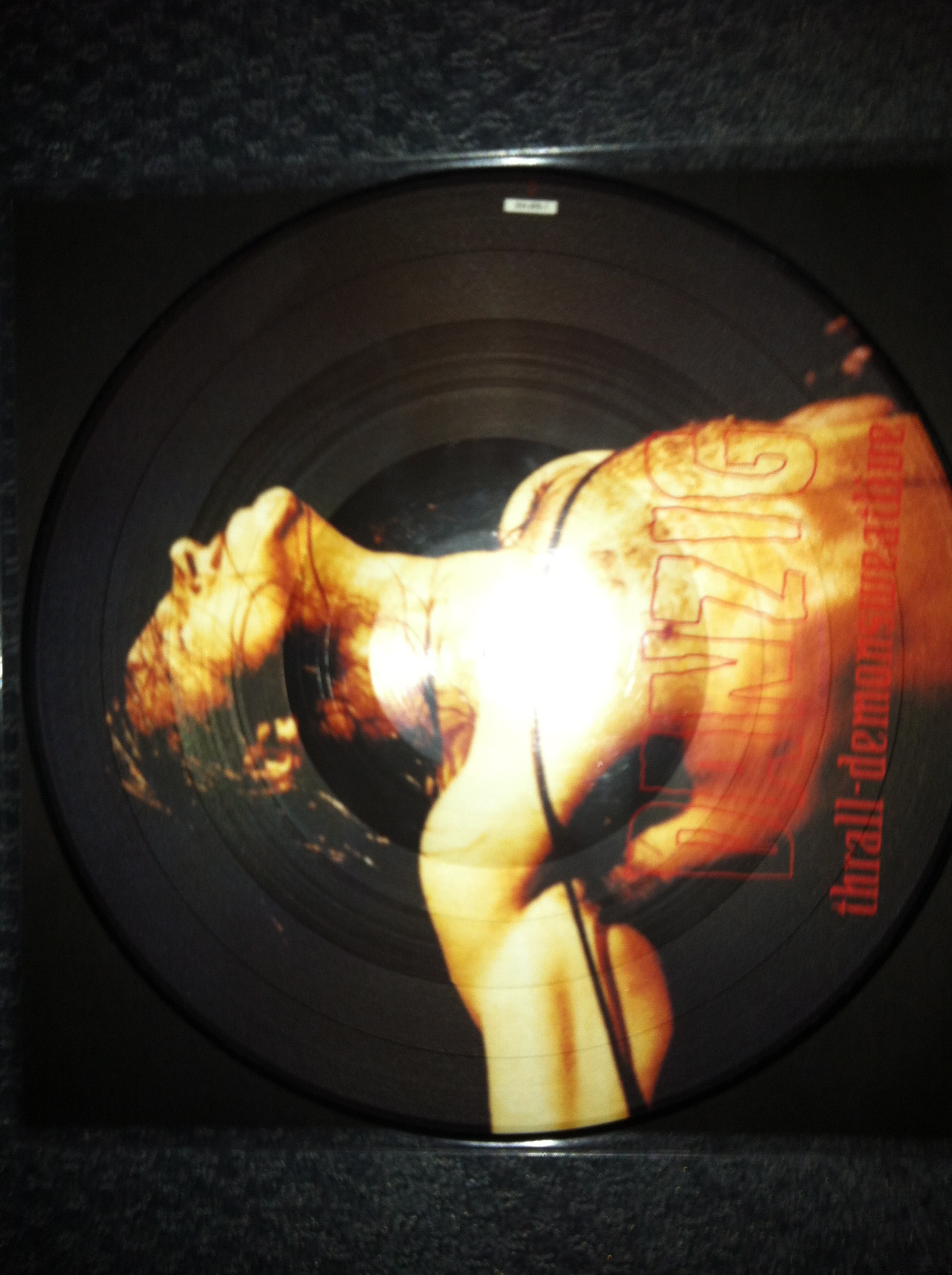
Side B of the picture disc release.

In between Danzig III and Danzig IV, Glenn Danzig approached the label about doing an EP.  The label wasn’t too keen on the idea, but according to Glenn he was able to to get them to agree to put one out after pointing out how well Alice in Chains had done with the Jar of Flies EP.  Once the agreement was in place, the band hit the studio in between tours to record a couple of original tracks and one cover.  The two originals ended up being “It’s Coming Down” and “The Violet Fire.”  Joining them for the Thrall portion of the release was a cover of the Elvis tune “Trouble.”  The band had been working on this cover ever since the Samhain days but had never found an appropriate place to release it.  Those three tracks comprised what was called the “Thrall” portion of the release, and were paired up with four live tracks that made up the “Demonsweatlive” part of the album.  These four tracks were all taken from the band’s Halloween gig at Irvine Meadows in 1992, they are:  “Snakes of Christ”, “Am I Demon”, “Sistinas”, and “Mother.”  There’s also one hidden track on most releases, a slightly remixed version of “Mother” often referred to as “Mother ’93.”  To my ears, it doesn’t sound any different than the original version.  It was this version of the song that was made into a new music video featuring nothing but live shots which found an audience on MTV.

The studio tracks on this release are pretty solid, with “It’s Coming Down” becoming a staple of most live setlists ever since.  I personally prefer “The Violet Fire” for its more groove-oriented pacing.  The live tracks are all pretty ferocious and played faster than they were on the albums.  Glenn almost growls the lyrics for most of them, with the exception of “Sistinas” which features his signature croon.  I know a lot of people who prefer the live version of “Sistinas” to the album version, to me, both are excellent.  The live version of “Mother” is superior to the album version as it captures a different kind of energy that really lends itself well to the rebellious lyrics.

Danzig: Live on the Black Hand Side (2001)

The rest of the setlist from the Irvine Meadows show would pop up here and there one track at a time on various singles.  The majority of it would be released on 2001’s Live on the Black Hand Side.  Live on the Black Hand Side is Danzig’s only other live release and the band’s only full-length live album.  It’s a two disc set that captures the band’s peak in the mid 90’s as well as the Satan’s Child tour from 2000.  Disc 1 is split between the Irvine show and a Seattle show from the 4p tour.  The track-listing is like a greatest hits album, and the first disc is a nice piece to own.  Disc 2, on the other hand, is a disaster.  The audio quality, perhaps because the shows took place in smaller venues, is garbage.  The track-list is pretty solid, though there are a couple clunkers, but the quality ruins it.  Glenn’s vocals are often hard to make out and the band sounds thin.  Live on the Black Hand Side can be a tough album to track down these days, but is only worth doing so for the hardcore.

Danzig: Sacrifice (EP, 2000 E-Magine release)

The only other EP put out by Danzig is the Sacrifice EP.  It was originally released as a single that contained six tracks, all remixes of the of the song “Sacrifice.”  It was re-released in 2000 by E-Magine with additional tracks added; remixes of “Deep” and “Serpentia.”  The original version did have a limited vinyl pressing for you completists out there, while the re-release was CD only.  It’s a release for the hardcore only, as none of the remixes improve upon the original songs, and in the case of both “Deep” and “Serpentia,” the original song wasn’t that great to begin with.

Thrall-Demonsweatlive is a must own for Danzig fans.  The studio tracks are solid and the live ones entertaining.  It was released on CD and cassette initially, but also had a German picture disc release that can be hard to track down these days.  The front cover of all of the releases features artwork by Simon “Biz” Bisley who would go on to do a lot of illustrations for Danzig.  The reverse image of the picture disc features a bare-chested Glenn Danzig from Irvine Meadows, an image also included inside the CD booklet.  The booklet for Live on the Black Hand Side features dozens of live shots from throughout the band’s existence and is arguably the best thing about the release.  The front cover is atrocious though and very amateurish.  There’s not much noteworthy to say about the packaging for any of the Sacrifice releases, save for it does include that image of Glenn spreading his arms melded with the skull logo.


Danzig: Circle of Snakes

Danzig: Circle of Snakes (2004)

2004 was a great year for me.  That year started off with a Superbowl victory by my New England Patriots and culminated in one of the happiest moments of my life; the Red Sox victory over the St. Louis Cardinals in the World Series.  2004 was also the year I began my junior year of college which would be a fun and memorable one and not long after the year’s close the Patriots would capture their third (and despite the team’s best efforts, most recent) Superbowl win.

2004 also saw another release from Danzig; Circle of Snakes.  After releases in 1999 and 2002, Danzig appeared to be back on track in terms of an established release schedule.  There was also a live album during that timeframe and some other re-releases as well as plenty of touring.  And while 1999’s Satan’s Child wasn’t that great, the follow-up I Luciferi showed some promise.  Circle of Snakes was heralded as yet another return to form for Danzig, with pre-release hype claiming Glenn Danzig had gone back to his roots.  This sort of hype had become tired at this point, since both of the previous efforts were described in a similar fashion and yet both were quite different from older works.  I’m not even sure fans ever really wanted Danzig to sound like it did back in 1988, most just didn’t want the band to sound like a NIN knock-off.

Even so, Circle of Snakes was more of a return to form than either of the previous records.  The approach the band took to the record was simplified when compared with prior works.  Basically all of the extraneous effects have been removed from the production and replaced with a pervasive heavy-ness.  Like the prior two records, Circle of Snakes features down-tuned guitars that go lower than the popular drop D technique.  The mastering of the record was either bare-bones or not done at all giving everything a rough quality.  The guitars dominate this release and if their tuning wasn’t heavy enough, the tone used added even more thickness to the sound.

The end result is a sound that works in some parts, but not in others.  Unfortunately, the latter is more common.  The opening instrumental, “Wotan’s Procession,” features that distinct guitar tone right off the bat.  It’s rather ugly, though some would argue it works here and in the following song, “SkinCarver.”  “SkinCarver” is designed to be a destructive album (and show) opener.  It’s fairly straight-forward and one of Glenn’s heaviest compositions.  It’s not among the best openers on a Danzig album, but provides a good preview of what’s to come.  The title track contains a variation on that classic Danzig riff we’ve been hearing since ’88 which adds a groove to the track, in contrast with “SkinCarver.”  The tone of the guitars is more pervasive here though and quite jarring and once everything gets brought in on the chorus Glenn’s vocals get drowned out.  The song is mildly catchy though and not unbearable, if one overlooks the campy-ness of the lyrics.  “1000 Devils Reign” follows and represents the album’s strongest track.  A catchy little drum pattern kicks things off before giving way to a simple three-chord progression and some silky Glenn Danzig croons.  The chorus is classic Danzig, and the whole package comes together extremely well.  The heaviness of the guitars feels a little out-of-place on such a melodic track, but they’re not over-powering.

Unfortunately, the album kind of falls off a cliff shortly after.  “Skull Forest” is a decent semi-ballad with perhaps the best vocal performance on the album.  The end of the song almost drowns out and ruins the vocal performance but it does give the song a bigger sound.  The rest of the album bounces around from forgetful to annoying.  “Hellmask” and “My Darkness” represent some of the worst of the worst from Danzig; just obnoxious, direction-less tracks with no redeeming qualities.  “NetherBound” is starts to make up for things while “Black Angel, White Angel” is a pretty effective hard rock track, but by then it’s too little too late.

The musicianship from the Danzig lineup is pretty solid, if unspectacular.  The whole band was replaced following I Luciferi and the recording lineup this time included Bevan Davies on drums, Jerry Montano on bass, and ex-Prong main-man Tommy Victor on guitar.  Victor had played with the live band on several occasions before so this was a return engagement for him and one that has continued to this day.  The other two would eventually be replaced by Steve Zing and Johnny Kelly (who Danzig really wanted to use for this album but was unavailable).  The mix is where things fall apart for Circle of Snakes as Glenn wanted to achieve a heavy, analog sound.  The successor, Deth Red Sabaoth, would actually be recorded via tape to better achieve this sound, though mixing and mastering would still be an issue.

Circle of Snakes on blue vinyl.

Release wise, Circle of Snakes shines as one the more diverse albums in the Danzig catalog.  It received a standard CD release with a minimalist booklet complete with C-grade porn stars in place of lyrics for some songs.  Glenn Danzig is once again pictured with his black, latex, monster gloves though he decided to keep his shirt on this time.  Circle of Snakes received a true vinyl release, something that really hadn’t occurred since Danzig 4.  Satan’s Child did receive a very limited run as a picture disc, but Circle of Snakes received something close to a full-scale roll-out.  The album was available on blue vinyl and as a picture disc for the first pressing, and then on clear vinyl and another picture disc for the second pressing.  The first pressing totaled 1,400 and the second 880 with both editions evenly pressed.  I believe these were only available in Europe, but I’m not certain.  They’re fairly easy to come by on eBay and copies have worked their way into American second-hand shops.  Needless to say, there’s plenty for the completest collector to go after.

Circle of Snakes brought the band back to its more stripped-down roots, but introduces enough newness to make it stand out from the pack.  Unfortunately, it stands out for all the wrong reasons.  Where the heavy sound of the record works it creates a head-banging, hard rockin’ tune but for many of the songs it becomes oppressive.  Even without it, many of the songs just sound tired and uninspired.  There’s not a whole lot going on from a musical standpoint or a lyrical one.  Given that, it’s not surprising that the band would have a long hiatus between albums with six years lapsing before 2010’s Deth Red Sabaoth.  The break was apparently needed, as Deth Red Sabaoth is a heavy but far superior effort to this one.  Circle of Snakes does have a few good tracks which keeps it from being the band’s worst, but it’s probably the most forgettable.

Top Tracks:

  • 1000 Devils Reign
  • NetherBound
  • Black Angel, White Angel

Nightwish: Imaginaerum

Nightwish: "Imaginaerum" (2011)

From time to time I like to break format and post my thoughts on a current game or album.  It helps to keep things interesting, and even though I love things from my past, I’m actually a pretty forward thinking individual.  And lately I feel like this blog has become a video game one because there’s just been so much to talk about where games are concerned.  Which makes this a perfect time to post a new entry on something that’s both current and not a video game.

2011 was not a banner year for music.  At least, not for me.  I made a couple of posts on new albums in 2011 but none were glowing.  And it’s a shame because there was some stuff in 2011 I was really looking forward to, most notably Opeth’s latest album Heritage.  Heritage ended up being a bit on the underwhelming side.  There was some good stuff, but it fell short of my admittedly lofty expectations, and it had nothing to do with the lack of any true metal moments on the album.  There were some albums that impressed me to various degrees.  Symphony X released Iconoclast and the double album version is an enjoyable listen.  Mastodon’s The Hunter was a big surprise for many as the prog-metal masters decided to go in a more rock n’ roll direction.  I enjoyed it, though it lacks true staying power.  Devin Townsend released two albums under the Devin Townsend Project moniker that had their pluses and minuses.  Deconstruction was an abusive, relentless, heavy piece of music that’s so destructive it borders on unlistenable.  Fantastic in small doses, but tough to digest as a whole.  On the other hand, Ghost is extremely accessible and damn near dull by comparison.  There are some moments where Townsend stumbles on some truly memorable hooks and melodies, though ultimately the album’s style is not my kind of thing.

Sneaking in at the end of the year though was the latest album from Finnish symphonic metal maestros Nightwish; Imaginaerum.  It had been over four years since Nightwish’s last album (and first without longtime vocalist Tarja Turunen) Dark Passion Play and I’m sure the die hard fans were eager for something new.  I’ve never been among the die hards and only own two Nightiwish albums in addition to this one, Once and Dark Passion Play.  Nightwish is a band I’ve often enjoyed in small doses.  Keyboardist and lead composer Tuomas Holopainen has always had a gift for composition, especially when crafting a chorus, but has the tendency to over dramatize the music.  This can, at times, give Nightwish a pretentious air to it.  Not that such a feeling is bad in itself as many bands convey that sentiment as well (Tool and Opeth immediately come to mind), it’s just that Nightwish goes for an almost Hollywood sound that doesn’t agree with me all the time.  Often I actually find myself enjoying their more complex pieces and only some of the considered accessible stuff.  The ones I enjoy the least tend to be the heavier tracks where the band almost tries to be too metal.  My least favorite track on the last album was “Master Passion Greed” which just so happened to be the heaviest.

Nightwish: Jukka Nevalainen, Emppu Vuorinen, Anette Olzon, Marco Hietala, Tuomas Holopainen

Nightwish also has a reputation amongst the metal community as being “girl metal” or other terms too derogatory for me to list.  I kind of get it, the metal community is always going to be this ultra macho thing and women always have a harder time winning over a metal audience than men.  Especially women who earn the label of pop singer.  Nightwish has also invited drama in the past with their handling of Tarja Turunen’s dismissal by publishing an open letter to her on their web page.  The whole scenario had a very high school feel to it and I legitimately felt bad for newcomer Anette Olzon who had to walk into this mess, though I’m sure she’s been well compensated for the aggravation.  Olzon has had a seemingly difficult time winning over the fans as her vocals are more “poppy” than Turunen’s operatic vocals.  I find them too different to really compare to one another, but Olzon is by no means a deficient vocalist and the music the band is producing now suits her style quite well.  I’m closer to 30 than 20 these days and labels like “girl metal” are juvenile and, quite frankly, beneath me.  Good music is good music, and I don’t care about labels (I’m listening to country while writing this), and Nightwish has made a better album in 2011 than Megadeth, In Flames, and just about everybody else.

That said, Imaginaerum is one finely crafted piece of art and would be considered such no matter what year it was released in.  This is the first Nightwish album I’ve listened to from start to finish and can honestly say I enjoy every song.  I don’t love every part of every song, but this is a complete album and quite possibly the best of 2011.  It’s a concept album and Holopainen explains it as being from the point of view of an old composer looking back on his life.  This seems to take the form of the protagonist longing to be a child again where imagination rules supreme.  There are many references to fairy tales and folklore and the album has a story book quality to it.  The first single and second track, “Storytime,” captures this beautifully.  If the opening track “Taikatalvi” is an intro then “Storytime” is the launching point.  It’s a catchy, bombastic song with the type of chorus Nightwish is adept at crafting.  Seriously, if I made a list of the 10 catchiest choruses I’ve ever heard there’s a good chance Nightwish would have as many as 5 of them.  Holopainen seems to be well aware of this strength as just about every song is chorus heavy and the band is not above doubling or tripling up on the chorus to close out a track.  My only complaint with the lead single is the speed at which it shoots on by.  It almost sounds like the vocals have been artificially sped up.  As a result, this one had to kind of grow on me even though it’s supremely catchy.

With "Imaginaerum" the band is going for a creepy, fairy tale vibe which has shown up in the artwork.

There are some heavy tracks too, and the third track is one of them.  “Ghost River” is perhaps the most experimental track on the album as it contains some odd time changes.  It’s hard to digest on the first listen due to its placement in the album, but it has its own hooks that will eventually take root.  “Slow Love Slow” is the only track that falls a bit flat for me.  Nightwish attempts an old style lounge song with this one that doesn’t quite fit.  It does start off well, and vocalist Anette Olzon proves more than capable for the material, but the band doesn’t really know where to take the song.  It almost sounds like they want it to have a more bombastic second half but there’s restraint in the air.  Even Olzon sounds like she doesn’t really know what to do with the vocals towards the end and the song never reaches the crescendo it seeks.

“I Want My Tears Back” is the album’s most accessible song.  Similar in structure to “Wish I Had an Angel” from Once, it’s a faster number that gives considerable room for bassist Marco Hietala to stretch his vocal chords.  The song’s title makes it sound like some teenage angst song, but it’s a reflection on nightmares with the twist that the protagonist is sad dreams can no longer frighten him.  It almost seems like fluff on the first listen, but it’s too catchy to remain so and I like the interesting angle the lyrics put on the song.  “Scaretale” is anything but conventional and is the album’s most daring track.  It’s a circus with Olzon producing the creepiest, scariest vocals she can.  She doesn’t cheapen out by just using a growl she just creates this maniacal persona that’s insanely fun to listen to.  Hietala does the same, but to lesser effect.  It’s certainly a wild one!

The album has an extremely well-rounded second act.  “Turn Loose the Mermaids” is a celtic kind of ballad that has its moments, while “Rest Calm” is a doom-laden track with some wonderful layers.  “The Crow, the Owl, and the Dove” is a more traditional ballad that has a nice vocal duet between Olzon and Hietala.  It’s one of the simpler compositions on the album but extremely effective.  “Last Ride of The Day” is fittingly a roller coaster of a track with a fist-pumping, bombastic chorus that will likely delight live audiences on the tour.  “Song of Myself” is actually one of the more disappointing tracks for me.  It starts off flawlessly and feels like it’s building towards something fantastic before it just kind of gets ground to a halt halfway through.  The rest of the “song” is just spoken word and where Nightwish decides to overdue the pretentious angle.  There’s nothing particularly worth saying within the spoken word section and it goes on for over six minutes.  I kind of wish it either wasn’t there or was considerably shorter.  The final, title track is just an instrumental medley of the entire album that’s actually pretty enjoyable, and I’m not usually one for instrumentals.

As with most releases these days, numerous special editions exist for the collector market.

The band’s playing is also top notch here.  The lead guitar riffs have a stronger presence and more variety than what was on Dark Passion Play as Emppu Vuorinen is given plenty of room to breath.  Holopainen’s keys are consistently strong and actually aren’t the overbearing presence they sometimes are on other Nightwish compositions (call it the Steve Harris effect where the main composer is perhaps too audible in the song at times).  Most of the tracks contain some kind of orchestration, and like with their previous albums, these are real orchestras and not electronic.  The album has a rich and full sound as a result.  Olzon’s vocals are wonderfully diverse and she’s really given room to express herself on several tracks.  At times it felt like Dark Passion Play’s songs weren’t crafted to fit her strengths while every track on Imaginaerum has been.  Hietala’s vocals are also quite good and more dynamic than they have been in the past.  Musically there’s plenty of celtic influences sprinkled about as well as a Danny Elfman influence on others.

The album is wonderfully arranged and even tracks that sound out of place on the first listen start to make sense on subsequent ones.  Imaginaerum is a rollicking journey through the fantastic that proves quite charming and a real joy to experience.  Nightwish’s older records never grabbed me like this one.  And even though the Tarja vs Anette debate likely rages on amongst Nightwish fans I consider this Nightwish’s finest hour.  It’s actually really hard to even pick a favorite track off of this one as I tend to enjoy all of them for different reasons.  This is a surprise favorite of mine for 2011 and I hope to get a lot of milage out of it.

Top Tracks

  • Scaretale
  • Rest Calm
  • The Crow, the Owl, and the Dove

Danzig 777: I Luciferi

Danzig 777: I Luciferi (2002)

By the time June of 2002 rolled around the world was ready for some relevant Danzig once again.  Well, maybe most of the world didn’t much care, but I certainly was.  After two disappointing studio albums and a mostly bad live album, Danzig needed to make a statement.  For better or worse, that statement would come in the form of Danzig 777: I Luciferi.

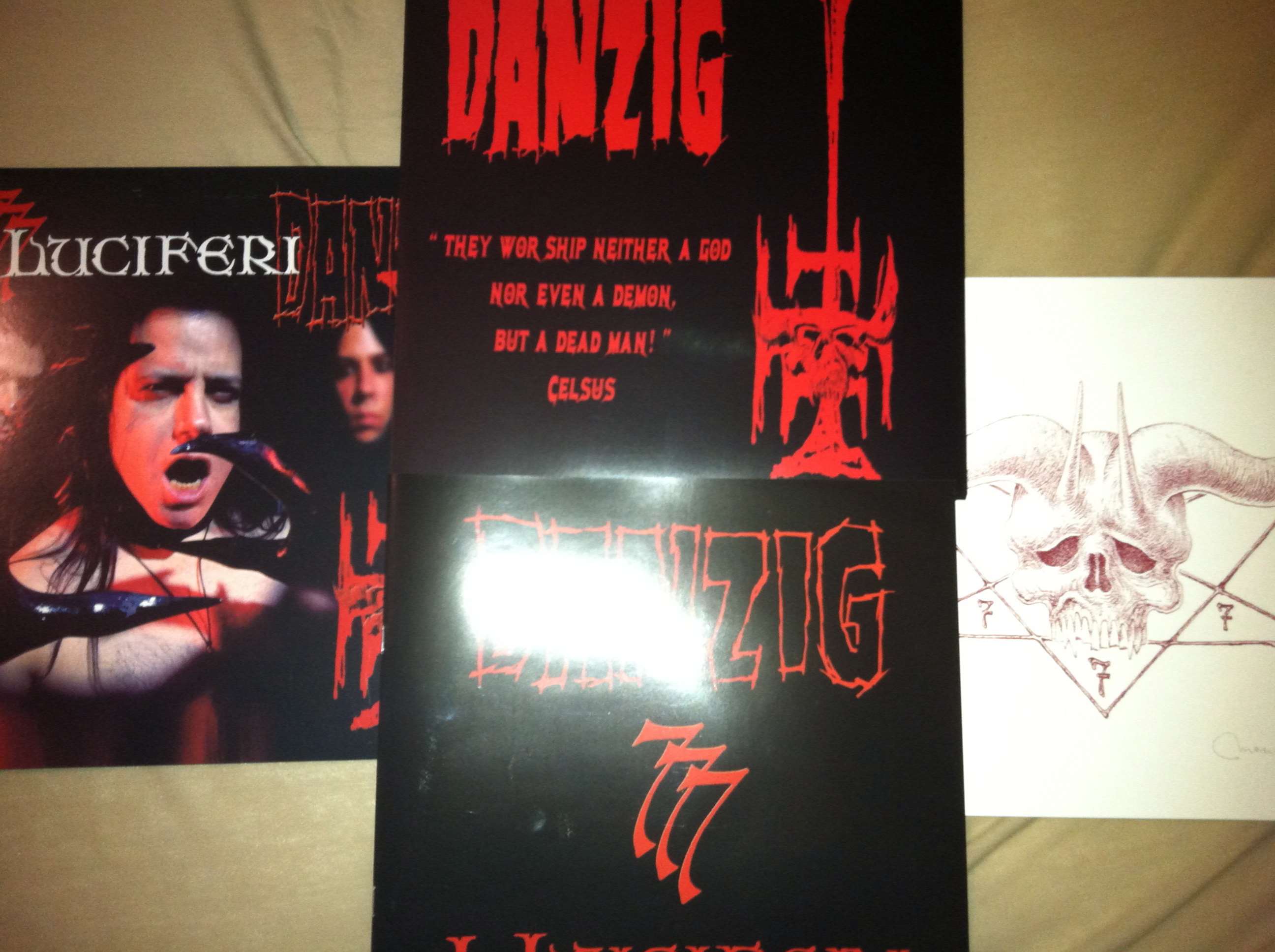
I Luciferi was released on Glenn’s evilive label through Spitfire Records and would be the band’s only release with the Spitfire logo.  The band thought it had a new long-term relationship with label E-Magine Music but Danzig ended up being that label’s biggest acquisition, and as much as I love Danzig, it can’t carry a label.  By the time I Luciferi hit stores it had been just about 2 and a half years since Satan’s Child was released to mostly negative reviews.  The band had a decent showing on the road due in part to the inclusion of a Samhain set and fans had also been treated to several other releases including a Samhain Box Set and re-issues of Danzig 5 and Black Aria.  Danzig suddenly was a very busy band and even though it had been over 2 years since the last studio effort it sure didn’t feel that long.

The lineup for Danzig 7 was the same as the touring band for Danzig 6 and included guitarist Todd Youth, bassist Howie Pyro, and drummer Joey Castillo.  For all three this would be the last Danzig album they’d play on.  Pyro and Youth would go off to try to make a name for themselves elsewhere while Castillo was offered the drummer position with the much higher profile Queens of the Stone Age.  For the most part, all three go out on a relative high note and have nothing to be embarrassed by.  Like most of the modern Danzig releases, there aren’t a ton of guitar solos for Youth to show off on but what’s there is played capably.  Castillo continues to be the stand out for the group and Pyro’s bass actually has a presence here, which is not often the case with Danzig albums.

Stylistically, Danzig 7 could be called more of the same.  It’s a little louder and more varied than Danzig 6 but with less of an industrial presence.  Where Danzig 6 stuck mostly to power chords and low notes, Danzig 7 brings back the old pinch harmonics the band was known for and some more traditional Danzig-style guitar riffs.  Some of the songs are tried and true Danzig, such as the moody “Black Mass” and powerful outro “Without Light, I Am.”  There are also some new sounds though like the destructive “Coldest Sun” or Gary Glitter inspired “Kiss the Skull.”

That’s not to say it’s all good.  “Black Mass” is a fantastic opener (following the instrumental “Unendlich”) but “Wicked Pussycat” tries its best to derail any momentum gained.  Glenn’s vocals are clear and pristine on “Black Mass,” but “Pussycat” brings back that hoarse delivery fans seemed to dislike on Danzig 6.  That and the song’s subject matter is about as silly as the title suggests and Danzig’s “rapping” on the chorus caused many to double-take.  Talk to a Danzig die hard today and many will try to tell you he isn’t rapping, but consider me unconvinced.

“God of Light” follows and can best be described as nu-metal sludge.  It took a long time for me to come to grips with that, but it’s true.  The song is melodically offensive and one of the worst Danzig songs ever recorded.  “Liberskull” begins the album’s long, winding road to recovery.  The main riff is a bit too bouncy for my taste, but the chorus and build up to it is well executed and quite pleasing.

From there the album is a bit uneven.  Songs like “Dead Inside” and the title track show promise but ultimately fail to deliver on it.  It’s towards the back end of the album where things pick up.  “Angel Blake” represents perhaps Glenn’s first classic horror tale since his days with The Misfits and proves quite pleasant, if a bit simple.  “The Coldest Sun” combines a dreary and kind of odd verse with one of Glenn’s catchiest choruses of all time.  His vocals are quite strong here, as they are on the closer “Without Light, I AM,” which strikes me as a kind of darker version of 4p’s “Let it be Captured.”

The musicianship is adequate, and while this isn’t the best collection of songs Glenn Danzig has put together it’s certainly quite listenable.  What most fans were really concerned with heading into this album was Glenn’s voice.  I Luciferi eased a lot of concerns amongst the Danzig faithful.  While most seemed satisfied with the vocals during the Satan’s Child tour, the following live album Live on the Black Hand Side caused people to question if what they heard on the road really was any good.  Live on the Black Hand Side contained two discs, one from the band’s glory days from ’92-’94 and a second disc with material from the Satan’s Child tour.  Disc 2 is practically unlistenable.  Some of that is likely due to the band skimping on good tech for a quality recording, but Glenn’s vocals just aren’t very good.  From the opening line of “Black Mass” though people were breathing a sigh of relief.  Danzig’s classic croon was back, and even though virtually no other song on the album sounds like “Black Mass” there are plenty of other stand-out moments.

The production is a little bit of a mixed bag.  While it’s no where near as bad as some of the future releases would present, it’s not quite on par with Satan’s Child.  Love it or hate it, the whisper backing track is still used on some songs but for the most part there’s little or no vocal distortion this time around.  While some people still want to call Danzig 6 an industrial metal album, Danzig 7 is pretty much a straight-up metal album with a modern sound.  The guitars are still tuned low (C once again) but there’s actual attempts made at crafting lead riffs this time around.  The quality of Castillo’s drumming, as I mentioned earlier, is quite good but the production on them is spotty at best.  On some songs it sounds like he’s drumming in your living room, on others it sounds too hollow and distant.  There’s a nice drum solo at the end of “Naked Witch” that could have sounded much better if given a full sound.  Mostly the album is lacking in those warm, full tones which is either a production short-coming or a stylistic choice.

“I Luciferi” vinyl release contents.

As for some technical notes on the release, it was released in 2002 on CD only and came in a blood-red jewel case.  The booklet contains photos of the band posturing with porn star Devon and looking mostly ridiculous.  Danzig has these big rubber gloves that make me think of comic book villain/hero Venom and he would sport them on tour.  Not all of the lyrics are printed in the booklet, a trend started by this release that would annoy most fans.  A vinyl version of the album was released in 2010 in Italy on Night of the Vinyl Dead Records.  Not much is known on how this came to be, presumably the distributor approached Spitfire about wanting to do it and they came to an agreement because the release wasn’t approved by Glenn (or he at least claimed to not know anything about it).  While it’s not technically a bootleg, it wasn’t endorsed by Glenn though I hear he has no qualms about signing it should you own a copy and wish to have him put his signature on it.  Release wise, it’s solid.  The booklet is nice and large and the record has an attractive inner sleeve.  The outer sleeve is the same as the CD artwork (which, admittedly, is pretty shitty though I kind of like the waxy new cross logo) and there’s also a skull lithograph included.  I assume the image is the artist’s interpretation of the classic Danzig logo.  This edition is limited to 500 copies.

Ultimately, Danzig 777: I Luciferi is a bit of an uneven release and isn’t going to make anyone forget about the band’s peak in the 1990’s.  It was the best album from Danzig since 1994’s 4p, and while it wasn’t a return to the classic sound, it was a return to respectability.  For a long time after this one was released I listened to it daily.  It was the album of my summer that year and I was never shy to bust it out when someone would ask me if Danzig was still around.  Some of the songs are among my favorite, and for me this is probably a top 5 Danzig release and a job well done.

Top Tracks:

  • Black Mass
  • The Coldest Sun
  • Without Light, I Am