

When I settled on doing a top ten for animation on television there were eight entrants I felt rather strongly about, and a ninth I was pretty content with. The tenth spot was the wildcard and a number of programs were considered, but since this is my list (and it’s not exactly an original topic) I decided I should use this spot to highlight a personal favorite of mine, so I went with X-Men. That’s a pretty flimsy lead-in but it’s not as if X-Men is undeserving of praise. I’ve wrote about the series quite a bit, even going so far as to do a mini review for each of the show’s 76 episodes during this blog’s first year of existence. At the time, I was using the show as a device to keep me posting but I was also reliving what was probably my favorite show as a kid.
X-Men launched on the Fox network in October of 1992, and at the time, was another attempt to re-ignite Marvel’s television properties. Prior to its debut, a pilot had been produced in the late 80’s called “Pryde of the X-Men” which focused on a much different cast of mutants. It was never picked up, and Marvel’s television properties were fading from memory. The same could be said for superhero cartoons in general, as only recently did Batman return to animation shortly before X-Men debuted. X-Men was the best-selling comic at the time, so it made sense for a cartoon to finally break through. Before X-Men (and Batman), cartoons based on comic book heroes tended to be pretty generic and bland. They usually took the form of the hero, or heroes, taking on the villain of the week and toppling whatever hair-brained scheme had been concocted by said villain to take-over the world or just cause general mayhem. Other shows, like Teenage Mutant Ninja Turtles, were just severely watered-down aspects of the source material intended to move action figures, which in the 80’s became frequently attached to various cartoon properties (He-Man being the best example of a cartoon existing solely to sell toys).

Wolverine and Gambit were likely to two most popular characters on the show, but that didn’t stop the writers from developing many others.
X-Men was different. This was a show that, while aimed at children, wanted to bring legitimacy to the medium. The show placed its brightly colored heroes against the backdrop of an easy to grasp civil rights movement. Enemies were no longer defined as simply bad guys but were colored with shades of gray and given real motivations for their actions. Magneto was the prime example. Had “Pryde of the X-Men” been picked up, Magneto would have just been another super villain with a motley crew of evil mutants willing to do his bidding and match up against the heroic X-Men. In the Fox show, he was a Holocaust survivor which had convinced him that humanity could not accept the differences within its own kind, and therefore, could never accept anyone outside humanity. In this case, that was mutant-kind, often referred to as homo-superior by Magneto. Mutants often took the form of normal looking people but with special gifts. We the audience took those gifts to be super powers, and in the case of the X-Men, most could be described as such. They did often come with costs that were more obvious for certain individuals. Cyclops could not open his eyes without a special visor or else risk destroying anything in his line of sight. Rogue could not even touch another person skin-to-skin without putting them in a coma. And Beast was simply covered in blue fur. This take, later admitted by creator Stan Lee as a lazy way to explain how the X-Men got their powers, freed the writers from having to come up with yet another experiment gone wrong origin story for every mutant under the sun.
This civil rights narrative is what framed the first two seasons of the show. The opening plot revolved around an organization funded by the government who would pose as friends to mutants but was really secretly creating a database of mutants from which it could target them and, though only hinted at during the show since it was for kids, cull them from society. The X-Men could not simply fight this opponent and beat them into submission, but had to convince the United States government that this was the wrong course of action. As a child, some of this went over my head. When Beast was put on trial in episode three I did not understand why the X-Men did not simply break him out of jail. Such would have likely been the course of action in many of the show’s contemporaries with the plot either being resolved at the episode’s conclusion or just dropped entirely. Instead, Beast spent the bulk of the first season in jail awaiting a formal trial before finally being pardoned after the X-Men were able to win-over at least one prominent political figure.
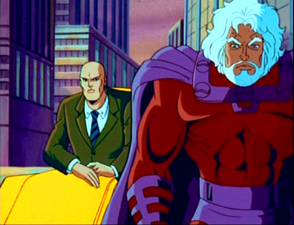
Magneto was easily the show’s most successful attempt at blurring the lines between hero and villain.
After the first season, it seemed like all was right with the world but the show once more took a more sophisticated approach. With mutants gaining more legal freedoms, bigoted members of society sprung up to do what they felt the government failed to do. Once more, the show mirrored society in that the X-Men couldn’t hope to ever win over everybody to their side. The show would lose touch with this narrative after season two, instead opting to take the show in a more sci-fi direction while focusing on more condensed plots, but in those two seasons X-Men did a lot to legitimize the superhero genre outside of the comic book world. It’s the strength of those two first seasons, merely 26 episodes, that vaults the X-Men into this position, but the show also got a lot else right.
For starters, the voice cast (comprised of Canadian voice actors mostly unknown to American audiences) did an excellent job with the often weighty material. The show could, at times, be joyless and very melodramatic and the scripts would often contain superhero jargon that probably read poorly, but the actors were able to step up and deliver. Some characters, like the perennially wooden Storm, were always lacking but others shined very bright. For me, I will always hear Cal Dodd’s voice in my head whenever I read a line from Wolverine. His raspy, quiet, delivery perfectly suited the sometimes explosive Wolverine. When the show needed him to get loud and angry, Dodd was able to come through time and time again. David Hemblen’s Magneto was another highlight. This show is one of the few that actually depict the Austrian Magneto with an accent, something even the films chose to ignore. George Buza’s Beast was so good that it obviously formed the template for the Kelsey Grammer version of the character that appeared in X-Men 3. The soundtrack was also a standout, mixing orchestral instruments with electronic aspects that suited the show’s somewhat futuristic-like setting. The theme song should be considered a cartoon classic at this point.
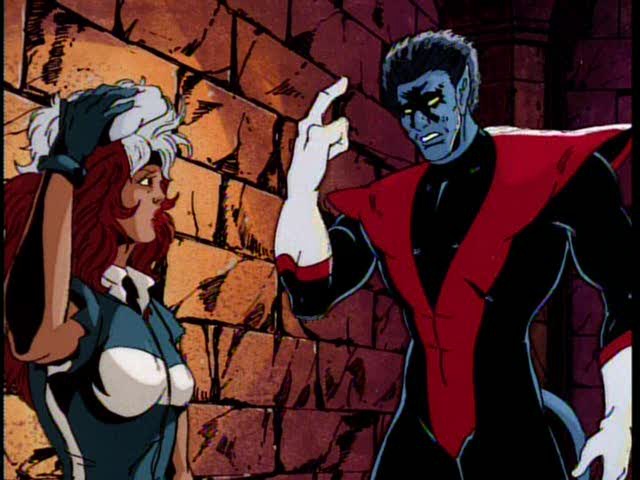
The show never added to its core cast of X-Men, but that didn’t stop other fan-favorites from appearing in the show, like Nightcrawler.
Visually, the show adopted the look of Jim Lee’s X-Men quite well with some minor alterations. Most of what makes up the Jim Lee style was still retained though, with the men having bulging physiques and the woman looking like super models. Even the extras in society tend to look idealized. It’s a legitimate criticism of Lee’s work but I’m sure the animators were happy that the vast majority of characters were basically the same shape. There is enough detail in the work that the show looks quite nice in still-shots. The animation, especially in the first season when the budget presumably was at its smallest, could be stiff at times. The animators were obviously under some constraints as well as to what kind of violence could be depicted. After the first season though, the animation improved noticeably. X-Men was not the best looking of its kind, but it certainly was not among the worst. I enjoyed it far more than I would Spider-Man, which came in 1994 and featured some primitive, and mostly ugly, computer-enhanced imagery as well as a softer color palette.
X-Men was able to leave a mark on the world of cartoons. It’s solid production values combined with its mature approach to story-telling is what makes it standout amongst other Saturday morning fare. X-Men is still the gold standard for the super hero ensemble show, and still stands as the best thing Marvel has ever done on television. X-Men took risks in a world where risk-taking is often frowned upon. Most people think kids want a mindless program where the hero always wins and everything is wrapped up in 22 minutes. Children are capable of so much more and the success of X-Men is proof of that.
If you want to read more about the X-Men animated series, there’s plenty to be found on this blog. In addition to numerous posts that summarize and review every episode, I also made an entry on what I considered to be the best episodes the show ever produced.


 The Nostalgia Spot