Tag Archives: walt disney

Porco Rosso

Porco Rosso (1992)

Porco Rosso (1992)

It almost seems pointless at this point to sing the praises of Studio Ghibli and its famous director, the great Hayao Miyazaki. The internet is dotted with support for his brilliance and his films are readily available on US soil thanks to an agreement between Studio Ghibli and The Walt Disney Company. Even so, it’s still worthwhile repeating that Miyazaki is a supremely gifted director with an apparent synergy with the animation medium. Many of his works are animated films because that’s just what Miyazaki does. They could have easily been shot in live-action and more obviously marketed towards adults. Some possess such fantastic imagery that it’s clear to see why they are animated, while a film such as The Wind Rises, Miyazaki’s most recent and possibly his last, is essentially a drama well-grounded in reality that just happens to be animated.

Porco Rosso is one of Miyazaki’s older works. Debuting in Japanese cinemas in 1992, it tells the tale of a former Italian flying ace turned bounty hunter cursed to live out the rest of his life with the face of a pig. Like The Wind Rises, it romanticizes the role of the pilot and easily could have been a live-action piece (though the pig-faced Porco may not have played as well as an actual person). And like many of Studio Ghibli’s films, it’s now available via Disney Blu Ray which is how I had the pleasure of experiencing it.

The film opens with Porco battling sky pirates: pirates that choose to attack luxury cruise ships via seaplane. The setting is post World War I and Porco has apparently been hired by the ship owners to keep the pirates away. We immediately get a sense of the film’s tone as the pirates are pretty bad at what they do and Porco is quite nonchalant in his attitude towards them. He combats them via a seaplane of his own, a beat-up old red thing that has trouble getting off the water, and has little trouble foiling their plans and freeing their hostages. There’s an obvious lack of danger throughout the sequence despite the bullets flying through the air but it doesn’t harm the enjoyment of the scene. Following this confrontation, we’re shown a little more of the setting. The pirates, looking to rid themselves of Porco once and for all, have turned to an American named Curtis. Curtis sees this as an opportunity for fame and fortune as he yearns for a career in Hollywood. He also would like to woo Porco’s longtime friend and proprietor of a local establishment frequented by pirates and pilots alike, Gina.

Preparing for take-off.

Preparing for take-off.

Curtis is an interesting character from a westerner’s point of view. Some may call his portrayal unflattering, or even offensive, as he does not possess any obvious virtues. I found it interesting to see how an American is stereotyped outside of the country and found the character pretty amusing. He is a skilled pilot and represents some sense of danger in an otherwise light-hearted film, and is a natural foil for the care-free Porco.

After a confrontation with Curtis that leaves Porco’s plane in need of repairs, Porco is forced to head back to his homeland of Italy where he is wanted for desertion. Porco’s mechanic Piccolo is introduced, along with his family and a large contingent of locals, and proves to be a very entertaining addition to the cast. What could have been a slow and boring part of the film turns into a strength. Some credit should go to the english translators who are able to come up with snappy dialogue to suit the original tone of the scenes as well as fit the mouth-flaps of the animated characters. The film builds towards a confrontation between Porco and Curtis, one Porco seems disinterested in, and plays upon the notion of pilot’s honor. There’s also a bit of a romantic angle thrown in that feels tacked on but isn’t focused on enough to be a distraction.

Porco and Fio are a natural movie pairing. I'd dog the two for being too typical an odd couple if they didn't work so well together onscreen.

Porco and Fio are a natural movie pairing. I’d dog the two for being too typical an odd couple if they didn’t work so well together onscreen.

The star of the film is clearly the Porco character, not just because of his prominence in the title but in his personality as well. He’s a flawed human but an inherently interesting one. He’s funny, boorish, yet charming. The english version features Michael Keaton as the voice of Porco. At first, I wasn’t sure his voice suited the character but I warmed to it quickly. Keaton is almost deadpan in his delivery at times, but he’s able to lend his charisma to the character through the excellent script and his superb delivery. The rest of the cast features some names familiar to those who have watched a lot of anime. Gina is played by Susan Egan, who has done a lot of work in the field of animation and is a consummate pro. Brad Garrett, who also seems to be amassing a lot of voice credits, plays the leader of the seaplane pirates and Kimberly Williams-Paisley portrays Piccolo’s granddaughter Fio with charming exuberance. Joe Hisaishi is once again the composer who utilizes a lot of period pieces to help enhance the film’s setting. The main Porco theme is one of my favorite works he’s composed as its perky nature suits the tone of the film perfectly.

Even the "bad guys" in this film are likable.

Even the “bad guys” in this film are likable.

The animation, as always, is breath-taking. The colors are rich and are only more so on the Blu Ray medium. I particularly love the shade of red used for Porco’s seaplane and the understated blues of the ocean water. Milan is drawn wonderfully and a sequence featuring Porco racing through the city’s canals is probably the most technically impressive of the whole film. The level of detail shown in the plane components was something I found myself appreciating and it’s quite clear that Miyazaki has a love for airplanes.

The film moves at a comfortable pace, wrapping up in just over 90 minutes. It’s tone never wavers as it’s quite high-spirited and inherently fun. I don’t know if I was just turned off by Porco’s look going in, but I wasn’t really excited to watch this film at first but it quickly won me over. It compares quite favorably to My Neighbor Totoro in that it isn’t a deeply serious film with a lot on the line. It’s really just a good old-fashioned adventure full of likable characters, captivating action, and gorgeous visuals.


Walt Disney’s One Hundred and One Dalmatians

One Hundred and One Dalmatians (1961)

One Hundred and One Dalmatians (1961)

If one were to research, even briefly, the history of Walt Disney Animation Studios one would find many successes as well as many failures, some of which by films considered classics today. Snow White and the Seven Dwarfs was the big break-through for the studio and it set a precedent for feature-length animation. Following that picture though, war broke out in Europe and suddenly Disney’s audience was much harder to reach. Perhaps the charm of a feature-length animated picture had worn off following Snow White’s success as well, for the the next several films put out by Disney failed to meet expectations. Following a series of “package films” in the 1940’s, Disney returned to prominence, and profitability, with Cinderella in 1950. The follow-up, Alice in Wonderland, performed poorly at the box office, but the next several films fared much better all the way up to Sleeping Beauty, that is. Sleeping Beauty bombed, despite being the most expensive film the studio ever put out. It was such a disaster that many around Walt Disney were suggesting the company get out of animation, which was something Disney refused to entertain. He was able to acknowledge that their current process needed change. While films like Peter Pan and Lady and the Tramp had been profitable, the profit margin on those films wasn’t what the studio needed to keep going. Success was also being found on television and with live-action films as well as the recently opened Disneyland theme park. Disney probably did not need animation, but it’s what the studio had been founded on.

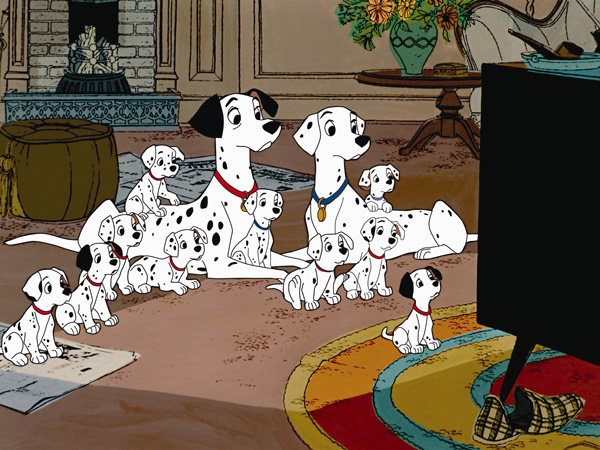
The Pongos, most of them anyways.

The Pongos, most of them anyways.

One Hundred and One Dalmatians was a big film for Disney. While it can’t be said with certainty that had the film failed Disney would have abandoned animation, it’s probable to assume things would have turned out much differently. It’s a good thing then that the film not only was a hit with movie-goers and critics but also a hit when it came to the bottomline. Utilizing Xerox, the film ended up being much cheaper to produce than its predecessors leading to a very healthy profit margin. Instead of being one of the last animated features from the company, it ended up being the first of many achieved through the Xerox process.

It’s well-known that Walt Disney was fond of recalling that the success of his company all started with a mouse, but despite that Walt’s most favorite animal was clearly the dog. One Hundred and One Dalmatians was the studio’s second feature to utilize canines as the lead protagonists, and much like Lady and the Tramp, the film serves as a window to the unseen world of dogs that we humans are oblivious to. Adapted from the book A Hundred and One Dalmatians by Dodie Smith, the film tells the tale of a dalmatian named Pongo, his “pet” human Roger, and how they came to be romantically linked with Perdita and Anita and proud parents of fifteen puppies. Everything would have been quite lovely had it not been for Cruella De Vil, Anita’s old classmate with an appetite for fur that can only be sated by dalmatian coats. The story is one of suspense, with some elements of mystery and plenty of humor added in. It works well with its modest 79 minute running time which foregoes the usual Disney musical style.

Several scenes in the film feature simple, almost one color backgrounds.

Several scenes in the film feature simple, almost one color backgrounds.

Stylistically the film is rather serious in tone, but from the point of view of dogs. It opens with Pongo deducing he and Roger’s lives as bachelors needs to end and he is outwardly searching for a mate for his pet (while also taking care to make sure his own needs are met). Unlike the dogs in Lady and the Tramp who seem to define their lives based on their loyalty to their masters, Pongo clearly views himself as the master in this relationship. He respects the needs of Roger, to a point, but when his puppies go missing later in the film he clearly implies that humans can’t solve their problems. Lady and the Tramp chose to emphasize that its story was from the point of view of dogs by keeping the camera at dog level, rarely straying far enough from the ground to even glimpse the visages of the humans Jim Dear and Darling. One Hundred and One Dalmatians is more straight-forward and positions its shots in a more traditional manner. The backgrounds are minimalist, a drastic change from the prior films from Disney, and it opts to use more flat colors with little to no shading. The film is also the most contemporary of any Disney film prior as its modern setting is quite different from the fantasy worlds many of the Disney films exist in. This even allows the story-tellers to utilize satire when depicting television and how the characters interact with it.

They don't come meaner than Cruella.

They don’t come meaner than Cruella.

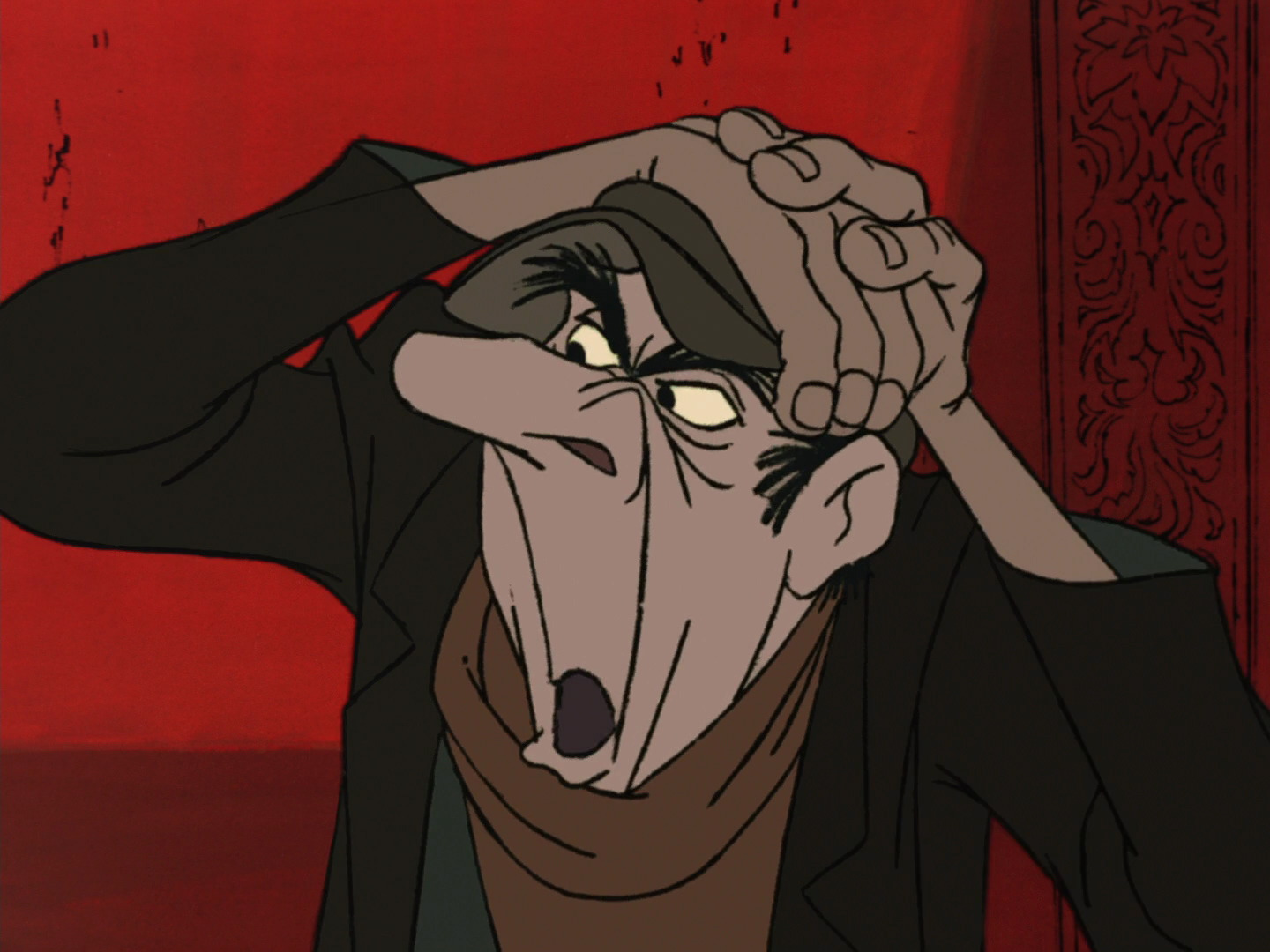
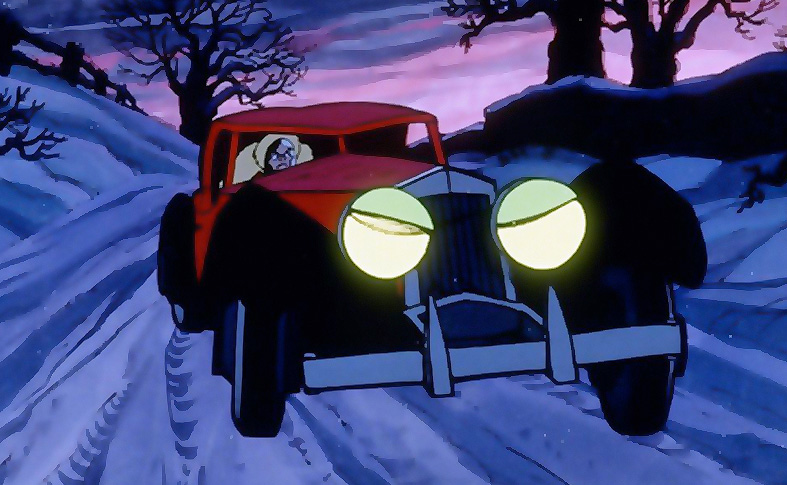
Cruella De Vil, and her lackeys Horace and Jasper, is one of Disney’s finest villains. Her motivations are clear, rational considering her character, and easy to despise. Even those who do not consider themselves dog-lovers likely would not support someone in their quest to slaughter puppies for their fur. She is strikingly wicked looking, with sharp angles and manic eyes. Her face appears to be stretched to its limit to cover her skull, and her two-toned hair has become a hallmark of the character. She barges into the home of Anita and Roger, her fur coat slipping from her bony shoulders and the smoke-trail from her cigarette permeates the air and appears to be a character all its own. She drives an enormous vehicle like the biggest asshole you’ll ever encounter on the road and is prone to violent outbursts. Her voice actress, Betty Lou Gerson, is absolutely perfect with her performance and it is hard to imagine anyone else doing a better job with the role. Horace and Jasper are her henchman. They handle the puppy-napping and were to also handle the slaughter but they’re typical, stupid, lazy, cohorts and are easily out-maneuvered by the film’s protagonists. They’re also mindless servants to television with their eyes constantly glued to the box and whatever rubbish is presented on it.

The pencil lines left behind by Xerox are easy to see in Roger's sleeves.

The pencil lines left behind by Xerox are easy to see in Roger’s sleeves.

The film is a success where profit and entertainment is concerned, but it must be said that this all came with a cost. The Xerox process, conceived of by Ub Iwerks, had its drawbacks when compared with the old process of drawing, inking, and painting each animation cell by hand. Naturally, the advantage was in cost as now the drawings by the animators were simply copied to cel by Xerox, eliminating the need for inking. Then they could go right to paint, and time was also saved by simply copying one image of a puppy several times over for the scenes involving the whole lot. The most obvious drawback to this process was the inability of Xerox to smooth out a pencil line during the copying, giving each character a rough, scratchy, look. Prior films were recognizable by the softness of the lines but also the rich, colored, outline each character possessed. Lady and the Tramp is my pick as the best looking of the Disney pictures. The characters pop even when placed on busy and highly-detailed backgrounds. Of course, the other drawback was that the entire inking staff was laid off, which meant hundreds of women lost their jobs in an era where work was hard to come by for women. Walt Disney Studios famously employed women almost exclusively for inking and painting, mostly due to prejudices of the time. They let men handle the drawing and decision-making when it came to creating the pictures. It obviously takes talent to ink and paint animation, but it was also thought-of as being a lesser position to artist. Still, the only other positions for women at the time were with the telephone company and service industries so it must have hurt when Disney shut-down inking. Walt Disney himself was not a fan of Xerox and disliked the look of the picture. Over the years, the process was improved upon but it would be decades before the pictures started to resemble the old films, which all came long after Disney’s passing. Art Director for Dalmatians, Ken Anderson, was said to be saddened by Walt’s opinion of the film’s look, though according to him Walt unofficially gave the art of the film his blessing shortly before he passed away.

Evil women drive evil cars.

Evil women drive evil cars.

One Hundred and One Dalmatians is a significant film for several reasons for Walt Disney Animation Studios. It’s the film that saved animation but also the film that changed it forever. Having recently viewed the Blu Ray release, I can say the film is actually more enjoyable than I remembered it from my childhood. The characters, despite mostly being dogs, are believable and their world is fun and fascinating. Visually, the film does suffer when compared with what came before it, but it also includes a wonderful car chase sequence that creatively utilized actual three-dimensional models to achieve its look. Even though the art is not as wonderful as it could have been, the film is animated superbly. The dogs walk like dogs, the humans display great personality with their mannerisms, and the action scenes are engrossing on their own. What little use the film makes of musical numbers is done quite well, with Cruella’s theme being one of the most memorable of all the Disney villain themes. One Hundred and One Dalmatians was the last great picture released by Walt Disney during his lifetime and it’s one fans will continue to treasure for years to come.


The Adventures of Ichabod and Mister Toad

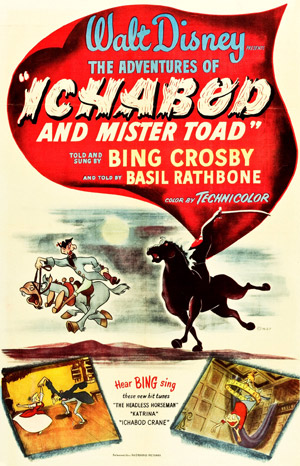
The Adventures of Ichabod and Mister Toad (1949)

The Adventures of Ichabod and Mister Toad (1949)

Walt Disney was a household name in the 1930’s due in large part to the success of characters such as Mickey Mouse and Donald Duck, as well as for being really the only producer of feature-length animated films. Snow White and the Seven Dwarfs was a massive success for the company, and though its follow-ups are well-regarded today, they struggled to turn to a profit at the time. With the onset of World War II, the company found its resources spread quite thin making war propaganda films for the government with little time and money available to produce more feature-length animated tales. Thus, the company resorted to shorter “package” films where two stories not really worthy of feature-length treatment were packaged together as one feature and released to the public. Some of these, such as Fun and Fancy Free, would mix live-action and animation in presenting its multiple tales. And others, like The Adventures of Ichabod and Mister Toad, would simply combine two animated shorts into one feature-length experience.

The Adventures of Ichabod and Mister Toad was released in 1949. The two were seemingly paired as a result of both stories being British in origen, though both were considered for feature-lenght treatment at one point or another. The Mister Toad portion, based on the story The Wind in the Willows by Kenneth Grahame, was a natural fit for Disney as it already starred several anthropomorphic characters and had an easy to adapt plot line. The Ichabod portion, based on The Legend of Sleepy Hollow by Washington Irving, was a tougher piece to adapt to a feature length, and while its source material may seem too scary by today’s standards, would slide in rather seamlessly given the presentation of recent films Pinocchio and Fantasia. And given the eventual release date of October 5th, it possessed the Halloween spirit movie-goers likely would be looking for.

For various reasons, neither tale was able to secure a feature-length production and release. The Wind in the Willows was especially affected by the war and budget, with the finished product omitting numerous planned sequences adapted from the novel. This release would end up being the last of package films, as the follow-up Cinderella would get the Disney company back on track. Over the years, Ichabod would become a regular on television around Halloween time, while Mr. Toad would be immortalized as an attraction at both Disneyland and Walt Disney World (though in the case of the latter, Mr. Toad’s Wild Ride has since been demolished). Children today may not be familiar with Disney’s version of Ichabod as the sequence is rarely shown on television. And if they’re at all familiar with the characters from Mr. Toad, it’s likely thru their many cameos in Mickey’s Christmas Carol or the previously mentioned theme park ride. However, those of an older generation seem to remember this feature quite fondly just judging by the ratings it has accumulated around the internet. In perusing them, it seems most viewers have a stronger connection to the Ichabod sequence than the Mr. Toad one, likely due to the television airings during the 1980’s, but do have a fondness for Mr. Toad and his compadres.

I recently purchased the feature on Blu Ray. Given that Halloween is just around the corner, it made sense for Disney to get a truckload of copies onto retail shelves. It was modestly priced, which makes sense given that it’s only 68 minutes long and the release is light on special features. I had seen both sequences from the feature as a child, but really didn’t recall much. I am not sure if I saw them together or spread apart. My memory was slightly stronger when it came to the Ichabod portion, probably due to the scary visuals and the unique look of the Ichabod character. Given that I only vaguely recalled viewing these two shorts as a kid, watching them on Blu Ray felt more like watching them for the first time. My reaction was muted at best.

Toad, together with his partner in crime, Cyril.

Toad, together with his partner in crime, Cyril.

The Adventures of Mister Toad is up first. A brief live-action sequence introduces the tale as a camera pans around a library and settles on the book the story is adapted from. Basil Rathbone is our narrator and the narrators chosen for both shorts is where Disney paid for any sort of name recognition. They are both used quite differently though with Rathbone just introducing the tale and interjecting some thoughts and explanations throughout the story. Toad and the rest of the cast are fully voiced and are appropriately presented with British accents. This is actually somewhat noteworthy as most of the early Disney films were set in Europe but the characters possessed American accents. The story obviously centers on the Toad character who’s a carefree toad of wealth (and debt) consumed by a passion for anything trendy, which at the moment is motor cars. His plainly named associates either approve of his actions or disapprove while all try to keep him out of trouble. He ends up being taken advantage of and framed which lands him jail for Christmas, and the most exciting part of the short centers around his escape and attempt to clear his name. Despite the brief running time, I found the sequence to be rather slow-moving, and at times, downright boring. The film takes time to set-up the story, but the characters are drawn in the broadest of strokes and little time is really needed to establish who they are. It’s easy to tell right form the start that Toad is a compulsive and sheltered individual. His exuberance makes him the most interesting of the small cast, and he’s certainly likable as a lead.

The voice acting is mostly adequate but I couldn’t help but feel that some of the voices chosen did not suit the character. Few of the voices seem like they should be coming from the characters, with the most jarring being the horse, Cyril, who had me wishing he was a silent character. The animation could also be described as adequate which I suppose is expected given the studio’s financial situation at the time. It’s basically on par with the theatrical shorts the company was known for as opposed to the feature-length pictures. All in all, I found it hard to care about the characters as presented, and when the sequence was over I was ready for it to end.

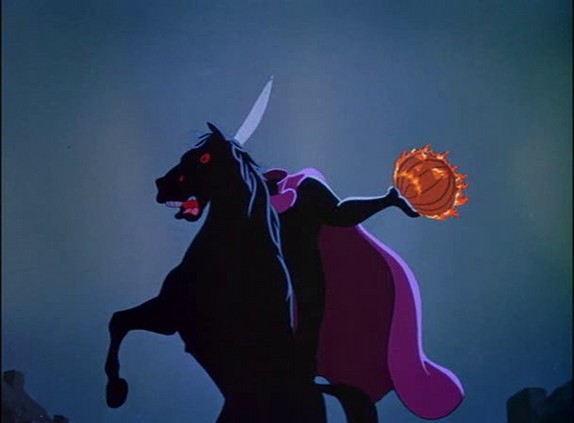
The Headless Horseman is the true star of the second act.

The Headless Horseman is the true star of the second act.

The Sleepy Hollow portion follows and was the sequence I was most interested in. While I was curious to see how The Wind in the Willows was adapted, I never had a strong affinity for Mr. Toad. The Legend of Sleepy Hollow is also a story I’m more familiar with, as I assume most people are. Ichabod’s last ride and the specter of the Headless Horseman have been recounted numerous times in popular media either as a direct adaptation or as a spiritual retelling. It’s a timeless tale and little effort is needed to convey the doom possessed by the Horseman. It’s really quite hard to make a headless knight riding a black stallion not look scary.

This segment is narrated, and sung, by Bing Crosby as a true narrator. If you’re looking for an example, think Boris Karloff from How the Grinch Stole Christmas. Crosby narrates the entire portion and sings at times. Ichabod and the characters do not actually speak, instead Crosby narrates the whole damn thing. It’s not the approach I would have taken if I were placed in the director’s chair, but there’s no reason why this shouldn’t work either.

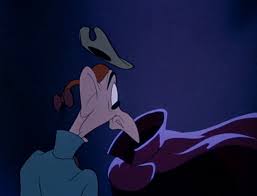
As was the case with the Mister Toad sequence, the Ichabod portion suffers from pacing issues as well. This is partly to be expected as anyone familiar with the story knows the Headless Horseman shows up at the end. Leading up to it we’re essentially shown how Ichabod is basically a conman who’s motivated by wealth and food. He’s the local school teacher, and despite being a rather ugly looking fellow, is able to woo the local women with his singing voice and charm. When a wealthy individual comes to town with a fetching daughter by the name of Katrina, Ichabod sets his sights on a new prize. This puts him in competition with a local man by the name of Brom Bones, who is basically a lunkhead (he must have been inspiration for the much later Disney character, Gaston, from Beauty and the Beast) who is outsmarted by Ichabod when trying to court Katrina. It’s at a Halloween party hosted by Katrina’s father that Brom gets the idea to tell the tale of the Headless Horseman in an effort to scare Ichabod, who is revealed to be a superstitious man at the very same party. Given how slow-moving the story is, I found it lazy that Ichabod’s superstitious ways were not revealed throughout the picture in a more subtle fashion. Anyways, it’s when Ichabod leaves the party the he encounters the ghostly horseman.

If they had just committed to the horror, and left comedy to Toad, the Sleepy Hollow segment would have been better for it.

If they had just committed to the horror, and left comedy to Toad, the Sleepy Hollow segment would have been better for it.

The sequence where Ichabod is chased by the Headless Horseman is easily the highlight for both pictures. The setting is chilling and the Horseman looks particularly menacing. Ichabod, seated atop a very unimpressive horse, is forced to run for his life and the music and animation does a decent enough job of allowing the audience to share in his terror. There are some disappointments to be had, however. As mentioned during the Mr. Toad portion, the animation is merely serviceable and not feature-length quality. As a result, there is really no use of shadows or shading on Ichabod who pops too much against the background. Perhaps feeling the ride was too scary, some comedy was also added to the chase which really disrupts the mood. It’s basically screwball comedy not unlike what would appear in a Bugs Bunny cartoon and feels woefully out of place. At the end of the picture, there are some scenes that also detract from what should have been a more ambiguous ending, which also felt like a cop-out.

Overall, I was unimpressed by The Adventures of Ichabod and Mister Toad. As someone who loves and appreciates animation from all eras, I can easily forgive the films technological short-comings there as I wasn’t expecting it to be up to Disney’s usual standards from that era. I can’t really excuse either film for the pacing issues, and if given the chance, I probably wouldn’t have purchased this had I seen it first. The DVD release for the film a few years ago at least included a Mickey Mouse short that for some reason isn’t included here. And while I have all of the Mickey Mouse cartoons on DVD already, it would be nice for others if it had been included on the Blu Ray too. If you happen to be in the mood for a re-telling of The Legend of Sleepy Hollow, I’d suggest looking elsewhere (or scanning the various Disney channels to see if they show their version for free) this Halloween. As for The Adventures of Mister Toad, the weasel characters for the film inspired the same for Who Framed Roger Rabbit?, an immensely more enjoyable film. And if you really want to see the characters from the original, just wait for Mickey’s Christmas Carol which undoubtedly will start showing up on television before Thanksgiving arrives.


The World and The Land: A Disney Comparison

orl-disneyland-vs-disney-world-castles-pictureIt has been a long time between posts for me. Never since I started this blog have I only made one post for an entire month, but my personal life left little time for leisure throughout the month of June. Without getting into too much detail, I spent the end of June and the start of July honeymooning in Disneyland: The Happiest Place on Earth.  As a dweller of the east coast, I have been fortunate enough to vacation in Disney World several times as both a kid and adult (it’s actually where I “popped the question” to my now wife) but I had never left the east coast for the west and visited the original park, Disneyland.

Growing up, Disneyland was sold to me as the lesser Disney World. As such, I never had any desire to really see Disneyland if Disney World was better. When vacationing at Disney World, the cast members there love sharing the fact that the entire Disneyland park (and the new park, California Adventure) could fit inside the parking lot of Disney World’s Magic Kingdom. The common thing I heard from people who had been to both was that Disneyland was something to do on a weekend, while Disney World was a destination worthy of a week’s investment. Recently though I became interested in the historical aspect of Disneyland. As many know, Disneyland was the original park and its construction was orchestrated by Walt Disney himself, while Disney World was in the early planning stages when Disney passed away in 1966. And while many attractions are shared between the two resorts, Disneyland does have a few unique rides and also still has some of the older rides that have vanished from Disney World over the years. When it came time to settle on a honeymoon, going back to Disney World was certainly an option for my wife and I but we both had a desire to do something at least a little different. It seemed like the right time to hop on a plane bound for California and check out the original and see for ourselves which was best. In the end, we came to find the two were comparable, but also different enough to possess their own charm. It didn’t seem right to necessarily pit the two against each other, which is why this post is merely a comparison and not a contest. After a week (with a five day park hopper pass) at the Disneyland Resort, this is the impression it left upon me:

Size

A map of Disney World, Disneyland is said to be able to fit in the Magic Kingdom's parking lot.

A map of Disney World, Disneyland is said to be able to fit in the Magic Kingdom’s parking lot.

The first thing that comes to mind when comparing the two resorts is size. Disneyland started off as one theme park with Sleeping Beauty’s castle serving as the central hub for park goers looking to experience the wonder of Fantasyland, the thrill of Adventureland, and the mystique of Tomorrowland. Since 2001, California Adventure has existed opposite Disneyland on the site of the original Disneyland parking lot. Loosely inspired by Disney World’s Hollywood Studios park, California Adventure is home to Pixar and the unique Paradise Pier and Cars Land attractions. Disneyland covers approximately 160 acres with California Adventure an additional 67 acres. By comparison, Disney World’s four parks and several hotels occupy 40 square miles, with the Magic Kingdom totaling 107 acres, Hollywood Studios 135, Epcot 300, and Animal Kingdom a whopping 500 acres. There are also two water parks at Disney World and both have a Downtown Disney area but it should be clear that it’s an apples and oranges comparison when it comes to size.

The size of Disney World was the main draw for Disney as he wanted an area with limitless potential. As a result, Disney World still has tremendous room for expansion should the need or desire arrive while Disneyland is basically locked in. The added size means more room for guests and more variety, but it also means a heavier reliance on transportation. Get used to waiting in lines for a bus at Disney World, while Disneyland’s compact size means everything, including most hotels, is within walking distance. The size of each resort is both a pro and a con, and Disney World at least gives patrons multiple options for park hopping via the shuttle lines, monorail, or ferry boats (the only exception being Animal Kingdom, which is basically isolated from the other three parks). I love the variety of Disney World, but I also really loved going back and forth between Disneyland and California Adventure throughout the day, gaming the fast pass system or just trying to avoid whichever park was more crowded.

Rides and Attractions
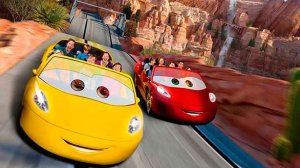
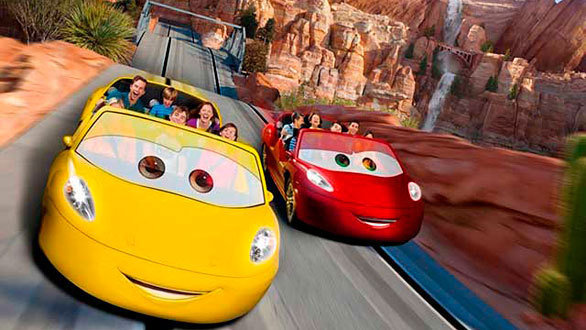
Disneyland's current biggest attraction:  Radiator Springs Racers.

Disneyland’s current biggest attraction: Radiator Springs Racers.

The size of both resorts is obviously of no consequence if there’s nothing worth seeing and experiencing at the parks. To make comparing the two easy, many rides are duplicated across the parks while some of the seemingly unique rides share the same technology or format as a ride at the other park.

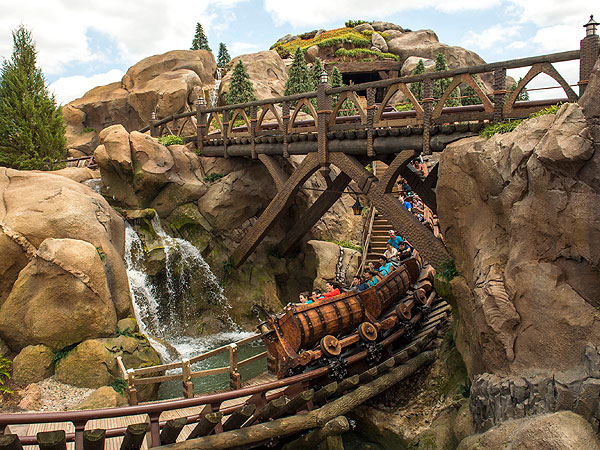
Disneyland and The Magic Kingdom are the easiest to compare as The Magic Kingdom is essentially the sister park to Disneyland. They have the same layout and general design with a castle serving as the central hub of everything. In Disneyland, it’s Sleeping Beauty Castle while The Magic Kingdom is home to the colossal Cinderella’s Castle. Cinderella’s Castle is the representation of the size difference between the two resorts as it dwarfs Sleeping Beauty Castle. When it comes to the surrounding lands, the only major difference is the northern most land at each. In Disneyland there’s Mickey’s Toon Town while Disney World boasts a larger version of Fantasyland (and at one point in time, had its own Toon Town). Originally, many of the classic Disneyland dark rides existed at Disney World, such as Snow White’s Scary Adventure and Mr. Toad’s Wild Ride. These have been replaced at Disney World in favor of an additional Dumbo ride, a small Goofy coaster, and the new Seven Dwarves Mine Train, a ride unique to Disney World.

And here's Disney World's newest ride:  The Seven Dwarfs Mine Train.

And here’s Disney World’s newest ride: The Seven Dwarfs Mine Train.

The dark rides are mostly for kids. As an adult, I find myself only riding them to escape the heat. Between the two parks, the only one to really leave an impression on me is the Disneyland version of Peter Pan’s Flight which seemed faster and appeared to be kept in better shape than its Disney World counterpart. Disneyland has some unique dark rides such as the Monsters Inc. ride and Alice in Wonderland, but none are difference makers. As for the rides the two parks share, I prefer Splash Mountain at Disney World to the one at Disneyland. Disney World’s version has a bigger car and a bigger drop at the end. Disney World’s Space Mountain is a bit better, though I’m personally not a fan of the ride. A lot of people prefer Disneyland’s version of Pirates of the Caribbean, but I don’t find either ride compelling. Disneyland has a newly refurbished Big Thunder Mountain that’s noticeably smoother than Disney World’s, and therefore better. The original Tower of Terror at Disney World is a more immersive ride experience, but I actually preferred the shorter and quick to the point version at California Adventure. Disneyland also has the superior version of Buzz Lightyear thanks to the non-mounted gun, though both versions of Buzz pale in comparison to Toy Story Mania, which is the same experience at each park.

The unique rides offer the best way for the two parks to stand out. I haven’t been on the newest ride at Disney World, the Seven Dwarfs Mine Train, but it does look pretty rad. A unique ride at Disneyland that I wasn’t able to experience is the Finding Nemo Submarine Voyage due to an expansive refurbishment going on right now. The ride is a rebranding of the old submarine ride that also existed at Disney World and was pretty hokey, so I can’t say with any certainty that it’s a worthwhile experience. Seemingly unique rides like the Indiana Jones ride at Disneyland, exist at Disney World but under a different theme, in this case the DINOSAUR ride at Animal Kingdom. Of the two, I prefer Indy but the experience is pretty comparable. Another one is Epcot’s Test Track, which basically exists at Cars Land as Radiator Springs Racers. Again, if given the choice between the two, I’ll take the Disneyland version because of the fun theme though Test Track offers a bit more thrills than its counterpart and both are awesome. The two resorts also each sport their own roller coaster: California Screamin’ at California Adventure and Rock n’ Roller Coaster at Hollywood Studios. Both start off with a bang and contain sharp turns and an inverted loop. The Rock n’ Roller Coaster is indoors and features an Aerosmith theme while Screamin’ is outdoors, is longer, and overlooks the Paradise Pier area. Of the two, again I side with Disneyland as California Screamin’ offers the overall better experience. And for some reason it’s not very popular and boasts consistently short wait times. Animal Kingdom has the safari ride which is obviously an experience unique to that park. It also has the Expedition Everest ride which also does not have a Disneyland counterpart and is a pretty thrilling experience.

Both parks feature shows and fireworks displays to entertain guests when they’re not eating or enjoying the rides. Every night at Disney World’s Magic Kingdom, there’s “Wishes” the fireworks show. It’s a love letter to the Disney films of old (and some new) that will stir the emotions of anyone with fond memories for such films. The outdoor spectacular “Fantasmic” at Hollywood Studios is something to be seen if you’re a kid or adult. One part water show, one part broadway, and one part fireworks, it’s probably the best thing going at either resort. Not to be outdone, Disneyland has the Magical Fireworks each night which are entertaining but not quite on the same level as “Wishes.” Disneyland also has its own version of “Fantasmic,” but without a dedicated amphitheater setting, it’s not as grand, but gets the job done. California Adventure boasts “The Wonderful World of Color” which is basically a laser water show out in front of Mickey’s Fun Wheel. It’s unique and pretty neat to experience, and the special Glow With the Show edition of the famous Mickey Ear Hat is a fun, albeit pricey, addition to the experience. It’s not quite on the same level as “Fantasmic,” but is something visitors to Disneyland should go out of their way to experience at least once.
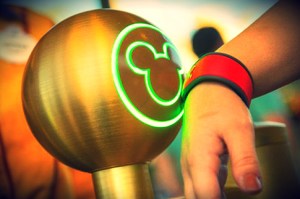
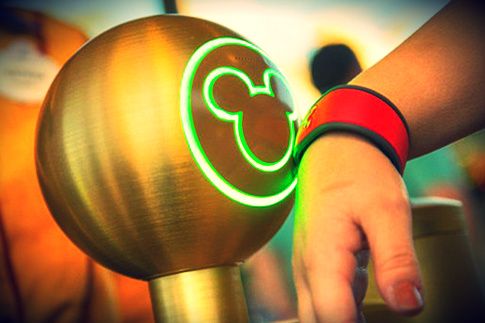
Making its debut in 2013, Disney World's Magic Band is the new fast pass.

Making its debut in 2013, Disney World’s Magic Band is the new fast pass.

One huge difference between the two resorts is the Fast Pass system. At Disneyland, patrons are able to visit kiosks throughout the parks and essentially reserve time in the future to experience a certain ride or attraction. For most rides, it means avoiding a line and returning to the attraction in an hour or so (for the mega-popular Radiator Springs Racers, it may mean returning to the ride in several hours) at no additional cost. The downside to this is that only certain rides are equipped for Fast Pass with some popular rides like The Matterhorn or Toy Story left off. The system was in place at Disney World for years until recently when Disney introduced the Magic Band and Fast Pass Plus. Basically, now park goers decide before they even enter the park what rides they want to fast pass and for when. The downside is that each person gets only three fast passes per day so if you want to experience an entire park in a day you’re going to have to wait in some uncomfortable lines. Especially if you have kids that want to go on Peter Pan, Dumbo, It’s a Small World, Splash Mountain, Big Thunder Mountain, etc. On one hand, it’s convenient to be able to decide ahead of time what rides you want to go on (you can also make changes at the locations in the park or via a smart phone app), but only having three and being limited to one park per day kind of sucks. It would be nice if they added one or two more, or at least let you spread the three across parks, but I don’t know if Disney really has any incentive to do so (aside from the potential to sell more park hoppers).

Dining and Accommodations
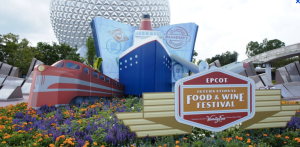
Epcot; otherwise known as my home away from home.

Epcot; otherwise known as my home away from home.

Disney World, being true to its name, is expansive and boasts numerous Disney brand hotels. It’s one of the main advantages the resort has over Disneyland for The Walt Disney Company was able to control all of the land surrounding the parks. By contrast, Disneyland is literally surrounded by tons of hotels, all but three are independently owned by non-Disney corporations. For the consumer, this means some very reasonably priced rooms, but a lack of Disney flair.

Even though Disney owns nearly all of the hotels in Disney World, it is possible to stay onsite without breaking the bank. The “value” hotels are fairly priced and offer free transportation to the park via shuttle. The moderate and premium resorts will make a dent on your wallet, but offer better locations and grounds. Conversely, if you want to stay at a Disney hotel at Disneyland expect to pay, at minimum, $300 a night for a bland room. I did stay at the Disneyland Hotel, and even though I can freely admit it’s overpriced, it is a really great hotel for Disney fans. Nearly everything in the hotel room is adorned with a Mickey Mouse head and the swimming pool boasts a monorail themed water slide. Ultimately, a room usually just ends up being a place to sleep but if you want to go nuts both resorts have plenty to offer, but Disneyland on the cheap pretty much can’t be done at a Disney hotel.

While I feel both resorts compare quite favorably with one another in most areas, one they do not on is dining. As far as dining and food go, Disney World is hands-down the better experience and that’s almost entirely due to Epcot. Both resorts offer the same old stuff in the parks and at the hotels, but Epcot’s World Showcase is the only place where you can sample all kinds of different cuisine and get a stiff drink too. California Adventure offers beer, wine, and frozen margaritas, but both the wife and I found the margaritas and mixed drinks to be a little on the weak side. By contrast, even hint at Epcot’s La Hacienda that you want a little kick to your margarita and you’ll be going home in a wheelbarrow. My wife and I very much enjoyed Disneyland, but on more than one occasion we both voiced our disappointment at the lack of an Epcot.

Final Words
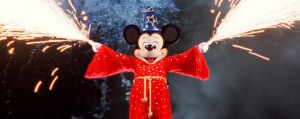
fantasmicIn the end, Disney is Disney and if you like the Disney experience you’ll love Disney World and Disneyland. It’s charming and familiar and both feature a lot of the same rides, attractions, merchandise, and so on. If you just want to go and enjoy the rides, you’ll have a blast but if you only have a day to spend there then Disneyland will let you see more. If you’re interested in the history of Disney, both parks offer very well done tours including Disneyland’s Walk in Walt’s Footsteps which takes you inside Walt Disney’s private apartment atop the Main Street firehouse. Disneyland will also provide the more casual experience, with cast members heading to and from work a common site outside the park. Disney World will go the extra mile to make you feel as if you’ve left the country and entered another world. The workers seem more devoted to maintaining the illusion at Disney World and it definitely attracts a more diverse workforce. My wife and I will never forget the dinner and waitress who served us at Be Our Guest following our engagement at Disney World. She was superb!

Because I live in the northeast, Disney World will likely be my preferred destination for a Disney vacation for as long as I live here. It’s more of a destination and it’s designed to be seen and experienced in a week as opposed to a weekend. That’s a not a slight against Disneyland, they just serve different purposes. I loved my Disneyland experience and I recommend anyone who loves Disney and has never been there to make the trip out to California. See and experience where it all started, just know you’ll probably only need a three day pass (with park hopper) as opposed to a five day one. And if you’ve never been to either resort, well then I just feel sorry for you.

Mickey Mouse: In Living Color, Volume 2

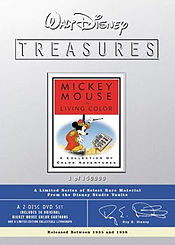
175px-DisneyTreasures03-mickeycolorAs the 1930’s came to an end and Disney transitioned into the 40’s, Mickey Mouse saw his starring roles in cartoon shorts dwindle.  He was, more or less, unofficially retired by the time the decade came to a close and relegated to hosting duties on television and as the official mascot of the Disney brand.  There were several factors contributing to the decreased screen-time for the world’s most famous mouse.  For one, Disney had moved on to feature-length productions and was producing fewer cartoon shorts.  And when Disney was producing shorts, Donald Duck was usually the star, not Mickey Mouse.  As the Disney brand grew, Mickey was not surprisingly delegated as the face of the company.  As such, Disney felt that Mickey needed to be a role model.  While the Mickey who starred in numerous black and white shorts could be kind of mischievous and a bit of a trickster, this new Mickey needed to embody a more wholesome image.  Donald Duck could be the bad boy, and as a result, the funnier of the two characters which made creating shorts for him a natural process.  Donald Duck could be the hero or the villain of any cartoon he starred in, while Mickey was forced to be the straight man.  Another reason why Mickey made fewer appearances in animation is because he was voiced by Walt Disney himself.  As the Disney empire grew, Walt found himself too busy to voice Mickey.  Eventually, he would hand over the voicing duties to sound effects man Jimmy MacDonald because of his too busy schedule.

As a result, this final set of Mickey Mouse cartoons is much shorter than its predecessors.  It’s also not as good as the first Mickey Mouse:  In Living Color collection, but still contains some classic material and worthwhile bonus features.  Disc one includes the last of Mickey’s original run while disc two contains some of his more prominent starring roles and last theatrical short.  The set captures Mickey’s twilight years, and includes material from his three most prominent voice actors: Disney, MacDonald, and Wayne Allwine.  The set is, if nothing else, a nice piece of history for one of animation’s most famous characters.  The animation is top-notch Disney, as one would expect, making even the lesser shorts still fun to watch.

images-187This may be a lesser set when compared with the previous one, but there are still some classic shorts to be found on disc one.  Mickey often finds himself paired with other characters, such as Pluto, Donald, and Goofy.  in “Tugboat Mickey,” Mickey, Donald, and Goofy spend their time repairing an old boat and little goes right.  There’s plenty of slapstick humor in the same style as other shorts that grouped this trio together.  In “The Pointer,” Pluto and Mickey are out hunting and soon find themselves nose to nose with a bear.  Pluto probably gets equal screen time as Mickey and arguably steals the short.  This is common for Mickey though as the guest stars tend to generate the most laughs.  A personal favorite of mine for nostalgic reasons is “Mickey and the Seal.”  I remember watching this one as a kid and it involves Mickey being followed home from the zoo by a seal pup.  They get into some humorous situations as Mickey is unaware the seal followed him which climaxes is in a very entertaining bath tub scene.  There are some duds though, such as “The Nifty Nineties” and “The Simple Things.”  “The Nifty Nineties” is basically a love letter to the 1890’s.  It contains some nice music and pretty backgrounds, but it’s just really boring.  Nothing happens.  “The Simple Things” is another Mickey and Pluto short, and also the last Mickey Mouse short until the 1990’s.  It’s not so bad in a vacuum, but a lot of the gags are recycled from older Mickey, Pluto and Donald cartoons and have become worn out at this point.

There are some curious inclusions amongst the cartoons as well.  Namely, there are a few Pluto cartoons here that would have made more sense as part of the Pluto collections.  Perhaps Disney felt it needed to include more content on this one, but “Pluto’s Party” and “Pluto’s Christmas Tree” would have been more at home on the Pluto sets, but I can’t say I’m disappointed they’re here.  It’s actually more of a hindrance to the Pluto sets that they weren’t also included there.  The short, “Plutopia,” included on this set actually also shows up on The Complete Pluto, Volume Two as well.

Still breathtaking more than 70 years later.

Still breathtaking more than 70 years later.

In addition to the short-form cartoons are the longer feature appearances of Mickey.  Included on disc one, is “The Sorcerer’s Apprentice” from Fantasia and “Mickey and the Beanstalk” from Fun and Fancy Free.  These end up being about three to four times the length of a typical cartoon short, and are essential to the Mickey Mouse legacy.  “The Sorcerer’s Apprentice” kind of goes without saying, but for the record I will state it’s an iconic piece of American animation and possibly Mickey’s most famous appearance.  “Mickey and the Beanstalk” is less known, but important because it was the unofficial passing of the torch for the voice of Mickey from Walt Disney to Jimmy MacDonald as portions of the cartoon feature Mickey voiced by Disney and portions by MacDonald.  For a long time, it was thought that this was the last time Disney voiced Mickey, but it was actually revealed by MacDonald to film critic and set host Leonard Maltin that Walt reprised the role of Mickey for the intros to the Mickey Mouse Clubhouse television show.  Those intros, five in total, are included as a bonus feature on this set and are impossibly cool for fans of Disney and Mickey Mouse history.

The Prince and the Pauper is hardly a classic, but it's nice to have it included all the same.

The Prince and the Pauper is hardly a classic, but it’s nice to have it included all the same.

Disc two contains more special features as well as Mickey’s most recent cartoons.  The long-form shorts “Mickey’s Christmas Carol” and “The Prince and the Pauper” are featured.  I’ve written more than once on this blog about “Mickey’s Christmas Carol” so I won’t go into much detail here, but there’s some bonus content with some animators who worked on it which is worth checking out.  It’s a neat cartoon for many reasons, but also because it’s the first time Mickey Mouse was voiced by Wayne Allwine, who would eventually go on to become the longest running voice of Mickey Mouse until his death in 2009.  The cartoon also features the Uncle Scrooge character voiced by Allen Young, who would of course go on to voice Scrooge in the very successful DuckTales series.  The cartoon is also the last time Donald Duck was voiced by his original voice actor, Clarence Nash, making “Mickey’s Christmas Carol” one of the most historically significant cartoons ever produced by the Disney company.  “The Prince and the Pauper” is another twenty-four minute short.  Coincidentally, it was released to theaters with The Rescuers Down Under while “Mickey’s Christmas Carol” was released with The Rescuers (Disney apparently likes to group its mouse characters together).  It’s a fairly unremarkable short but does feature some nice animation, though its brightness contrasts it with the muted pallet of “Mickey’s Christmas Carol” in a way that kind of puts me off.  It is notable for being the last time Disney used the Xerox process for its animation, a process that had been in use since 101 Dalmatians.

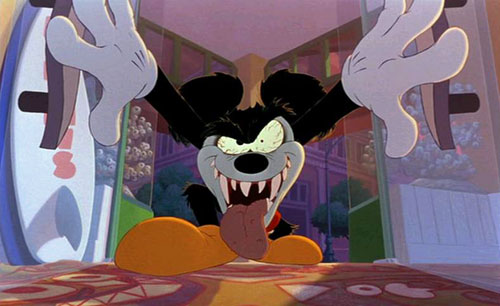
Runaway Brain feels like it's mostly been forgotten, which is a shame because it's great fun.

Runaway Brain feels like it’s mostly been forgotten, which is a shame because it’s great fun.

The last short include on the collection is, up until very recently, the last Mickey Mouse short, “Runaway Brain.”  Released in 1995 along with A Goofy Movie, it features Mickey and Minnie (voiced by Allwine’s real-life wife Russi Taylor) and marks the debut of mad scientist Dr. Frankenollie (named after longtime Disney animators Frank Thomas and Ollie Johnston), who is voiced in the short by Kelsey Grammar.  The plot involves Mickey forgetting his anniversary with Minnie and trying to make up for it by volunteering for a science experiment to earn money for a Hawaiian vacation.  Mickey ends up as a mindless beast and it’s a pretty entertaining cartoon short.  It served as a nice way for Mickey to bow out of animation, though starting in 2013 new Mickey Mouse shorts have been in production featuring a new style and approach in terms of both look and content.

Mickey Mouse: In Living Color, Volume Two isn’t quite as good as Volume One, but there’s enough here that any Disney fan should own it.  More than anything, this set is a piece of Disney history as it documents the changing look of Mickey Mouse as well as the men who gave voice to him.  There’s a little bit of sadness to it as well, as Mickey quietly exited the world of animation with little fanfare or celebration.  It seems like he deserved better, and it’s too bad that generations of kids have grown up without new Mickey Mouse cartoons.  The most recent shorts produced actually aren’t bad, and the few I’ve seen I’ve enjoyed but it doesn’t seem like they get much attention.  Disney would do well to make an effort to keep Mickey’s animation presence alive and well by celebrating his legacy more and pushing his current shorts.  Kids today deserve to know Mickey Mouse as more than a theme park attraction and brand.

Mickey Mouse:  In Living Color, Volume Two

  • Society Dog Show
  • The Pointer
  • Tugboat Mickey
  • Pluto’s Dream House
  • Mr. Mouse Takes a Trip
  • The Little Whirlwind
  • The Nifty Nineties
  • Orphan’s Benefit (1941)
  • Mickey’s Birthday Party
  • Symphony Hour
  • Mickey’s Delayed Date
  • Mickey Down Under
  • Mickey and the Seal
  • Plutopia
  • R’Coon Dawg
  • Pluto’s Party
  • Pluto’s Christmas Tree
  • The Simple Things
  • The Sorcerer’s Apprentice
  • Mickey and the Beanstalk
  • Mickey’s Christmas Carol
  • The Prince and the Pauper
  • Runaway Brain


A Mickey Mouse Christmas

Mickey Mouse has appeared in many Christmas themed specials and shorts over the years.  I suppose that should be expected of a character who has been around for over 80 years.  I don’t think he’s appeared in more Christmas specials than any other popular character (the boys in South Park actually had a nice streak going on of a Christmas special nearly every year) but he’s certainly in the discussion.  Many of Mickey’s Christmas exploits took place on the big screen in the form of shorts, but have since become television staples during the Christmas season.  Rather than make an individual post here and there on certain ones, I’ve decided to make one long post that hits on the ones I’m most familiar with.  This list isn’t exhaustive as I’m sure there are more modern television specials that I’m not familiar with, but consider this a good start.  The following list is in chronological order, starting with the earliest.  They’re all available on DVD in some fashion, and the old shorts can be found on youtube as well (Disney is pretty lax with its old shorts when it comes to youtube, probably because the Treasures line of DVDs is out of print)

Mickey’s Good Deed (1932)

The original version was in black and white, but colorized versions exist today.

The original version was in black and white, but colorized versions exist today.

Mickey’s rise to fame nearly coincided with The Great Depression.  As such, it’s a pretty common site to see Mickey depicted poor and penniless.  In Mickey’s Good Deed, he’s a street performer looking to make a buck.  As far as we know, his only possessions are his cello and Pluto.  After a day of playing, Mickey and Pluto look to score some dinner and find that passer-byes have been tossing nuts and bolts into Mickey’s cup instead of coins.  Down on their luck, Mickey has a mishap that leads to the destruction of his cello, while a rich pig offers to buy Pluto for his bratty kid.  Mickey, of course, refuses but he soon happens upon a family of poor cats.  Wanting to give them a good Christmas, Mickey reluctantly sells his dog, dresses up as Santa, and gives the cat family a nice Christmas.  Pluto, meanwhile, is miserable as he’s abused by the bratty boy pig leading to the father tossing him out and spanking his kid.  Pluto is able to happen upon a despondent Mickey and we get a nice, happy ending.  It’s a cute little Christmas short that unfortunately is never shown on air because of one instance of perceived racist imagery.  A little balloon the Santa Mickey carries appears to depict a blackface character portrait on it.  This means the short is relegated to the vault section on the release Mickey Mouse In Black and White Volume 2.  Despite that, it’s actually been released here and there on VHS and DVD, including a colorized version on the most recent release Holiday Celebration with Mickey and Pals.

Toy Tinkers (1949)

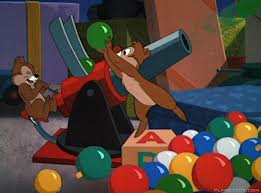
It's all-out war when Chip and Dale sneak into Donald's house.

It’s all-out war when Chip and Dale sneak into Donald’s house.

I’m cheating here, because this is actually a Donald Duck short and does not feature Mickey, but who cares?  This Christmas themed short pits Donald versus perhaps his most famous antagonists:  Chip and Dale.  While out chopping down a Christmas tree, the mischievous chipmunks take notice and follow Donald back to his home where they see a nice, warm environment and bowls full of nuts.  The duo slip in and immediately start using the toys around the tree to transport the nuts out of there.  Donald, not one for charity, takes note and a full-scale battle breaks out over the nuts with the two using pop guns and toy cannons on each other.  It’s a silly, and fun short where Donald is mostly punished for his cruelty (and because it’s more fun to see Donald lose his temper) and things mostly work out for Chip and Dale.  Unlike Mickey’s Good Deed, this one will pop up from time to time on the Disney channel during the holiday season.  Otherwise, it can be found on some compilation releases and the Treasures release The Chronological Donald Volume 3.

Pluto’s Christmas Tree (1952)

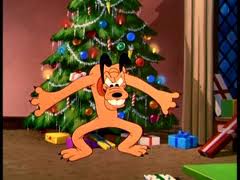
Pluto is very protective of his Christmas tree.

Pluto is very protective of his Christmas tree.

Despite what it’s title suggests, Pluto’s Christmas Tree is actually considered a Mickey Mouse short instead of a Pluto one, for some reason.  It’s also one of the few shorts to feature Jimmy Macdonald as Mickey Mouse, as Walt found he didn’t have the time to voice the character any longer.  Pluto’s Christmas Tree is actually fairly similar to Toy Tinkers.  Mickey and Pluto set out to get a Christmas tree and they settle on one that happens to be occupied by Chip and Dale.  Once inside the house, Chip and Dale immediately start to make themselves comfortable in the Christmas tree while Pluto takes notice.  Pluto tries, in vain, to point out the chipmunks to Mickey who just sees Pluto’s antics as the usual.  Eventually he can’t take it anymore and attacks the tree, finally revealing the chipmunks to Mickey who basically has the opposite reaction as Pluto.  The short ends with Christmas carols, where the chipmunks take issue with Pluto’s singing voice.  This is another wildly entertaining Chip and Dale story mostly full of slapstick humor.  This one is really easy to get ahold of as it’s been released several times on VHS and DVD and is one of the most well-received Disney shorts.

Mickey’s Christmas Carol (1983)

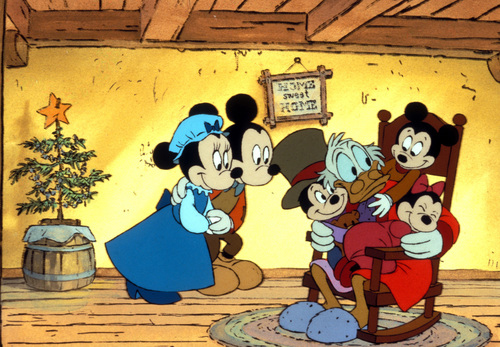
Not a Christmas season goes by where I don't watch this one numerous times.

Not a Christmas season goes by where I don’t watch this one numerous times.

Mickey’s Christmas Carol is fairly recent compared with the other shorts.  It’s also quite easy to catch on television or find on DVD and was even recently rereleased on Blu Ray (along with Pluto’s Christmas Tree, among others) this year.  It’s the classic Dickens’ tale with Mickey as Bob Cratchit and Minnie as his wife.  Scrooge McDuck is, naturally, the film’s Scrooge while other Disney characters show up in supporting roles.  As far as takes on A Christmas Carol go, this one is my favorite as it’s both funny and poignant and the inclusion of Disney characters somehow makes it more relatable.  The recent re-release does make it all the more obvious that one giant Christmas release from Disney is necessary.  Mickey’s Christmas Carol is also how many were first introduced to the longest running voice of Mickey Mouse, Wayne Allwine (who passed away in 2009), and also marks the final performance of the original Donald, Clarence “Ducky” Nash.

Mickey’s Once Upon a Christmas (1999)

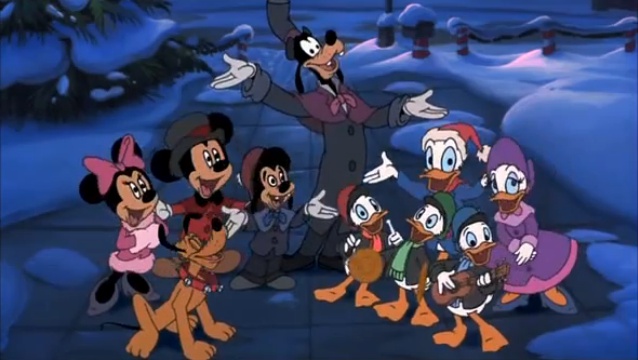
Once Upon a Christmas is far from timeless, but it is nice to see all of the Disney characters together at Christmas time once again.

Once Upon a Christmas is far from timeless, but it is nice to see all of the Disney characters together at Christmas time once again.

Once Upon a Christmas is a traditionally animated direct-to-video collection of three shorts starring Donald, Goofy, and Mickey.  It’s shown annually on television still and represents the modern Mickey Mouse and friends.  The first short, titled Stuck on Christmas, stars Donald and his nephews Huey, Dewey, and Louie and is a take on the story of What if Christmas Were Every Day?  In it, the three boys wish it could be Christmas every day and are then forced to deal with the consequences.  It’s a bit like Groundhog Day, in that the boys need to be considerate of others and have the perfect day to undo the spell.  The second short, A Very Goofy Christmas, stars Goofy and his son Max as Goofy tries to prove to Max that there is a Santa Claus after their neighbor Pete informs him there’s no such thing.  The third short, Mickey and Minnie’s The Gift of the Magi, once again depicts Mickey as rather poor as both he and Minnie try to scrounge up some money to buy each other the perfect Christmas gift with both discovering the only thing that matters is having each other.  The animation on all three is pretty well done and it’s kind of fun to see modernized versions of the characters.  Aside from the Mickey short, the others tend to run a bit too long and run out of steam towards the end.  It’s a solid Christmas special but falls short of being a classic due mostly to the pacing issues.

Mickey’s Twice Upon a Christmas (2004)

Another direct-to-video Christmas special, Mickey’s Twice Upon a Christmas is naturally the sequel to Once Upon

The CG look for the characters just doesn't do it for me, and as you can see here, the backgrounds suffer too.

The CG look for the characters just doesn’t do it for me, and as you can see here, the backgrounds suffer too.

a Christmas, though the stories contain no obvious references to the previous ones.  Differing itself from its predecessor, Twice Upon a Christmas is entirely computer animated and the results are something less than spectacular.  The characters are mostly harmed by the transition to 3D models which makes sense considering they were never drawn for such a look to begin with.  This collection also contains five shorts which does address the pacing issues from the first set.  The shorts are:  Belles on Ice, Christmas: Impossible, Christmas Maximus, Donald’s Gift, and Mickey’s Dog-Gone Christmas.  The first one stars Minnie and Daisy as competitive figure skaters and is easily the worst of the set.  There just isn’t much to it.  Christmas: Impossible stars Huey, Dewey, and Louie as they sneak into Santa’s workshop to get on the nice list.  It’s kind of cute, but the CG really shows its limitations as the should-be wondrous Santa’s workshop is really unimpressive looking.  Christmas Maximus stars Goofy and Max, who’s now returning home for the holidays from college with his new sweetheart.  It’s only slightly better than Belles on Ice but is ultimately forgettable.  I also found Max’s look to be really off-putting for some reason.  Donald’s Gift is a rather simple Donald tale where his grumpiness and overall bad demeanor nearly ruin Christmas for his family, but he redeems himself in the end.  I’m a Donald sucker, so I was entertained by this one but it can’t hold a candle to Donald’s classic shorts.  Mickey’s Dog-Gone Christmas is definitely the strongest of the collection as Pluto runs away to the North Pole after Mickey gets mad at him.  There he befriends Santa’s reindeer and adopts the moniker Murray (Murray Christmas, get it?!) and even gets to fly.  The reindeer characters are entertaining, and the CG look actually works for Pluto, though I still prefer the traditional look.  Eventually Pluto is reunited by Santa with his depressed owner and everyone’s happy in the end.  Overall, this is a weak collection and the CG makes it hard to watch.  Check it out if you happen to catch it on TV, but don’t feel like you need to go out of your way to see it.


Mickey Mouse: In Living Color

Mickey Mouse:  In Living Color

Mickey Mouse: In Living Color

I love classic cartoons.  They just seem to be so much more developed than present day television shorts.  There’s an emphasis placed on the score and plot while not forgetting the laughs.  The most iconic of cartoon characters from this era include Bugs Bunny and Daffy Duck, but is any more well known than Mickey Mouse?  The mouse that built an empire, Mickey was Disney’s original star.  While he ruled the world in the 20’s during his black and white career, he was eclipsed later on by other characters, most notably brand-mate Donald Duck.  Mickey was eclipsed more out of choice than anything.  He became the Disney brand which necessitated him becoming a more wholesome character.  Early portrayals had him playing the role of the trickster at times, but he evolved into more of a straight man (err, mouse) with Donald becoming the more devious character.

As a result, while he wasn’t the most watched cartoon character in the 1930’s he still received all-star quality toons.  When Disney set out to re-release collections of their classic shorts they wisely lead off with this set, Mickey Mouse:  In Living Color which covers the years 1935-1938.  Some of Mickey’s most famous shorts are contained on this set and all appear uncut (save for a minor audio change in “Clock Cleaners”).  Either Disney wanted to create strong demand for these collections, or the company failed to predict how popular they would become because now they can be hard to come by.  They’re worth it though for animation buffs and I’m going to tell you why.

I currently own three sets from the Walt Disney Treasures line.  This one as well as Donald Duck Volume 2 and Mickey Mouse: In Black and White Volume 2.  Picking a favorite is an exercise in futility, and this one is a great starting point for anyone.  It features a total of 26 shorts (listed at the end of this post) all starring Mickey with many featuring Donald, Goofy, Minnie and Pluto.  Perhaps starring is too strong a word as some of the ensemble pieces feature equal screen time for the trio of Mickey, Donald and Goofy and some feature very little of Mickey.  There’s also an easter egg short that’s kind of amusing as it was sponsored by Nabisco so it’s basically an extended commercial (and may have been the first Mickey cartoon to give him pupils).

Mickey and Donald are often friends but also often adversaries.

Mickey and Donald are often friends but also often adversaries.

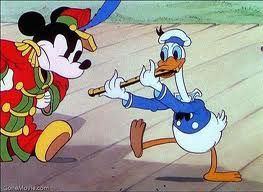
A few feature Mickey playing off of Donald.  As I mentioned earlier, Mickey became relegated to the role of straight-man with Donald being relied upon for the comedy aspect.  Mickey’s most famous cartoon (other than “Steamboat Willy”) is probably “The Band Concert” where Donald tries to ingratiate himself to Mickey to hilarious results.  There’s also solo cartoons like “Thru the Mirror” which puts Mickey into the book “Through the Looking-Glass” and has him interacting with personified objects.  Fans of the 8 bit and 16 bit era Mickey video games will recognize several scenes from some of these cartoons.  “Thru the Mirror” is a visual delight and one of the stronger cartoons on the set.  For pure comedy there’s “Moose Hunters” which features the trio going after a moose and failing spectacularly.  Another I adore, partly because I had this cartoon on VHS as a kid, is “Mickey’s Trailer” which again features Donald and Goofy.  In this one, Goofy is towing Mickey’s camper while Mickey and Donald are inside.  Goofy, predictably “goofs up” and it leads to some amusing physical comedy.  There’s also a great sequence where Mickey has to get Donald out of bed and relies on the trailer’s technology to assist him.  Another nostalgic favorite for me is “On Ice” which used to be included, in quick clips, with the Mickey’s Christmas Carol broadcasts from the 80’s.  In it, Mickey teaches Minnie how to skate while Goofy tries to ice fish and Donald plays a prank on Pluto.  It’s one of the funnier cartoons included.

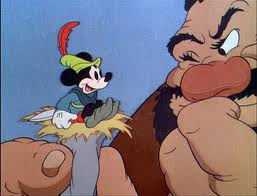
Some of these shorts offer a nice glimpse at the era from which they’re from.  In the 30’s, the nation was still coming out of The Great Depression and the short “Moving Day” reflects that as Mickey and Donald face eviction from their landlord.  “Mickey’s Polo Team” features several caricatures of popular actors from that period including the likes of Charlie Chaplin and Harpo Marx.  This  particular toon should be a real treat for film buffs out there and adds another dimension to the viewing experience.  Another short I was familiar with before picking up this set was “Brave Little Tailor.”  This one is another visual treat as it pits Mickey against a giant.  The plot is setup when the king confuses Mickey’s boast of killing seven flies in one blow with killing seven giants with one blow.  Mickey attempts to correct the viewpoint but when he finds out Princess Minnie is his reward if he solves the kingdom’s giant problem he finds it hard to say no.

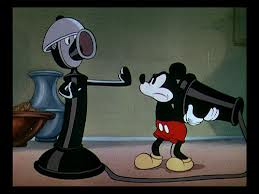
Mickey Mouse in "Thru the Mirror."

Mickey Mouse in “Thru the Mirror.”

The set comes housed in a tin with images printed on both sides.  Later sets would replace the back print with an insert instead which is actually beneficial as these tins are susceptible to shelf ware.  Leonard Maltin is the host on all of them and there’s a mini documentary included where he goes over Mickey in the 30’s.  He’s also present to educate the masses since these cartoons are not always politically correct.  There’s smoking in some, even by the protagonists, and some jokes that may be considered tasteless.  This set is fairly harmless in that regard when compared with others.  Other sets contain episodes dubbed as “From the Vault” that usually contain images that could be considered racist.  This one contains no such section which is a good thing as those Vault sections contain a mandatory word of caution from Maltin that can’t be skipped.  It just becomes annoying whenever you want to watch those episodes and you have to sit through it each time.  I did mention that there is one edit on “Clock Cleaners” and that’s because some people insisted a Donald Duck line contained the word “fuck,” which was an absurd claim to make since Disney would have never tried to get away with such in the 30’s, let alone now.  Nevertheless, the line was replaced to avoid confusion but it has been released uncut in other sets.  I don’t consider it a big deal though and it’s not something that should affect anyone’s purchasing decision.

Mickey gets to take on a giant in "Brave Little Tailor."

Mickey gets to take on a giant in “Brave Little Tailor.”

This is a wonderful collection of cartoons and anyone who enjoys the medium should try and track down a copy.  Even though these sets only exist in standard definition, the visual quality is very good.  Especially considering these cartoons are over 70 years old.  Some are better than others, but there aren’t any that appear to have deteriorated too bad.  Mickey’s face is pretty much always white and doesn’t appear dirty.  The only one that seemed a little rough around the edges to me was “On Ice,” but it was nothing that could dampen the viewing experience.  This is a fun set to watch and it’s great to experience the joy of these shorts as an adult and I’m sure kids today would still get a kick out of them.  To a lot of children Mickey is just a logo, a character that is featured prominently at Disney’s theme parks, but few have experienced him as a cartoon star.  This set is from an era where Mickey was king of the cartoon world, and it’s not hard to see why.

As promised, here’s the full list of the cartoons included as part of this collection:

  • The Band Concert
  • Mickey’s Garden
  • On Ice
  • Pluto’s Judgement Day
  • Mickey’s Fire Brigade
  • Thru the Mirror
  • Mickey’s Circus
  • Mickey’s Elephant
  • Mickey’s Grand Opera
  • Mickey’s Polo Team
  • Alpine Climbers
  • Moving Day
  • Mickey’s Rival
  • Orphans Picnic
  • Hawaiian Holiday
  • Moose Hunters
  • The Worm Turns
  • Magician Mickey
  • Mickey’s Amateurs
  • Clock Cleaners
  • Lonesome Ghosts
  • Mickey’s Parrot
  • Boat Builders
  • The Whalers
  • Mickey’s Trailer
  • Brave Little Tailor