Tag Archives: playstation

Mega Man 8

25576-mega-man-8-anniversary-edition-playstation-front-cover

Mega Man 8 (1996/1997)

Mega Man 8 is perhaps the most divisive game in the history of the Blue Bomber. The first developed without series creator Tokuro Fujiwara, it was the only mainline Mega Man game released during the 32 bit era, and for a long time, was the last to be made with current generation technology, even though it didn’t seem like that at the time. After the release of Mega Man 8, the series essentially disappeared in favor of the many Mega Man spin-off franchises such as X, Legends, Battle Network, and others. When Capcom finally reconvened to create a Mega Man 9 it opted to pretend as if this game (and to some extent its predecessor Mega Man 7) never existed going back to a visual style akin to the original NES games and a gameplay style that went even further back. Capcom would stay with that look for Mega Man 10, but finally announced in 2017 that a new Mega Man game is coming and it won’t feature illusory 8-bit images.

It’s interesting that the game has become so maligned over the years, since at the time Mega Man 8 was supposed to be a celebration of Mega Man and the impact he had made in the world of gaming. Coinciding with the 10 year anniversary of the first game, Mega Man 8 stayed true to the series roots by sticking with 2D gameplay when the whole world was demanding 3D. Sony Computer Entertainment of America (SCEA) initially wanted nothing to do with the game because of its use of 2D visuals. Wanting to highlight the processing power of the PlayStation, SCEA nearly prevented the release of the game in North America, but eventually relented when Capcom agreed to dress-up the packaging. Since it was also to be released on the Saturn, SCEA wanted exclusive content and thus received a little booklet to be included with each copy of the game recounting the legacy of Mega Man. Maybe out of spite, Capcom would introduce better, exclusive, content on the Saturn with optional hidden bosses.

Mm8promo

There’s a whole bunch of new enemies for Mega Man to vanquish.

Mega Man 8 largely follows the formula of the games that came before it building off of Mega Man 7. So unlike more recent entries in the series, this one still retains the charge shot and slide maneuver as well as the bolts currency which can be used between levels to purchase upgrades for Mega Man. Dr. Wiley is the main antagonist once again and Bass and Treble return from 7 to make Mega Man’s life more difficult. The plot isn’t of much importance, suffice to say that Wiley is up to no good and has created 8 robot masters that Mega Man has to get by before he can ultimately take on the mad scientist. A new character is introduced, Duo, who’s from outer space and brings with him some kind of weird energy that Wiley wants to make use of. He starts off as an ambiguous character, but will eventually become an ally when he “senses justice” within in Mega Man, or some nonsense.
PLAYSTATION-Mega-Man-8-_Jun1-13_51_20

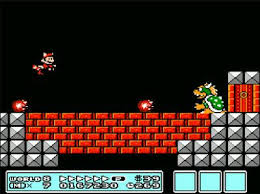
Most of the levels have an appealing design that serves its robot master well.

What you need to know as a gamer is that Mega Man has roughly 12 new stages to topple. After a simple introductory level, four additional stages are open to Mega Man and each features a robot master to take down. Following their defeat, an intermission stage is unlocked before the final 4 robot masters are available and then eventually the multi-stage Wiley Tower. Splitting the 8 robot masters into two separate groupings of four does make it a little easier to determine an order to tackle them in. As is the case with virtually every Mega Man game, defeating a robot master earns Mega Man a new weapon and each one is a natural weakness for another robot master (Wiley should really avoid doing that when creating these things). There is an added challenge in introducing the robots this way as the player needs to figure out which robot to tackle first – twice! There’s no overlap in terms of weaknesses between the two groups of four, so the first boss you fight and the fifth will basically necessitate relying on the Mega Buster to topple. If you want my advice, I suggest starting with Grenade Man and Aqua Man, respectively. Although I did have this game before I had internet access and a boss order available to me so I have taken down more than just those two with the Mega Buster.
Mega-Man-8-228

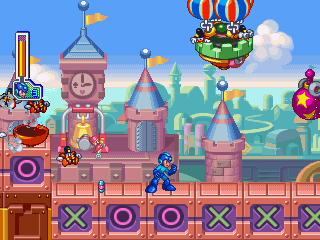
Mega Man 8 is gorgeously animated, but few appreciated it in 1996 since it wasn’t 3D.

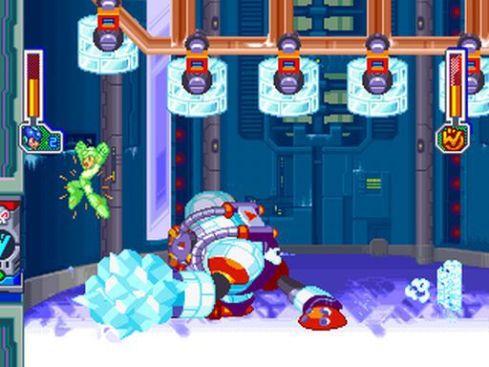
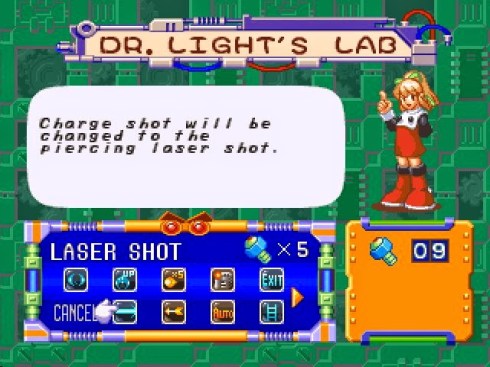
Scattered throughout the stages are bolts. There is a finite amount of them in the game and they serve as currency for Mega Man to purchase upgrades. Since you’re limited by the amount of bolts in the game, this also means you’ll be unable to purchase all of the upgrades in a single save file. Some of the upgrades available to Mega Man include a fast charge attachment, a shield that will prevent knock-backs, a laser shot, and a spread gun, among others. Basically all of them are useful to some degree, though I’d argue the most essential is probably the quick-charge. One annoyance, the ability to exit already completed stages must be purchased, so if you want to go back for bolts that you missed (and you will, since some require a weapon acquired later to access) you will have to either waste bolts on this feature or play through the entire level again.
343-Mega_Man_8_Anniversary_Collectors_Edition_(U)-14

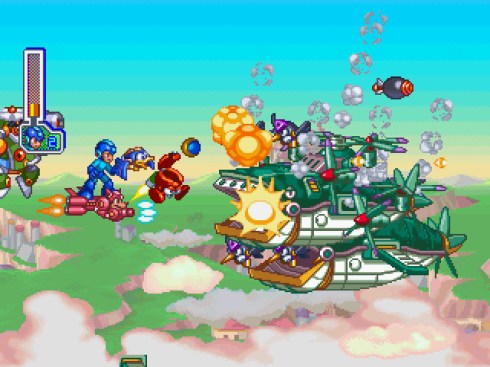
There’s some auto-scrolling segments to break-up the gameplay. This Rush segment works well, but don’t ask me about the snowboarding one.

The stages feature a solid mix of run and gun and platforming gameplay, as well as a couple of auto-scrolling events. The levels offer a rather average level of difficulty for a Mega Man game sitting this one squarely in the middle of the pack if arranged accordingly, though perhaps closer to the easy side. Continues are unlimited, so the game is forgiving in that regard, but the checkpoints are spread out enough that having to use a continue does hurt a bit. There are no E Tanks in this game, which might explain why it’s a touch on the easier side, but there is a Rush attachment that can be used once per stage that summons Mega Man’s trusty robotic canine who will drop power-ups as he flies back and forth. It’s not as seamless as an E Tank since Mega Man still has to chase down the power-ups and there’s no guarantee that Rush will drop exactly what you want. This makes him a bit unreliable during the chaotic boss encounters in the game and he’s also basically useless if you’re in an area where Mega Man is limited by where he can stand (auto-scrolling segments, spike pits, etc.).
b963dfddf9672d1dd78d31d44c649b7d

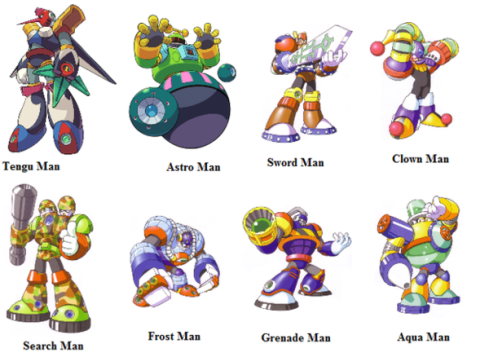
In what was apparently common for Capcom at the time, fan input was sought for boss designs. Some of the original fan-submitted works appear in the credits.

Of the main stages available, none are probably memorable enough to supplant a Quick Man or Flash Man stage, but they mostly offer plenty of variety and avoid the pitfalls of tedium. Tengu Man’s stage features a pervasive gust of wind that extends Mega Man’s jumps when moving with it, but also hinders his ability to backtrack. This stage also features one of the auto-scrolling portions where Mega Man hops aboard Rush and uses him like a jet-board as he soars through the air. During these segments Mega Man can also summon his lesser allies like Auto and Beat to assist him in taking out the various enemies he encounters. Astro Man’s stage features some maze-like portions as well as a frantic escape from a sinking tower. Sword Man’s stage is broken up into sections that can be tackled in any order, sort of like the boss gauntlet that appears towards the end of every Wiley Castle. Some levels also feature a mid boss and defeating that boss unlocks a new Rush ability (4 in total) that include the health power-up, as well as a few other things that aren’t really essential but can be useful.

other-consoles-45995-21342332094

Mega Man has finally learned how to swim, but I’m not sure that’s a good thing.

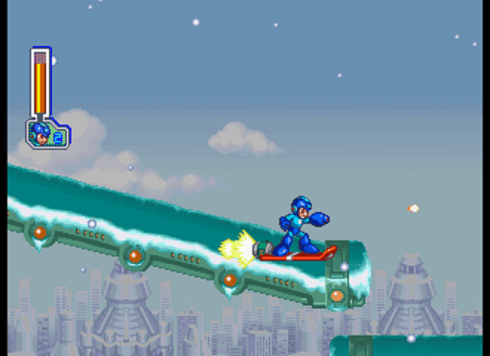
Some levels, on the other hand, don’t go over as well. Frost Man’s stage features the snowboarding auto-scrolling bit and it is not enjoyable. The input feels laggy, and the developers apparently noticed this as well because they inserted audio prompts commanding the player to “Jump! Jump!” or “Slide! Slide!” These segments are mercifully short, but also short on fun and it’s a shame they recognized the need for the cues but not the need to just cut them entirely. Aqua Man’s stage also features scenarios completely submerged in water. Mega Man has apparently received a software upgrade that taught him how to swim, as he no longer just jumps around slowly in water. Swimming basically works the same way in Mega Man 8 as it does in Super Mario Bros, which is to say it’s not good. Mega Man is also a lot longer relative to Mario so it’s not easy to maneuver him around enemies. You’re better off to just plow through those segments and hope for the best.
Mega Man 8 35

Mega Man’s “sister” Roll runs Dr. Light’s shop which you can visit to purchase upgrades for Mega Man after acquiring enough bolts.

The bosses themselves are all fine. They’re fully voiced, like Mega Man (more on that later), and it’s kind of funny to hear them taunt Mega Man before and during confrontations. There’s nothing particularly logical about who is weak to who, unless you know more about the robot than the game presents. For example, Sword Man does have a fire element associated with him that’s not apparent just by looking at him and Aqua Man’s Aqua Bubble is his weakness. There’s also no weapon on par with the Metal Blade that makes life easier across the board, though the multi-hit Grenade Bomb is pretty good and seems to have the most uses. Other weapons are more utilitarian. The Tornado Hold can be used to levitate Mega Man or hit enemies that are high in the air and the Thunder Claw can be utilized like Bionic Commando’s claw at certain points in the game (another benefit to splitting the bosses in groups of four means levels can be designed to utilize certain weapons because it’s guaranteed the player will have it). There’s also a 9th weapon that Mega Man receives in the opening stage:  the Mega Ball. It’s basically a soccer ball and pressing the fire button causes Mega Man to drop the ball. He can then dribble it if he likes or even jump on it for a small height boost on his subsequent jump, or press the fire button again to kick it. The ball can ricochet off walls, but it’s mostly too unwieldy to properly utilize. Only one boss requires its use. Two other very useful weapons include the Homing Sniper, which can fire up to three homing missiles, and the Astro Crush which rains down death on the entire screen. As a result, it has a very limited amount of uses.

Wily-1-Boss

This is the only boss who requires the use of the Mega Ball, and as a result, he’s pretty annoying.

Where things start to fall apart with Mega Man 8 is after the eight robot masters have been vanquished. Wiley’s various stages are lackluster and downright annoying at times. The first opens with another snowboard segment, this one far more annoying and longer than the ones from Frost Man’s stage. Worse yet, it ends with the only boss fight that requires use of the Mega Ball, and as a result, it’s pretty tricky. If you have to resort to a continue you’ll be stuck playing through that snowboarding segment once again and you’ll want to snap the disc in half. After that is another Rush auto-scrolling segment that uses the scrolling gimmick to kill you if you’re not paying attention (and it’s mean enough that you probably will die at least once when you hit that part for the first time) and concludes with the worst boss fight in the game. It’s long and tedious, but as a plus it’s not particularly difficult so hopefully you take it out on the first try. The third level is better and finally presents what feels like a fair challenge plus a dual boss fight when you take on the Bass + Treble machination and then the Green Devil, or whatever it’s called. The Devil boss is probably the easiest one of them all, but if you don’t know its weakness it is considerably more difficult.
896456-mega-man-8-anniversary-edition-sega-saturn-screenshot-an-actual

Seriously, fuck this shit.

Finally, there’s Wiley, and unfortunately he kind of sucks too. He’s very similar to his Mega Man 2 version in which you take on his tank thing before fighting him in a floating capsule/bubble contraption. The tank is not terribly difficult, but it’s also not easy, and given the lack of E Tanks there is a bit of added challenge. The capsule part is a bit boring because he just doesn’t take much damage. He doesn’t appear to be weak to anything, so you just have to make sure you outlast him.
892726-mm8

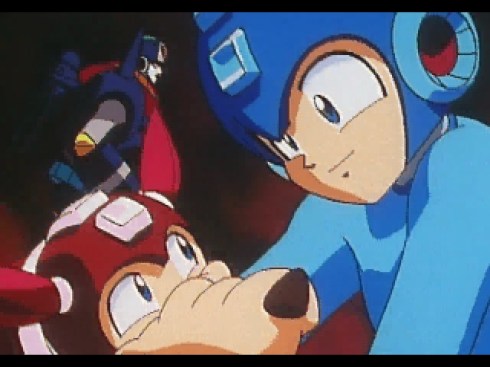
The anime cut scenes by and large look great considering they’re stored on CD ROM, but the voice acting just kills it.

Since this was the 10 year celebration for Mega Man, Capcom decided to dress things up with some anime cut scenes! Xebec was contracted to do the scenes and they actually did a really nice job considering these are forever trapped on a PlayStation disc. Since the total run-time for all of the sequences put together is probably only 10-12 minutes, they could afford to take their time and put a lot of effort into making them look good. Unfortunately, the same degree of care was not put forth into the voice acting when it came time to localize the game for North America. I don’t know if the Japanese voice acting was equally terrible, but the English version is hilariously bad. It’s the most infamous part of the game and what people think of first when they think of Mega Man 8. Mega Man sounds like an adolescent high-voiced girl while apparently no one realized that the characters Bass and Treble refer to music and not fish. Dr. Light is especially bad and sounds like a bumbling old fool who refers to Dr. Wiley as “Dr. Wow-ee” while the voice actor for newcomer Duo just sounds like he would rather be anywhere than in a studio voicing this character.

The voice acting is a real shame because outside of that the production values are pretty great. While few wanted 2D games in 1996, no one could argue that Mega Man 8 wasn’t attractive to look at. It’s hand-drawn visuals have aged way better than basically anything else on the PlayStation. Mega Man is the right size in relation to the screen and is lovingly animated. Many of the generic enemies are brimming with personality and the bosses, in particular Frost Man and Sword Man, are also a lot of fun to look at. The music is solid as well, and while most are probably nostalgic for that 8 bit sound I doubt few would suggest the soundtrack is poor. And while the voice acting during the anime bits is atrocious, it does succeed in adding some personality to those bosses and its mostly welcome in that space.

Aqua-Man-Miniboss

An assortment of mini bosses keeps things interesting and provide a vehicle for awarding Mega Man with even more power-ups.

Mega Man 8 performed rather well at retail when it was released, but reviewers were far more mixed. Incidentally, what it was maligned most for (its visuals) is what it’s most likely celebrated most for today. There was an undercurrent of backlash from some outlets because of its simplified look and there was also some Mega Man fatigue at the time. After all, this wasn’t just the 8th Mega Man game. It also followed three Mega Man X titles and some handheld ones as well. That’s a lot of Mega Man games in the span of 10 years so reviewers and gamers could be forgiven if they weren’t as excited for a proper Mega Man title in 1996 as maybe they would be today. Opinions are still divided on this one though. As recently as 2010, IGN considered it the worst of the mainline Mega Man titles. More recently, Retronaut’s Jeremy Parish ranked it as high as 5th among all of the Mega Man games (did you know there’s 20 total as of this writing?) which is probably the most praise I’ve ever seen given to the game. Perhaps not surprisingly, I tend to fall somewhere in between those two extremes. It certainly is not the worst of the Mega Man games, but Mega Man 2 and 3 are probably superior, at least. I definitely would rather play this one than Mega Man 7, though I’m less sure when it comes to other games. I’m not an expert Mega Man gamer and I never touched the ultra hard Mega Man 10 because it sounded like something I wouldn’t enjoy. When I picked this game up in 1997 as a birthday present I had some fun with it and returning to it in 2018 was by no means a bad experience. If you like Mega Man, but have never played this one and have only heard bad things then I’d suggest giving it a shot. It’s not hard to come by thanks to the compilations put out by Capcom nor is it prohibitively expensive if you want an original PlayStation version (if you want it for Saturn you will have to pay a lot, though) so you only have yourself to blame if you haven’t played it.
DuckTales: Remastered

DuckTales_Remastered

DuckTales: Remastered (2013)

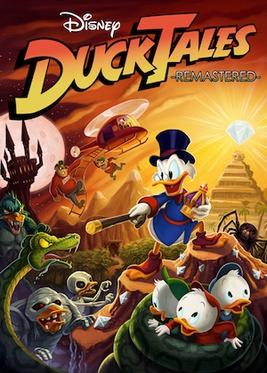
If you read yesterday’s post about DuckTales for the NES, you may have thought, “Wow, I’m surprised he didn’t mention anything about the re-make that came out in 2013.” Well, that’s because I was saving it for its own post! DuckTales: Remastered is a complete remake of the original NES game for Playstation 3, Xbox 360, and Nintendo Wii U. Initially a digital only release, DuckTales: Remastered would receive a tangible release as well, and for a game the started as a budget-friendly digital title, I can think of few others that received as much attention and fanfare as DuckTales: Remastered.

Capcom debuted the game at E3 with a memorable video hyping it up before indulging the audience in a sing-along of the memorable theme song from the show. The release of the game coincided with the 25th anniversary of the NES original, and it was a worthy title to revisit based on the fact that the original is still a ton of fun to play. Naturally, remaking a game many consider to be a classic is a tall task, but with such simple play mechanics, how could Capcom go wrong?

cd86dd950cf61320f768d1708052b37beaf5f292-498501

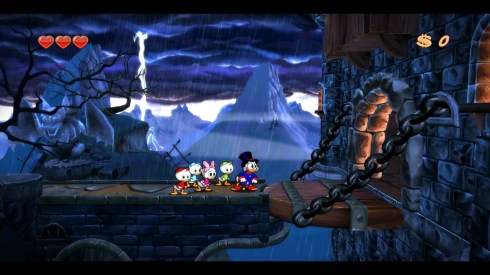
Transylvania got a lot scarier over the last 25 years.

DuckTales the game is largely unchanged at its core. The player still controls Scrooge who jumps and pogos his way through various levels (now six) in an effort to accumulate more wealth for himself and eventually to recover his lucky dime. What is changed are the production values. Modern game consoles can obviously handle quite a bit more, and this being tied to a Disney property, means a remake needs to meet the expectations and standards of The Walt Disney Company.

ducktales-remastered-npc-character-roster-wubba-duck1

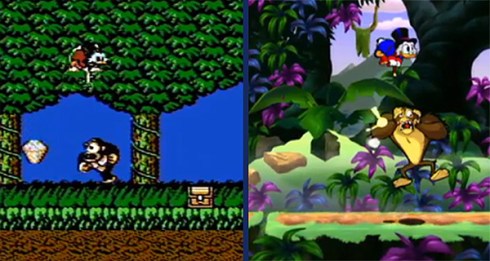
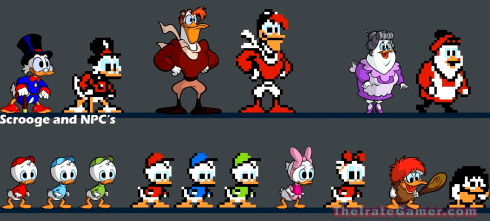
A comparison of the sprites from the NES original and the Remastered version.

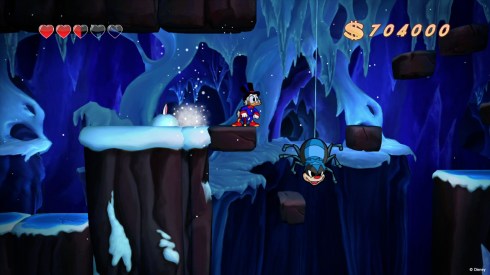
For the first time ever, a Disney Afternoon property can now basically look just like it does in game form as it did on television. The game is still a 2D side-scroller, but now the sprites for the characters are lovingly hand-drawn in great detail in bright, expressive colors. Scrooge will mostly sport a happy expression, but when he encounters the Beagle Boys or Magicka DeSpell he’ll scrunch his face up into a frown. The enemies too feature changing facial expressions, and not just the boss characters, but even lowly spiders and the like. The levels really come to life as the difference in climate is really accentuated by the enhanced presentation. All in all, DuckTales: Remastered is a beautiful game to behold and one of my very favorites from a visual point of view.

DuckTalesSideBySide

Another comparison shot to the original.

The enhanced fidelity of the game’s graphics are not the only aspect of the presentation to be enhanced with better technology. The audio is also greatly expanded upon featuring full-voiced characters with actors from the show as well as remastered music. Alan Young, in what is basically his swan-song as Scrooge, does a great job of voicing the greedy old duck and shows that time hasn’t taken much away from his vocal chords. Russi Taylor is on-hand to reprise her role as the nephews, Huey, Duey, and Louie, while  Terry McGovern returns as Launchpad. The wonderful June Foray was even brought back to voice Magicka DeSpell, making this a reunion of sorts for the cast. This seems all the more special since the new version of the cartoon set to launch this summer will feature an all new cast for these characters.

577660

I love how cold this cavern looks.

The downside to all of these resources is the need to make liberal use of them. DuckTales for the NES was a quick and fun to play title that would have worked even without the DuckTales license. For Remastered, a lot of cut scenes and cinematics were tacked onto the experience, not just in between levels, but even during them. They can be skipped, but even so they really break up the experience of playing the game and not in a welcomed way. Worse, I feel kind of guilty skipping over any line from Young and the other cast-mates, but it can get old hearing the same lines over and over if you’re forced to retry a stage. The game has also been lengthened quite a bit, not just with these scenes, but with a new level and longer boss encounters. Some of the boss fights are fine in their new form, while others do drag. I particularly hated the very final encounter with Magicka and Glomgold. What was a pretty simple race to the top of a rope in the first game, is now a death-defying escape from an active volcano with questionable hit detection. I had to replay the final, added level (which aside from the ending was quite good) repeatedly because I kept dying on this final part. Once I finally beat it I was too aggravated to enjoy it.

DuckTales CapCom Gold

And you thought only Zelda came in gold carts.

The game also adds additional collectibles that can be unlocked as you play, giving you something to do with all of the money Scrooge accumulates throughout the game. It’s mostly limited to concept art and background stills from the game but it’s still fun to look at, though not really enticing enough to encourage repeated play-throughs. I wish Capcom had gone the extra mile and included an unlockable version of the original game or its much rarer sequel. There was a press kit sent out to select individuals that included an actual copy of the original NES game, painted gold, and with the Remastered artwork on the cart. Acquiring one of those on the after-market will set you back a few grand, though it is a pretty neat collectible (and one that probably really irritated those select few that had a complete library of NES games in 2013).

Ultimately, DuckTales: Remastered is a fine enough love letter to the original game. It looks and sounds great, though it’s not quite as much fun to play as the original (though Scrooge’s pogo is still just as satisfying as it was back then) due to the pacing issues. It’s an odd duck (pun intended) in that regard, as most objective onlookers would take one look at both and immediately decide they’d rather play the remake. If you enjoyed the original, Remastered is still worth your time as it’s pretty cheap to acquire and includes enough fan-service to make you smile. And at the end of the day, it’s still DuckTales and still inherently fun, even if it could have been more.


Gaming Controllers: Your conduit to a virtual world

When it comes to video game development, there are a lot of factors to consider when crafting the perfect game. Visuals have always been a top priority as they’re the simplest way to demonstrate quality to the consumer so the necessary hardware is required to craft some pretty graphics. A fast processor is certainly required or else those pretty games will be choppy and slow. Audio is obviously important, as who would ever want to go back to mono? When it comes to actually interacting with a game and that little avatar on the screen, few things are as important as a controller. There are a lot of different factors that go into creating the perfect controller. Before the NES the joystick was the preferred input method, which was replaced by the directional pad or rocker switch, which has now mostly been supplanted by the analog stick or nub. Those early Atari controllers usually only featured one action button, now anything less than eight is unacceptable. As games have advanced through the decades, the controller has been asked to do more. Let’s pay tribute to those who have done it the best.

First, let’s also make some dishonorable mentions, those controllers that failed to impress.

nintendo-64-controller-gray-flatNintendo 64 – How to rank this one? You all know it, that oddly shaped, three-handled device released in 1996 alongside the Nintendo 64. It wasn’t the first controller to feature an analog thumb-stick, but it certainly made it standard, which is about the only good thing I can say about it. It was chunky, the face buttons felt cheap, and the shoulder buttons offered little satisfaction. The Z-trigger was a nice touch, but unless you were playing one of the many 3D platformers featured on the N64, this one was lacking.

images-222Atari Jaguar – Just look at this thing. If you never handled one consider yourself lucky. Ignoring that the system was a terrible waste of money, this controller was a beast of unwieldy proportions. See that key pad? Of course you do because it’s gigantic. That thing had inserts that could be snapped over it depending on the game, but it was mostly a tacky, useless feature that just made the controller obtuse. The cheap feel didn’t help things either.
All right, with those out of the way let’s move onto the top five. For the controller to be considered, it had to be a “stock” controller during a system’s lifespan, meaning it came bundled with a new console. I also tried to give some deference to the controllers that paved the way, otherwise this top five would be really slanted towards the modern additions since developers have naturally had many opportunities to improve upon the designs of yesterday. Before I get to the top five, let’s first pay homage to the godfather of the modern controller:

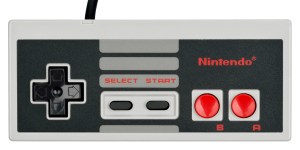
nes-controller-flatThe NES controller – It’s the one that standardized the modern layout of basically every controller. The d-pad on the left, and action buttons on the right. Maybe the squared edges weren’t the best idea but the re-designed “dog bone” bundled with the later model NES rectified that mistake. It’s been improved upon by leaps and bounds, but few people thought at the time there was anything wrong with it.
neo-geo-cd-controller-fr

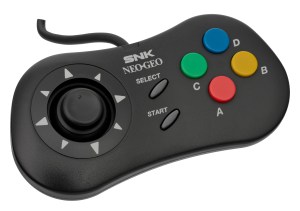
5. The Neo Geo CD Controller – Neo Geo is the console for SNK and their many arcade games. It was a high-end console for arcade enthusiasts as the giant cartridges were essentially identical to the arcade counterpart. As such, it was really expensive. It was also heavily populated by the fighters, and since every arcade cabinet is equipped with a joystick, the Neo Geo was bundled with one as well. When the Neo Geo CD came out though, it came with a more traditional controller. The layout is the standard established by the Super Nintendo with four face buttons arranged in a diamond shape, but the thing that stands out is that analog slider type of input on the left. Quite simply, it’s the finest analog stick or slider I’ve ever encountered, which is incredible since it’s over twenty years old at this point. It has a satisfying click to it and enough resistance for more precise actions. I’m not sure how well it would hold up with modern 3D games, but for 2D games it’s flawless. And best of all, it’s the only analog thumb-stick I’ve ever encountered that’s usable with fighting games. Anyone who tried to play Street Fighter IV on an Xbox 360 can tell you how impossible a task that is.

v00276-5y

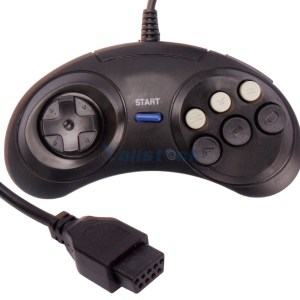
4. Sega Genesis Six Button Controller – Not a stock controller initially, the six button version of the Genesis controller was the preferred controller by gaming enthusiasts who had a Genesis. And if you were really into fighting games, it was probably your favorite across all consoles. It maintained the standard Genesis d-pad, which included easy diagonals making it superior to the one offered by the Big N. The three buttons layout though was suboptimal, and the six button controller rectified that shortcoming. The layout made it super easy for games like Street Fighter II and Mortal Kombat to access the strongest punch and kick attacks. By the time the Genesis 3 and the CDX came to be the controller even came with a turbo function (in case you forgot, gamers in the 90’s thought turbo was the greatest)! The only criticism that can be levied on this one is the size. Being quite small, it takes some getting used to in the hands of an adult male.

xbox-one

3. The Xbox One – It’s more or less the same as the 360, which is probably what most gamers wanted. The ergonomics of the controller are pretty tried and true and this point, though while most controllers are trended more towards the smaller side, Microsoft still likes to keep their controller a little thicker than others. While the original Xbox controller was too much like the Dreamcast in that department (which was a contender for a dishonorable mention), the Xbox One controller has found a nice balance. The only thing holding it back is that damn D-pad. One of the measuring sticks of a controller is how well it handles all genres of games, and the Xbox One’s inability to properly control a quality 2D fighter is a hindrance carried over from its predecessor. If you don’t like 2D fighters though, a genre that has certainly seen its popularity apex long ago, then you’re probably good with this one.

snes-controller-flat

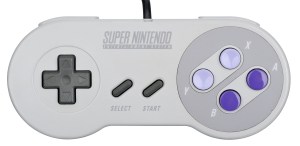
2. The Super Nintendo – The Super Nintendo is essentially the root of all modern controllers (excepting, of course, the oddball Wii controllers) as it established the preferred layout for virtually every game. A directional input on the left, diamond shaped action buttons on the right, and shoulder buttons for easy trigger finger access. The rounded edge made it comfortable, and the center of the controller was open for less important buttons and functions which is something future controllers took advantage of. The Super Nintendo controller was essentially perfect for its era. While most gamers would agree the the d-pad on the Genesis controller was superior, it wasn’t able to match the feel of the SNES controller, nor was the d-pad advantage enough to make up for the extra buttons. Oddly enough, Nintendo has been the one company to not really carry forward the SNES controller’s design. After it came the N64 and Virtual Boy, which also featured a terrible input device, before the Gamecube sort of brought Nintendo back to the old design. The Wii and Wii U obviously went in completely different directions for their input device, but at least they’ve had secondary controllers that resemble the SNES one. Sometimes it’s better to just stick with what works.

a703161

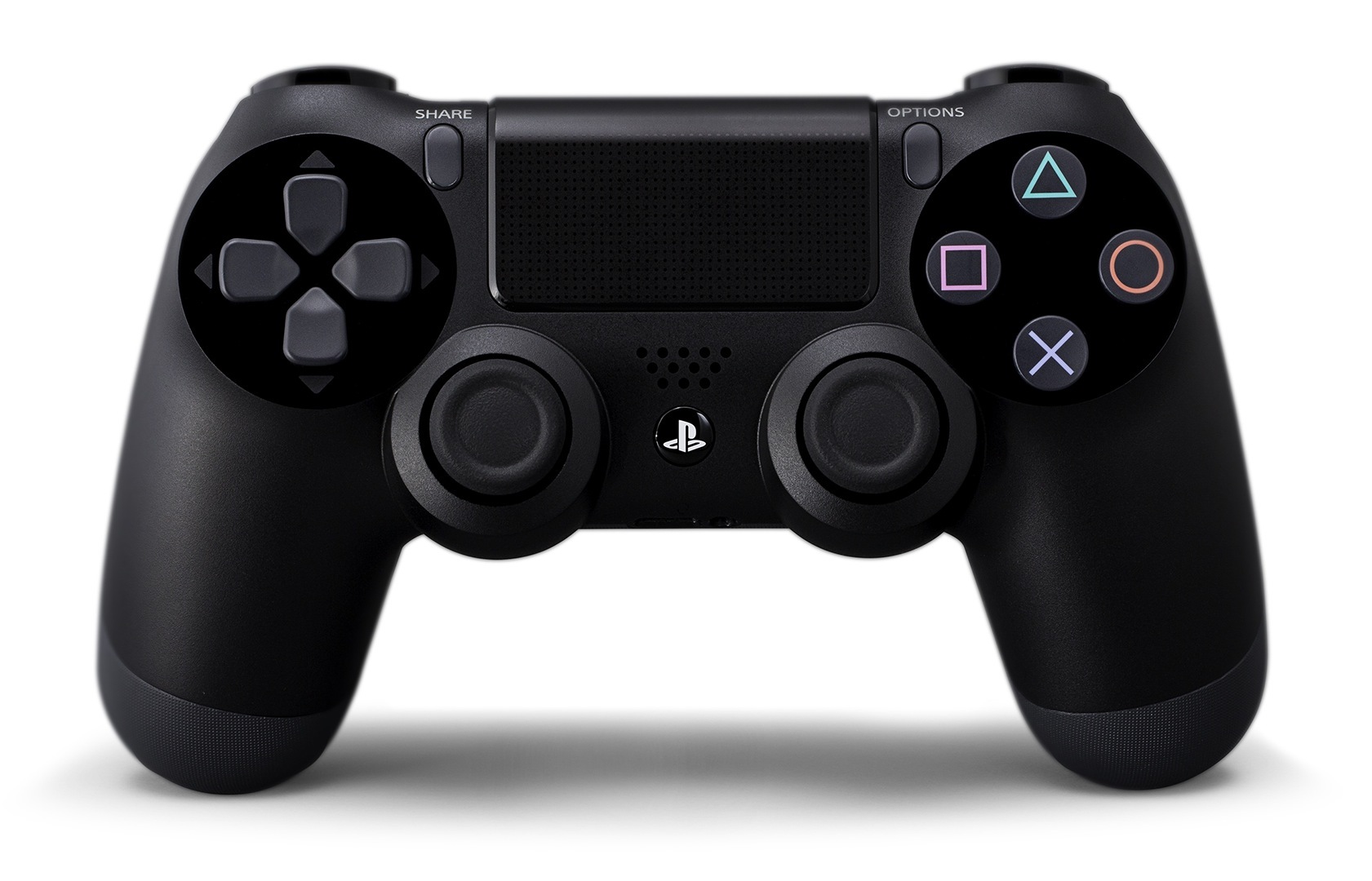
  1. The Dual Shock 4 – Stick with what works seems to be an unofficial motto for Sony and its Playstation controllers. The original Playstation featured a controller that was essentially a SNES controller with two extra shoulder buttons and handles for added comfort. After the N64 made analog a big deal, it was replaced by the Dual Shock which added a vibrating function and twin analog sticks. The PS2 and PS3 did little to change from the Dual Shock, but the Dual Shock 4 brought about some slight modifications that have helped to make it gaming’s best all-around controller. The D-pad is still placed in a prominent spot despite the fact that it’s utilized less than an analog stick, but the analog input manages to remain in a thumb-friendly zone. The rear triggers are comfortable and responsive, and the diamond layout for the face buttons is preserved. Sure, the touchpad in the center of the controller is a novelty addition, but it’s not one that takes away from the controller’s main functions. It’s the one controller I really can’t complain about as it has a nice weight to it, it’s durable, and never lacking for buttons. Good luck to those who try and top it, but hopefully Sony continues to stick with what works.

Suikoden II

Suikoden II (1998) Suikoden II (1998)

In the early part of the 1990’s, there were basically two companies known for producing Japanese Role-Playing Games: Squaresoft and Enix. Square, as the legend goes, was rescued by the success of a last ditch effort for relevancy in the form of Final Fantasy for the Famicom/Nintendo Entertainment System. Prior to that, Enix had already staked its claim to RPG supremacy with its hit Dragon Quest (known as Dragon Warrior in the US). During the 16 bit era, Square would come to surpass Enix as the premier publisher for the genre, as not only were Final Fantasy’s many sequels hits, but so was seemingly everything else Square etched its name on. These two companies were not the only ones exploring the JRPG genre. When someone strikes gold with an idea a legion of copycats arise. Capcom would enlist Square’s help with localizing its own take on the genre with Breath of Fire. Capcom has since dabbled with the genre here and there without ever becoming a true power. One of the other main Japanese game developers was Konami. Back on the NES, Capcom and Konami were arguably the two most popular so it made sense for Konami to toss its hat into the JRPG ring and it did so with the Suikoden series.

Suikoden debuted on the Playstation in 1995, but the series truly arrived with its sequel in 1998 simply titled Suikoden II. Suikoden did not break the mold in terms of what it brought to the genre. Rather than trying to be something entirely different from the established franchises at the time, it opted to be a jack of all trades. Turn-based battles entered into via random map encounters paired with large, map-based tactical confrontations more commonly found in a series like Fire Emblem. Suikoden’s approach to variety is part of what made it a success, but also contributing to that success was its massive stable of characters and high stakes.

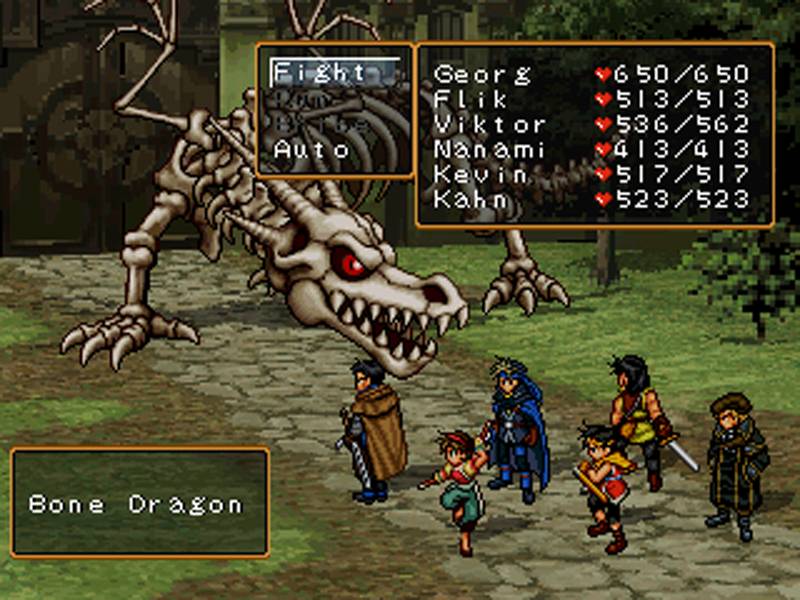
Suikoden II reserves its best character models for its boss encounters. Suikoden II reserves its best character models for its boss encounters.

When the Playstation was in vogue, I was an early adopter. I wore out my Playstation which conveniently ceased to function just a month before the launch of the Playstation 2. During my time spent with the Playstation I played a ton of RPGs, but none of the Suikoden games. For years, I’ve often heard from friends and relatives that I should seek out and play Suikoden II, if nothing else, but the game fetches obscenely high prices on resale markets and I was just never willing to pull the trigger (or borrow such an important game from a friend). Finally, Sony and Konami were able to make the game available this past June on the Playstation Network, and I’ve been playing it on my Vita ever since. It is kind of a shame that I did miss out on this one back in 1999 (when the US version was released) because I would have really enjoyed it then. However, that didn’t prevent me from enjoying it now.

Suikoden II is not unlike many games in the genre in terms of pacing and structure. As the player, you control a nameless, voiceless, shell of a character who seems unimportant at the game’s start but soon is arguably the most important person in the world. The main character and his best friend, Jowy, are soldiers in a youth brigade that soon is attacked from outside, and within, and disbanded. War has broken out across the land as the most powerful, ruling family is not just seeking to bring everyone else to knee but seeks total chaos and destruction of the world. The main antagonist, Luca Blight, is a villain so evil he’s boring, but like many games in the genre, he’s only the main villain for so long as another emerges from the shadows and the stakes get higher. Throughout the hero’s adventure he’ll encounter over 100 recruitable allies. Each character has his or her own reasons for joining the resistance against Blight’s tyranny and the player is free to mix and match parties of six almost at will throughout the entirety of the game. Travel takes place on a world map and the player can enter and exit towns and dungeons as they are found. If you’ve played any other JRPG from this era then it should feel pretty familiar.

At times, the player will be tasked with completing more tactical battles. At times, the player will be tasked with completing more tactical battles.

Battles are also pretty straight-forward. Enemies, aside from boss fights, are encountered randomly when on the world map and in dungeons. Battles are turn-based with the heroes and enemies having their order of attack determined by an individual speed score. There’s no active component to the fights as the player simply tells each character what to do and watches the round unfold. If both sides survive, then another round commences. Where Suikoden separates itself is by having battles be, up to, two groups of six. When assembling a party, the player is expected to pay attention to each character’s range:  short, medium, or long. Short range characters have to be placed in the first row and can only attack the opponent’s first row. Medium range characters can attack from either row, but can only attack the opponent’s first row. Long range characters can attack any enemy from the back row. By forcing the player to go with a 2×3 formation, the player is forced to mix-in medium and long range characters which is important because the short range ones usually pack the most punch when it comes to attack power. In addition to standard attacks, characters can also make use of runes, which once equipped to a character or weapon, grant the character magical abilities. Some of these, such as the ability to heal between rounds, are passive while others are actual attacks or defensive spells. Rather than have a collection of mana or magic points, characters simply can only cast a certain amount of spells in between rest stops (such as sleeping at an inn). Early in the game, a character may have access to three level one spells and a single level two spells, but by the end of the game that same character will likely have access to level five spells as well. Characters more proficient with magic can equip more runes with the best able to equip one on each hand plus one on their head and weapon. And not all runes are equipable on all characters. This helps make each character feel unique not just among the other 107, but even from one play-through to the next. Lastly, borrowing a page from Chrono Trigger, certain characters can be paired with other characters for Unite attacks. These are kind of a secret in the game, but they’re also logical in terms of the pairings. Experimentation is encouraged.

Suikoden II's most memorable attribute is undoubtedly its large roster of characters. Suikoden II’s most memorable attribute is undoubtedly its large roster of characters.

Occurring at set points during the games are the tactical battles. As mentioned before, these battles very much imitate Nintendo’s Fire Emblem as characters are moved around on a grid and engage in combat that has a bit more of a random feel to it but is also more strategic. Very rarely is the player able to simply overwhelm the opponent necessitating a more thoughtful approach. Death in this scenario also has the possibility of being permanent making the stakes much higher. Even so, most of these encounters are fairly easy and few actually require the player to completely vanquish the opposition. Ranged attackers can often be leveraged to dish out most of the damage against non-ranged enemies with the short-range attackers being called upon to clean up the mess. As a result, Suikoden II’s approach to these tactical battles feels kind of half-assed but they are still a nice change of pace when they occur.

Graphically, Suikoden II comes up short when compared with most of its peers. The game makes use of sprites as opposed to 3D models with very limited use of CG effects. Some of the larger enemies are attractive, but they also seem to tax the system and slowdown is a frequent problem. The original game is said to be buggy at times as well, though I never encountered any playing on the Vita. The simple visuals have kept the game from aging horribly, as some titles from that era have, but it is kind of disappointing that a late era Playstation title wasn’t given a bit more love from its developers. The soundtrack is quite good though, with the game often reserving its best pieces for its biggest moments. This comes at the expense of the more mundane moments and I did find myself getting sick of the world map theme after 40 hours or so.

Where Suikoden II really separates itself from its peers is with its tone. The story is handled in a very serious manner. As I mentioned earlier, Luca Blight is kind of a silly villain but once he’s out of the way the main confrontation becomes far more interesting. The game does suffer a bit from its rigid approach to story-telling, but that was pretty common for the era with more open-ended plots a recent phenomena. I found myself often disagreeing with the choices the game had my character making but it didn’t prevent me from enjoying the storyline for what it was. I also enjoyed watching the hero’s castle, acquired maybe a quarter of the way into the game, improve as the game went along. I also really appreciated the fact that there were not many missable characters or items, as if you want to see the game’s best ending, you need to recruit all 107 characters. I also appreciate that the game made some attempt at giving each character a backstory, and it’s also pretty easy to bring an under-leveled character into the main party and get them up to speed quickly. This is something a game like Chrono Cross should have tried to emulate.

In short, gameplay-wise, Suikoden II is not terribly unique when compared with other games from the Playstation era, but that’s not a bad thing. What’s there works and it’s a fun game to play. Sure, random encounters can get annoying (and they’re really bad during the final dungeon) but anyone who grew up with these games should be able to deal with it. The variety of the characters helps keep the game fresh even on multiple play-throughs. I may have missed out back in 1999 when this game first arrived on US soil, but I’m glad to have experienced it now in 2015. And if you’re in the same boat as me, playing it on the Vita is a nice way to experience the game on the go. If only Suikoden III was playable on Vita then I’d have something to play tomorrow when I’m riding the train to work.

Final Fantasy X-2 HD Remaster

Final Fantasy X-2 HD Remaster (2014)

Final Fantasy X-2 HD Remaster (2014)

It was way back in July that I posted about the remastered Final Fantasy X which was released in March on both the Playstation 3 and Playstation Vita. It is now the end of January and I’m just getting around to talking about the companion game with that release:  Final Fantasy X-2. It’s not because I’m lazy, though I have neglected this blog some during that timeframe, but because I actually just recently finished Final Fantasy X-2 even though it was the only game I played on my Vita in that span of time. I didn’t split time between my Vita and 3DS, I actually haven’t touched that system in nearly a year, it’s that I just had enough content to keep myself busy. Now, my handheld gaming is basically confined to my work commute, which became a 3 day commute over the summer thanks to the wonders of telecommuting. Those three days total about 4 hours of gaming per week so maybe it’s not that crazy a game could last me nearly six months but it is pretty cool that between March 2014 and January 2015 I only played one release on my Vita and was perfectly satisfied. That’s getting the most out of forty dollars.

Final Fantasy X-2 has the distinction of being the first true sequel for the Final Fantasy franchise. That seems crazy considering this is an ongoing series stretching back to the late 1980’s, but every longtime fan knows that all of the Final Fantasy games were self-contained games with only thematic and gameplay similarities making them all one franchise. The characters, settings, plots were all different. While some were certainly similar in setting, especially the first five games, they all differentiated themselves quite distinctly. There have been some mega-popular games in the series and ones that fans probably wanted a sequel to more than Final Fantasy X, but be it for creative reasons or economic ones, it was Final Fantasy X that received the first sequel. Final Fantasy X ended on a pretty final note. There certainly were questions about what the characters would do following the events of that game, but not really more than any other title. It wasn’t exactly an “everyone lived happily ever after” ending, but it was far from being a cliffhanger. The direction of the sequel wasn’t obvious, but Square-Enix rightly chose which character to center the sequel around.

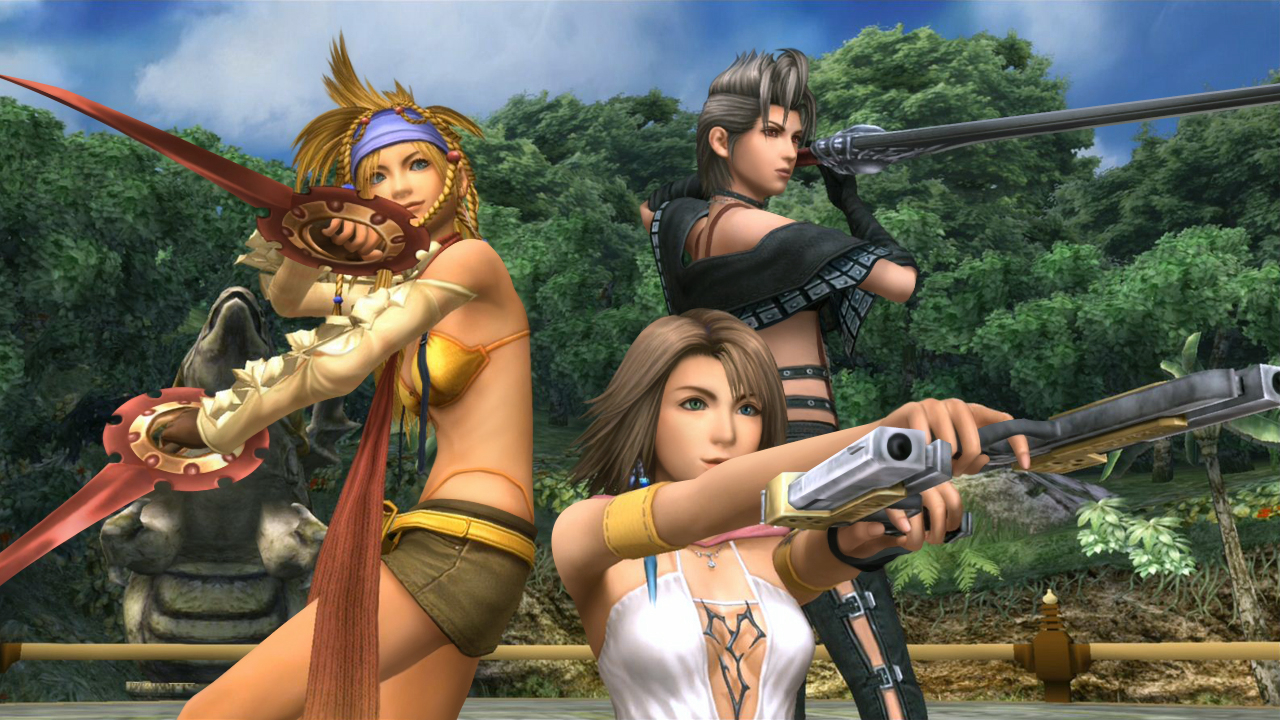
The main cast (left to right): Rikku, Yuna, Paine.

The main cast (left to right): Rikku, Yuna, Paine.

Yuna was the pseudo-protagonist of Final Fantasy X. While the main character, Tidus, often reminded the player that this was his story, it would be more appropriate to say it was their story when referencing both Tidus and Yuna. For much of the game, Yuna was Sherlock Holmes to Tidus’ Watson and we were experiencing her journey as a summoner through the eyes of a different character. In Final Fantasy X, Yuna was reserved, somewhat shy, and lacking in confidence. She grew throughout her journey, but the events at the end would lead one to wonder just how she would adjust to her new life. Final Fantasy X-2 picks up two years after the first game’s conclusion and we find a Yuna bursting with energy and a sense of adventure. Together with Final Fantasy X hold-over (and her cousin) Rikku, plus new-comer Paine, she travels Spira in search of lost spheres which are essentially records of Spira’s past. There’s a market for such spheres as Spira comes to grips with the loss of its center, the Yevon religion, which was exposed as fraudulent during the events of Final Fantasy X.

When Final Fantasy X-2 was originally unveiled, the thing most gamers and press seemed to key in on were the three main characters:  Yuna, Rikku, and Paine. It might not be obvious based on their names, but all three characters are female. And all three were the only playable characters (sort of, more on that later) in the game. This was pretty significant for the time as Final Fantasy had never really had a female lead, let alone an all female party. It was a pretty bold move, especially in the West where the video game fanbase is almost exclusively male. Not surprisingly, there was some backlash and amongst my friends I came upon those who had no interest in playing a “girl” or “gay” game (we were in high school and certainly still growing up). It didn’t help things that the game essentially opens up with the characters attending a J-Pop concert where Yuna is the apparent performer. The game makes the declaration that it isn’t going to shy away from the fact that the main characters are women. They could have portrayed them in a masculine or more subtle way but chose not to. The only thing I would criticize the game designers for is the overly sexualized nature of the characters. Some of the battle attire the girls where is just not at all practical and pretty ridiculous.

If you're going into battle against knives, guns, and who knows what else, this doesn't seem like the best choice of attire.

If you’re going into battle against knives, guns, and who knows what else, this doesn’t seem like the best choice of attire.

Because of some of the design choices, the game alienated people from the start and it has often felt like an overlooked title in the Final Fantasy series. I played the Playstation 2 version and enjoyed some aspects of it while I didn’t others. At the time, I think I was suffering from some RPG fatigue because I remember the game being a slog for me. I finished it, but it was sort of a joyless experience. I wasn’t thrilled to play the HD version as a result, but fortunately for me I enjoyed the game a lot more the second time around.

The foundation of the game is fundamentally solid. It’s essentially Final Fantasy V complete with the return of the Active-Time Battle System and the job class system, with some tweaks. The job system is now known as the dress sphere system, but it works the same. Characters are free to choose between any dress sphere which includes staples such as the warrior, white mage, black mage, thief, and so on along with a few unique to the game. The major twist for X-2 is that characters can switch between dress spheres during battle, providing they equipped them to their character’s Garment Grid. The Garment Grid is like a mini Sphere Grid from Final Fantasy X that features open nodes that can be equipped with any dress sphere. The character can move from one node to another during one turn in battle, but must move to adjacent nodes. The grids also bestow other special abilities like certain spells or stat buffs. It’s pretty customizable and a lot of fun to mix and match dress spheres among the three characters. Each girl is obviously better suited for certain spheres, Rikku is the speed character while Paine is the strongest attacker, but all three girls can make any dress sphere work. The lone weakness of the system is that some dress spheres are far superior to others, which lessens the enjoyment of mixing things up, but I found it pretty addicting to keep mastering different dress spheres by unlocking all of their abilities.

The rest of the game functions a little different from traditional Final Fantasy titles as well by going with a mission based approach. The game is separated into five chapters with each one containing a few story-line based missions that must be completed. The rest are ancillary but strongly encouraged. Just plowing through the game, I suspect someone could beat it in around twenty hours but it wouldn’t be as much fun. There are plenty of dull missions but most add something either in the form of humor or challenge. Particularly at the end of the game, there are several challenging missions that will definitely consume a lot of time. Completing tasks contribute to the completion percentage of the game, with the obvious goal being to achieve 100% and getting the “best” ending. It’s possible to do so on the first play-through, but there’s a lot of junk you would never hit on without a guide. Silly things like talking to certain characters in a specific order can ruin your shot at 100%. It can be frustrating to be forty hours into the game and find out you have no shot at 100% on one play through, but that’s what Square-Enix was going for as they wanted gamers to play the game a second time as your completion percentage will carry over.

The J-Pop stuff is pretty silly, but it is by no means a game-breaker if it's not your cup of tea.

The J-Pop stuff is pretty silly, but it is by no means a game-breaker if it’s not your cup of tea.

Thematically, Final Fantasy X-2 is a much lighter experience compared with its predecessor. Final Fantasy X wasn’t exactly a melodrama, but it had some weightier tones. X-2 somewhat embodies that J-Pop intro in that it’s mostly a game featuring three women having the time of their lives. There is some tragedy to the story, especially in the wake of the events of Final Fantasy X, but it’s mostly a fun experience. The music, even with a couple of J-Pop tracks I could do without, is quite good and on par with the rest of the franchise. Changes made going from the PS2 original and the HD version are minimal from a visual standpoint, but the game received additional content not previously available to western audiences. There are two new dress spheres, one of which is actually very useful, and a new monster capturing mechanic that actually expands the playable battle party. It wasn’t something I took advantage of, but it’s cool for those who want it.

The major addition to the game is the inclusion of The Last Mission scenario. The Last Mission takes place after the events of the main game and sees Yuna, Rikku, and Paine reunite for one final mission. It’s almost a completely different game as it’s basically a rogue-like, dungeon-crawler instead of a typical JRPG like the main game. I personally found it to be a real drag, and getting through it for the additional storyline content was not an enjoyable experience for me. The storyline was also pretty trivial and the lesson in it felt forced like it was coming from a completely different voice than from those behind X-2’s plot. I would suggest that if you do not enjoy the gameplay, as I did, then save yourself the time and just watch the cut scenes from it on youtube. They’re everywhere.

The Last Mission is a very different experience and one I didn't care for, but maybe I'm in the minority.

The Last Mission is a very different experience and one I didn’t care for, but maybe I’m in the minority.

The last piece of new content is the Bonus Audio which is being referred to as an audio drama on the internet. It’s basically a story that takes place after X-2 and centers on a new character (if you do not want spoilers, then skip ahead to the next paragraph). The new character is actually the daughter of Auron, and she wants to meet up with those who knew her father. To make a long-story short, the end result is that Yuna is once more a summoner for a Yevon-like organization, Sin returns, and she and Tidus break-up over some really silly stuff. I know some people did not like that Tidus died, or ceased to exist, at the conclusion of Final Fantasy X and the perfect ending of X-2 basically remedies this. I was fine and happy with how FFX concluded, not because I hated Tidus, but because I respected the story it told. I actually wish they never brought him back since I prefer death be treated as permanent in pretty much any story I experience. To bring him back though and then have Yuna break-up with him over some silly insecurities such as the ones presented in the audio drama just seemed like bad story-telling. I do not know if this audio was meant to be a spring-board for a Final Fantasy X-3, I doubt Square-Enix has any interest in going back to Spira, but if it was I hope they soundly rejected it. Listen to it only if you’re absolutely curious because the story sucks, to put it bluntly.

Final Fantasy X-2 is a perfectly acceptable Final Fantasy title, and a damn good game. I do not think it is better than Final Fantasy X and it’s not in my top five Final Fantasy titles, but it’s probably right in the middle somewhere. If you’re like me and either felt you short-changed it back when it was originally released or ignored it all together, I would suggest giving it another go. If you didn’t like Final Fantasy X then don’t bother, but if you loved Final Fantasy III and V because of the job system then maybe you should take a look regardless of your thoughts on Final Fantasy X. It’s a fun game and it stands out among other Final Fantasy titles, and given how many there are, that’s an accomplishment worth celebrating.


Final Fantasy X HD Remaster

Final-Fantasy-X-X-2-HD-Remaster-1Over the years I’ve talked a lot about Final Fantasy but I’ve never posted a game review for any of the numeric titles in the long-running series. Well that ends today as I post my thoughts on the somewhat recently released Final Fantasy X HD Remaster.

One opinion I have stated on more than one occasion here is my affinity for Final Fantasy X, the Playstation 2 RPG released back in 2001. I consider X the last great Final Fantasy game to be released while some want to lump it in with the lesser received post Final Fantasy VII games. Some of these games have been a bit underwhelming while some of the criticism is likely born from the series’ rise in popularity. Prior to VII, Final Fantasy was a niche title with a small but devoted following. Once a bandwagon becomes crowded, the older fans tend to shun the new ones. It happens all of the time within the music industry and video games are no stranger to it as well. Final Fantasy X though took what made the series so great and made some noteworthy improvements to the tried-and-true formula. It took chances too, by eliminating the world map and adding spoken dialogue for the first time in the series. The game was a commercial and critical success even if it’s not often cited as one of the best Final Fantasy games in the series. And since it’s a PS2 game, upgrading the visuals to high definition and re-releasing it makes sense and the world is better for it!

A composite shot featuring the original game merged with the HD version.

A composite shot featuring the original game merged with the HD version.

For those who missed out when the game debuted over ten years ago, Final Fantasy X is a pretty familiar experience for those who played any of the nine previous titles in the series. Players maneuver a character amongst towns, dungeons, and open areas to get from one place to another. Players can interact and speak with other characters while non-interactive moments move the story along. In battle, characters take turns attacking, stealing, casting spells, or defending in an effort to win the fight. A menu screen is used to outfit characters with weapons and armor to boost their stats and make them more formidable foes or to tailor their character for a certain approach. Where X departed from past games was with just about everything else. Some changes, like the new Conditional Turn-Based Battle, are subtle but different enough to leave an impression. In many of the previous games, each character had a meter that would fill gradually during battle before an action could be taken. This was dubbed the Active Time Battle System by developer Squaresoft. The Conditional Turn-Based Battle creates a list of both enemies and player characters determining the order of battle. The list can be altered by certain spells, actions, and effects but overall it creates a more tactical experience, which is enhanced further with the ability to swap characters in and out of battle on the fly. The removal of the world map was a change that felt big at the time but played much smaller. Removing the world map just meant that each area of the game world was integrated seamlessly with one another. The world map had really only existed in prior games as a technological limitation or as a trick to make the game feel bigger than it is. When it was first announced that Final Fantasy X would not include a world map scenario it seemed scary, almost unthinkable, but it ended up being a change for the better.

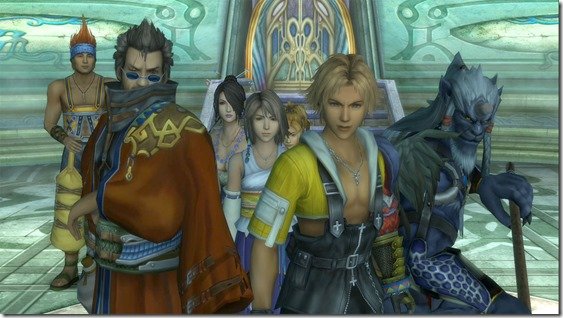
The main cast.

The main cast.

A much bigger change for Final Fantasy X’s gameplay is the Sphere Grid. Just about every Final Fantasy game has its own unique way of evolving the characters throughout the game to make them better suited for combat. In the original game it was all based on experience points and each character had its own special class be it warrior or black mage. Final Fantasy III and V both made use of what was termed the Job System where the player was free to assign a character’s class making it possible to have a party of all black mages if one so desired. Other additions over the years were the Espers in Final Fantasy VI which allowed characters to learn spells and abilities while being paired with a unique creature, VII had the materia system which was dependent on amassing a bunch of materia and weapons with ample space to use it, and so on. Final Fantasy X’s Sphere Grid was perhaps the most radical departure from the other games. Characters no longer earned experience points, something that was common to all prior Final Fantasy games, and instead earn sphere points. Once a character gains enough sphere points, he gains a sphere level. One sphere level can then be spent to move the character one space on the Sphere Grid. The grid itself is outfitted with several nodes that can be activated with special spheres collected during battle. These nodes can have anything from a point of strength to a spell like Flare. All character evolution takes place on the Sphere Grid. It’s the only way to improve a character’s base stats, like strength, defense, magic, and so on, as well as hit points and abilities. No spells or special moves need to be acquired by beating a special boss or finding it as a prize in some mini game, it’s all right there on the Sphere Grid for you to see from the start. Of course, acquiring a spell like Ultima is going to take lots of time and many sphere levels to get there, but you’re free to plot your own course. The Sphere Grid in the original game starts each character in their own section, and while you’re free to do with them as you please, the game clearly intends for Lulu to be a black mage, Rikku a thief, and so on.

It may not be PS3 quality, but the game is far from an eyesore.

It may not be PS3 quality, but the game is far from an eyesore.

For the international edition of Final Fantasy X, some additional content was added and this HD remaster includes all of it. The Sphere Grid from the original game is present, but if you wish, you can opt to use the expert grid. This grid starts every character right in the center freeing them up to pursue whatever abilities they wish. In general, a balanced attack is preferred and most anybody who plays this game is going to take a character like Lulu down the black mage path, but I found there was more opportunity to diversify with this version of the grid than before. I was able to have Yuna, the summoner/white mage of the group, bounce between the white and black mage paths giving her some punch in battle she didn’t have when I played the game for the first time. Khimari, the blue mage of the original game, was basically my version of the red mage from III and V as I was able to grant him white and black magic while keeping his base stats high enough to make him a suitable physical attacker early on. Like the red mage of prior games, he would eventually outgrow his usefulness but for the early part of the game he was a frequent contributor.

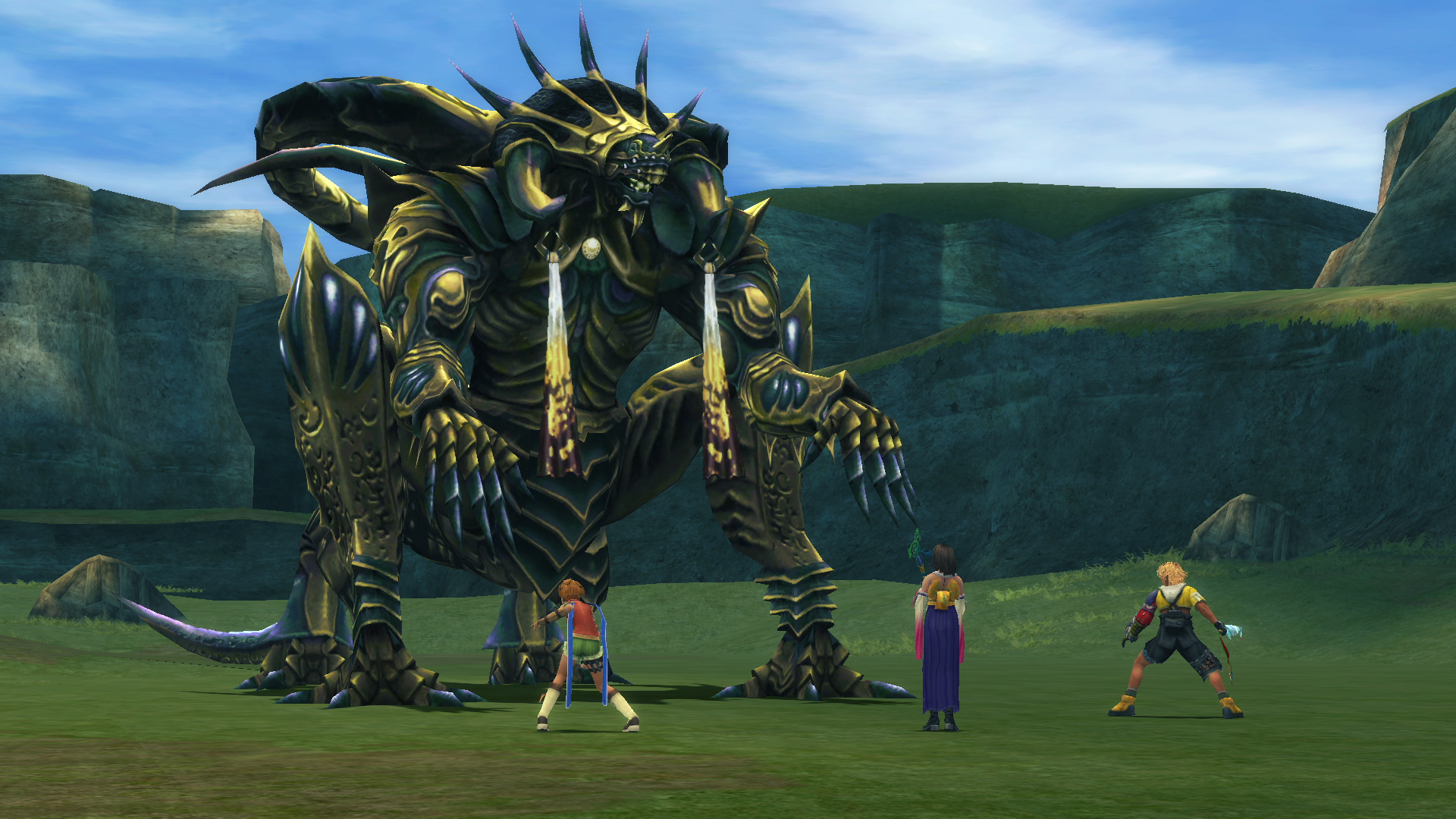
Another big change for X was with the summons. Squaresoft seemed to always be searching for a way to make the summon magic more interactive. Once VII arrived with the Playstation it meant the summons could be more of a spectacle as full-motion video sequences captured the awesome power of Bahamut and did so with gusto. For X, Square opted to let the players control the summoned beasts, dubbed aeons, directly. They’re fully integrated into the plot of the game and only Yuna can summon one at a time. When she does, the rest of the party vacates the battlefield and the aeon takes over. Their overdrive meter fills rapidly (X’s version of the limit break) and once full they can unleash the mega attacks we’re used to seeing. Outside of battle, a special item allows the player to improve the base stats of the aeons or even teach them new spells and abilities. They’re limited in their usefulness, but at the very least they make good cannon fodder against enemies that have devastating special attacks as once an aeon dies in battle they’re just replaced by the battle party.

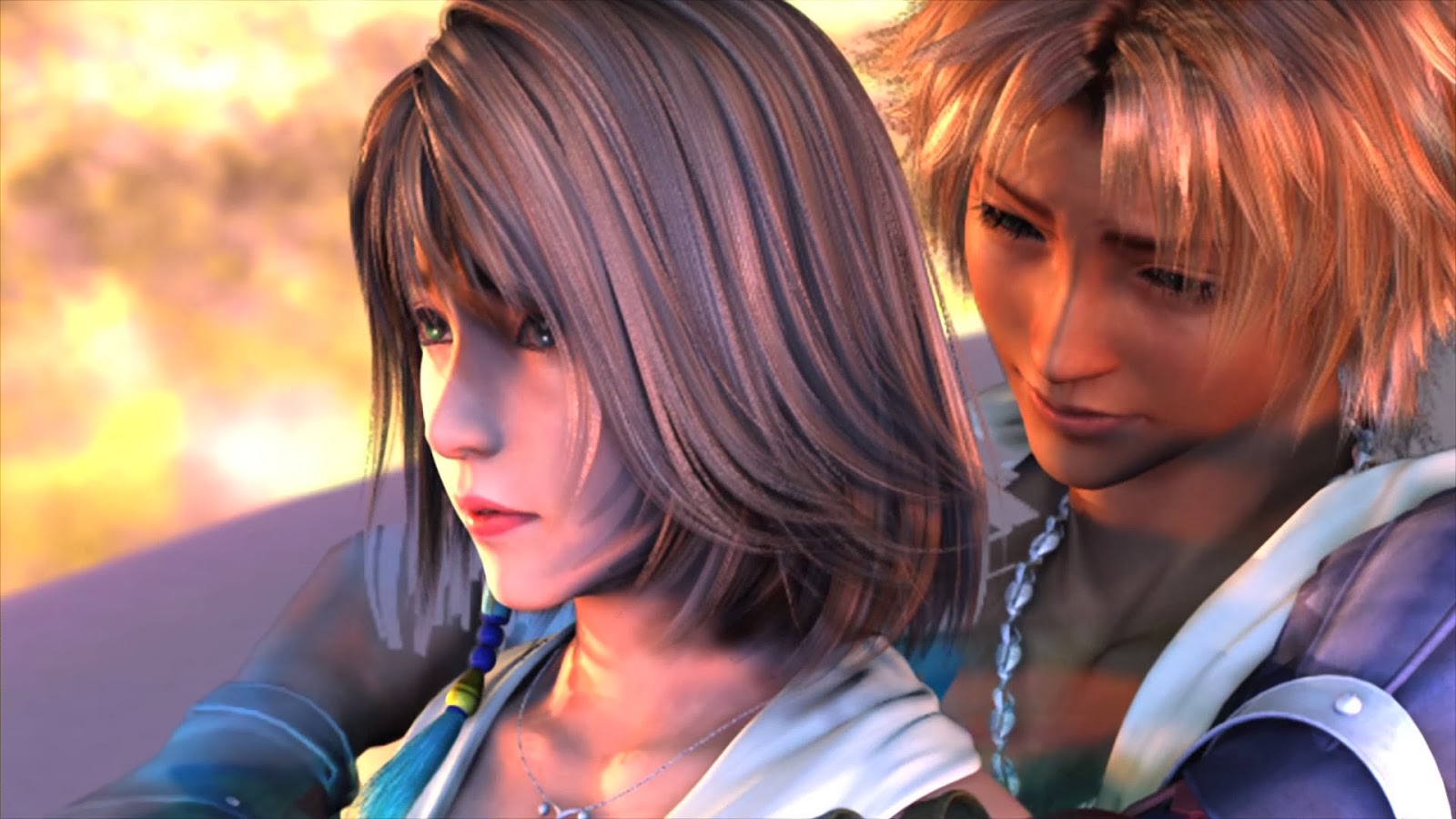
My journey through Spira was much as I remembered it. The HD upscaling is welcome though it does not disguise the fact that this is a PS2 game. SquareEnix apparently re-did the faces of Tidus and Yuna to make them more expressive but they’re still a little wooden by today’s standards. The game is only noticeably better looking when compared directly with the PS2 game. Otherwise, it’s bright and colorful setting is still mostly pleasing to the eye. The game really only shows its age with the limited animations. There’s a sequence where the characters ride snow mobiles and it’s painfully obvious that the game could not handle animated hair, aside from a ponytail or something, so Tidus’ hairstyle remains frozen in place while he zips along. You’ll also see the same character models used over and over among non-player characters and enemies. The audio is quite nice though and the game’s musical score is fitting for a Final Fantasy title. The voice acting was somewhat maligned the first time around, but I found no obvious faults with it then or now. The poor lip-syncing is still an issue and can be distracting, though I found it never took me out of a scene completely.

The game's stoyline has room for cheer and also for more emotionally weighty moments.

The game’s stoyline has room for cheer and also for more emotionally weighty moments.

Final Fantasy X HD was released for the PS3 and the Vita with the two platforms supporting cross-save functionality but not cross-buy. As such, I only purchased the game for the Vita, and it’s been a great experience taking Final Fantasy X on the go. The load times have been the only detraction. I do not know what the situation is like on the PS3, but on the Vita there’s a delay of a couple seconds going from the field to the menu as well as when going from one screen to another. It took some getting used to and I still don’t understand why the Vita’s load times aren’t better considering the medium is flash-based. I got used to the load times, but it’s still annoying. There’s also no soft reset function that I could find which stinks because there are multiple screens to navigate just to get to the game. One area of the game that wasn’t as good as I remembered was Blitz Ball, the underwater sport that’s a popular mini game. It’s still fun, but it’s so painfully easy and you have to play hours of it to acquire some special items for Wakka. They’re totally optional, but who is going to pass on getting Wakka’s best weapon?

Other than the new Sphere Grid, the other additions of the international version of the game are less impactful but still welcome. The most obvious is the addition of the Dark Aeons, optional boss battles that spring up very late in the game. These represent a new challenge for veteran players. Defeating them is purely for pride as there’s nothing of importance gained from toppling them. Beating all of them will likely mean maxing out the base stats of most of the characters in your party, which means lots and lots of level grinding. I had every intention of beating them, which is one reason why this post took nearly three months for me to get to, but eventually I just got too bored. I beat some of the easiest ones, one of which I had to beat to regain access to one of the game’s towns, but never attempted the toughest. There’s really not that much strategy to beating them, it’s more an investment of time crafting armor and weapons that best suit the confrontation, but it’s cool that it’s there. Another addition is the Eternal Calm, which is basically an epilogue. It’s a fifteen minute movie meant to serve as the bridge between this game and its direct sequel, but it’s pretty unnecessary. I watched it once, and I’ll probably never watch it again, as the early parts of Final Fantasy X-2 do a good enough job of bridging the two games.

Plot-wise, I enjoyed Final Fantasy X just as much this time around as I did in 2001. It’s likable cast of characters are charming and portrayed well. The game actually feels pretty quick even though it will take most players 40 hours to beat the main plot (defeating all of the optional bosses will likely take over 100) and I attribute that to the game’s exceptional pacing. I very much enjoy the fact that the game has its own distinct look. It’s not a medieval or steam punk setting but more of an asian one with a lot of subtropical climates as well. I find it kind of funny that this was the first Final Fantasy game to have asian-looking characters considering they were all made in Japan, as opposed to a european look. Mostly, this is just a really well-executed Final Fantasy title and I had a great time with it. And since it comes bundled with a copy of Final Fantasy X-2, my adventure in Spira is not over yet. Look for a post on that game in another two to three months.

Final Fantasy VII – To Remake, or Not to Remake?

images-190In the gaming community, a popular topic of conversation seems to always stem around remakes.  They’re fairly popular and have become more so due in large part to the rising price of game development and the profitable business known as nostalgia.  Games cost a ton of money these days to develop, and with little change in the pricing structure of games once they hit retail, profit margins aren’t what they used to be.  I haven’t seen any hard studies on the matter, but I would assume that publishers make less per game sold today than they did twenty years ago.  Just look at the credits for a game developed in 1994 and compare that to a modern game.  I recently completed Assassin’s Creed 4 on the PS4 and the end credits ran as long, if not longer, than most films.  All of those people have to be paid, so either they’re getting paid peanuts (and many probably are) or the take-home is much smaller than it used to be.  Remakes allow developers and publishers to take existing software, sink little resources into the remaking of it, and release it at a comparable price to a new game.  Square-Enix is one such company that has made a habit out of this strategy with its Final Fantasy franchise, but one game has yet to be remade in any sort of way despite being arguably the most popular game every put out by Square:  Final Fantasy VII.

Whenever remakes are discussed, the potential for a Final Fantasy VII remake coming up is inevitable.  Part of that is due to the game’s immense popularity, and part of it is due to the fact that Square-Enix used the game’s likeness to create a Playstation 3 tech demo years ago.  Such a strategy was a huge tease to fans of the game seeking a remake.  Square-Enix will even bring it up seemingly on an annual basis and offer reasons for why it hasn’t happened while leaving the door open to the possibility just a crack, giving fans legitimate or false hope, depending only on one’s perspective.  The supporters for the game are vast in numbers, though there is a contingent that has risen up over the years downplaying the impact of Final Fantasy VII.  That’s mostly due to the fact that Final Fantasy VII was the jumping-on point for many fans.  Much like when a band gets popular with a specific record, the old fans tend to want to keep a part of that band for themselves and look down upon fans of the newer material.  Final Fantasy VII is a great game, and many of its detractors exist just to downplay it in comparison with a prior game, or just never liked Japanese RPGs to begin with.

Many fans feel like Square could do a better job with FFVII if given another shot, mostly because Cloud looks like this in the original game.

Many fans feel like Square could do a better job with FFVII if given another shot, mostly because Cloud looks like this in the original game.

Many Final Fantasy games have received either a port or a remake over the years, with the most recent being the HD release of the PS2 games Final Fantasy X and and X-2, set for release next month on the PS3 and Vita.  Final Fantasy X is a popular and well-received entry in the series, but for some its remake is a source of frustration considering it’s a more recent release when compared to Final Fantasy VII, so why is it getting an HD release first?  Well, as most can probably deduce, it comes down to money.  Being a PS2 game, Final Fantasy X can be upscaled to HD and touched up here and there with minimal effort, and more importantly, minimal cost.  The game will still look old, but still mostly pleasing to the eye.  Playstation 2 games as a whole have aged pretty well.  Early generation Playstation One games on the other hand, have not.  An HD version of FFVII would likely not improve the look of the title any, and may even harm it.  Even when it was released, FFVII was not considered a tour de force when it came to graphics.  Certain aspects of the game were praised, such as the FMV summons and cut scenes, but the general look of the game was mostly just passable with its blocky characters and pre-rendered backgrounds.  For a re-make, FFVII would require a new game engine and would need to be recreated from the ground up.  Square-Enix could use an existing engine and could probably farm a lot of the textures and models needed from other games, but the cost would be considerable making it more like a brand new game in terms of production, as opposed to a remake.

As a result, none of the Playstation-era Final Fantasy games have received a make-over since release.  Final Fantasy VIII isn’t looked on fondly, so that fact makes it unlikely for re-release, but Final Fantasy IX was mostly well-received by fans and critics and that too has not been re-done.  As a later era title, an HD remake would suit the game far more than one would for Final Fantasy VII.  If anything, it’s surprising none of these titles were ported to the PSP, but availability on the Playstation Network has made it so that they can be purchased and downloaded to Sony’s portables, as well as the PS3, and enjoyed as they were originally released.

If Square-Enix is growing tired of this topic, it only has itself to blame after inviting this kind of attention with a PS3 tech demo of FFVII.

If Square-Enix is growing tired of this topic, it only has itself to blame after inviting this kind of attention with a PS3 tech demo of FFVII.

The lack of a physical re-release for Final Fantasy VII likely irritates fans almost as much as the lack of a re-make, and that’s mostly due to the fact that so many other titles have been released in its place.  The NES era games have all been re-released, and in some cases, remade all together.  The SNES games have also all been re-released or remade on other platforms, most notably Final Fantasy IV which has been re-released multiple times and also completely redone for the PSP.  A sequel was also commissioned and released in installments before being released as a physical game.  If supporters for a FFVII re-make are looking for companions in misery, they at least can turn to the group looking for a Final Fantasy VI re-make.  Final Fantasy VI and VII are often considered the best in the series.  I blogged years back on the subject and selected VII as my favorite, but in truth my opinion changes with the wind.  FFVI has had the benefit of re-release on the Gameboy Advance and Playstation, but outside of those two it really hasn’t been touched much.  Working against both games is their reputation as all-time greats, which probably does intimidate, to some degree, Square-Enix as they know any attempt at a reimagining for both games will be held to considerably high standards.  Square-Enix likely could have remade VI instead of IV with the Final Fantasy III engine crafted for the DS, but maybe felt like fans would be less willing to accept a half-way attempt at a remake of such a beloved game.

Whichever game you would prefer to see remade, it’s undeniable that supporters for a Final Fantasy VII remake have been teased far more than those holding out hope for a VI remake.  Square-Enix, and the gaming press, have kept the topic alive over the years and I sense that fans are starting to tire of it.  Most seem to have the attitude of “just announce a final decision already or don’t talk about it at all.”  I suppose I share that sentiment, as I don’t care to read about Square-Enix or one of its producers musing on the subject and offering no substance.  Part of the reason why the subject seems to be coming up more and more is due to the fact that a lot of gamers aren’t satisfied with the current Final Fantasy XIII themed games.  Ultimately, the question is simply should Square-Enix take the time (and money) to re-make Final Fantasy VII?

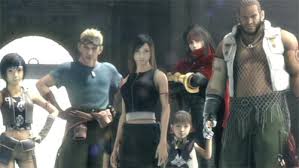
There may never be a remake, by the film sequel Advent Children did offer fans a glimpse of what their favorite characters might look like in a modern game.

There may never be a remake, by the film sequel Advent Children did offer fans a glimpse of what their favorite characters might look like in a modern game.

In short, the answer is “Yes.”  Square-Enix could approach a remake in two ways: build it form the ground up, or just attempt a better looking game from the original.  The ground-up approach wouldn’t necessarily mean a brand new engine.  Square-Enix could opt to use the same engine currently in use for Final Fantasy XV which is being developed for the Playstation 4 and Xbox One.  They’re also developing numerous other “next-gen” games they could utilize.  Going in the other, less-ambitious, direction, Square-Enix could opt for a remake more on par with the Final Fantasy IV ones, which aimed to improve the look of the original but not up to current home console standards.  That engine was crafted for the old portables and obviously would not be suitable for a FFVII remake now, but Square-Enix could use the FFXIII engine, or if aiming to be even less ambitious, a PS2 era engine.  Upgrading FFVII to resemble a game like FFXII would be a huge improvement over the original and something fans may even accept if released for a modest price.

Considering how big the game is and how beloved by its fan-base it’s become, Square-Enix probably feels like a Final Fantasy VII remake can’t be done on a conservative scale.  This is likely the biggest obstacle standing in its way.  That means if Square-Enix decided to green-light the project today, it would have to do so as a PS4/Xbox One game for retail release at the standard price of $60.  In addition to re-crafting the look of the game, Square-Enix would also be faced with the decision of whether or not to dub the game.  When FFVII was originally released, the characters didn’t speak and would not do so until FFX.  A sequel movie for FFVII was made a few years back, so Square-Enix has already given a voice to the main characters, but it’s still a large undertaking to dub an old game for multiple audiences.  Such an undertaking means Square-Enix is basically faced with the choice of remaking FFVII or making a new game such as a potential FFXVI.  Square-Enix’s strategy with the previous generation of consoles was to make a new game, FFXIII, and then reuse the resources to create multiple sequels.  Square-Enix never used to make direct sequels to its Final Fantasy games but I suspect it started to because of the rising cost of game development.  A sequel to FFXIII was a lot cheaper to make than a brand new game, primarily because development time was shortened with gameplay mechanics that could just be carried over as well as textures and character models.  I would propose this time around, Square-Enix opt to not make a direct sequel to FFXV and instead remake VII.  XV already started off as Final Fantasy Versus XIII, a would-be spin-off/sequel for the original FFXIII that never made it out of development Hell.  It’s likely not going to happen, but if FFVII is ever to be remade then this seems like the now or never point.

Even if a remake never happens, at least we'll always have the original to fall back on.

Even if a remake never happens, at least we’ll always have the original to fall back on.

At the end of the day, I find myself asking do we even need a remake for Final Fantasy VII?  It’s only being discussed as much and as often as it is because it was such a well-received game in the first place.  If it’s already a classic, does it need a new version?  After all, nobody is asking for remakes to Casablanca or The Wizard of Oz even though technology has advanced monumentally since those films came out.  I would argue it is different with video games as opposed to film.  Classic films are restored and re-released on new formats all the time, Final Fantasy VII hasn’t even received that much attention.  The game is somewhat crude looking by today’s standards, more so than even the game that preceded it.  The sprites of Final Fantasy VI have aged much better than the polygons of Final Fantasy VII, and a fresh take on the game could make the world even more expansive than before (just go ahead and look at the world map of FFVII, there isn’t much going on that makes it feel “alive”).  Fans want a remake because they honestly believe the game can be improved, which isn’t something you hear when discussing remakes for famous films.  It feels like it’s worth doing because it is, and there’s little question a remake will sell extremely well for Square-Enix, and that’s the biggest reason why fans are still holding out hope.


Ni no Kuni: Wrath of the White Witch

NiNoKuniI normally only write about old games, but sometimes a game comes along that evokes the spirit of the games of yesterday and I feel compelled to write about it.  It doesn’t hurt that said game is a collaborative effort between developer Level-5 and the great animation super power Studio Ghibli.  I am, of course, speaking of Ni no Kuni:  Wrath of the White Witch, a role-playing game for the Playstation 3 that came out nearly a year ago in the US.  Translated literally as Second Country, Ni no Kuni is a Japanese RPG that borrows heavily from the games of old such as Final Fantasy and Dragon Quest, with a touch of Pokémon for good measure.  The game tasks the player with guiding the main character Oliver into a parallel world on a quest to not only save that world from an evil wizard, but also save his mother.  There’s swords and sorcery, dungeons and dragons, and all of the familiar tropes of the genre.  It’s a fun trip down memory lane for those of us old enough to remember when seemingly every RPG followed the same path, but there is enough infusion of modern elements to give the game a fresh feeling.  Top it off with the unparalleled presentation afforded by Ghibli, and Ni no Kuni is easily one of the top games of 2013.

Ni no Kuni, at its core, is a story about a boy and his love for his mother.  Aww!

Ni no Kuni, at its core, is a story about a boy and his love for his mother. Aww!

The plot for Ni no Kuni is, like its gameplay, a mixture of traditional and non-traditional.  The main character, a kid named Oliver, is the typical unlikely hero destined to save the world from evil.  The non-traditional part is how the story begins with Oliver being rescued from an innocent mishap with a go-kart by his mother, who tragically loses her life in the process.  It’s a seemingly ordinary piece of tragedy and it plunges the main character into depression, something not many video games are willing to deal with.  Much of the story centers around depression, or similar emotions, and Oliver is beckoned to help heal their broken hearts while healing his own in the process.  Not long after Oliver becomes withdrawn, his stuffed animal Mr. Drippy soon comes to life as Drippy, High Lord of the Fairies, and he takes Oliver to a parallel world to not only save his mother, but save Drippy’s world from the evil dark djinn Shadar.  Oliver’s world, a 1950’s looking America, and Drippy’s share an unseen bond in that people in one world are linked to people in the other by their spirit.  Oliver’s mom in this other world was a powerful sage, and by defeating Shadar, Oliver hopes to uncover what happened to his mother’s spirit-sister and hopefully save his mom in the process.  The story unfolds over roughly 50 hours of gameplay with Oliver becoming a wizard himself and visiting every corner of this other world making friends and toppling enemies while uncovering the mysteries of the past.  It’s very rewarding, and I was quite happy with how the major parts of the story resolved itself, though a lot of the plot is resolved before the game’s final act which made the last parts of the game less impactful.  It’s a minor complaint, but the story could have been tied together a little better.

The environments are some of the most breath-taking every displayed in a video game.

The environments are some of the most breath-taking every displayed in a video game.

The thing that will stand out strongest to individuals playing Ni no Kuni for the first time are unquestionably the visuals.  This game looks just like a Studio Ghibli film brought to a video game console.  When I first heard about the game I was more than a little intrigued as I am a big fan of Ghibli’s films.  This game exceeded my lofty expectations and really pushes the artistic merit of gaming.  It also pushes the power of the PS3 and it shows.  Some textures are slow to populate and there’s definitely numerous instances of pop-in especially on the over world, but this is all easily forgiven considering just how superb the game looks.  The color palette is varied though slightly muted which actually adds a great deal of charm and gives the game an old feel.  Ghibli opted for near pastel shades over more striking primary colors in many places, but where they go bright it really shows.  The vegetation in several spots really pops and gives the environment a lush quality.  The water effects are some of the most natural I’ve ever seen, and the special effects are suitable and effective without being over-the-top.  The character designs are mostly kept simple, and in the case of the many creatures, perhaps too simple.  The main cast looks great though, and I really liked the look of the White Witch herself and her astral cloak that has a life all its own.  Further adding to the presentation is some excellent voice acting by a mostly British cast and a truly wonderful score from the master Joe Hisaishi.  Ni no Kuni is easily on my short list of favorite video game scores and it’s absolutely feature film quality.

Battles can feel chaotic at first, but eventually most gamers will find a rhythm.

Battles can feel chaotic at first, but eventually most gamers will find a rhythm.

All of the bells and whistles though would be for naught if the gameplay didn’t stack up, and thankfully it does.  Ni no Kuni, as I said earlier, is a mix of old and new concepts for the JRPG genre.  Oliver and his companions still have hit points and magic points and get stronger through participating in battles and gaining experience points.  As they level up they learn new skills and gain better base stats like strength, dexterity, and so on.  The battles take place in “dungeons” and on a world map where enemies are visible and some will attack and some will run away.  Where Ni no Kuni tries to incorporate some of the elements of modern JRPGs is with the battle system.  It’s not a turn-based battle, making it similar to Final Fantasy XII and Xenoblade.  The party is limited to three members during the game, with the player controlling only one at a time.  When controlling Oliver or one of his companions, the player is free to move around the battle field and position the character to attack up close or from far away and can switch at any time to one of the other characters.  Where Level-5 looks to separate Ni no Kuni from a game like Xenoblade is with the familiar system.  Taking a page out of Pokémon, Oliver is able to capture the monsters he encounters and use them as familiars.  These familiars basically do the fighting for Oliver, and each character can enter battle with up to three familiars.  These familiars share hit points and mana with their human overlords, but level-up independently and are able to evolve at certain points.  Each familiar can evolve twice, with the second evolution presenting a choice for the player to make which usually takes on the form of picking a water type vs a fire type evolution or something similar.  The familiars interject some variety to the mix and helps to keep the playing experience unique for each individual who picks up the game.  Level-5 also did a good job of making several viable familiars lessening the occurrence of over-powered creatures likely to dominate every gamer’s party.

Complementing the impressive game engine are some wonderful pieces of traditional animation from Studio Ghibli.

Complementing the impressive game engine are some wonderful pieces of traditional animation from Studio Ghibli.

The battle system has its own quirks that everyone has to get used to, and the choice to go with a live battle system means the A.I. is going to be controlling two of the party’s characters at all times.  Naturally, this is less than ideal and Ni no Kuni’s artificial intelligence is pretty limited.  Each character can be set to behave a certain way, but there’s still no way to tell the A.I. to forego using mana on weak enemies or to focus on fire spells because the enemy is vulnerable to it over some other elemental property.  Often times I found myself using the setting that commands my partners to not use any special abilities, or else they’d blow through all of their mana after just a handful of enemy encounters.  There’s also no way to select the tactics when out of battle, which is an oversight that should be corrected in a sequel.  Another annoyance for me were the more theatrical attacks.  Certain spells and such trigger special animations during battle and these are fine when initiated by the player, but when initiated by the A.I. it becomes annoying because it cancels any commands I had issued which can be deadly if it was a healing item or spell I had pulled up.  There’s also the whole taming of new familiars, which definitely could use some tweaking.  It’s one thing to make it hard to catch the elite creatures in the game, but just about every familiar is overly difficult to tame and that’s because it’s all predicated on chance.  Sometimes when beating an enemy, instead of dying, they’ll get little hearts over their heads prompting the player to initiate a series of commands that will make the creature a new familiar for the party.  The chance of most any creature going into this state is usually less than 10%.  There are quests in the game that require Oliver to tame certain creatures and these were my most hated tasks due to how random the whole system is.  Outside of battle, navigating the world is pretty seamless but there are unpolished aspects.  The game doesn’t let you get ahead of it at any time.  If you know you have to cast a certain spell on a certain individual or object you can’t just walk up and do it, you have to engage it first so that Drippy can tell Oliver he needs to cast Give Heart or some other spell.  The game has a tendency to think everyone playing it is pretty slow, or just stupid, and overly explains how to do certain things.  The thing I found most annoying though are these special treasure chests spread all over the world that can only be opened by having one of the characters shoot them.  That doesn’t bother me, but the fact that the party has to be standing on a specific spot to do it drove me nuts.  The chest could be perfectly visible from where I had Oliver positioned, but because it wasn’t the exact spot the game wanted to be at, I couldn’t interact with the chest.  Each one of these chests was a piece of trial and error as I slowly moved Oliver around until an exclamation point popped up over his head.

The game's many familiars and deploying them properly are often the difference between success and failure for Oliver.

The game’s many familiars and deploying them properly are often the difference between success and failure for Oliver.

The battle system is not perfect but it’s far from broken and it contains enough depth to remain interesting.  It does take getting used to though, which makes Ni no Kuni the rare game where the beginning is more difficult than the end.  Especially because early on the player will only have Oliver and one or two familiars at his or her disposal.  With such limited options, it basically means most battles will require proper defense to make it through.  During battle, a well-timed attack can stop an enemy dead in its tracks.  It also can cause a special gold “glim” to appear, which when obtained, triggers an ultimate attack or special move.  What the game doesn’t convey properly early on is that well-timed defense is actually a better strategy for getting these glims to appear, and for the first couple of boss fights, these gold glims are tide-turners.  Later on in the game Oliver and his familiars will have access to a wide range of spells and abilities capable of striking from a distance making these super moves less important, but early it can be a challenge to topple a boss character.  After that though, the game is basically as hard or as easy as the player wants to make it.  As is typical of the genre, the world map opens up gradually as the game progresses by giving the player new modes of transportation to utilize, starting with sea and then ultimately air travel.  Once the seas open up though, the player can find some tucked-away areas where certain enemies frequent that grant boatloads of experience points.  If at any point a player finds the game too hard, they can simply go off and level-grind their way through it.  Spend enough time leveling-up, and the game becomes a breeze.  Even without doing so, the game is far from difficult.  Once the main campaign is bested, some more difficult challenges await but a Ruby Weapon you will not find.

Oliver and his friends are sure to leave an impression on anyone who plays Ni no Kuni and sees the story through to its conclusion.

Oliver and his friends are sure to leave an impression on anyone who plays Ni no Kuni and sees the story through to its conclusion.

Ultimately, what separates Ni no Kuni from its peers is the story and presentation.  The tale of a heart-broken young boy just trying to save his mother against all odds is touching and sobering.  In a world of fantastic creatures and unbelievable happenings, it’s a grounded premise that anyone can relate to.  The general presentation for the rest of the game is truly unparalleled.  Other games possess greater raw processing power and more detailed texture maps, but as far as artistic presentation goes I’m not sure I’ve enjoyed or been more impressed by any other game’s visuals than Ni no Kuni’s.  It’s beautiful, and I often found myself getting lost in the scenery more than once.  The battle system took time to grow on me, and there’s no doubt I would have preferred a more traditional turn-based approach, but it does possess its own charms and once I felt comfortable with it the game opened up for me.  The game is designed to entertain gamers of all ages, meaning it does have to cater to younger gamers at times.  It probably holds your hand too tight, with the same explanation for what the Veil spell does popping up every time it’s cast, but such annoyances are minor quibbles of an otherwise excellent game.  The game is a true JRPG, a genre that may finally be making a comeback, which means it has all of the charms and all of the annoyances inherent in the genre.  There are tons of fetch-quests to go on, the story unfolds in a strictly linear fashion, and there’s probably way more text in this game than anyone cares to read, but it’s also a grand tale that unfolds in a satisfying manner with lots to see and explore.  If this is a genre you’ve always loved, then Ni no Kuni is a game that should not be missed.  And if you’re new to it, Ni no Kuni is a great place to start.


Fighting the Post-Xmas Blues with the PS4

images-180Every year it’s the same.  The Christmas decorations and merchandise show up in stores in early October, in homes right around Thanksgiving, and everything is pretty festive come December.  Then like a rush, it comes and goes and we all settle in for a cold winter (unless you live in a warm climate, in which case I hate you right now) and wait to do it all over again come the fall.  I love Christmas, and I’ve talked about that at length in other posts, and whenever it’s over I get the post-Christmas blues.  A friend and I used to refer to December 26th as the most depressing day of the year, because it’s the furthest away from Christmas one can be.  My adoration for the holiday is not rooted in the fact that I have to wait another year for gifts.  Certainly, that was a big part of it as a child, but as an adult I’ve just come to appreciate the season even more and that special connection I have with it via my childhood.  Now I appreciate the lead-in to Christmas more than the actual holiday.  I like seeing the specials on television, I enjoy having decorations all over my home (I don’t decorate for any other holiday, though my Danzig/Misfits theme could be considered a Halloween one, if it wasn’t year round), and I even kind of like the stupid songs on the radio and in every store.

Whenever Christmas leaves, though, I get the blues.  Each year it seems to be slightly worse.  This year it took me a good week to shake it though sitting here and thinking about it brings the ache back.  The only way to combat the post-Christmas blues is the same today as it was when I was a kid:  with new stuff!  Namely, the stuff I received for Christmas.  As a kid, this worked pretty damn well and while I was bummed Christmas was over I at least had a ton of new action figures, games, and movies plus no school until after New Year’s.  As an adult, the material things are less important and less fun (I typically use Christmas as an opportunity to refresh my wardrobe), but this year I did receive a most excellent present:  Playstation 4.

I was actually quite proud of myself for not buying the PS4 when it launched.  Part of that was I did kind of expect to receive it as a gift from my bride-to-be, but part of it also was me trying to be more financially responsible.  I had a Disney World vacation in September to budget for, plus a wedding in the new year (and the bill for the engagement ring), and an expensive summer to recover from that included a new water heater and central AC condenser.  2013 was an expensive year and I actually did a good job of not buying a bunch of video games and records and such.  It still wasn’t easy to resist the call of new hardware though, but I am glad to say the wait was worth it.
A new controller for a new generation.

A new controller for a new generation.

Getting a new console like the PS4 is less fun than others.  Not because it’s inferior or anything, but because it’s so ordinary.  With consoles like the Wii and the Wii U, there’s excitement over the new input device but with the PS4 it’s just a more powerful PS3.  It’s a modern console and works in a modern function.  I did not get the camera, so I can’t talk about how that works, but everything else is pretty much as expected.  There’s a new interface that modifies the cross-media bar of the PS3, but not drastically so.  It’s nicer to look at and there’s more emphasis placed on the Playstation Network features though not at the expense of the actual game loaded into the system.  That, and any downloaded titles and demos, are front and center so jumping right into a game is seamless and easy.  The new setup is different enough from the old one that first-time users will have to actually pay attention to what they’re doing, but it soon becomes second nature.

Really, the PS4’s most distinguishing features are it’s physical look and dimensions.  The new console is pretty sleek looking and reminds me of the technology from the Mass Effect series.  It’s black with about 2/3 of the console having a matte finish, and the remaining third a glossy one.  There’s a single stripe that runs through it that glows when the console is on or in standby mode.  There’s a couple of USB ports on the front for controller charging, and the only two buttons are almost impossible to see.  They’re actually just touch panels, one for power and one for disc ejection, and are placed amongst the stripe running through the console.  I couldn’t even find the power button with my eyes the first time I hooked up the console and brushed it accidentally.  The console is also quite small and tidy.  It’s smaller than basically all of the prior Playstation consoles, save for the PSOne and the PS2 Slim.  It’s practically tiny when placed beside my model one PS3 and much smaller than its direct competitor, the Xbox One (it dwarfs the Wii U though).  The size is perfect for me as it just barely fits into my entertainment stand beside the Wii U with both laying horizontally.  Like the PS2 and 3, the PS4 can be displayed vertically.  Sony recommends users buy their stand if opting to do so, though the console seems pretty stable to me without it.  The console runs quiet and runs cool as well.  I have played it in marathon sessions for five to six hours at a time and it’s only ever warm to the touch, not hot, so it appears to be well ventilated.

The biggest change for the PS4 resides in the controller.  The dual shock controller was first introduced by Sony during the PSX era and has received only minimal modifications since.  The new dual shock 4 represents the biggest change for the venerable controller, though it still retains its traditional shape.  The handles have been elongated and the body of the controller is a touch thicker.  The face buttons, including the directional ones, are ever so slightly closer together.  The directional buttons feel better, which is great considering the Playstation console has always had the best d-pad, and the analog sticks are now closer to the rest of the controller.  The new ridges added to each stick does help keep one’s thumb in place (and makes them basically the same stick as what’s on the Wii), and both still retain button functionality.  The handles of the controller have a satisfying grip texture to them, and the R2 and L2 buttons are better shaped for human fingers.  The start and select buttons are gone, replaced with an options button and a big touch panel that also acts as a button.  It remains to be seen if the touch functionality of this over-sized button will have any worthwhile applications, but it’s there for developers to utilize.  The Playstation button has been moved in between the sticks to accommodate this touch pad, and a Share button (for social media integration, if that’s your thing) and speaker have been added.  The console also comes with a headset that can be plugged into the underside of the controller.  I haven’t used it, but it’s a nice feature to have.

The high seas have never looked better.

The high seas have never looked better.

The dual shock 4 truly feels like a home run for Sony.  It’s an improvement in pretty much every way from the dual shock 3 and its updates are both practical and tasteful (well, maybe not the touch pad but we’ll see).  The only negative I have found with it is the battery life.  Like the dual shock 3, the dual shock 4 contains a non-removable rechargeable battery.  Unlike the PS3, the PS4 can charge controllers when it’s in standby mode. Unlike the dual shock 3, the dual shock 4 cannot be charged by plugging it into a non PS4 device such as a PC or cable box.  With the dual shock 3, I could often go days in between charges but with the 4 I find I’m plugging it into the console whenever my gaming is finished for the day.  I haven’t ridden it down to nothing yet, but I would estimate the battery only lasts 6-7 hours on a full charge.  That’s suitable for one gaming session, though there are some who may not agree, but if I were to forget to plug it into the PS4 when I’m done for the day I’d be regretting it the next time I went to play.  Part of this issue will be rectified by getting a second controller (I’m holding out for the colored ones), but it is disappointing to see the battery life so poor.  Some users have also complained that the rubber of the analog sticks wares out quickly.  I just inspected mine which has logged probably around 30 hours at this point, and the heavily used left stick looks no different from the little used right one.  Maybe some people are just getting duds or are really hard on analog sticks.

Thief is looking like it will be my second PS4 game, hopefully it doesn't disappoint.

Thief is looking like it will be my second PS4 game, hopefully it doesn’t disappoint.

The only other fault I currently find with the Playstation 4 right now is a problem all too common, it seems, with new consoles:  the games.  Now, I should state that I am not a first-person shooter fan.  If I was, I’d probably be having a good time with the new Kill Zone game.  Since I’m not, I have Assassin’s Creed 4.  The Assassin’s Creed series is a popular and well known one published by Ubisoft.  I have previously played Assassin’s Creed 2 and enjoyed it, but when it was over I was not itching to play another.  AC4, which I am around 25 hours into, is a better game.  It’s a good game, it’s just not a “wow” game.  It was developed for and is available on the Xbox 360 and PS3, so it’s visuals on the PS4 are not a true representation for what the console can output.  It’s a great looking game, just not a great leap over what I’m used to.  And like AC2, there are little things about AC4 that bug me.  There are too many missions where I’m asked to just follow somebody and eavesdrop on their conversation.  AC has always been an action game masquerading as a sneaking one.  The sneaking mechanics just aren’t anything special, especially considering that I just finished up Dishonored a few weeks ago, and the enemy AI is downright shoddy when it comes to sneaking around.  The fighting is fun, though it can get annoying during big conflicts such as ship-boarding when Edward (the main character) starts attacking the wrong guy.  Or when he goes into one of his long kill sequences only to get struck from behind by another enemy.  Controlling him out and about the various locales is equal parts fun and frustrating.  He can scale almost anything, and often will start climbing something you don’t want him to.  Sometimes the game calls for quick decisions and Edward makes the wrong one by jumping to an unintended spot or assassinating the wrong enemy.

Assassin’s Creed 4 may be flawed, but it’s also really fun.  It can aggravate me greatly at times, but I’m also hopelessly addicted to it so clearly it’s doing something right.  It’s a meaty game too, which is great because nothing else currently available for the console interests me in the least.  The next game I have my eye on is Thief, which drops next month so I should be all set.  Especially considering I still have last generation games to play including The Last of US, Ni No Kuni, and Skyward Sword (which I received for Christmas in 2011, and have yet to play, which is embarrassing).  I’ll be plenty busy the next few months with or without PS4.  I look forward to more games though, and the PS4 has made an excellent first impression on me.  Hopefully the various developers comes through and the PS4 ends up with a library of games that rivals its predecessors.


Ranking the Mario Games – Part 3

Part 1

Part 2

This edition of ranking the Mario games is going to be slightly different than the two previous ones.  In trying to summarize each game in my previous posts I tried to keep it to one paragraph, which lead to some really long paragraphs.  One paragraph is fine for the lesser Mario outings, but now as I enter the top 5 one paragraph seems like too few, so this post will capture the titles I ranked from position five to three, with one more post to follow for the top two.  This way I can elaborate more on each individual title and attempt to give each game the time it deserves.  These games are some of the best of the best, and while I feel very strongly about their position in the top five, it’s debatable how each should be ranked amongst each other, but that’s what makes these things so fun.

5. Super Mario Galaxy 2 (2010, Nintendo Wii)

Yoshi is the major selling point of Super Mario Galaxy 2.

Yoshi is the major selling point of Super Mario Galaxy 2.

Super Mario Galaxy 2 might be the favorite Mario game for some people, or a lot of people, and with good reason.  It falls to position five on my list not for quality but more for redundancy.  Super Mario Galaxy felt like a revelation while Galaxy 2 felt like a continuation of that game.  In a way, it’s Super Mario Galaxy’s Lost Levels.  That’s not to say it was entirely the same, as there are some obvious additions to the formula, just not necessarily worthwhile.

The premise of the Galaxy series of games takes Mario into space aboard a ship that serves as a hub world.  From there, Mario enters various levels that play out over a map similar to Super Mario Bros. 3, or more recently, New Super Mario Bros.  The levels themselves range in size, and the setup is similar to Super Mario 64 in that the game asks the player to re-play each level to collect stars by beating it in a specific manner.  Sometimes replaying the levels opens up larger parts while other times it just tasks Mario with a new objective in the same setting.

As with any new Mario game, new power-ups have been added to differentiate from prior games.  For Super Mario Galaxy 2, we have Cloud Mario, Rock Mario, and the Spin Drill.  Cloud Mario allows Mario to create cloud platforms to utilize to reach higher areas or cover wider gaps.  Rock Mario is basically a wrecking ball that powers through areas and certain pieces of the environment.  The Spin Drill isn’t a suit, but an object Mario can grab and use to drill through an entire level, emerging on the other side.  All three are kind of neat, but none are exceptional when compared with some of Mario’s other abilities.  The ice flower from the first game does not return, nor does the flying star, but Bee Mario is still around as are the other power-ups from Super Mario Galaxy.

Even though the more powerful Wii U console boasts a Mario title of its own, Galaxy 2 remains the best looking Mario game to date.

Even though the more powerful Wii U console boasts a Mario title of its own, Galaxy 2 remains the best looking Mario game to date.

The other major addition, and the one promoted right on the box, is the return of Yoshi.  Yoshi is more advanced than ever in Super Mario Galaxy 2 as he’s more than just a second power-up.  His tongue, controlled using the Wii remote’s pointer, can not only consume enemies from afar, but also trigger switches or be used to swing across gaps.  He can still flutter jump and give Mario a boast to his jumps, but he also has power-ups of his own that bestow special abilities for a limited time.  There are three fruits that do this:  a dash fruit, bulb fruit, and blimp fruit.  The dash one (actually dash pepper, making it a vegetable, I suppose) lets Yoshi dash at a high speed.  While dashing he can run up certain walls and across water.  The bulb fruit makes Yoshi glow and shows up primarily in Ghost Houses to illuminate pathways.  The blimp fruit is like the P Balloon from Super Mario World, only with the helium effects taking place on Yoshi this time allowing him to float through the air while Mario hangs on for dear life.  Of the three, the bulb fruit is the most conventional in that it doesn’t affect how Yoshi handles.  The dash pepper makes Yoshi dash almost uncontrollably and it can be a challenge to negotiate the various obstacles in the way.  That’s likely the whole point of the thing, but I never found it enjoyable.  I also loathed the P Balloon in Super Mario World, mostly thanks to the infamous Tubular special world, so blimp Yoshi does little for me.  Controlling Yoshi without the power-ups is infinitely more enjoyable, but few Yoshi levels don’t include a power-up of some sort.  And as you can probably guess, Yoshi is only usable in certain levels.
Super Mario Galaxy 2 does score points over its predecessor by being the more challenging of the two.  Getting to the final battle with Bowser is a moderate challenge, but the extra levels and special stars can be exceptionally difficult.  It tends to be challenging without being overly frustrating, though the hardest level in the game may drive you to break a controller or two.  Super Mario Galaxy 2, disappointing power-ups aside, is a marvel of game design that basically gave gamers more of what they wanted.  I personally found the original title more enjoyable as it was more new and I found some of the challenges less annoying (though both games contain balance ball levels, the shoe-horned Wii remote feature that most could do without.  And Spring Mario).  Every fan of the 3D Mario games should have this one in their library though, as should anyone who thinks modern Mario titles are too easy.

4. Super Mario 64 (1996, Nintendo 64)

Running through the early stages of Super Mario 64 was a kind of joy I can't begin to describe.

Running through the early stages of Super Mario 64 was a kind of joy I can’t begin to describe.

If you’re someone who grew up with a Gamecube or Playstation 2 as your first console, then you cannot possibly understand what it was like to play Super Mario 64 for the first time in 1996.  It only took a moment for Super Mario 64 to blow you away and convince you that you were playing something special.  It arrived at a really interesting time with Nintendo taking a backseat to Sega and Sony in getting its new hardware to market.  Sega’s Saturn never set the world on fire due to its hefty price tag and lacking software, but Sony’s Playstation was winning gamers over worldwide with new franchises and old, proving once and for all that a CD-ROM based console could work and work well.  Sony had even won Nintendo staples like Final Fantasy, and up till now it seemed like Nintendo was just going to stand and take it.  Then the public got a glimpse of the Nintendo 64.  Sure it was kind of plain looking and still boasted a cartridge medium, but with promises of 3D Mario and Zelda people were convinced it would succeed and the pre-orders came pouring in.

At this point in my life I felt I had “outgrown” Nintendo and the prospects of playing a new Mario game didn’t excite me in the least bit.  My first experience with the console should have been totally unremarkable as it occurred at a Toys “R” Us prior to the system’s launch at a demo kiosk.  It couldn’t have lasted more than ten minutes, and was maybe closer to five, but I remember it so well because of how incredible it felt to control Mario in 3D for the first time.  There was nothing like that currently available anywhere, and seeing Mario run around such an immersive world was shear joy.  The game was inherently fun, and I felt like I could have just run around in that first stage for hours.  I remember after playing it I went to the Saturn kiosk and tried the upcoming NiGHTS and frowned at the pixilated visuals.  Sony was demoing its Mario adversary, Crash Bandicoot, who’s commercials ended up being more fun than his games.  I probably tried to convince myself that Crash was superior, and that Mario was too kiddie, but deep down I knew I had just experienced the future.  The game was such an experience that I feel kind of stupid for not ranking it number one, though I know as I write about the games to follow I’ll feel better about my decision.

Bowser was very big, though not exactly frightening.

Bowser was very big, though not exactly frightening.

Years removed and numerous star challenges completed, I can still say that Super Mario 64 is an exceptional game, even if it’s imperfect.  Super Mario 64 was the first true attempt at a 3D platformer and it’s still the core of what all the games in the genre still follow, especially future Mario titles.  For the first time, Mario could jump, double jump, and triple jump his way to Bowser and free the princess.  Familiar foes returned like the goomba and koopa troopa, while new power-ups and locations were unveiled.  Super Mario 64 felt unique not just because of the new interface, but by creating its own world.  Traditional power-ups like the super mushroom and fire flower were absent from the game with Mario now having a life meter for the first time.  Mario could no longer breathe underwater or ride Yoshi or even partner with his brother Luigi.  There was more emphasis on exploration and uncovering hidden challenges and levels. Beating a stage once awarded Mario with a star and opened up additional challenges in the level.  To proceed further in the game Mario needed to collect a set amount of stars to face Bowser for a final time.  And for the first time, Bowser truly towered over Mario.  Looking more like a turtle than ever, it was intimidating encountering Bowser and also fairly challenging as the player needed to position Mario behind him in order to grab his tail.

The game was so flashy and new that many seemed to ignore the few areas it fell short, while time has made them more apparent.  As was the case with seemingly every 3D title from this era, the camera can be problematic and there will be times where the player is forced into making a leap of faith hoping there’s a platform out of sight.  And while controlling Mario in wide open spaces is a breeze, negotiating platforms and narrow ledges is less so, and there’s a reason why Mario hasn’t been able to punch and kick enemies following this game.  And other than the wing cap, the power-ups were decidedly un-fun, and no Luigi seems like borderline blasphemy.  In short, the Mario titles to follow were clear improvements on the interface enough to overcome nostalgia.  Or rather, I should say one title in the 3D Mario universe is clearly superior, though if someone held a gun to my head I might opt for Galaxy 2 over Super Mario 64, but that’s all right.  Here, nostalgia counts for something which puts Super Mario 64 at a strong number four on my list.

3. Super Mario Bros. 3 (1990, Nintendo Entertainment System)

The map layout common to many Mario games originated with Super Mario Bros. 3.

The map layout common to many Mario games originated with Super Mario Bros. 3.

It took me a long time to admit to myself that Super Mario Bros. 3 was no longer my preferred Mario game (and no, it’s not number 3 on my list because that number appears in it’s title), which is a testament to just how great it is.  I still consider it amongst the most highly anticipated video games of my lifetime.  Following the rather odd Super Mario Bros. 2, I think most people were excited about returning to what felt like the more traditional style of Mario games.  And knowing Mario was going to be able to fly was the kicker.  The game came out in 1988 for the Famicom in Japan, so US gamers had to endure nearly two years of screenshots in Nintendo Power (and a cameo in The Wizard) before getting to play the game, but it was worth the wait.

Super Mario Bros. 3 was the true sequel to Super Mario Bros. and the clearly superior one at that.  It was everything the original game was times 100.  It looked better, Mario and Luigi felt better (they could now slide down slopes and carry koppa shells), and the worlds of the game were so much more immersive and fun when compared to the original.  It felt huge having eight worlds with each map seemingly larger than the one before it.  It starts innocently enough with World 1 and its clear path to the castle.  Then World 2 stretches to a second screen, while World 3 has Mario sail across the map.  World 5 is basically two maps with one hidden from view at the start.  The game was always throwing new things at the player, especially when it came to the power-ups.

Super Mario Bros. 3 is remembered for a lot of reasons, but mostly it's for the power-ups.

Super Mario Bros. 3 is remembered for a lot of reasons, but mostly it’s for the power-ups.

Super Mario Bros. 3 can be credited as the game that really took the various power-ups to a new level.  It’s still the game I use as a measuring stick when evaluating all of the new and old abilities Mario acquires in his latest games.  The super leaf was the major and much hyped new ability which gave Mario a raccoon tail and ears and let him fly.  We excused the ridiculousness of the whole thing because, after all, MARIO COULD FUCKING FLY!  It blew my little mind that Mario could soar through the air like Superman.  It might seem like such a small thing younger gamers today, but it really was unheard of at the time.  The first time I laid eyes on Super Mario Bros. 3 it was all I wanted to see, just show me Mario flying so my head could finally wrap itself around the idea.  It didn’t just end there, of course.  World 3 introduced the frog suit which made swimming fun for the first time.  The water levels are kind of that thing we all overlook (except when it comes to the first Teenage Mutant Ninja Turtles game), but we all kind of secretly hate them.  The frog suit was a needed addition, even if trying to hang onto one through the land-based levels was a chore as Mario could only run in the suit if he was carrying a koopa shell.  The tanooki suit in World 5 was a cuter take on the super leaf, but it did allow Mario to turn into a statue and avoid damage, a deceptively useful tool.  World 5 was also the world that held the one stage (5-3) everyone remembers for the Kuribo’s Boot, a green boot Mario could steal from the goomba’s in the level and pound his way to victory.  The hammer bros. suit was the most sought after though.  Found in World 7, it was a more powerful take on the fire flower and most players would hang onto it until the final showdown with Bowser.

Now Bowser really has to contend with a "Super" Mario.

Now Bowser really has to contend with a “Super” Mario.

Super Mario Bros. 3 also introduced a lot of enemies that became staples of future titles.  The koopa kids made their first appearance as did the boo ghost and variations of the hammer bros. like the boomerang bros. and fire bros.  The airships were introduced for the first time and various mini games dotted the maps along with Toad Houses where power-ups could be found.  Mario and Luigi could also store power-ups for later use that could be activated from the world map.  Fortresses appeared and toppling them were necessary to reach the final fortress in each level.  The magic whistles replaced the secret warp zones and acquiring all three was the quickest way to reach the final stage.  With no game save feature, they were almost necessary for beating the game as the game was almost too big for on session forcing many gamers to leave their NES on all day to save their spot.

For the most part, Super Mario Bros. 3 is just a really fun game that keeps throwing new things at the player the further into the game they go.  It’s scope felt epic back in 1990, and it truly is the ultimate 8-bit Mario title.  Really, the only thing the top two games on my list succeed over it is with level design, but even they owe a lot to Super Mario Bros. 3 which really paved the way for all of the Mario games to follow.  It’s, simply put, among the greatest games ever made.