Tag Archives: anime

Space Dandy – Live With the Flow, Baby

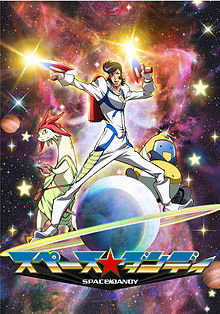
Space_Dandy_promotional_imageA new anime series premiered last night on Cartoon Network’s Toonami block:  Space Dandy.  Space Dandy is the latest series from Shinichiro Watanabe (which is how it got my attention, it also didn’t hurt that Toonami used a Misfits song in the TV spots leading up the premier), best known for  being the director of Cowboy Bebop and Samurai Champloo.  I never got into Samurai Champloo (never really tried to, either), but I love Cowboy Bebop and consider it the finest anime series I’ve ever experienced.  Granted, my experiences with anime have decreased in volume over the years.  As a kid and teen I took in quite a bit.  I’m familiar with pretty much all of the big ones from the 80’s and 90’s such as Akira, Neon Genesis Evangelion, Dragonball, Fist of the North Star, and so on.  Like any medium, there are good and bad representatives.  There are also common threads amongst the various programs.  Most anime certainly shares similarities in look and appearance.  There are also certain tricks that have become cliché since, like the screaming hero jumping through the air, still frames with nothing but a mouth moving, mouths going from being really small to really large, etc.  Even so, it’s not fair to generalize and say that anime is either good or bad, or that someone is an anime fan or non fan.  Anyone with an open mind can find anime they like and don’t like, just as they can with live-action movies and television shows.

All of that was a long-winded way of saying that the success Watanabe has had in the past has little baring on Space Dandy.  Cowboy Bebop is among the greats, and holding Space Dandy up to that standard seems unfair, and yet they invite comparisons due to the Watanabe connection.  They also share other similarities.  For one, Space Dandy takes place in space (big shocker there) and the main character, Dandy, is an alien hunter.  That is quite similar to the space bounty hunter profession of the Bebop crew.  And like the Bebop crew, Dandy doesn’t appear to be very good at his job.  He’s alone on his space ship when the episode begins accompanied only by his robot assistant QT.  We soon learn QT is out-dated and becoming obsolete and the spaceship is in need of some repair as well.  Dandy’s occupation as a space hunter is to apprehend unclassified aliens, and then turn them in for profit.  I presume they need to be alive, but I’m not positive.
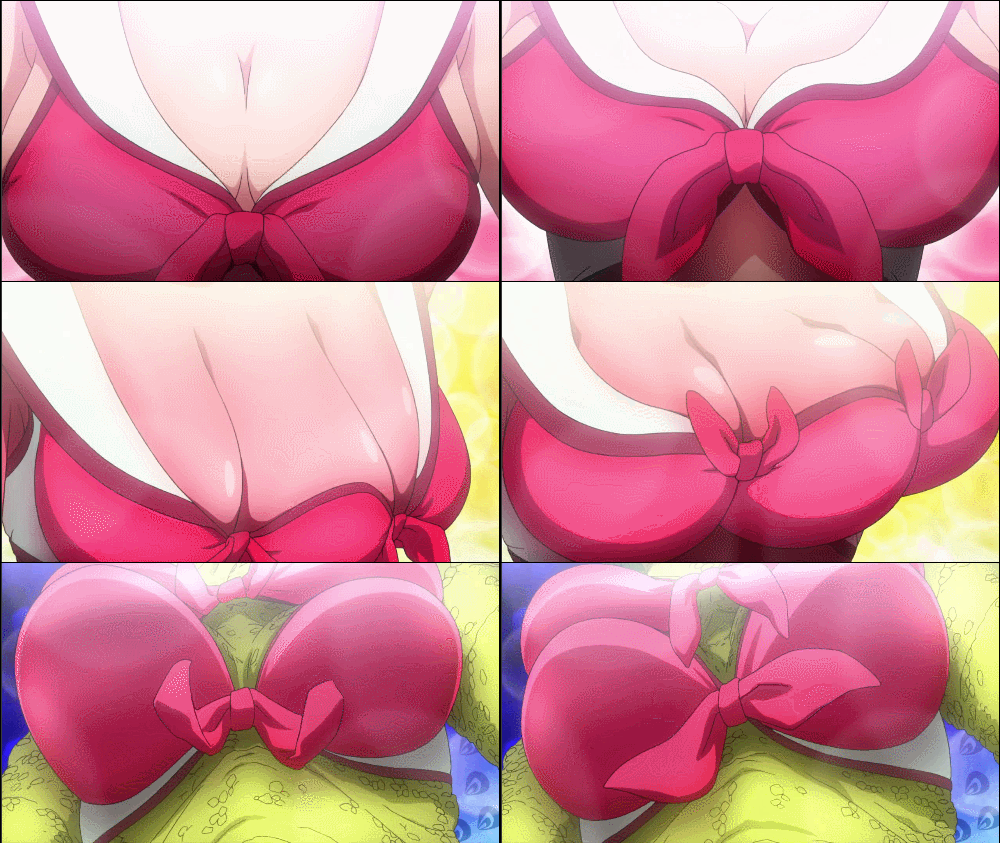
Expect to see lots of T&A with this program.

Expect to see lots of T&A with this program.

That’s the basic premise.  Where Space Dandy seeks to differentiate itself from prior Watanabe programs is with its look and humor.  Space Dandy is riddled with sophomoric humor.  The first episode opens with Dandy debating the merits of ass-men and boob-men before going to his favorite hang-out, the Hooters parody simply known as BooBies.  The show is accompanied by a narrator, who informs us that Dandy hopes to one day own his very own BooBies.  This narrator is really a third character, and the other characters in the show break the fourth wall more than once to acknowledge him.  The narrator is forgetful and provides updates throughout the show and fills in some of the back story, which in the first episode, almost seems irrelevant.

Dandy himself is rather dim-witted and perverted.  He’s a slow thinker, though he’s not obviously dumb like a Homer Simpson or Peter Griffen.  He’s also really self-absorbed and appears to have an obsession with his own hair.  He’s also a pretty lousy shot and poor judge of situations.  He’s not mean-spirited though, which makes him likable.  QT is similarly incompetent at its job, some of that due to the fact that its obsolete.  QT, despite being a robot, also doesn’t seem to mind being lazy.  Other characters introduced in the first episode include an alien from Betelgeuse with an unpronounceable name (he looks like some kind of space cat, so Dandy dubs him Meow against his will) and a mysterious ape-like scientist named Dr. Gel.  Dr. Gel is an ominous figure in the debut episode who is pursuing Dandy as he is the key to a war raging on.  Gel answers to a strange monarch-like figure with a flaming skull for a head and pilots a spaceship that contains the head of the Statue of Liberty with a ball-gag in its mouth.  Clearly it’s a reference to Planet of the Apes though I do wonder if it will have any relevance beyond that or if it’s just a visual gag (no pun intended).

The main goal of the show appears to be to induce laughter.  The tone is very silly and the neon colors and up-beat electronic music add to the feeling.  The plot of the first episode mostly exists to introduce the characters and then show us just how bad Dandy is in action.  It ends on an apocalyptic note, and I wonder how the second episode will open.  It’s possible there will be an absence of continuity from one episode to another though I personally doubt that.  It’s impossible to judge a series based on one episode, but Space Dandy did not make an overly strong impression on me.  It seems fun enough, but I do wonder if it will have much staying power.  It may prove too silly for my taste, but I am comforted by the fact that it took a few episodes for Cowboy Bebop to hook me so it’s possible Space Dandy will require the same.  To make myself stick with it, I’ve programmed my DVR to record it each week.  Maybe I’ll have reason to revisit this topic in a few months.

Dragon Ball: Season 3

Dragon Ball:  Season 3 (2010)

Dragon Ball: Season 3 (2010)

Apparently I’ve settled into a once a year pattern with Dragon Ball.  I have all five seasons, and I’ve viewed them all, but it’s taking me a long while to write about them.  That’s ok, as sometimes this blog becomes too video game centered and it’s nice to have something like Dragon Ball to fall back on when I want to post about something other than gaming.

Because these seasons are not actual seasons, season 3 of Dragon Ball picks up right where season 2 left off with Goku trying to defeat the evil Mercenary Tao.  In order to do so, he has scaled Korin Tower to enlist the help of Master Korin who’s training is said to make the most formidable warriors even stronger.  With Korin’s help, Goku is confident he can topple Tao and avenge the death of his friend, Bora.  Korin, the dimunitive cat-like creature, seems unwilling to offer much assistance to our young hero and the ensuing “training” Goku goes through contains a heaping dose of comedy for the viewers, which works well following the rather heavy close to season 2.

The over-reaching conflict of the first part of season 3 is still General Red and the Red Ribbon Army.  It is they who hired Tao to take out Goku and eliminate their greatest obstacle in recovering the seven dragon balls.  Goku will have a satisfying encounter with Tao following his training with Korin and then go on to assault the home base of the Red Ribbon Army to put a stop to them once and for all.  It’s here Dragon Ball settles into its pattern of Goku easily dispatching most foes before tasting defeat, training with a powerful warrior, and then returning to topple the previously unstoppable.  There’s a lot of good action pieces, and the whole Dragon Ball gang gets involved which is nice after the Goku heavy season 2.

Sometimes Master Roshi's perversions can be useful.

Sometimes Master Roshi’s perversions can be useful.

Following the end of the Red Ribbon Army conflict, the heroes seek out the help of Fortune Teller Baba in order to find the final dragon ball so that Goku can restore Bora to life.  It turns out that Baba’s services come with a steep price that can either be paid with money or blood, and since Goku has no money, he opts for the latter.  Baba pits Goku and his pals against her warriors, and if he wins, she’ll help him.  Most of the matches here exist for comedic relief as the first combatant for Baba is a vampire and another, invisible opponent, is defeated when Master Roshi’s nose explodes with blood to cover him at the sight at Bulma’s breasts.  There is one serious fight between Goku and a masked man who turns out to be someone very important to Goku and is a mostly entertaining affair.

Following the Baba portion are a bunch of filler episodes of Goku traveling the world and helping people along the way.  These are the most boring sections of Dragon Ball for me as it’s just Goku and he’s usually not given anyone to play off of.  He tends to encounter these overly nice and kind characters and he tends to work better when paired with the impatient types like Bulma and Krillin or the perverse like Roshi.  Along his travels he does encounter Tien Shinhan and Chiaotzu for the first time who will play a bigger role going forward.  They’re depicted as talented and powerful fighters who lack character, which makes them natural foils for Goku.

Chiaotzu, Crane, and Tien Shinhan are the main foes for Goku and his friends during the final act of season 3.

Chiaotzu, Crane, and Tien Shinhan are the main foes for Goku and his friends during the final act of season 3.

The final act of season 3 covers the World Martial Arts Tournament once again, with the natural goal of pitting Goku against his newest rival Tien.  There are several lesser characters inserted into the tournament for comedic relief, but the main players are mostly the same from last the time:  Goku, Krillin, Yamcha, and Jackie Chun, with new-comers Tien and Chiaotzu.  Master Crane is the one who trained Tien and Chiaotzu and it’s revealed early on during the tournament that he is the older brother of Mercenary Tao.  It’s the clear the two did not have much love for each other, but pride dictates that Shen must avenge the death of his brother at the hands of Goku.  This just adds another layer of conflict to the main tease of the tournament.  Unfortunately, because of FUNimation’s arbitrary end points for its seasons, the bulk of the tournament falls to season 4 giving season 3 a mostly unsatisfying conclusion.

Season 3 of Dragon Ball, as defined by FUNimation, might be my least favorite of the five, though season five is also a bit slow.  It’s very top heavy with the early part being fairly entertaining but the last 15 or so episodes are a bit of a slog.  For whatever reason, Dragon Ball (and it’s successors) are bogged down by a lot of filler episodes and a great many of them found their way into season 3.  The seasons preceding it were not absent of them, and the ones to follow aren’t as well, but they just felt less entertaining here.  Hurting it too is the fact that the main enemy, the Red Ribbon Army, is never really billed as a credible threat to Goku outside of Tao.  At no point during Goku’s assault on the RRR HQ am I lead to believe that he might actually fail.  This tends to be one of the problems of the show as Goku’s enemies are either woefully under-powered or obviously over-powered.  The exceptions usually end up being the final matches in the martial arts tournaments, but unfortunately, that falls to season 4.  That said, there are some nice moments on season 3 and there’s also a good dose of comedy.  Some fans could probably skip it entirely if they’re mostly interested in the biggest fights the series has, but if you want the full Dragon Ball experience there’s still some must-see episodes contained here.


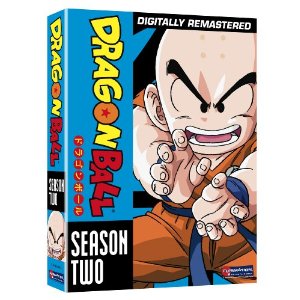
Dragon Ball – Season Two

Dragon Ball – Season Two

Last Summer I acquired the entire series of Dragon Ball on DVD when amazon.com was having a big sale on anime.  I had seen some of the series, but not all of it, and what I had seen was edited for television.  I had always wanted to revisit the series as the little of it I saw was charming, but just never got around to it.  That sale presented the perfect opportunity and by summer’s end I had seen every episode.  In December of last year, I made my first entry on the subject and promised to review the entire series on a season by season basis.  My initial idea was to post one review a month, but as is plainly obvious considering it is now past Memorial Day, that didn’t happen.  Better late than never!

Season one ended with Goku striking out on his own to find his grandpa’s four-star dragon ball.  By taking Goku and sending him off on another adventure, it brings the series back to how it started, only this time Goku is flying solo.  Let’s get it out of the way up front:  season one of Dragon Ball is the best season.  Everything is new and fresh from Goku’s indomitable will to Master Roshi’s inappropriate advances towards the show’s female characters.  That’s not to say the rest of the series is lackluster, not at all, but some of the shine does ware off.  Akira Toriyama must subscribe to the theory that you should stick with what got you there.  He’ll re-use a lot of the same gags and gimmicks, and while Roshi’s perverted nature is usually pretty funny, the more dramatic elements become tiresome (such as when a villain disappears in a cloud of smoke and the heroes foolishly think it’s dead, oh yeah, that one will be used a lot).

While Toriyama is comfortable sticking with what he knows, changing the show’s focus to just Goku is a pretty bold move.  He has essentially removed the entire supporting cast from season one (I should point out, the “seasons” are pretty much arbitrarily broken out by Funimation for the localization process and DVD releases and aren’t true seasons in the literal sense) and is relying on Goku to carry the show.  That doesn’t mean Goku is going to go it alone entirely.  Along his travels he’ll meet several new friends and many new foes.  Some exist to better serve the plot, and some for comic relief, but there are some pretty good characters introduced in season two that will make a lasting impression on the series and our hero.

General Blue; he’s basically a massive douche.

The major conflict of season two revolves around Goku V.S. the Red Ribbon Army.  The Red Ribbon Army (RRA) was introduced at the tail end of season one and is an organization after the dragon balls(what else?).  Emperor Pilaf was the main villain in the first part of season one and he too was after the dragon balls, but at no point does the audience consider him a threat.  He’s a bumbling sort of villain used mostly for comedic relief.  Even Goku has trouble remembering who he is and clearly doesn’t take him seriously.  The Red Ribbon Army, on the other hand, is well equipped to give our hero fits and is considerably more dangerous than Pilaf.  Early on, that won’t be quite as clear as they feel out Goku and learn (slowly) that conventional means will have little to no effect on him.

While some of their membership is quite nefarious, others are here to make us laugh.  When Goku’s travels lead him to a remote mountain village he agrees to help free their chief, who has been captured by the RRA.  This brings him to Muscle Tower, where he has to work his way from the bottom to the top in true video game fashion.  Along the way he encounters various foes, including the imbecile Ninja Murasaki.  Initially Murasaki seems like a foe worthy to take on Goku, but over the course of several episodes we realize that isn’t the case.  Their encounter is best described as slapstick and there’s some nice visual gags (particularly when Murasaki has a painful encounter with Goku’s power pole).

Along the way Goku encounters his first android.  Dragon Ball Z fans know the androids as homicidal robots created by Dr. Gero with the sole purpose to kill Goku, but Goku’s first android encounters go much different.  One is the Arnold Schwarzenegger inspired Major Metallitron.  He’s pretty much a rampaging killing maching, but Android 8 ends up being a gentle giant.  The Frankenstein-inspired 8 is quickly dubbed Eighter by Goku and they become fast friends.

Muscle Tower ends up being little trouble for our hero (hope that isn’t spoiling anything), but when Goku doesn’t find his beloved 4-star dragon ball, he seeks out Bulma once more.  This brings the old gang together for The General Blue Saga.  This saga further brings along the RRA and introduces the pirate robot too.  The heroes (Goku, Krillen, and Bulma) go on a wild run thru the maze-like undersea base of the RRA and there’s a lot of action and a healthy dose of comedy.  The saga runs perhaps a touch too long but it’s good to have Bulma and Krillen back in the fold for a few episodes.  As the name of the saga implies, General Blue is the main adversary here and he has enough tricks that he can put up a fight against Goku, something few have managed up to this point.  His “threat” is kind of short-lived and he soon ends up as another slapstick villain, especially when he and Goku end up in Penguin Village where things get a bit weird.

Mercenary Tao ends up being Goku’s most formidable opponent yet.

The last part of the season has Goku off on his own once more.  The RRA send the famed Mercenary Tao after him this time, who actually proves to be a very capable opponent for the young hero.  Here, Toriyama will employ an effective tool for the first time to get the viewer emotionally invested in the conflict:  death.  Tao is a cold-blooded killer with no redeeming qualities, and Goku figures this out pretty quickly.  He’s a true threat, and the season ends with Goku setting off on a strange quest of sorts to gather enough strength to make sure he can stop Tao for good.

Season two contains a lot of the charms that made season one so enjoyable.  Goku is off on his own for a large portion of it, but he’s never truly alone as other allies fill the void.  Few of these allies are as entertaining as Bulma or Master Roshi, but it’s nice to change things up.  Of the new characters, I find Blue, Tao, and Korin the most interesting though Korin only appears in the season’s finale.  Season three is probably a little better as Goku’s conflict with the Red Ribbon Army gets ratcheted up a notch and the next round of the World’s Martial Arts tournament begins again.  Season two establishes Dragon Ball as a fun and pretty consistent television show.  Don’t watch it for depth, just watch it for the sheer enjoyment of it.