Category Archives: Film

X-Men (2000)

X-Men (2000)

The X-Men hit the big screen in the summer of 2000.  And while their arrival wasn’t a colossal hit like Batman or Superman, it was a critical and commercial success for Marvel and 20th Century Fox and served as the successful first entry for a whole new movie franchise.  Fans seemed genuinely satisfied with the big screen adaptation of their favorite mutant heroes, even though the picture contained some obvious flaws.

Casting is always a big deal for a well-established franchise making the leap from one medium to the motion picture one.  X-Men was no exception and while the casting of Patrick Stewart as Professor Charles Xavier was a fanboy’s wet dream, an aussie for Wolverine and a natural brunette for Jean Grey left many unsatisfied.  That was before the movie’s release and the general perception after the dust had settled seemed like most of the fears going in about the casting were alleviated.  Hindsight is 20:20 though, and hindsight tells us that the casting was far from perfect.

Wolverine was going to be the focal point during casting and the character who would be the most challenging to find an actor for.  This is not due to the character’s many emotional complexities.  While the Wolverine character has evolved from a trash-talking tough guy to a character with legitimate depth, he still isn’t an overly difficult person to portray from an acting standpoint.  When a director chooses an actor for a role, looks should be secondary to general ability.  Especially when looking for a lead actor as any shortcomings with his ability will be hard to hide.  The Wolverine character is a short, stocky, hairy Canadian with an aggressive disposition.  The hairy aspect and accent can be accounted for easily, but the stature and build is something an actor can’t accommodate if he’s 6’2″ and long-limbed.  Director Bryan Singer clearly felt that the character’s height and build were not essential, so Hugh Jackman received the part.  Jackman was able to bulk up, especially for the later films, and at least look the part of a tough guy, but his height and smooth talking delivery made him less than ideal.  Following the film’s release it seemed that most fans were happy with this Wolverine but I personally have never been among them.  Wolverine to me has always been a character with a tremendous chip on his shoulder and his short stature is a big part of that.  It’s always been an easy target for his foes to go after with arch-enemy Sabretooth often referring to him as “runt.”  A rough and more gravelly voice would also suited the character better than Jackman’s delivery, though I’m willing to concede that part of my opinion is heavily influenced by voice actor Cal Dodd who portrayed him in the 90’s animated series.

Hugh Jackman as Wolverine.

Beyond the appearance of the character, I’ve never been all together satisfied with Wolverine’s personality on screen.  Part of this is due to the director being unfamiliar with the source material.  In the comics, Wolverine is a loner who is difficult to work with.  His teammates tolerate him because, as he is often willing to point out, he is the best at what he does.  The movie franchise asks Wolverine to be more noble and a leader for the X-Men, which just doesn’t suit the character.  The downside to this is the affect it has on the Cyclops character, who is reduced to a childish brat insecure over the inclusion of Wolverine in the X-Men.  Cyclops merely serves as Wolverine’s foil in the first film, and then hardly even appears in the sequel and is hastily killed off in the third film.

A large part of the film’s plot focuses on the pairing of outsiders Wolverine and Rogue.  In this film Rogue is portrayed by Anna Paquin, who at the time was a teenager and portrayed a girl on the run trying to find a way to cope with being a mutant.  Rogue is used in the same manner as Kitty Pryde and Jubilee from the comics.  The relationship Wolverine and her develop is close to the one he has with Jubilee in the 90’s comics and cartoon.  They both feel like outcasts who only have each other once they end up at the intimidating X-Men facilities.  Rogue is an excellent character for the franchise because her powers clearly make her an outcast and are as much a curse as they are a blessing.  She is incapable of skin to skin contact with other humans and mutants.  When touching a human, she drains their energy and can leave them comatose.  With mutants the same occurs but she also absorbs their special powers for a short time.  She also can gain access to the memories of those she touches, though the film doesn’t really make good use of this.

The decision by the film makers to reduce Rogue to a teenager did not initially sit well with movie goers.  If the purpose of the character was just to have a young person trying to cope with their identity, why not use Kitty Pryde?  The answer of course lies in the fact that Rogue’s abilities make her a more sympathetic character and her abilities end up being a focal point of the film’s conflict.  While the decision to force this role on Rogue didn’t initially sit well with me, I do think it works out well though the execution could have used some work.

Famke Janssen and Halle Berry were the other leading female roles.  For Janssen this meant a dye job for her hair to play the redheaded Jean Grey.  Her hair naturally does not look right but it is nit-picking.  She’s a capable actress and the casting is suitable.  Berry required a wig to play the snow-haired Storm.  Berry would see her star become much brighter following roles she took after X-Men so she wasn’t cast as a big name at the time.  Her part is largely ignored by the film and a general weakness throughout the franchise as it was never able to adequately deal with a large cast.  The size of the X-Men in this first film seems like a good choice, but Singer proved incapable of even managing a meager squad of five which made the decision to include more mutants in the sequel all the more puzzling.

As with most of the characters, the film makers chose to go in a different direction with the look for Mystique. In this particular case, most of the male-dominated fan base didn't seem to mind.

The villain chosen to oppose the X-Men was, naturally, Magneto.  Ian McKellen was chosen to portray the X-Men’s most dangerous foe and he was given a band of mutants to lead as his Brotherhood (the film wisely dropped the tag line of “evil mutants” from the name).  Assisting Magneto was the shape-shifting Mystique, feral Sabretooth, and the…sticky?… Toad.  Wolverine may have been the focus for fans when it came to casting, but easily the most difficult role to cast falls on Magneto.

Magneto is nearly impossible to cast given his age and appearance in the comics.  He was a young boy during World War 2 who found himself imprisoned by the Nazis for being Jewish.  As a result of this early form of prejudice on his life, Magneto has hatred for humanity who further hates him for being a mutant.  He feels humans cannot create peace among themselves, so why assume they could ever co-exist with mutants, whom he views as homo-superior.  This viewpoint on life makes Magneto comic’s greatest, and most engaging villain.  Unfortunately, comic artists do not feel an old man is a suitable villain for the X-Men.  In the 60’s Magneto could be portrayed as a middle-aged man and still look fearsome, but a holocaust survivor in the year 2000 is not a formidable looking man.  McKellen is suitably aged to portray such a character, but he is not very threatening.  The comics in the 90’s chose to portray Magneto as a man in his physical prime.  The only aspect of his appearance that makes him appear old is his silver hair.  The film makers, probably rightly, felt they could not cast a young man in this role and simply give him white hair.  The comic book audience would have been satisfied by the casual movie goers would have probably felt insulted.  The film could have tried to go with one of the gimmicks proposed by the comics to explain Magneto’s appearance, but probably felt that would be too confusing or too silly.  And while I do feel that Ian McKellen is an excellent actor, he does come up short as Magneto, through no fault of his own.

This guy was around for the Holocaust. Seriously.

Magneto’s henchmen are mostly undeveloped and serve merely as goons.  Rebecca Romijn’s Mystique gets the most face time and is incorporated well into the plot.  Toad is best left as a simple henchman and his updated appearance works for the film, as the comic’s version of Toad was always subpar.  Sabretooth is the biggest casualty on the villain side.  Tyler Mane was chosen on looks alone, and the character is given minimal lines, just one silly threat.  His talons are cheap looking, and his character has no history with the Wolverine character, a huge swing and a miss by the film makers.  Perhaps they felt the movie had too much going on to make Wolverine and Sabretooth arch enemies, but if that’s the case then why go with Sabretooth?  They could have easily replaced him with another brute from the X-Men’s long line of villains and made everyone happy.  The fight sequence between Wolverine and Sabretooth should have been a highlight point for the film, instead it’s severely lacking and results in a quick “death” (with comics, one can never be sure) for Sabretooth.

Beyond casting, the other major bane of contention for any comic book film is the look.  While characters like Superman and Spider-Man were able to mostly keep their comic book, others were not.  Batman is notable in this regard as his costume went from blue and gray to all black.  Since he was able to keep his defining “horns” and cape, it seemed to work just fine.  The X-Men mostly favored bright colors in the comics and Singer felt that would not translate well to the big screen, and probably rightly so.  Instead the costume designers went with all black.  Storm was able to keep her cape, and Cyclops his visor, but everything else was mostly dropped.  And while yellow and blue spandex would have looked silly, these black costumes aren’t exactly fashionable either.  It would have been nice to see more of an attempt to re-create the comic look.  Cyclops and Jean could have been given cowls and the costumes could have contained at least some color.  Wolverine’s costume has a hint of the stripes from his comic counterpart but dropped the mask.  I don’t know if the film could have pulled off a mask on Wolverine, but I would have liked to have seen some test shots to confirm that.  These outfits come across as mostly pointless.  The costumes should give the team an identity but they kind of do the opposite.  Wolverine, for example, comes across better in his street clothes than he does in costume.

Singer didn't think much of the yellow and blue, so black leather became the choice for the costumes.

The plot for the movie focuses on mutant oppression and one senator’s attempt at creating mutant control.  The Mutant Registration Act would force all mutants to register as mutants with the federal government and would force them to identify themselves and face public persecution.  The merits of the act, presented by Senator Robert Kelly (played by Bruce Davision) are easy to understand; some mutants possess enormously destructive abilities and the government feels it needs to know who these people are in order to safeguard the general public.  The argument against this is that most mutants have committed no crime, but are being treated as if they are criminals.  It also calls into question the right to privacy and ends up being very un-American.  This is a plot lifted directly from the comics and one that was also the focal point for the animated series’ first season.  It’s an excellent choice for the film, but like most of the aspects of the film, it is not exploited as well as it should be.

Kelly’s backing of the bill makes him an easy target for mutant terrorist Magneto and he quickly sets out to abduct the senator.  Magneto has created a machine that draws on his own powers of magnetism and, somehow, can turn normal humans into mutants.  He tests it out on the senator and the end result is that Kelly becomes some sort of amorphous creature that can’t even hold itself together.  The machine is physically taxing on Magneto and if he plans to use it on all of New York it will likely result in his death.  Learning that the X-Men possess a mutant capable of mimicking his abilities, he and his followers set-out to abduct Rogue.  The X-Men need to work together as a team to save her and all of New York.

Could the Sentinels have been successfully incorporated into the plot? Maybe, but probably not as giant mutant hunting robots.

The part of the plot that does not work is Magneto’s plan.  It’s campy and poorly executed.  The Mutant Registration Act is kind of forgotten until the film’s conclusion and could have been a much bigger part of the plot.  In the animated series, a young Jubilee is registered by her well-meaning foster parents which makes her a target of the Act’s secret backers, the Sentinels.  The Sentinels are mutant hunting robots created by Bolivar Trask and are sent out to abduct dangerous mutants for imprisonment.  The X-Men learn of this and set out to destroy the files held by the organization behind mutant registration which lead to them being branded as mutant terrorists as well.  This film’s plot never puts the X-Men at odds with humanity.  In the comics the general public often views Magneto and the X-Men in the same manner, but here the X-Men aren’t really given a public identity.  What could have been a movie about social injustice with no clearly defined path of right or wrong turns into a summer popcorn flick with little depth.  There’s no one on the X-Men who questions why they should risk their lives to protect people who hate and fear them.  Critics new to the X-Men ended up being somewhat impressed by the depth here, but veterans of the franchise felt it to be shallow and in no way represents the complexities inherent in not only the comics, but also a cartoon crafted for children.

I’ll likely save my further suggestions for how the X-Men could have been better treated by the film industry for another post, but here it is obvious things could have been handled much better all the way around.  My review here is of a negative tone, but despite that I can acknowledge that the movie can be an enjoyable experience.  If one goes into it with no expectations and takes it on face value alone, it’s pretty good.  It doesn’t rival previous comic book adaptations like Superman and Batman, but it doesn’t come close to matching the futility of The Punisher or Judge Dredd.  For me, the film feels like a wasted opportunity and really setback the X-Men film franchise.  Because any sequel had to remain consistent with this one, they’ve never been able to realize their full potential.  A lot of people were happy when it was announced that Bryan Singer would oversee the upcoming X-Men First Class and blame the poor quality of the third film on his departure.  I personally have never felt that Bryan Singer was the right choice to helm the X-Men.  The X-Men, more than most comic to film franchises, needed someone who was very familiar with the source material to do it justice.  Singer merely scratches the surface of what makes the X-Men so unique, but ends up leaving most fans wondering “what could have been?”

Mutants! Mutants! Mutants!

Comic book characters seem to go through peaks and valleys where their cultural impact is affected.  Take Superman, for instance.  Superman was a force to be reckoned with back in his hey-day.  Not only was he a popular comic book, but he had live action television shows, cartoons, serials, and eventually feature films about him.  His popularity probably peaked when Richard Donner brought him to the big screen in 1978.  “You will believe a man can fly,” was the popular tag line on every poster and the film spawned three sequels of varying quality.  Ever since his last television show was canceled though, Lois and Clark: The Adventures of Superman, he’s faded away.  DC Comics and Bryan Singer tried to bring him back in 2006 with the feature film Superman Returns, but the film was a disappointment and Superman has been in limbo ever since.

For many, this is still the first image that comes to mind when thinking of Superman.

Spider-Man is another good example.  He was mostly relegated to the comic book world with a few tries at television.  There were the cartoons and a short lived live action series and made for TV movie but nothing to really push Spidey into the mainstream.  That changed in 2002 with the release of Sam Raimi’s Spider-Man which was a great success at the box office.  The sequel did even better and Spider-Man was all of a sudden the world’s most popular comic book character.  It’s tough to stay on top, and Spider-Man 3 derailed the webbed one’s momentum.  Now the public awaits a new Spider-Man movie set to release in 2012 and both Marvel and Sony hope it can reignite the franchise.  Time will tell.

Right now, the unquestioned king of the comic book mountain is Batman.  Batman has probably been the most consistent character in terms of maintaining his appeal.  He’s always been popular since his creation in the late 30’s, though he’s always kind of played second fiddle to Superman.  He did have a successful television show starring Adam West in the 1960’s which helped him to cross over into the mainstream even further.  There was a bit of a lull for the caped crusader in the 70’s as writers struggled to find the right way to portray him and TV and film were disinterested.  As I mentioned in my last post, Batman took off once again in the 80’s following the release of Frank Miller’s The Dark Knight Returns, which helped influence Tim Burton’s two Batman films.  And while two poor outings for him on the silver screen in the 90’s dimmed his star a bit, along came Christopher Nolan to put Batman back on the top.  It seems impossible to expect the upcoming sequel to The Dark Knight to equal or surpass its predecessors, but Nolan and Co. will surely give it their best.

Always lurking on the periphery of main stream super stardom has been Marvel’s most famous team, the X-Men.  The X-Men were created in the 1960’s by Stan Lee and Jack Kirby, but was soon turned over to other writers to craft the stories.  Lee admits the X-Men were born from burn out, to a point, as Lee had run out of ways for characters to gain super powers.  The solution was to make the X-Men born with super powers as a result of a genetic mutation.  To make things a little more interesting, their leader was placed in a wheel chair and made the most powerful mutant in the world.  The back drop ended up being civil rights, where mutants were considered to be something less than human by society and struggled for equality.

The X-Men as they appeared in the 1960's.

The premise was strong, but the execution wasn’t always up to the task as the X-Men were mired in obscurity for much of their existence.  Marvel would in effect cancel the series after issue #66, choosing to re-print older stories up through issue #93.  In 1975 the famed Giant Sized X-Men #1 was released and got the X-Men rolling.  This issue introduced the soon to be most popular (and sometimes most hated) X-Men of them all, Wolverine, to a broader audience.  From that point on the X-Men began to rise steadily in popularity throughout the 80’s behind the writing of Chris Claremont and leading eventually to the books illustrated by new comer Jim Lee.  The series peak coincided with the launch of a second series, simply titled X-Men, in 1991.  The inaugural issue is still the best selling comic book of all time, totaling sales of over 8 million copies (I personally had two).

During this time Marvel tried to bring the X-Men to an even bigger audience.  In the late 80’s an attempt was made to get the X-Men on tv and a pilot was produced titled “Pryde of the X-Men.”  The plot for the single episode was new comer Kitty Pryde being integrated into the lives of the X-Men (Xavier, Cyclops, Nightcrawler, Dazzler, Storm, Colossus, and Wolverine) when Magneto and his cronies storm the gates and steal Cerebro’s core.  The show wasn’t picked up and no reason was given why.  And while the show looked great for its era, it was a bit campy and was probably most well known for making Wolverine Australian.  It ended up being a good thing that the show wasn’t picked up, as it sent Marvel back to the drawing board and an X-Men cartoon was eventually created and shown on Fox.  It was, for awhile, the number one rated kid’s program on Fox (until the Power Rangers came along) and had a long run totaling 76 episodes over 5 years.

Marvel spent much of the 90’s trying to find a way to get their characters to the big

The X-Men received a huge boost in popularity in the early 90's, leading this issue to sell over 8 million copies and become the best selling single comic book of all time.

screen.  X-Men was the most popular book put out by the company but it also presented the toughest challenge in terms of a big screen adaptation.  Managing a large cast of characters was the first obstacle, and the next was probably trying to find a way to make yellow and blue spandex look good on the film.  As most know, it took a long time but a script was eventually agreed upon and Bryan Singer was chosen to direct.  Singer, admittedly, was not a fan of the book or even a comic fan at all which didn’t sit well with fans.  Of course, the fanboys would be holding their breath until the part of Wolverine was cast.  The honor eventually fell to then unknown Australian actor (irony!) Hugh Jackman.    Reactions were mostly negative but Jackman’s performance would, more or less, win fans over when the film debuted in 2000.  Critics mostly approved of the inaugural film though few were effusive in their praise.  The end result being a movie that was considered good, but not great.

The X-Men finally made their way onto the big screen in 2000.

The X-Men ended up getting three films, pretty standard these days for a movie franchise, plus a Wolverine spin-off.  This summer, the fourth movie in the series will be released.  It’s a prequel titled X-Men First Class and will attempt to provide a more in depth back story for both Charles Xavier and Magneto.  The first trailer hit the web this week and reactions have been mixed.  The film takes place in the 60’s and appears to depict the inaugural formation of the team, lead by both Xavier and Magneto.  At some point, the two personalities will clash to the point that the two become enemies.  Since it tries to stay within the same world as the other X-Men films, none of the team members from those films (except a younger Beast) are a part of the team.  It remains to be seen if a compelling cast of mutants could be found to carry the film, but I have a feeling it’s going to lean heavily on the Xavier/Magneto dynamic and probably relegate the others to minimal roles.

I plan on looking at the three already released films in more depth in future posts, as well as the animated series.  I am of the opinion that while the films were mostly solid entertainment, they ultimately end up being a disservice to the franchise and have left the series in a bad spot.  Perhaps the upcoming film will change my opinion but my expectations have been set pretty low.


Batman (1989)

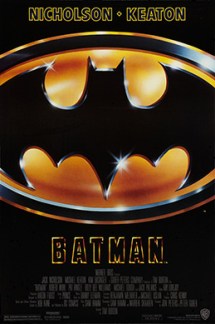
Batman_(1989)_theatrical_poster

Batman (1989)

Batman has had a love/hate relationship with the world of film.  He made his debut on the big screen in old serials that used to play in movie houses in the 40’s.  It wasn’t until 1966 that he got his first shot at a true feature length movie.  Based on the popular television series starring Adam West and Burt Ward, it was a silly take on the caped crusader.  For those of us who grew up on the 1990’s animated series, the film and television show do not come across as authentic, but Batman had a pretty light tone in the comic book world then.

Frank Miller is often credited with bringing Batman back to the shadows with his graphic novel, The Dark Knight Returns.  Other stories would soon follow, such as Death in the Family and The Killing Joke, all serving to steer Batman in a more serious direction.

It is no surprise that Batman’s return to the big screen in 1989 would follow the same path in terms of tone and visuals.  Audiences were ready to put the days of Adam West behind them and embrace Batman in a new way.  The super hero genre was mostly stagnant at the time and a lot of obstacles were present for Batman, but the project went ahead.  While the critical response was mixed, the film proved to be a box office hit for Warner Bros.

Tim Burton was an odd choice at the time, and even in hindsight, still looks like an

It’s hard to imagine where Batman would be today if not for Frank Miller’s 1986 portrayal of the character.

odd choice for the director of a Batman film.  Burton’s biggest hits at the time were Pee Wee’s Big Adventure and Beetlejuice, two movies that contained extraordinary visuals but hardly the type associated with Batman.  If movie goers were puzzled by this choice they were even more weary of the studio’s choice to sport the cape and cowl.  That honor fell to comedic actor Michael Keaton who had worked with Burton before playing the starring role in Beetlejuice.  In hindsight, it’s amusing how much controversy existed over this casting decision given how much fans missed Keaton when he left the franchise.

To pull off the role, the costume designers outfitted Keaton with a rubber batsuit featuring sculpted muscles to give him an imposing look.  The camera is also kept in close on Batman and rarely is he shown in full.  This helps to disguise the actor’s average height which proves to be a good move.  In the few scenes where Batman is shown in full frame he does look less imposing, particularly when running along side co-star Kim Basinger.

For the most part, once people saw what Keaton looked like in costume they soon realized the only quality a Batman actor needed to possess was a good jaw.  Keaton’s Batman ended up being a man of few words.  When he spoke it was barely above a whisper and direct.  During the film’s climax we do see a more emotional Batman which comes across well and helps add to the scene’s impact.

Keaton also plays Batman’s alter ego in a similar fashion to how most productions, past and present, have.  Which is to say he tries to distinguish the two in terms of behavior and even vocal tone.  Keaton is able to do so with subtlety and never resorts to playing Wayne in an over the top, playboy, manner.  Keaton’s Wayne is charming with a mostly light demeanor when around company.  In his scenes with Basinger’s Viki Vale, he does let on that there’s a dark side to him.

As long as your mouth looks good in the mask, you can play Batman.

Keaton is partly able to portray Bruce Wayne this way because in this world Wayne is an unseen force.  The people of Gotham know his name but not his face and the film doesn’t reveal much about Bruce Wayne’s business life.  Early on in the film a party is held at Wayne Manor that is attended by most of the film’s secondary characters, including one of Gotham’s most notable journalists, Alexander Knox (Robert Wuhl).  In one of the film’s more comedic scenes, Knox and Vale are walking around Wayne’s art exhibits and cracking jokes about the trust fund baby.  When Keaton’s Wayne saunters into the room and joins the conversation both reporters are unaware of who he even is.  The scene ends with an awkward introduction and a seemingly aloof Wayne promises to get Knox a grant for his research.

Of course, Batman wouldn’t be much of a hero if he didn’t have a foil to make him

For a long time, many thought there was no one who could top Nicholson’s portrayal of the iconic villain.

look good.  Enter Jack Nicholson as the Joker.  Nicholson was the big name hired to give the movie instant credibility.  He was also a favorite for the role by Batman co-creator Bob Kane, much to the disappointment of Joker-hopeful, Robin Williams.  Nicholson’s Joker comes across as a hybrid of Cesar Romero’s Joker from the 1966 series and the comic book character’s more sinister takes.  He is a bit more menacing and focused in the film and he’s given a back story as mob underling Jack Napier.  We’re shown his transformation in one of the film’s earlier scenes, which Batman is given a hand in.  The Joker in the comics is famous for not having a true back story so this was a bit of a surprise.  Napier is also later revealed to be the gunman responsible for the deaths of Thomas and Martha Wayne giving Batman and the Joker an interesting dynamic as both are responsible for the other’s existence.

The Joker here is over the top, as any Joker would be.  He is obsessed with his own disfigured appearance and fancies himself an artist, an interesting but in the end irrelevant aspect of his personality.  He’s equipped with joke-type weapons; an acid spitting flower, electro-shock joy buzzer, and an absurdly long barreled revolver.  His main mode of attack is reminiscent of some of his comic exploits with Joker gas.  Here he’s poisoned all of the city’s cosmetics with his Joker poison that will leave it’s users disfigured, much like himself.  This is, of course, preceded by a fit of uncontrollable laughter.

The Tim Burton films ended up being the main source of inspiration for the animated Batman that ran during the 1990’s.

Since Gotham’s police force is riddled with corruption and incompetence, it falls on Batman to deduce who the Joker is, what his ultimate goal is, and just how to stop him.  It’s an okay plot and serves to please casual audiences.  For the Batman die-hards, having Joker cast as the murderer of Batman’s parents was an unwelcome turn.  Nicholson’s Joker ends up being the dominant personality in the film, almost forcing Batman to the rank of supporting character (Nicholson did receive top-billing at the box office, though that has more to do with his star power and contract than anything).  The film also ends with Batman getting his revenge and the Joker finished.  Considering that Batman and the Joker have always been intertwined in the comics, this also was not welcome as it removed the Joker as a possible villain for all future films.  Batman was also portrayed as a killer, something most of the comic books tried to avoid.  Considering that The Dark Knight Returns was the primary source of inspiration though, this wasn’t that hard to accept.

Visually speaking, dark was the theme.  Few scenes occur in broad daylight and most of the interior shots are shadowed, particularly the ones taking place in Wayne Manor.  Some duality is used as Viki Vale’s apartment is bathed in light with a white theme.  When Bruce and Viki change rooms during the dinner scene at Wayne Manor, they move from a dark dining hall to a cozy and warmly lit kitchen, drawing a parallel between the Bruce Wayne most assume and the one he truly is.  The Batcave is portrayed as just that, a cave, and Gotham is given a gothic theme.  This approach often leads to the film being classified as a noir, though some critics (most notably Roger Ebert) disagree with the label.

Batman is outfitted with an array of gadgets (a fact captured so well in the film’s

Burton’s take on the Batmobile was more tank than hot rod, something both the comics and future films were quick to adopt.

most memorable line) and vehicles.  The Batmobile is jet-black and armored.  It’s also voice activated and apparently perfectly capable of driving itself.  Batman’s suit is also entirely black and armored, the only dash of color are the yellow/gold of his symbol and utility belt.  He has an assortment of bombs, grappling hooks, and batarangs that he uses throughout the film, though he’s not afraid to engage in straight-up fisticuffs when the situation calls for it.  He saves his biggest toy for the end when he brings out the Bat Wing, or Bat Plane as some call it.  Designed to look like his logo, the Bat Wing is a stealth plane he uses to take out the Joker’s gas-filled parade balloons.  Strangely, it is felled by a single shot from Joker’s elongated .38.

Prince was brought in to craft the film’s soundtrack and the results are mixed at best.  Prince’s blend of funk and pop work in contrast to the film’s dark mood.  His songs are mostly reserved for scenes involving the Joker so it isn’t as noticeable, though it still comes across as unnecessary Hollywood indulgence.  Danny Elfman is given the score and produces arguably his most iconic work.  The Batman theme was an instant hit and was carried over into the television product that would follow.

The film ends up coming together fairly well.  There are definitely some aspects that work better than others, but the cast is competent and the directing effective.  This a film full of personalities that could have lead to Burton over playing his hand but he keeps most everything in check.  The film’s most glaring weaknesses reside fully in its screen play and plot.  Ultimately, Batman needed more Batman and less Joker.  The romantic angle served as an okay subplot, so the seemingly happily ever after ending felt odd and was made even more odd when the sequel rolled around and Viki Vale was no where to be found.  Batman works best as a loner, and perhaps a noble break-up would have worked better (something Nolan would attempt with Batman Begins).

Batman’s Gotham was retro before the term was even invented.

Ultimately, I decided to make this entry because I do feel that this film has been over-shadowed by the recent Batman films.  In truth, the newest films are the best Batman movies created, and I would even rank the animated feature Mask of the Phantasm ahead of the Burton films.  I do think there are things this film did better than the recent ones though, most notably the Batman voice and Bruce Wayne character.  In this film, since the origin of Batman was revealed through sporadic flashbacks, we’re allowed to see how quietly disturbed Bruce Wayne is without him having to come out and say it.  In many ways, Michael Keaton is still the best Batman even if Christian Bale’s Batman possesses a more believable look.  Burton also doesn’t waste time trying to explain to the audience how Batman acquired his talents or where his money is coming from which helps keep the film from becoming too bloated.  Some things need no explanation.

This Batman, like really all of the other Batmans, exists in his own world separate

1989’s Batman isn’t perfect, but it is a quality film.

from every other one.  Films based on well established properties do best when they do not seek to simply mirror the original medium.  Here the audience is given the tone of The Dark Knight Returns, but not the plot.  The plot is, for better or worse, a unique one among Batman stories and this Batman is different in attitude from other Batman portrayals.  When taken at face value, this is an interesting and enjoyable take on the character.  The sequel, Batman Returns, would contain even less Batman and as a result is an inferior film.  The two that followed that one were so abysmal they’re not even worth discussing.

As production is about to begin on the third film in the latest Batman franchise, it’s a good time to go back and revisit what the past has given us.  1989’s Batman is not a perfect movie or the caped crusader’s best, but for a long time it was the best live action Batman on film and should not be forgotten.