Category Archives: Film

Mickey Mouse: In Living Color, Volume 2

175px-DisneyTreasures03-mickeycolorAs the 1930’s came to an end and Disney transitioned into the 40’s, Mickey Mouse saw his starring roles in cartoon shorts dwindle.  He was, more or less, unofficially retired by the time the decade came to a close and relegated to hosting duties on television and as the official mascot of the Disney brand.  There were several factors contributing to the decreased screen-time for the world’s most famous mouse.  For one, Disney had moved on to feature-length productions and was producing fewer cartoon shorts.  And when Disney was producing shorts, Donald Duck was usually the star, not Mickey Mouse.  As the Disney brand grew, Mickey was not surprisingly delegated as the face of the company.  As such, Disney felt that Mickey needed to be a role model.  While the Mickey who starred in numerous black and white shorts could be kind of mischievous and a bit of a trickster, this new Mickey needed to embody a more wholesome image.  Donald Duck could be the bad boy, and as a result, the funnier of the two characters which made creating shorts for him a natural process.  Donald Duck could be the hero or the villain of any cartoon he starred in, while Mickey was forced to be the straight man.  Another reason why Mickey made fewer appearances in animation is because he was voiced by Walt Disney himself.  As the Disney empire grew, Walt found himself too busy to voice Mickey.  Eventually, he would hand over the voicing duties to sound effects man Jimmy MacDonald because of his too busy schedule.

As a result, this final set of Mickey Mouse cartoons is much shorter than its predecessors.  It’s also not as good as the first Mickey Mouse:  In Living Color collection, but still contains some classic material and worthwhile bonus features.  Disc one includes the last of Mickey’s original run while disc two contains some of his more prominent starring roles and last theatrical short.  The set captures Mickey’s twilight years, and includes material from his three most prominent voice actors: Disney, MacDonald, and Wayne Allwine.  The set is, if nothing else, a nice piece of history for one of animation’s most famous characters.  The animation is top-notch Disney, as one would expect, making even the lesser shorts still fun to watch.

images-187This may be a lesser set when compared with the previous one, but there are still some classic shorts to be found on disc one.  Mickey often finds himself paired with other characters, such as Pluto, Donald, and Goofy.  in “Tugboat Mickey,” Mickey, Donald, and Goofy spend their time repairing an old boat and little goes right.  There’s plenty of slapstick humor in the same style as other shorts that grouped this trio together.  In “The Pointer,” Pluto and Mickey are out hunting and soon find themselves nose to nose with a bear.  Pluto probably gets equal screen time as Mickey and arguably steals the short.  This is common for Mickey though as the guest stars tend to generate the most laughs.  A personal favorite of mine for nostalgic reasons is “Mickey and the Seal.”  I remember watching this one as a kid and it involves Mickey being followed home from the zoo by a seal pup.  They get into some humorous situations as Mickey is unaware the seal followed him which climaxes is in a very entertaining bath tub scene.  There are some duds though, such as “The Nifty Nineties” and “The Simple Things.”  “The Nifty Nineties” is basically a love letter to the 1890’s.  It contains some nice music and pretty backgrounds, but it’s just really boring.  Nothing happens.  “The Simple Things” is another Mickey and Pluto short, and also the last Mickey Mouse short until the 1990’s.  It’s not so bad in a vacuum, but a lot of the gags are recycled from older Mickey, Pluto and Donald cartoons and have become worn out at this point.

There are some curious inclusions amongst the cartoons as well.  Namely, there are a few Pluto cartoons here that would have made more sense as part of the Pluto collections.  Perhaps Disney felt it needed to include more content on this one, but “Pluto’s Party” and “Pluto’s Christmas Tree” would have been more at home on the Pluto sets, but I can’t say I’m disappointed they’re here.  It’s actually more of a hindrance to the Pluto sets that they weren’t also included there.  The short, “Plutopia,” included on this set actually also shows up on The Complete Pluto, Volume Two as well.

Still breathtaking more than 70 years later.

Still breathtaking more than 70 years later.

In addition to the short-form cartoons are the longer feature appearances of Mickey.  Included on disc one, is “The Sorcerer’s Apprentice” from Fantasia and “Mickey and the Beanstalk” from Fun and Fancy Free.  These end up being about three to four times the length of a typical cartoon short, and are essential to the Mickey Mouse legacy.  “The Sorcerer’s Apprentice” kind of goes without saying, but for the record I will state it’s an iconic piece of American animation and possibly Mickey’s most famous appearance.  “Mickey and the Beanstalk” is less known, but important because it was the unofficial passing of the torch for the voice of Mickey from Walt Disney to Jimmy MacDonald as portions of the cartoon feature Mickey voiced by Disney and portions by MacDonald.  For a long time, it was thought that this was the last time Disney voiced Mickey, but it was actually revealed by MacDonald to film critic and set host Leonard Maltin that Walt reprised the role of Mickey for the intros to the Mickey Mouse Clubhouse television show.  Those intros, five in total, are included as a bonus feature on this set and are impossibly cool for fans of Disney and Mickey Mouse history.

The Prince and the Pauper is hardly a classic, but it's nice to have it included all the same.

The Prince and the Pauper is hardly a classic, but it’s nice to have it included all the same.

Disc two contains more special features as well as Mickey’s most recent cartoons.  The long-form shorts “Mickey’s Christmas Carol” and “The Prince and the Pauper” are featured.  I’ve written more than once on this blog about “Mickey’s Christmas Carol” so I won’t go into much detail here, but there’s some bonus content with some animators who worked on it which is worth checking out.  It’s a neat cartoon for many reasons, but also because it’s the first time Mickey Mouse was voiced by Wayne Allwine, who would eventually go on to become the longest running voice of Mickey Mouse until his death in 2009.  The cartoon also features the Uncle Scrooge character voiced by Allen Young, who would of course go on to voice Scrooge in the very successful DuckTales series.  The cartoon is also the last time Donald Duck was voiced by his original voice actor, Clarence Nash, making “Mickey’s Christmas Carol” one of the most historically significant cartoons ever produced by the Disney company.  “The Prince and the Pauper” is another twenty-four minute short.  Coincidentally, it was released to theaters with The Rescuers Down Under while “Mickey’s Christmas Carol” was released with The Rescuers (Disney apparently likes to group its mouse characters together).  It’s a fairly unremarkable short but does feature some nice animation, though its brightness contrasts it with the muted pallet of “Mickey’s Christmas Carol” in a way that kind of puts me off.  It is notable for being the last time Disney used the Xerox process for its animation, a process that had been in use since 101 Dalmatians.
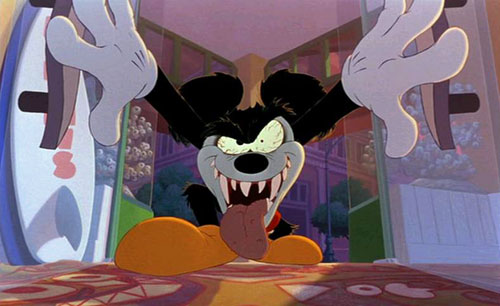
Runaway Brain feels like it's mostly been forgotten, which is a shame because it's great fun.
Runaway Brain feels like it’s mostly been forgotten, which is a shame because it’s great fun.
The last short include on the collection is, up until very recently, the last Mickey Mouse short, “Runaway Brain.”  Released in 1995 along with A Goofy Movie, it features Mickey and Minnie (voiced by Allwine’s real-life wife Russi Taylor) and marks the debut of mad scientist Dr. Frankenollie (named after longtime Disney animators Frank Thomas and Ollie Johnston), who is voiced in the short by Kelsey Grammar.  The plot involves Mickey forgetting his anniversary with Minnie and trying to make up for it by volunteering for a science experiment to earn money for a Hawaiian vacation.  Mickey ends up as a mindless beast and it’s a pretty entertaining cartoon short.  It served as a nice way for Mickey to bow out of animation, though starting in 2013 new Mickey Mouse shorts have been in production featuring a new style and approach in terms of both look and content.

Mickey Mouse: In Living Color, Volume Two isn’t quite as good as Volume One, but there’s enough here that any Disney fan should own it.  More than anything, this set is a piece of Disney history as it documents the changing look of Mickey Mouse as well as the men who gave voice to him.  There’s a little bit of sadness to it as well, as Mickey quietly exited the world of animation with little fanfare or celebration.  It seems like he deserved better, and it’s too bad that generations of kids have grown up without new Mickey Mouse cartoons.  The most recent shorts produced actually aren’t bad, and the few I’ve seen I’ve enjoyed but it doesn’t seem like they get much attention.  Disney would do well to make an effort to keep Mickey’s animation presence alive and well by celebrating his legacy more and pushing his current shorts.  Kids today deserve to know Mickey Mouse as more than a theme park attraction and brand.

Mickey Mouse:  In Living Color, Volume Two

  • Society Dog Show
  • The Pointer
  • Tugboat Mickey
  • Pluto’s Dream House
  • Mr. Mouse Takes a Trip
  • The Little Whirlwind
  • The Nifty Nineties
  • Orphan’s Benefit (1941)
  • Mickey’s Birthday Party
  • Symphony Hour
  • Mickey’s Delayed Date
  • Mickey Down Under
  • Mickey and the Seal
  • Plutopia
  • R’Coon Dawg
  • Pluto’s Party
  • Pluto’s Christmas Tree
  • The Simple Things
  • The Sorcerer’s Apprentice
  • Mickey and the Beanstalk
  • Mickey’s Christmas Carol
  • The Prince and the Pauper
  • Runaway Brain


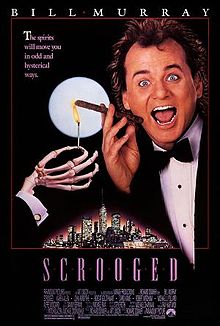
Scrooged

Scrooged (1988)

Scrooged (1988)

Richard Donner is known primarily for being the director who convinced you that a man could fly, but he also directed and produced the first Christmas movie I ever saw where the lead character was something more than despicable.  In a way, Scrooged is kind of a precursor to a film like Bad Santa where the audience isn’t supposed to like or even feel much empathy for the lead role.  And even though Scrooged is a take on A Christmas Carol, the leading male in the Scrooge-like role just seems far more unlikable than any Scrooge I ever bore witness to.

The Scrooge in this film is played by Bill Murray, an actor who has made an awful lot of money portraying selfish, sarcastic, and cynical characters that audiences are able to embrace because that character offers some redeeming qualities.  Murray’s Peter Venkman in Ghostbusters ultimately embraces his hero role and puts his life on the line for the city of New York.  Groundhog Day’s Phil Connors is quite the unlikable character at the film’s onset, but throughout the movie he’s redeemed and becomes a better person in the end.  In Scrooged Murray plays Frank Cross, a television executive whose ambition in life is entirely career oriented.  Unlike many depictions of Scrooge, he’s not necessarily out solely for financial gain (though that’s definitely a part of it, and he’s pretty cheap) as his main ambition appears to be to rise to the top of the career ladder.  He’s ruthless, self-centered, and shows no empathy for the people around him.  As a television executive, he approves a television spot for an upcoming live edition of A Christmas Carol that has an apocalyptic feel opting to lure in viewers through fear and intimidation rather than on the strength of the program he’s pushing.  He shows no regard for his loyal secretary, Grace (played by Alfre Woodard and the film’s Bob Cratchit), and makes her work late with no Christmas bonus, and when one of his subordinates (Bobcat Goldthwait’s Eliot Loudermilk) disagrees with his absurd TV spot he has him fired.  Usually we can laugh at a Bill Murray character even when he’s a jerk.  With Frank Cross, we can’t even laugh at him because he’s too good at being mean.

Carol Kane's character is likely to draw the most laughs.

Carol Kane’s character is likely to draw the most laughs.

I am an unabashed Bill Murray fan.  I love him in pretty much any role.  I don’t know exactly what it is about Murray that appeals to me so much.  He’s obviously a great actor whose range still seems to surprise people whenever he takes on a more dramatic role.  He’s best known for comedies and I certainly have a nostalgic affinity for Ghostbusters.  He also reminds me of my own father so that can’t hurt.  With that said, even I find it hard to watch the first half hour of Scrooged.  Frank Cross is a terrible person and he gets away with so much.  His brother James (John Murray, Bill’s real-life brother) is willing to forgive his short-comings to a fault, while ex-girlfriend Claire (Karen Allen) almost seems to ignore his numerous flaws.  We never quite see how the two characters broke-up, just a hurt Claire proposing they take a break when Frank once again chooses his career over her, and we get the sense that Frank just shrugged his shoulders and forgot to ever follow-up on that break.  I watched the film recently with my fiancé who remarked that she kind of hated the movie while we were in its early stages and I couldn’t blame her.  I do wonder if perhaps Murray and Donner felt like Murray was too likable as an actor at this stage in his career and that they needed to over-do just how awful Frank is to counteract that.  The film does benefit some from this overly cruel Scrooge as the character is redeemed by the film’s conclusion, but I still get the sense the Cross character was overdone.  Not only is he too cruel, he’s not always believable in his cruelty.  And it’s somewhat surprising that this character even could be redeemed.

The film's makeup effects are still impressive today.

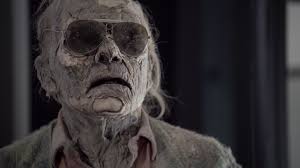
The film’s makeup effects are still impressive today.

The film was initially hyped as a special effects bonanza.  Given that the film was released in 1988, these effects are not impressive by today’s standards.  The effects are mostly put to use with the film’s ghosts.  Just like in A Christmas Carol, Frank is visited by three spirits, the ghosts of Christmas past, present, and future.  All take on an appearance and character to better suit this film’s setting of 1980’s New York.  The first ghost, played by David Johansen, is a cab driver who takes Frank on a tour of his past giving the audience insight into his childhood and past relationship with Claire.  Christmas Present is played by Carol Kane and she is portrayed as a violent fairy-type.  She repeatedly strikes Frank and is likely to be the character who induces the most laughs.  The Ghost of Christmas Future is depicted as a Grim Reaper-like figure whose main twist is a television screen for a face (and his “body” is revealed as a mass of screaming souls that looked revolting in the 80’s but kind of cheesy now).  A lot of makeup effects are in use with the ghosts, and the best is probably reserved for the Marley character played by John Forsythe.  His decomposing body is grossly, and convincingly, portrayed on-screen with lots of gray and a dusty, flaky, texture.

Eliot doesn't respond well to being fired.

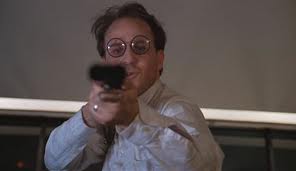
Eliot doesn’t respond well to being fired.

For the film’s comedy, it tends to rely on a grab bag of tricks as opposed to resorting to one style.  A lot of the “humor” in the film’s early scenes are of the dark variety as the audience is asked to laugh at the misfortune of others.  It’s horribly mean-spirited, and some won’t find any laughs at all.  As the film moves along the humor becomes more dialogue and situation specific with less of a mean tone.  There’s also physical comedy, notably from the Ghost of Christmas Present and later in the film when Goldthwait’s Eliot goes off the deep-end.  It’s not a rip-roaringly funny film, but the laughs are spread around well once it gets past the early parts.  The score is done by Danny Elfman and it’s a pretty typical Elfman type of score.  People seem to either love or loathe Elfman but I’ve never had anything against him and find his score suitable here.

Since this is a take on A Christmas Carol, Frank is shown the error of his ways and comes around by the film’s conclusion.  Just like how his cruelty felt overdone, the big redemption scene feels similar as Frank hi-jacks the live television production of A Christmas Carol to share his new-found appreciation for Christmas with the world. It’s uncomfortably funny and drawn out, but does provide the happy ending most were probably hoping for.  The film’s beginning and its end make it feel like the film is a lot longer than its 101 minutes running-time, but by the time it did end my fiancé had come around and proclaimed it “cute.”  I suspect most viewers will have the same experience.  Scrooged is too flawed a film to be a true Christmas classic, but it is well acted and differs enough from other clones of the source material to make it a worth-while viewing experience.  Those looking for something a little less saccharine in their Christmas movies will probably get the most out of Scrooged.


A Mickey Mouse Christmas

Mickey Mouse has appeared in many Christmas themed specials and shorts over the years.  I suppose that should be expected of a character who has been around for over 80 years.  I don’t think he’s appeared in more Christmas specials than any other popular character (the boys in South Park actually had a nice streak going on of a Christmas special nearly every year) but he’s certainly in the discussion.  Many of Mickey’s Christmas exploits took place on the big screen in the form of shorts, but have since become television staples during the Christmas season.  Rather than make an individual post here and there on certain ones, I’ve decided to make one long post that hits on the ones I’m most familiar with.  This list isn’t exhaustive as I’m sure there are more modern television specials that I’m not familiar with, but consider this a good start.  The following list is in chronological order, starting with the earliest.  They’re all available on DVD in some fashion, and the old shorts can be found on youtube as well (Disney is pretty lax with its old shorts when it comes to youtube, probably because the Treasures line of DVDs is out of print)

Mickey’s Good Deed (1932)

The original version was in black and white, but colorized versions exist today.

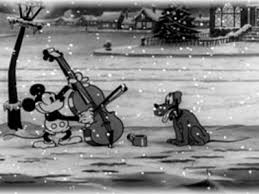
The original version was in black and white, but colorized versions exist today.

Mickey’s rise to fame nearly coincided with The Great Depression.  As such, it’s a pretty common site to see Mickey depicted poor and penniless.  In Mickey’s Good Deed, he’s a street performer looking to make a buck.  As far as we know, his only possessions are his cello and Pluto.  After a day of playing, Mickey and Pluto look to score some dinner and find that passer-byes have been tossing nuts and bolts into Mickey’s cup instead of coins.  Down on their luck, Mickey has a mishap that leads to the destruction of his cello, while a rich pig offers to buy Pluto for his bratty kid.  Mickey, of course, refuses but he soon happens upon a family of poor cats.  Wanting to give them a good Christmas, Mickey reluctantly sells his dog, dresses up as Santa, and gives the cat family a nice Christmas.  Pluto, meanwhile, is miserable as he’s abused by the bratty boy pig leading to the father tossing him out and spanking his kid.  Pluto is able to happen upon a despondent Mickey and we get a nice, happy ending.  It’s a cute little Christmas short that unfortunately is never shown on air because of one instance of perceived racist imagery.  A little balloon the Santa Mickey carries appears to depict a blackface character portrait on it.  This means the short is relegated to the vault section on the release Mickey Mouse In Black and White Volume 2.  Despite that, it’s actually been released here and there on VHS and DVD, including a colorized version on the most recent release Holiday Celebration with Mickey and Pals.

Toy Tinkers (1949)

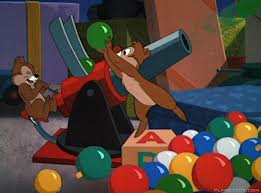
It's all-out war when Chip and Dale sneak into Donald's house.

It’s all-out war when Chip and Dale sneak into Donald’s house.

I’m cheating here, because this is actually a Donald Duck short and does not feature Mickey, but who cares?  This Christmas themed short pits Donald versus perhaps his most famous antagonists:  Chip and Dale.  While out chopping down a Christmas tree, the mischievous chipmunks take notice and follow Donald back to his home where they see a nice, warm environment and bowls full of nuts.  The duo slip in and immediately start using the toys around the tree to transport the nuts out of there.  Donald, not one for charity, takes note and a full-scale battle breaks out over the nuts with the two using pop guns and toy cannons on each other.  It’s a silly, and fun short where Donald is mostly punished for his cruelty (and because it’s more fun to see Donald lose his temper) and things mostly work out for Chip and Dale.  Unlike Mickey’s Good Deed, this one will pop up from time to time on the Disney channel during the holiday season.  Otherwise, it can be found on some compilation releases and the Treasures release The Chronological Donald Volume 3.

Pluto’s Christmas Tree (1952)

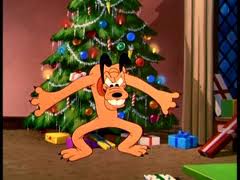
Pluto is very protective of his Christmas tree.

Pluto is very protective of his Christmas tree.

Despite what it’s title suggests, Pluto’s Christmas Tree is actually considered a Mickey Mouse short instead of a Pluto one, for some reason.  It’s also one of the few shorts to feature Jimmy Macdonald as Mickey Mouse, as Walt found he didn’t have the time to voice the character any longer.  Pluto’s Christmas Tree is actually fairly similar to Toy Tinkers.  Mickey and Pluto set out to get a Christmas tree and they settle on one that happens to be occupied by Chip and Dale.  Once inside the house, Chip and Dale immediately start to make themselves comfortable in the Christmas tree while Pluto takes notice.  Pluto tries, in vain, to point out the chipmunks to Mickey who just sees Pluto’s antics as the usual.  Eventually he can’t take it anymore and attacks the tree, finally revealing the chipmunks to Mickey who basically has the opposite reaction as Pluto.  The short ends with Christmas carols, where the chipmunks take issue with Pluto’s singing voice.  This is another wildly entertaining Chip and Dale story mostly full of slapstick humor.  This one is really easy to get ahold of as it’s been released several times on VHS and DVD and is one of the most well-received Disney shorts.

Mickey’s Christmas Carol (1983)

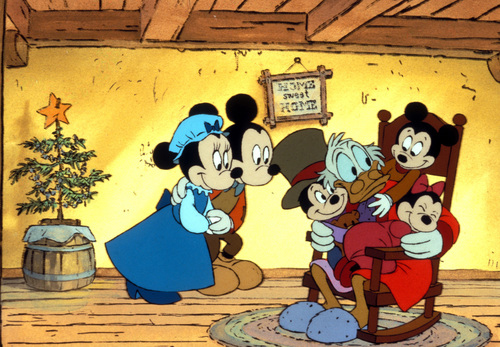
Not a Christmas season goes by where I don't watch this one numerous times.

Not a Christmas season goes by where I don’t watch this one numerous times.

Mickey’s Christmas Carol is fairly recent compared with the other shorts.  It’s also quite easy to catch on television or find on DVD and was even recently rereleased on Blu Ray (along with Pluto’s Christmas Tree, among others) this year.  It’s the classic Dickens’ tale with Mickey as Bob Cratchit and Minnie as his wife.  Scrooge McDuck is, naturally, the film’s Scrooge while other Disney characters show up in supporting roles.  As far as takes on A Christmas Carol go, this one is my favorite as it’s both funny and poignant and the inclusion of Disney characters somehow makes it more relatable.  The recent re-release does make it all the more obvious that one giant Christmas release from Disney is necessary.  Mickey’s Christmas Carol is also how many were first introduced to the longest running voice of Mickey Mouse, Wayne Allwine (who passed away in 2009), and also marks the final performance of the original Donald, Clarence “Ducky” Nash.

Mickey’s Once Upon a Christmas (1999)

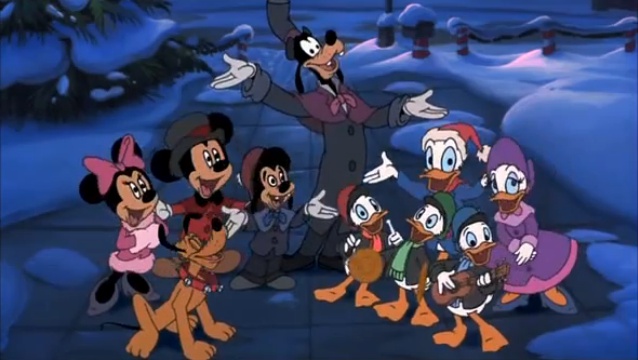
Once Upon a Christmas is far from timeless, but it is nice to see all of the Disney characters together at Christmas time once again.

Once Upon a Christmas is far from timeless, but it is nice to see all of the Disney characters together at Christmas time once again.

Once Upon a Christmas is a traditionally animated direct-to-video collection of three shorts starring Donald, Goofy, and Mickey.  It’s shown annually on television still and represents the modern Mickey Mouse and friends.  The first short, titled Stuck on Christmas, stars Donald and his nephews Huey, Dewey, and Louie and is a take on the story of What if Christmas Were Every Day?  In it, the three boys wish it could be Christmas every day and are then forced to deal with the consequences.  It’s a bit like Groundhog Day, in that the boys need to be considerate of others and have the perfect day to undo the spell.  The second short, A Very Goofy Christmas, stars Goofy and his son Max as Goofy tries to prove to Max that there is a Santa Claus after their neighbor Pete informs him there’s no such thing.  The third short, Mickey and Minnie’s The Gift of the Magi, once again depicts Mickey as rather poor as both he and Minnie try to scrounge up some money to buy each other the perfect Christmas gift with both discovering the only thing that matters is having each other.  The animation on all three is pretty well done and it’s kind of fun to see modernized versions of the characters.  Aside from the Mickey short, the others tend to run a bit too long and run out of steam towards the end.  It’s a solid Christmas special but falls short of being a classic due mostly to the pacing issues.

Mickey’s Twice Upon a Christmas (2004)

Another direct-to-video Christmas special, Mickey’s Twice Upon a Christmas is naturally the sequel to Once Upon

The CG look for the characters just doesn't do it for me, and as you can see here, the backgrounds suffer too.

The CG look for the characters just doesn’t do it for me, and as you can see here, the backgrounds suffer too.

a Christmas, though the stories contain no obvious references to the previous ones.  Differing itself from its predecessor, Twice Upon a Christmas is entirely computer animated and the results are something less than spectacular.  The characters are mostly harmed by the transition to 3D models which makes sense considering they were never drawn for such a look to begin with.  This collection also contains five shorts which does address the pacing issues from the first set.  The shorts are:  Belles on Ice, Christmas: Impossible, Christmas Maximus, Donald’s Gift, and Mickey’s Dog-Gone Christmas.  The first one stars Minnie and Daisy as competitive figure skaters and is easily the worst of the set.  There just isn’t much to it.  Christmas: Impossible stars Huey, Dewey, and Louie as they sneak into Santa’s workshop to get on the nice list.  It’s kind of cute, but the CG really shows its limitations as the should-be wondrous Santa’s workshop is really unimpressive looking.  Christmas Maximus stars Goofy and Max, who’s now returning home for the holidays from college with his new sweetheart.  It’s only slightly better than Belles on Ice but is ultimately forgettable.  I also found Max’s look to be really off-putting for some reason.  Donald’s Gift is a rather simple Donald tale where his grumpiness and overall bad demeanor nearly ruin Christmas for his family, but he redeems himself in the end.  I’m a Donald sucker, so I was entertained by this one but it can’t hold a candle to Donald’s classic shorts.  Mickey’s Dog-Gone Christmas is definitely the strongest of the collection as Pluto runs away to the North Pole after Mickey gets mad at him.  There he befriends Santa’s reindeer and adopts the moniker Murray (Murray Christmas, get it?!) and even gets to fly.  The reindeer characters are entertaining, and the CG look actually works for Pluto, though I still prefer the traditional look.  Eventually Pluto is reunited by Santa with his depressed owner and everyone’s happy in the end.  Overall, this is a weak collection and the CG makes it hard to watch.  Check it out if you happen to catch it on TV, but don’t feel like you need to go out of your way to see it.


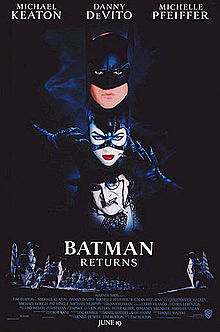
Batman Returns

Batman Returns (1992)

Batman Returns (1992)

It’s December 1st, and it’s time to inject a little Christmas into this blog once again.  Last year, I went pretty light on the X-Mas related topics and I intend to do a little more this year.  I’ll start off slow with a pseudo-Christmas movie in the form of Batman Returns.

Batman Returns is the 1992 sequel to the mega-successful Batman.  All of the major players return from that film including Tim Burton as director and Michael Keaton as Batman.  The only notable omissions are Billy Dee Williams as Gotham City District Attorney Harvey Dent; Kim Basinger’s reporter/photographer Vicki Vale, and Robert Wuhl as reporter Alexander Knox.  All three characters are absent from the film and were not re-cast.  The Vale character was presumably removed so as not to force Batman/Bruce Wayne to settle down, while the other two must have been cut for time (Williams was reportedly disappointed he never got to play Two Face).

The major additions to the cast are, of course, the villains.  Going with a “more is better” philosophy, Batman Returns includes three major villains compared to Batman’s one.  Created for the film is Max Shreck, played by Christopher Walken.  He’s a real-world villain in that he has no gimmick or special abilities, he’s just a greedy, corporate, jerk who values money more than human life and has ties to both of the other comic book based villains. Michelle Pfeiffer plays Selina Kyle, aka Catwoman.  Catwoman serves the dual role of being a foe for Batman, and a love interest for Bruce Wayne.  Also joining the part is Danny DeVito as Oswald Cobblepot/The Penguin, a monstrous take on the old Batman villain.  The two “super” villains have a sympathetic angle to play, which I’ll get to in a few paragraphs, and in 1992 both felt like logical inclusions for the big sequel.

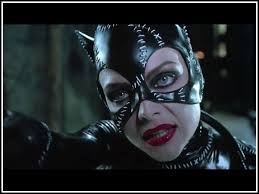
The red of Catwoman's lips really pop in all of her scenes due to the muted palette of the film's sets.

The red of Catwoman’s lips really pop in all of her scenes due to the muted palette of the film’s sets.

The film is virtually identical in look to its predecessor with Gotham taking on aspects of film noir.  The technology is modern, or post modern, but with the stylings of the 1930’s and 40’s dominating the landscape, with a touch of goth too.  The noir angle is played upon even further with a majority of the film’s colors being black and white.  It’s demonstrated in the film’s leads with both Catwoman and The Penguin having a near white complexion to go along with the black and white shades of their respective costumes.  This makes what little color appear really jump out, such as the crimson of Catwoman’s lipstick or the yellow of Batman’s logo.  Batman, and the other good guys, are depicted with warm, natural flesh tones while the villain Shreck is noticeably pale, but not to the same degree as the other villains.  He makes up for that with his bone white hair.  The buildings and structures around Gotham are also mostly confined to shades of black and white, as are all of Batman’s gadgets and vehicles.  Combining this stylistic choice with the setting of a snowy Christmas time and Batman Returns comes across as a very cold movie, even when compared with the already bleak feeling of the first film.

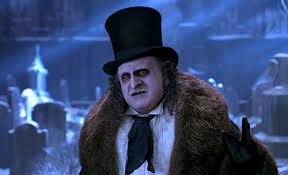
DeVito's Penguin is mostly monstrous but he's able strike a sympathetic tone at times.

DeVito’s Penguin is mostly monstrous but he’s able strike a sympathetic tone at times.

As was the case with the first film, for better or worse, the villains are meant to be the main driving force of the film.  It’s a good thing they’re well-developed as Batman Returns arguably leans even harder on its villains than Batman did with The Joker.  Shreck is meant to be the irredeemable villain and serves as a foil to both Bruce Wayne and The Penguin.  The Penguin is not a nice guy himself, but Shreck proves to be the true monster of the film when he coldly tries to murder his secretary, Selina Kyle.  Shreck is the owner of a department store and he’s seeking the approval of the mayor (and Bruce Wayne as an investor) to build a new power plant.  In a sort of goofy Tim Burton type of plot, Shreck’s new power plant will actually syphon power from Gotham and when Kyle figures this out (while working late in an effort to be a better employee) is when Shreck shoves her out of a window.  Burton’s twist on Catwoman occurs here, as the meek Selina Kyle is seemingly resurrected when a host of cats attend to her corpse.  The scatter-brained screw-up becomes the headstrong and vengeful Catwoman.  Kyle is played fairly straight, while Catwoman is intended to represent her ego gone wild which apparently has an S&M twist.  Catwoman, clothed in skin-tight leather and armed with a whip, also has the benefit of nine lives.  She’s over the top but it works for the picture.  Cobblepot, and his family’s rejection of him, is what opens the film.  He was a hideous and monstrous baby (who apparently has a taste for cats) and his upper class parents wanted nothing to do with him so they tossed his carriage into the sewer where he was apparently raised by penguins underneath an abandoned zoo.  At first his motivations seem are simply to find out his origins while his gang of circus thugs terrorize Gotham.  It’s his encounter with Shreck that changes his outlook and sets his sights on being mayor of Gotham.  Shreck, needing a new mayor to get his plant approved, thinks he can turn Cobblepot into a sympathetic figure who could win election on that alone (never mind his hideous appearance) and soon the two turn to villainy in order to make The Penguin look good in the eyes of Gotham’s voters.

Naturally, their dealings put them in conflict with Batman as everything becomes twisted and murky.  The Penguin, together with Shreck, emerges as a viable candidate for mayor while Catwoman seeks vengeance against Shreck.  She starts by attacking his department stores which puts her in conflict with Batman.  With Batman as a common foe, this pairs up Penguin and Catwoman who then concoct a plan to frame Batman and turn Gotham against him.  It’s a fairly clever pot and Burton should be commended for being able to get this trio of villains to fit together well and the framing angle makes for good drama.  Unfortunately, Burton has never been one for realism.  We don’t mind when that takes the form of a monster baby killing a cat or a man in a bat costume gliding over the entire city, but he leaves lots of loose ends in his plots and asks the audience to simply overlook them.  The framing plot, for example, is never really resolved.  Batman is made to look like he kills the Ice Princess, a mini celebrity of sorts, and by exposing The Penguin as a bad guy (but not as the person truly behind the murder) is apparently good enough for Gotham and it’s police department (to make it even more convoluted, the people don’t even know that it’s Batman that made The Penguin look like a bad guy as he hacks into a PA system while Cobblepot is making a speech, using pre-recorded taunts).

Once The Penguin is exposed, the film’s climax is put into motion where The Penguin, now abandoned by Shreck, decides to murder the first-born sons of Gotham’s wealthy elite, including Shreck’s son Chip.  He has his circus gang abduct the kids from their cribs and personally attempts to abduct Chip, but Max volunteers in his place.  Batman, of course, saves the day which just angers The Penguin even more forcing him to send his penguin army into the city to fire off a bunch of rockets and level a chunk of the city.  Catwoman, having also been betrayed and “killed” by The Penguin, is drawn out after Shreck and all three collide for a fitting resolution.

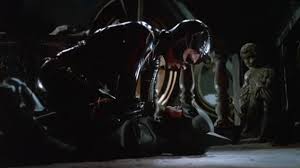
Batman and Catwoman play off each other quite well in their few scenes together.

Batman and Catwoman play off each other quite well in their few scenes together.

A great deal of the film rests on the Catwoman and Batman conflict.  With the characters in costume, their encounters become a fun bit of violent flirting, with all of the flirting basically on the part of Catwoman.  As Selina and Bruce, the two have a sometimes warms romance that develops a bit quickly with Bruce as the aggressor.  The two have a nice scene together where they both figure out each has a dual identity which is resolved during the final scene pairing Batman and Catwoman.  The film’s end suggests that Catwoman was to play a role in a future film, but perhaps because both Keaton and Pfeiffer were uninterested in continuing in their roles, this Catwoman would never surface again.

Batman Returns shares a lot of similarities with its predecessor, one of which being a rather major flaw in that sometimes each film doesn’t necessarily feel like a Batman film.  Batman Returns is even more guilty of this as the Batman character is really pushed aside in favor of the villains.  Perhaps Burton felt like he had more freedom to do this since the previous movie covered Batman’s origin, but we really learn nothing new about the main character.  In one respect, it does help to add more importance and excitement to the scenes that actually feature a costumed Batman, but it feels like their could have, or should have been, more from our hero.  The plot does mostly work though, even with the bloated cast, but it clearly had to make sacrifices somewhere and it’s debatable those sacrifices were worthwhile.

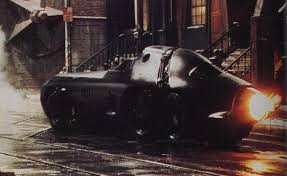
The Batmobile's ability to down-size into the Bat Missile was one of the big spectacles of Batman Returns.

The Batmobile’s ability to down-size into the Bat Missile was one of the big spectacles of Batman Returns.

The first film set a fairly high-standard for special effects and gadgets that Batman Returns is able to live up to.  The big spot occurs with the Batmobile once again, this time with it transforming into the Bat Missile.  Batman also debuts his ski boat during the closing moments of the film which serves as an interesting take on the more traditional bat boat seen in the comics and television series.  There’s also the previously mentioned gliding scene for Batman as he makes greater use of his cape.  Catwoman has some pretty spectacular death scenes as well and there’s plenty of fire and explosions throughout.  There are a few moments that scream “Tim Burton” that look kind of stupid, notably the penguin army and the final shot of a villain’s corpse at the end.  Some people are unwilling to forgive Burton for the campy penguin army, though I also kind of viewed it as Burton’s nod to the campy origins of the television show, and when viewed in that light, it doesn’t really bother me as much.  As a Christmas movie, there isn’t much here.  The film just happens to take place at Christmas, something Burton is quite fond of doing.  It does give the set designers a chance to play with snow which is kind of cool, and the only real mention of the holiday occurs during the final scene.

All in all, Batman Returns is an entertaining film with quite a number of flaws.  It’s pacing isn’t always ideal and the attention to detail is lacking where the plot is concerned.  The Batman character at times feels ignored, but the film is elevated by the performance of the villains and the way all of the major characters intertwine.  Pfeiffer’s Catwoman is a fun take on the character even if it isn’t that radical a departure from other portrayals.  The sexually aggressive Catwoman plays off of the more stoic, and sometimes naive, Batman rather well with the only drawback to those encounters being that they make Batman look pathetically boring.  DeVito received a Razzie nomination for his take on The Penguin which I never understood.  DeVito’s Penguin isn’t as overly campy as the character had been in the past, he has his moments but he’s mostly well done and I still enjoy this take on the character.  The makeup crew should be commended as it’s sometimes hard to believe it’s DeVito underneath all of the prosthetics.  Walken’s Shreck is perhaps the star, as he’s just so good in this role.  Shreck is hate-inducing, and he’s able to needle the audience in just about every scene he’s in.  The score, provided once again by Danny Elfman, is also adequate as are all of the other sound effects used in the film.  It’s the classic case of a flashy and big-budgeted film trying to compensate for some underlying problems, which are more obvious this time around than they were with the film before.  Batman Returns is far from being among the worst Batman films produced, but it’s also not really one of the best either.


Disney’s The Little Mermaid

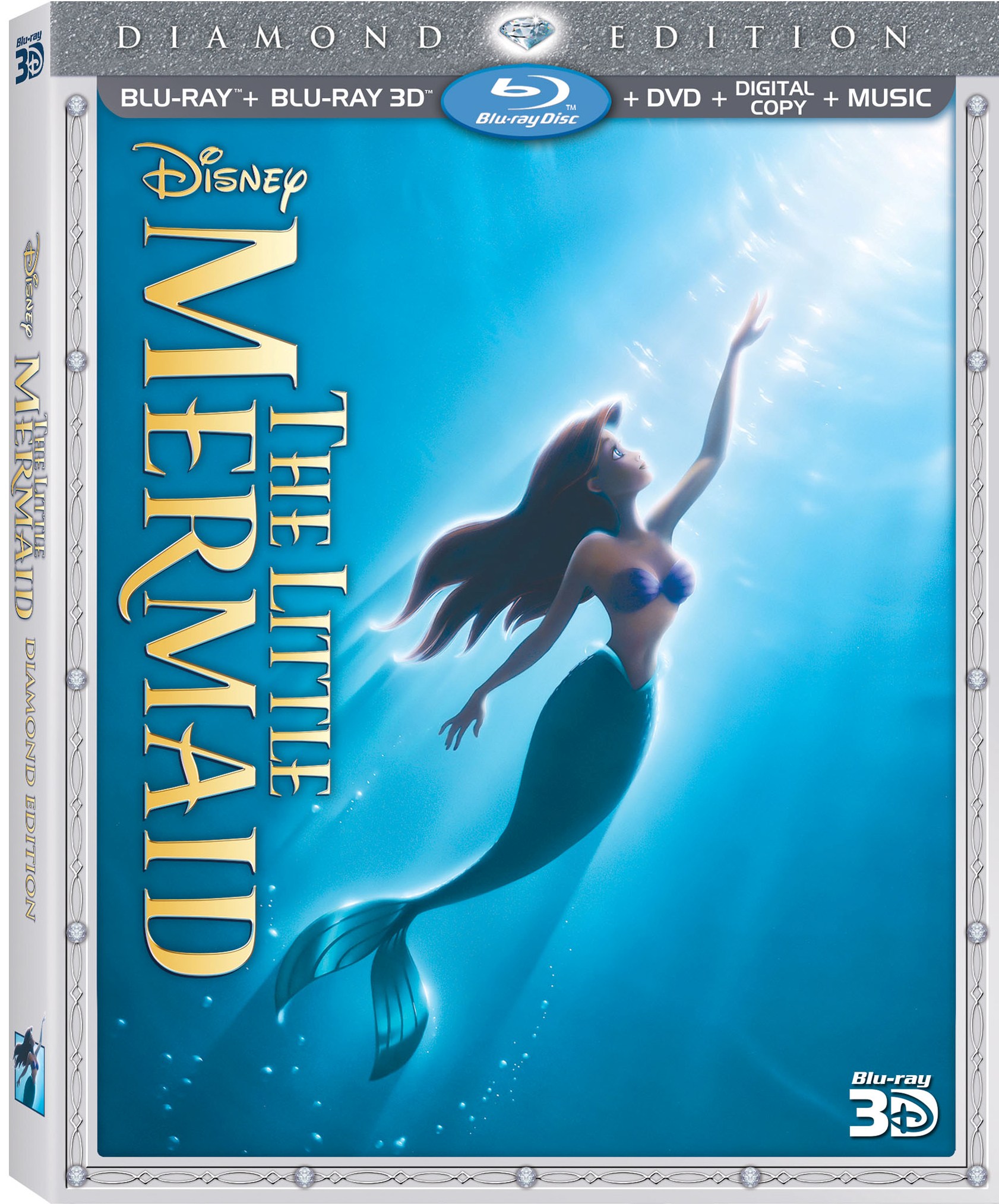
The Little Mermaid (1989)

The Little Mermaid (1989)

Come 1989, Disney was back on top both critically and financially as a movie studio.  Oliver & Company, while not wowing many movie buffs, was a commercial success and one of Disney’s biggest in years while Who Framed Roger Rabbit? was able to secure near universal praise for its combination of animation and live-action.  Even considering the successes enjoyed by those two films, it’s 1989’s The Little Mermaid that is often credited with launching the Disney Renaissance; a new period of creative and commercial success for the venerable studio that utilized a combination of animation and broadway.  After 1989, there was no question who was the king of animation and family entertainment. While it could be argued that Disney was never truly dethroned, it was certainly challenged and the studio struggled to prove that it was still the best at what it did.  There would be challengers in the 90’s, but none that would prove to be worthy adversaries.  Of course, by the close of the decade hand-drawn animation is practically dead and Pixar is a new household name, but the end of the 80’s through to the mid 90’s proved to be traditional animation’s last gasp and one of its finest eras.

The Little Mermaid represents a first for the company, and also a last.  The previously mentioned Oliver & Company, made regular use of music and the broadway element, but it was The Little Mermaid that truly committed to this format.  The music directors for the picture, the late Howard Ashman and Alan Menken, are both veterans of broadway and are credited with steering the The Little Mermaid in this direction.  The film, particularly the first act, is driven by the songs contained within as the film moves from one to another with often little traditional dialogue in between.  This proved so successful that future films adapted this style, but arguably none were as artistically successful as The Little Mermaid in doing so.

The Little Mermaid was the beneficiary of a huge budget, and it shows when compared with the animated films that preceded it.  It was also the first feature-length production to benefit from Disney’s new studio in Lake Buena Vista, FL, then known as Disney MGM Studios (with a theme park to follow, now called Disney’s Hollywood Studios).  It was the last picture to use traditionally drawn animation cells for Disney.  There were numerous amounts of FX added to the picture due to its undersea setting, and some computer effects were used as well here and there.

The Little Mermaid tells the story of Ariel, who finds herself unhappy living under the sea.

The Little Mermaid tells the story of Ariel, who finds herself unhappy living under the sea.

The Little Mermaid, based on the fairy tale by Hans Christian Anderson, tells the story of the young princess, Ariel (voiced by Jodi Benson).  Ariel is the seventh, and youngest, daughter of King Triton (Kenneth Mars), ruler of the seas.  Ariel is a free spirit who is fascinated with the world above which her father forbids her from interacting with.  She is able to sate her curiosity through human artifacts and items found in shipwrecks scattered across the ocean floor until her exploits bring her face to face with a living, breathing human.  Ariel soon finds herself in love with the prince, Eric (Christopher Daniel Barnes), and knowing her father will never allow such a romance to continue, in desperation she turns to the sea witch, Ursula (Pat Carroll), to make her human.  The story is predictable, but satisfying, and Ariel exhibits a lot of the same emotions most sixteen-year-olds are known for which helps make the unbelievable seem believable.  There are several memorable supporting characters to the story.  Flounder (Jason Marin), who does not resemble an actual flounder at all, is Ariel’s companion and the foil to her care-free spirit.  He’s cautious and kind of a worry-wart.  The film makes it seem like he’ll play a large role at first, but he soon fades into the background after the first couple of scenes.  Scuttle (Buddy Hackett), the sea-gull, is Ariel’s guide to the world of humans.  Unknown to Ariel (and Scuttle himself), Scuttle knows practically nothing about humans but she is more than willing to believe anything he says.  Sebastian (Samuel E. Wright), the crab, is the conductor of the royal symphony for King Triton and is also the King’s trusted confident.  Triton charges the Rastafarian crab with keeping an eye on Ariel with the intent being that he’ll get her to forget about the human world.  Sebastian, possessing a big heart, is soon convinced by Ariel’s actions and behavior to aid her in her quest to become human.

The film is home to several excellent supporting characters, with the sea-gull Scuttle likely being a favorite of many.

The film is home to several excellent supporting characters, with the sea-gull Scuttle likely being a favorite of many.

The love story is perhaps the film’s weakest aspect.  The character of Prince Eric is a young man looking for the right girl, though he appears to be in no hurry.  During a thunderstorm at sea, he winds up in the water where Ariel is lurking.  She rescues the prince from drowning and sings to him on a beach while he remains unconscious.  Waking, she flees, and Eric becomes obsessed with finding Ariel.  When Ariel returns as a human, she is without her voice (thanks to a bargain made with Ursula), and the two must fall in love in order for Ariel to remain human.  This being a Disney movie, I don’t think it’s spoiling anything to say that the two do eventually fall in love, though Ariel declares her love for Eric to her father after their first encounter.  It feels rushed, and I suppose it is considering the movie has a run-time of under 90 minutes.  I’ve seen worse when it comes to rushed love stories, but there are many cynics who will roll their eyes at first mention of the word love with this story.

The music, the film’s backbone, is quite good.  I am not a fan of the broadway format, but if a film is going to be overstuffed with songs then they better be good ones.  The Little Mermaid is the beneficiary of three iconic music pieces.  While most other Disney movies seem to only have one or two, The Little Mermaid boasts the trifecta of “Part of Your World”, “Under the Sea”, and “Kiss the Girl.”  “Part of Your World” is Ariel’s big solo number and it’s melody is used during the score as the main theme of the film.  It is returned to many times over, which is good because it’s a simple and very pleasing melody.  “Under the Sea,” the Caribbean sounding up-tempo track, is the film’s most fun moment and song and is likely the favorite of many of the film’s viewers.  “Kiss the Girl” is the slower track and it too boasts an island sound.  Not surprisingly, both are sung by Sebastian.  Ursula gets her own song as well, “Poor Unfortunate Souls,” but I find it to be less lively than the others.  It also drags on for too long.  There are other smaller tracks in the film but they prove to be less memorable, but their bite-sized running time also keeps them from being a distraction.

I probably wouldn’t have much affection for the film if it relied solely on its music.  Thankfully, The Little Mermaid is a fantastic picture to look at (made even better now that it’s available on Blu Ray), and it owes much of that to its setting.  The undersea setting proves to be a visual delight from the first scene.  When the audience isn’t being asked to focus on anything but the visuals, the animators make use of a blur effect to make the film appear as it would if being viewed by the audience if placed underwater.  Once the plot begins, the picture quality is clear and pristine.  Every movement from the characters is accompanied with bubbles and hair is wild and untamed as it floats about.  Most of the locations are depicted with shades of blue giving it a dark, sometimes cold, feeling.  When the picture explodes with color, such as during the “Under the Sea” segment, the juxtaposition with the blues make the picture really come alive and creates a warming effect on the audience.  The above water scenes pale in comparison as the kingdom Eric inhabits is somewhat lacking in personality.  I’m not even sure which part of the world it’s supposed to represent.  The climax of the film is a spectacle to behold with all of its lightning and massive whirlpool.  Ariel and Eric’s confrontation with a colossal Ursula is perhaps rivaled only by Aladdin’s final showdown with the snake Jafar.

The sea witch, Ursula, proves to be another memorable Disney villain.

The sea witch, Ursula, proves to be another memorable Disney villain.

Disney pictures, especially in more recent times, are often criticized for their shallow female leads.  The classic example being Snow White, who confesses in song she’s just waiting for her prince to come and rescue her from her hum-drum life.  Ariel is sometimes criticized in the same way, though perhaps not justifiably.  She’s plucky and strong-willed, and when she wants something she’s willing to make sacrifices in order to achieve her goals.  She is naive, but that comes with being only sixteen.  I do like that it is Ariel, and not Eric, that first takes on the role of rescuer as she saves him from drowning early in the film.  And when it comes time to face Ursula, it’s Eric and Ariel together taking her on.  If there’s room for criticism it’s in Ariel’s perception that she can only be happy if she’s made human and is able to win Eric’s love.  She’s a character with flaws though, which in turn makes her feel more real even if she is part fish. This is in contrast with the Disney princesses of the golden age which were essentially idealized women intended to be presented without flaws. Ariel is even allowed to contort her body into unflattering shapes, something animator Glen Keane was even criticized for doing by the old guard at the company, but something he felt was important to her story.  The film also has some scary moments which may frighten the very young, and Ursula is not some harmless screw-ball villain, but the scare-factor is still pretty minimal.  Parents ultimately know what is best for their kids and the best advice that can be given from an outsider is just watch the film first before exposing your kids to it, if you have concerns.

The Little Mermaid is a crowning achievement for Disney and is justifiably rated highly amongst the studio’s films.  It’s a gorgeous picture with memorable songs and characters that easily stands the test of time.  Despite its lead being a young princess, it’s a film that should have no trouble delighting both boys and girls while keeping the adults who watch it with them suitably entertained.  The Disney Renaissance unofficially began with The Little Mermaid, and I suppose it ended sometime around Mulan or The Emperor’s New Groove.  Amongst the Disney features released in that window, it’s probably second only to Beauty and the Beast.  The Lion King certainly has its admirers, as does Aladdin, but it’s combination of sound and visuals make it number two for me and I wouldn’t argue with anyone who felt it should be number one.


The Black Cauldron

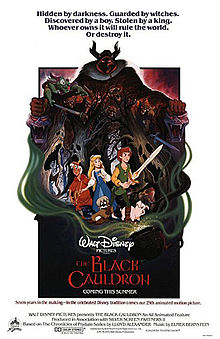
The Black Cauldron (1985)

The Black Cauldron (1985)

The Black Cauldron is one of those movies I wasn’t sure if I had even seen or not.  It’s kind of rare to find a Disney animated movie that I haven’t seen from before 1998, but in the case of The Black Cauldron it would seem I found just such a film.  My only interaction with it had been via the PC game of the same name produced by Sierra around the time the movie came out.  It was a frustrating and terrible game for someone used to Super Mario Bros. and I didn’t like it at all.  Upon doing just some basic research on the film it became obvious why I had never seen it.  The Black Cauldron just may be the most unloved of the Disney animated films to be released.  It was marred by creative differences between those creating the film and Disney Chairman Jeffrey Katzenberg who would have cut the film himself if not for intervention from CEO Michael Eisner.  The film went on to be Disney’s worst performing film at the box office and the film is known less for its merits and more for being Disney’s “rock bottom.”  Because of its failure, it never received a home video release until 1998, more than a decade after its theatrical run.  In spite of all the negativity surrounding the film, I was curious enough to spend a small amount of money on a DVD copy to see it for myself.  I’ve seen plenty of good Disney movies, and I’ve seen some bad ones too, and I was curious to see what made this one possibly the worst of them all.

The Black Cauldron is an adaptation of a Lloyd Alexander book from his Chronicles of Prydain series.  It was directed by Ted Berman and Richard Rich, who together with Art Stevens had previously directed The Fox and the Hound.  I consider The Fox and the Hound to be one of Disney’s weaker offerings, a film with a good heart but a sometimes sloppy execution, so right away I’m not impressed by The Black Cauldron.  The Black Cauldron also makes use of the  xerographic production process that Disney had been using for some time.  It leads to a rough, sometimes sketch-like quality, to the edges of the characters and is a far cry from Disney’s classic look.  For this picture though, which is tonally quite a bit darker than other Disney films, it does add a certain credibility to the look.  Some very early computer-generated effects were utilized as well that surprisingly look pretty fantastic even today.  The effects were used sparingly, mostly for smoke effects, and it really makes the picture pop.  The backgrounds have a very hand-painted look to them that helps add to the mystique of the picture.  The one major drawback I found with the film was with the character animation.  The backgrounds are rich with saturated colors, lots of shadowy holes and dingy dungeons, and the characters look flat against them at times.  There’s often no shading done to the actual characters and it takes away from the overall feeling the scenes are shooting for.  This is a flaw of pretty much all of the Disney animated works from this period, but it’s most obvious here because of the setting where all of the dark areas are lit by torch-fire.  Still, overall I found it to be a very rich experience from a visual point of view, which is certainly a good place to start with any animated movie.

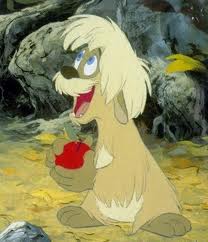
That's Gurgi, whom I kind of hate.

That’s Gurgi, whom I kind of hate.

The score for The Black Cauldron has never really been under fire.  It’s a quality film score and was composed by Elmer Bernstein, which from what I can tell, makes this the only Disney film Bernstein worked on.  The voice acting utilized mostly British talents, and unfortunately, is one of the film’s weak points.  The Horned King, played by John Hurt, sounds appropriately menacing and the creature voices are fairly well done.  The lead, Grant Bardsley as Taran, leaves no lasting impression and I didn’t care for the woman portraying Princess Eilonwy, Susan Sheridan.  I also never really warmed up to the voice of Gurgi, portrayed by John Byner.  It’s not that Byner’s performance was lacking, more that I just didn’t care for the voice they chose to go with for that character (his voice reminded me of Frank Welker’s Slimer from The Real Ghostbusters).

The production values on the whole for The Black Cauldron are pretty good, which is to be expected since it was the most expensive animated film ever produced at the time of its release.  Where the film seems to lack the most is in the plot and pacing of the film.  At a running time of 80 minutes, it’s neither long or short by animation standards.  The general plot revolves around Taran, a teen-aged farm hand who dreams of being a knight, who is tasked with shielding his pig, Hen Wen, from The Horned King.  Hen Wen possesses a special quality that allows her to show her master the future and The Horned King needs her to deduce the location of the black cauldron, an artifact of terrible magic.  Throughout his travels, Taran routinely makes mistakes and overestimates his ability as a warrior landing him in the clutches of The Horned King and his army of goblins and wyverns.  Taran acquires followers along the way, the Princess Eilonwy, the minstrel Ffledwwur Fflam, and the irrepressible Gurgi.  He’ll also encounter witches, pixie like people known as Fairfolk, and, of course, a magic sword.  It’s all rather conventional with The Horned King surrounding himself with an army of incompetent servants who constantly undermine him along the way.  I found Taran to be too cliché to really care about.  The Princess is actually a strong female character, which I could appreciate, while the character of the Minstrel I found completely unnecessary.  Gurgi is intended to be the cute, marketable character who provides some comedic relief.  I already mentioned my dislike for his voice, but I also dislike his look as well.  He looks like a combination of an old man and a shaggy dog which I found off-putting.

Younger audiences may find this one to be a bit too scary.

Younger audiences may find this one to be a bit too scary.

The first half hour, aside from the overuse of fantasy trite, is pretty exciting as Taran finds himself in the clutches of The Horned King, one of Disney’s most horrifying villains and a worthy antagonist.  Upon Taran’s escape, the film lost me as characters seem to be in limbo for the next half hour before the film’s climax.  The climax is actually really well done, with the film’s best animation being saved for these scenes.  There’s even a well-executed “sacrifice” and the film found a way to realistically have the heroes face off with The Horned King that audiences could accept.  Really, if the film could have found a way to make the middle section more interesting it would have gone a long way towards improving the experience as a whole.  There are times for comedic relief along the way, and some of it is contained in the middle parts when the witch characters are introduced.  A lot of film critics seemed to dislike the film for its joylessness when compared with other Disney works, but I actually though the film did a decent enough job of balancing the humor and drama.  It’s certainly a film meant to be more of a thriller than a laugher, but joyless it is not.

The Black Cauldron may or may not be the worst animated film put out by Disney.  I can’t say for sure as I haven’t seen every film the studio produced, but I have a hard time believing it truly is the worst.  The 1970s and 80s for Disney really were dark times for the studio as it struggled to recapture the old Disney magic and The Black Cauldron fits in among those works.  It really is no better or worse than most of Disney’s films from that time period like Robin Hood or The Rescuers.  It has things it does well, and things it does not so well.  Because it is a bit more serious and contains some menacing characters, it’s more similar to some of Disney’s older works than even the modern films.  The Horned King and his minions are characters intended to frighten young children, much like Monstro and Maleficent.  If you’re thinking of buying this for your four-year old, you may want to watch it alone first.  If you’re an older animation fan like myself and you’re curious about this picture, I say give it a look if you have the 10 bucks or so to spend on a DVD.  You’ll likely find a plot that is lacking, but the visual experience makes the minimal investment worthwhile.


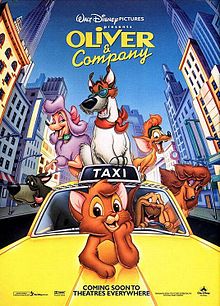
Oliver & Company

Oliver & Company (1988)

Oliver & Company (1988)

Memories are a funny thing.  What we choose to remember and forget really isn’t up to us.  The brain just kind of erases and deletes things as it sees fit without any conscious thought or action.  And when it comes to what we see and how we perceive our world, the brain has more say in that than we are often aware.  The eyes allow one to see, but it’s the brain that has to decode the feed like a receiver and actually tell the body what is there.  As a result, we can often remember things not how we saw them, but how we perceived them.  It gets really interesting when trying to recall a first memory. I have a few that could be considered my first memory and they’re all from around age 2.  The thing is though, I don’t know if these memories are real or if I’ve created them in just trying to reach back or from hearing a story.  It can be kind of wild to really think about it, and perhaps I’m better off just accepting what my brain says are my earliest memories.

One early memory I’m pretty confident in is my first trip to a movie theater.  I don’t know what went into it, where it was, or even what we did when there, but I do know that the first movie I ever saw in a theater was Disney’s Oliver & Company.  Oliver & Company came out in 1988 so I would have been around 4 years old.  Now everyone is used to films coming out on DVD or Blu Ray around six months after a film debuts in theaters.  When I was a kid this was not the case at all.  Some were released in about a year, but with Disney it was several years or not at all.  Disney spent a ton of money on its animated films and many did not turn a profit during the initial theatrical run.  Disney banked on theatrical re-releases to stay afloat so the company was very careful in what it released for the home market.  This philosophy was in place until The Little Mermaid was released and the home video market was thriving.  At that point, Disney had made a bunch of money already off the film and figured to make a whole lot more if it was available for Christmas.  The Little Mermaid was the film that followed Oliver & Company.  As such, Oliver & Company didn’t see a home video release until 1996, long after I stopped caring about Disney movies.

The film starts off like it might be a buddy flick with Oliver and Dodger before the cast is eventually expanded upon.

The film starts off like it might be a buddy flick with Oliver and Dodger before the cast is eventually expanded upon.

Because of Disney’s home video release schedule, when I sat down recently to watch my newly purchased copy of Oliver & Company on Blu Ray it was the first time I had seen the movie since I was four years old and in a theater for the first time.  It was kind of a surreal experience as I watched this film.  There were things I remembered, like Tito’s “Hey man, check it out,” line, and there were things I forgot I remembered like Dodger’s memorable “Why Should I Worry?” song.  There were also many things I had completely forgotten.  Before I sat down to watch the film a second time I could not have even begun to speculate on what the villain looked like.  I probably would not have remembered the name of the little girl (Jenny) and I certainly would not have been able to recall any of the names of the other dogs in the picture.  In many ways I felt like I was seeing the film for the first time, but there was an old familiarity there as well that created a rather warm experience.

Oliver & Company is probably not a film remembered by many.  I wasn’t even aware of the Blu Ray release and I’m someone who is pretty plugged into these kinds of things.  That’s not to say the film isn’t noteworthy for a few reasons.  Most notably, it was the film that basically laid the groundwork for all of the Disney animated features to follow.  Films that would prove to be far more successful than Oliver & Company (not that Oliver & Company wasn’t a success, it just wasn’t as big as the films to follow) like Beauty and the Beast and The Lion King.  It was the first to really utilize that Broadway format of interspersing narrative and song in a very MTV like fashion.  Sometimes the plot feels almost ancillary, as if it exists simply to move the film to the next music video.  I’m not a fan of this approach, and as a result, I tend to prefer Disney’s older films to the modern ones but there are films that are able to succeed with this approach.  Oliver & Company does, but on the most basic level.  It’s harmless entertainment and it has a good heart but there’s no deep undercurrent to the plot or there really aren’t any big visual moments.  The villain of the film is only ever lurking on the periphery.  He’s menacing, but not on the level of any of the big villains to follow.  This is partially due to the film’s short running time (74 minutes) and due to the fact that the story is a fairly simple one.

Marin's Tito ends up being the star of the film.

Marin’s Tito ends up being the star of the film.

The protagonist of the film is a small orange kitten named Oliver trying to find a place for himself in the world.  As indicated by the title, this is an adaptation of Dickens’ Oliver Twist but only loosely so.  There are quite a few celebrities on the cast for this one including a young Joey Lawrence as Oliver.  Billy Joel plays Dodger, a street-wise dog who is basically the alpha of a pack of thieving canines doing the bidding of the mostly harmless thief Fagin, played by Dom DeLuise.   Cheech Marin plays Tito, the wise-cracking chihuahua and Bette Midler is a pampered poodle named Georgette.  The cast does a good job with what they are given with Marin probably showing the best.  The music is obviously a big part of the picture and the opening number “Once Upon a Time in New York City” is performed well by Huey Lewis.  Joel’s number “Why Should I Worry?” is the star of the film.  It starts off as a smooth jazz number before the heat gets turned up.  It’s infectious.  The rest of the musical numbers fall pretty flat though.  Midler’s “Perfect Isn’t Easy” is supposed to be another big number that makes use of some early CAD technology but it just isn’t there.  The film kind of meanders along for the last half of the picture as a result.

Visually the film resembles a lot of the other Disney works that utilize the Xerox technology that debuted with One-Hundred and One Dalmatians.  The edges of the characters are rough and sketch-like.  Some of the backgrounds are as well.  It works when the film is trying to present some of the grimier locations in New York but it doesn’t work for the glitzy Times Square.  Disney’s animation, like its profits, took off after Oliver & Company and the company was willing to invest a bit more into each successive picture.  This isn’t a bad looking movie and it has its own visual charms, but it does lag behind Disney’s better works.

Oliver & Company is a really unremarkable movie but one that does hold a lot of nostalgic value for me.  If I didn’t have such a unique relationship with it I probably would not own it.  That’s not to say that it’s bad or anything.  I did enjoy watching the film for what it is, but it is mostly disposable entertainment.  For adult animation fans, this is hardly essential viewing, but if you have kids that will consume anything Disney then they will have some fun with Oliver & Company.


The Best of Pixar

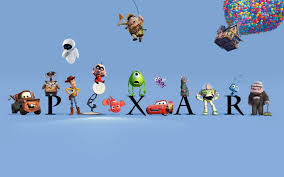
DownloadedFile-22In honor of the recently released to theaters Monsters University, I thought it would be fun to look back on the feature-length films put out by Pixar Animation Studios (in conjunction with Disney) and come up with a top 10.  This proved to be a pretty difficult task and I consider this list, especially the top 5, to be quite fluid.  Pixar has really eclipsed Disney as the premier creator of animated films.  It could be argued that before it, Japan’s Studio Ghibli had knocked Disney off the top of the mountain but Pixar now stands tall over all.  And while their output has dwindled in quality just a tad bit lately, it seems like the studio is likely to maintain that status for at least a few more years.  This list is not going to give each film the space it deserves, or else it would run into the tens of thousands of words.  I also want to add that I do not think Pixar has made a bad film yet, though I also have not seen Cars 2 which has been the worst reviewed film put out by the studio.  I didn’t see it because I didn’t really care for the original, though I didn’t hate it or anything.  I also did see Monsters University this weekend, and while I don’t think it makes their top 10, it was enjoyable entertainment.

10. Brave

Brave is hindered by that fact that it’s one of the more recent films put out by Pixar so it hasn’t had as long of a time to leave a lasting impression (and as you can imagine, nostalgia points count).  Brave is a refreshing take on the princess genre and Merida is a very likable and easy to root for character.  The visuals are splendid and the conflict unique, though the setting and style is perhaps a bit too similar to the previously released Dreamworks film How to Train Your Dragon.  This is a film I plan to revisit and I expect my appreciation for it will only grow from here.

9. The Incredibles

Perhaps a controversial selection as I know The Incredibles is a favorite for many.  For me, I absolutely love the concept of a super hero family and this was probably my most eagerly anticipated work from Pixar.  Perhaps it was the weight of expectations that resulted in my initial disappointment.  It just didn’t resonate with me the way I thought it would.  I very much enjoyed the Mr. Incredible character, but the rest of the family didn’t appeal to me as much.  The film is also a little overstuffed and could have used some trimming.  Every time I re-watch it I wonder if this is the viewing that will make me fall in love with it, but so far that hasn’t happened.  Despite that, I still look forward to the eventual sequel and will continue to enjoy the in-jokes thrown at comic book fans.

8. Toy Story 2

Toy Story was such a smashing success that it made sense for a sequel to follow.  Because these films take so long, Pixar first released A Bug’s Life before getting to Toy Story 2.  Serving as director for all three feature-length films was John Lasseter, who wisely realized he couldn’t expect to continue to direct everything put out by the studio.  Toy Story 2 is an excellent sequel that contains enough of what made the original so memorable without feeling like a re-tread.  Visually, it is far superior to the first.  Some people seem to prefer it to the original, but for me I enjoyed the plot from the first one more and found the end chase more thrilling than the sequence that closes out this one.  This one is still great though, and Jessie’s song is really well done, making Toy Story one of the best franchises in recent memory.

7.  Ratatouille

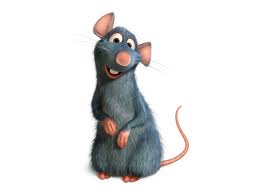
Remy is one of Pixar's best creations.

Remy is one of Pixar’s best creations.

This where the list starts getting hard for me.  I didn’t have much trouble ranking the first three, but now we’re getting into the films I truly love.  Ratatouille is a clever tale about a rat named Remy, who is one of the most well-crafted of any of Pixar’s leads.  He’s interesting, flawed, likable, and well-acted by the animators and voice actor Patton Oswalt.  This one isn’t as emotionally heavy as some of Pixar’s other films, but it is so much fun and it’s still a treat to experience all of Remy’s highs and lows.  I feel like I could watch this film every day and not get sick of it.

6.  Toy Story

The one that started it all.  Toy Story was a marvel when it was first released in 1995.  At that time, no one really thought computer generated images could captivate in the same way as hand-drawn animation and we were all proved wrong.  While I will always prefer more traditional animation, I both love and appreciate what today’s artists are capable of with CGi.  Toy Story doesn’t look as good now as it did back then (especially the dog and human characters), but that doesn’t detract from the wonderful and clever story about what goes on in the toy box when kids aren’t around.  It’s an easy to grasp concept and one that offers so many possibilities for visual gags and story potential.  The Woody (Tom Hanks) and Buzz (Tim Allen) rivalry is played up so well that it’s a shame it’s not as heated in the sequels.  Toy Story is a modern classic that is sure to delight and captivate audiences for generations to come.

5.  Wall-E

Wall-E is a rather bold film when one considers its audience.  The first act is absent of any dialogue as we explore a ruined earth with only a mute little robot to guide us.  It’s thru director Andrew Stanton and the supremely talented animators at Pixar that we’re able to connect and care about this little robot.  Wall-E, despite being a robot, is able to convey so many human emotions thru just the movement of his telescope-like eyes and limited vocalizations.  The film’s only weakness is how effective these early scenes are in comparison to the easier to follow scenes in space where humans dwell.  Some thumb their noses at the conservationist tone taken by the film, but I found it to be good satire and consider Wall-E a true treasure amongst american animation.

4.  Toy Story 3

I can’t say I was all that excited for another sequel for Toy Story, even though I very much enjoyed the first two.  I was so wrong when I finally sat down and watched Toy Story 3 and found myself completely blown away.  I didn’t realize how much I wanted to see the world of these toys explored with better technology over what was available for the first two.  The world popped and is an absolute feast for the eyes.  That wasn’t exactly a surprise, but the fact that the film had a plot that appealed to me even more than the first two is what truly shocked me.  I fell in love on the first viewing, and the additions of Michael Keaton and Ned Beatty to the all ready stellar cast was the cherry on top.

3.  Monsters Inc.

We have officially entered the splitting hairs section of my list.  1-7 was hard, 1-5 was harder still, and 1-3 feels almost pointless.  On any given day, any of these next three could be cited as my favorite from Pixar, but I’ve settled on this order for today.  Monsters Inc. was the first of the Pixar feature-length films to not be directed by Lasseter.  Pete Docter oversaw this one and would establish an ability to really make an emotional connection with the audience.  Monsters Inc. is kind of like a buddy comedy with leads Mike and Sully (portrayed by Billy Crystal and John Goodman), only in a fantastic setting.  The world of the monsters is fully realized and more than just a little clever.  This is the first CGi film I can recall where so much hair, or fur, was included and the results are spectacular.  It’s the addition of the Boo character though, that puts it over the top and gives it the weight I mentioned earlier.  This film’s ending is so perfect, it gets me every time.  I’m not sure if it’s not my favorite ending to any movie ever.  I love it!

2.  Finding Nemo

A lot of these films were all conceived around the same time.  I get the sense that the powers that be at Pixar decided on a bunch of worlds they wanted to see animated and went off of that.  Finding Nemo is Pixar’s undersea adventure and the results are breathtaking.  The world is so simple yet so complex, it is probably the film that benefitted most in the switch from DVD to Blu Ray of any other I’ve seen.  All of Pixar’s films are incredible looking, but Finding Nemo contains one of the more heart-warming father-son stories contained in any piece of entertainment.  And outside of that plot, the characters encountered along the way are amongst Pixar’s most memorable.  Whether it’s the possessive seagulls, laid-back Crush, or the unforgettable Dory, there’s something amazing in every scene.  I’m so glad that Pixar has chosen to revisit this world, even if it has no chance of matching up to the original.  Though Pixar has proved me wrong before.

1.  Up

The odd paring of the aged Carl with the youthful Russell paid off for Pixar.

The odd paring of the aged Carl with the youthful Russell paid off for Pixar.

If Wall-E was considered a bold move for a family movie, then what does that make Up with its octogenarian for a lead?  I suppose the marketing and merchandising department was disappointed when it found out that Carl Fredricksen (Ed Asner) action figures weren’t likely to generate the kind of revenue Disney is used to, but I like to think they were okay with that once they saw the film.  Up is a wonderful piece of animation, and if Pete Doctor’s previous directorial effort Monsters Inc. is considered weighty, Up is a virtual anvil.  The montage that takes place at the beginning of the film which sums up the life of Carl and Ellie is wonderfully moving, and like Wall-E, done so without any dialogue.  The sequence is masterfully done, and if viewers found it a bit too sad then I hope the rest of the film makes up for it.  The main plot pairs up Carl with the youthfully exuberant Russell.  This odd-couple pairing can be forgiven for being too obvious because it’s executed so well. The emotional response generated by this film seems so authentic, and it’s the rare animated film I can honestly recommend to viewers of all tastes.  And then there’s Dug.  Dug, who resembles no dog from the real world and yet makes me think of every dog I’ve ever met (any nice dog, anyways).  His mannerisms and thoughts are so spot-on it makes it seem like an easy thing to so faithfully convey a dog’s emotions, but it’s really not.  Up is absolutely wonderful, and not just among my favorites put out by Pixar or Disney, but one of my favorite movies of any I’ve seen.  It will take a lot from Pixar to top it, but I hope they like a good challenge.


The Chronological Donald Volume One

The Chronological Donald Volume One

The Chronological Donald Volume One

Mickey Mouse is the character that launched an empire.  When Walt’s darling little mouse took to the screen he captured the hearts of millions of movie-goers in the 1930’s, adult and children alike.  And even though he’s no longer a big part of Disney’s animation output, the theme parks and other merchandising have made sure that Mickey has never faded far from the spotlight. His earliest exploits though are thematically different from what is presented as Mickey Mouse today.  Sure the obvious distinction of Mickey no longer appearing in black and white is clear, but it’s his character traits that are most notable.  In his earliest days, Mickey was more like Bugs Bunny in that he was a bit of a trouble-maker.  He was never on Bugs’ level in that regard, but he did partake in things some parents were not overly fond with.  The cartoon that famously introduced the character Pluto, “The Chain Gang,” begins with Mickey in prison, of all places.  He smoked, he drank, and he could be a bit of a jerk in those old cartoons.  Walt Disney, after hearing the complaints from some parents, decided he needed Mickey to be the face of his company, and as a result, he needed to clean him up just a bit.  His cartoons still needed the characteristics he was about to excise from Mickey, so he took them (and then some) and applied them to a new character, an anthropomorphic duck he named Donald.

Donald took off like a rocket.  His easily irritable and temperamental nature made him a hit with fans who either rooted for him or against him.  His tendency to exhibit wild mood swings added a charge of electricity to his cartoons; fans knew the tantrum was coming, they just didn’t know when.  At first, Donald appeared alongside Mickey for the most part, but soon his popularity earned him his own series allowing him to surpass Mickey himself in terms of popularity.  To date, no other Disney character has appeared in more cartoons than Donald and he’s appeared in more comic strips than any character who doesn’t wear tights and fight crime.  Donald Duck is recognized all over the world and has become an institution, so it should come as no surprise that he has several DVD releases in the Walt Disney Treasures line as well.

I love Donald and always have.  I liked Mickey too when I was a kid, and I always had a fondness for Pluto, but Donald was my favorite.  He’s just an inherently funny character and a lot of that comes from the performance of Clarence “Ducky” Nash, Donald’s voice actor from the 1930’s thru to the early 80’s concluding with Mickey’s Christmas Carol.  That semi-intelligible voice is perfect for the character.  It sounds like something that would come from a duck, if a duck could speak.  Of course, that impression may only exist because Donald has been around for over 70 years but that certainly must have been the sentiment when Nash was awarded the role.  Sometimes it’s nearly impossible to figure out what Donald is saying, but that adds to the humor.  Early on, other duck characters that would appear in Donald cartoons, including Daisy, would speak like Donald but overtime that was dropped.  Donald’s nephews, Huey, Dewey, and Louie, exhibited a lesser but similar speech pattern until DuckTales when they were basically made to speak somewhat normal.

Sharks find ducks tasty.

Sharks find ducks tasty.

The Chronological Donald was released in four parts from 2005-2008.  As the name implies, the shorts appear in chronological order beginning with Donald’s debut from the Silly Symphonies series “The Wise Little Hen.”  This makes Donald the rare character to debut in color before black and white.  His first appearance with Mickey came in the short “Orphan’s Benefit” which can be found on the set Mickey Mouse in Black and White.  It would have been nice to have it here too to mark the occasion as several other sets contain overlapping cartoons, but oh well.  After “The Wise Little Hen,” the rest of the shorts are Donald cartoons though he wasn’t officially given his own series until 1937 with the first short being “Don Donald.”  Mickey doesn’t appear in any of these cartoons (with the exception of one brief cameo), but Pluto and Goofy make appearances as Disney seemed to enjoy pairing Donald with those two.  This set also contains the debut of Donald’s nephews in the cartoon appropriately titled “Donald’s Nephews.”  We’re also introduced to Donald’s cousin Gus in one short who never made another appearance that I’m aware of.

For the most part, these shorts try to put Donald in a new role in each one.  That role is either an official one like “Officer Duck” or making him a golfer or a celebrity chaser.  Some of the ideas repeat, such as “Donald’s Ostrich” and “Donald’s Penguin.”  There’s repeating gags too, of course the most famous being Donald’s tantrum where he thrusts out one arm and swings the other while hopping up and down.  If he doesn’t assume this pose in every cartoon, well then he does in almost every one.  It’s hard for me to choose a favorite, as several shorts here are ones I’m familiar with from my childhood so they have a nostalgic quality for me.  “Sea Scouts” is one where Donald and his nephews are sailors and have to contend with a shark.  It’s a mostly slapstick affair with a great sequence of Donald trying to keep from getting swallowed by the shark.  “Beach Picnic” is another where Donald finds his water float to be uncooperative and Pluto finds himself victimized by the irascible duck.  This cartoon also contains the Pluto fly paper gag, one that shows up in several other cartoons.

This set was created before the vault concept was created for this series.  For those unaware, the vaulted cartoons are ones that contain offensive material.  Leonard Maltin is the host for the set and he does comment on some of the shorts.  The most common bit of offensive material is stereotypical portrayals of native americans.  Anyone around the age of thirty who grew up watching old Warner Bros. shorts or Disney cartoons (including feature-length films such as Peter Pan) should be familiar with this kind of material.  I don’t tell people how to raise their kids so if you’re not familiar with this kind of stuff and are weary about showing it to your kids do some research.  In the case of Donald Duck shorts, a great many can be viewed on video sites for free making it easy to preview the material first.

Things rarely end well for Donald.

Things rarely end well for Donald.

Of course, if you want to purchase such a set for your kids know that it isn’t easy.  Disney only released a limited amount figuring only collectors and Disney diehards would be interested so walking into a store and simply buying a set of Donald Duck cartoons is basically impossible.  Volume One was produced in larger numbers than others but still can command a hefty price.  Amazon has it currently priced at $65 and volume two at $54 with volumes three and four jumping over $100.  I don’t know if they’re worth it, but if you do love Donald and want some of his cartoons you will find this to be a quality set.  The DVDs came housed in a plastic DVD case which in turn is packaged in a silver tin.  The only negative to the packaging is that the tin can be prone to denting in the shipping process.  The cartoons look great for the most part, especially when one considers how old they are.  Some have survived better than others and it shows on some with the usual white Donald being a little dingy or sometimes yellowed.  The quality of the animation can’t be dulled by age though, and if anything, it only looks more impressive in today’s age where a lot of animation is low-budget or computer generated.  Hand drawn animation is practically dead and this set certainly helps to bring the viewer back to the golden age for animation.  Animation fans and Disney fans would do well to track these sets down.  I own three of the four, and the completest in me likely demands that I eventually get the fourth.  I’ve watched them all and on a lazy Sunday morning it’s not uncommon to find me on my couch with a cup of coffee and Donald Duck playing on my TV.

The shorts:

  • 1934
    • The Wise Little Hen
  • 1936
    • Donald and Pluto
  • 1937
    • Don Donald
    • Modern Inventions
    • Donald’s Ostrich
  • 1938
    • Self Control
    • Donald’s Better Self
    • Donald’s Nephews
    • Polar Trappers (with Goofy)
    • Good Scouts
    • The Fox Hunt (with Goofy)
    • Donald’s Golf Game
  • 1939
    • Donald’s Lucky Day
    • The Hockey Champ
    • Donald’s Cousin Gus
    • Beach Picnic
    • Sea Scouts
    • Donald’s Penguin
    • The Autograph Hound
    • Officer Duck

Walt Disney’s Lady and the Tramp

Lady and the Tramp (1955))

Lady and the Tramp (1955)

It wasn’t my intention to double-up on the Disney posts but with it being Valentine’s weekend why not take a look at one of Disney’s most famous love stories?  It’s kind of funny that arguably Disney’s best stab at a love story involves two dogs considering all of the prince and princess relationships they’ve produced over the years.  There’s something special and endearing about the romance of Lady the cocker-spaniel and that loveable Tramp.  I think it has a lot to do with the fact that most people like dogs and this movie was clearly worked on by such people.  It gives the story a genuine feeling.  There’s often a feeling of audience manipulation with these Disney tales be it the need to be a good boy found in Pinocchio or the importance of growing up in Peter Pan.  Lady and the Tramp isn’t so obvious with its message, if it has one.  It’s one of the simpler tales produced during Disney’s prime years, along with Dumbo, and some of that is likely due to it not being based on a popular tale of old.  Lady and the Tramp is just a nice piece of entertainment, and one of my favorite Disney movies to date.

Incidentally, the fact that Lady and the Tramp wasn’t based on a well known story made Walt Disney nervous.  He felt that audiences would be less interested in the film as a result so he made sure a novelization was released before the film.  There was also a Disneyland TV special that aired before the movie premiered and basically went over the entire plot (this is included on the DVD and Blu Ray release, for those interested) scene for scene.  I don’t know why Disney felt that way, but it does seem odd to me.  I’ve also considered it one of the film’s strengths that it’s not a retelling of a popular fairy tale.  Those stories are well and good, but there’s little surprise for even younger viewers.  Also surprising is that the film was not well received initially.  Audiences gobbled it up but critics hated it, even panning the artwork.  Such a notion seems shocking to me when I watch it today and it seems like all of the critics that hated it either changed their mind or are dead.

If the puppy Lady sequence doesn't warm your heart then you simply have no soul.

If the puppy Lady sequence doesn’t warm your heart then you simply have no soul.

Visually, Lady and the Tramp is a remarkable picture.  Disney artists have become famous for their attention to detail when it comes to drawing animals.   Look up the making of pretty much any such picture from them and you’ll find the artists drawing from real life as they observe their subjects.  They’ve been doing it for years and it becomes clear why when watching any such film because the animals move and react in fantastic ways.  The common and expected movements of walking, sitting, begging, running, and so on are spot on for the canines in this film.  The subtler ones are also perfect such as when Lady is confused or is trying to get her beloved Jim Dear’s attention.  The animators also clearly want the audience to experience this world as the dogs do.  Every scene is from a dog’s point of view as Lady’s home is always displayed at floor level.  It’s rare to see a human’s face and often the people in the background are still paintings.  The animators want you to focus on the dogs, the humans are just ancillary.  Lady and the Tramp is also noteworthy for being the first animated feature to be shot in wide-screen Cinemascope.  This is a plus as it gives us even more artwork to take in!  Whether it’s the dogs themselves or the lovingly painted scenery, this film is a feast for the eyes.

These cats are jerks.

These cats are jerks.

Disney films are often as famous for their visuals as they are their songs.  Lady and the Tramp is more subtle in its use of music but is fantastic in its execution.  The music all works within the narrative and even after immediately watching it I have to think hard to remember when the film breaks into song.  That’s because it’s used so effectively and works with the picture as opposed to being an in-film music video.  One of the more popular spots for song is the introduction of the siamese cats (“We are siamese if you please,”) which is short and effective and sure to stick with you.  The most famous song though is easily “Bella Notte,” the song sung to Lady and Tramp by the italian restaurant owners during their iconic scene.  I’m not sure if there’s a more famous scene in any other Disney feature than the one where Tramp and Lady share their famous plate of spaghetti.  Describing the scene to someone who has never seen it is futile.  It sounds cute but utterly ridiculous.  The scene was shot and animated with such care though that it works.  It will charm you the first time you see it just as much as the fiftieth.

The animators had no trouble getting these dogs to display a wide range of facial expressions.

The animators had no trouble getting these dogs to display a wide range of facial expressions.

The film looks great, the film sounds great, but it wouldn’t be anything without a good plot.  Lady and the Tramp was a combination of storyman Joe Grant’s own tales about his English Springer-Spaniel and a short story Disney himself enjoyed called “Happy Dan, the Whistling Dog.”  It’s a tale about two worlds colliding as the upscale Lady falls in with the lowborn Tramp.  Tramp is a tramp of his own choosing apparently and rather enjoys his carefree lifestyle where as Lady can’t imagine life without her masters, Jim Dear and Darling (if Lady is aware of what their real names are she doesn’t let on).  Lady is introduced in the film’s first scene as Jim presents his wife with a Christmas present containing her.  The sequence that follows is perhaps the film’s best as we see the young couple get introduced to life with a puppy.  Jim wants to be stern with Lady on her first night and establish a nightly pattern where as Lady just wants to sleep with her new mom and dad.  Lady, of course, wins out and gets accustomed to life as the center of attention in the household.  It’s not until Jim Dear and Darling are expecting their first child that she gets a peak at what life could be like as second fiddle.  This is how Tramp is able to work his way in initially, and when Aunt Clara comes to babysit and views Lady as a nuisance, Tramp is there to seal the deal.  Lady gets a taste of what life is like for Tramp, the good parts and the bad, and our budding lovers are forced to confront their differences and Tramp is shown he needs to change if he wants to win the heart of his Lady.

Some Disney stories are scary and some are even sad, but Lady and the Tramp shuns most of these conceptions and remains a mostly fun picture with a very warm and happy outcome.  There are some scenes featuring action and suspense that may be a little frightening for young children, but this one is pretty tame by any standard.  Dog lovers will especially fall in love with this picture as it’s practically a love letter to our canine compadres and really only presents them in a favorable light.  Maybe those who do not have much affection for dogs will find this one harder to enjoy than others, but for my money this is one of Disney’s most watchable films and belongs in any movie collection.