

When it comes to Christmas themed cartoons featuring Popeye, I’ve somehow managed to work backwards. We’ve looked at two previous Popeye cartoons that center around the holiday, but today’s Christmas short is Popeye’s very first. It comes to us all the way from 1933 where it premiered as just the fourth Popeye cartoon. I don’t suppose Popeye is quite the household name he was even as recently as the 1990s. He was always on television in some form or another in fairly prominent timeslots where he would be exposed to kids. I know I saw my share of Popeye cartoons as a kid and he was basically the only reason I’d even consider eating something as nasty as canned spinach. Seriously, what were we thinking? Fresh spinach is just fine by me, but that stuff out of a can is rancid.
Nevertheless, Popeye has probably done wonders for the spinach industry to the point where it’s probably incalculable. And if you’re familiar with Popeye then you’re also probably familiar with why it was spinach that gave him super powers. In 1870, chemist Erich von Wolf misplaced a decimal leading him to publish his findings that spinach contained 35 milligrams of iron per 100 gram serving when in reality it should have been 3.5. That lead people to believe that spinach really was some kind of super food and a terrific and efficient source of iron. It was a discovery that was not corrected for some 70 years which, come then, Popeye was well-established as a comic and film star who gains powers from the wonderful iron-enriched plant. And his choice was always to consume it from the can, sometimes via his pipe, which just adds another dimension of nastiness to the whole thing.

Popeye cartoons were always a source of fun for me as a kid because there really wasn’t much to them. Popeye usually ran afoul of his rival Bluto somehow which would lead to fisticuffs. Sometimes they feuded for the attention of Olive Oyl, someone who is not really portrayed as conventionally attractive, but maybe in the world of Popeye she’s quite the catch? It’s not like Popeye is much of a looker. She also gets to be a stand-in for classic rubber hose animation as while Popeye’s dimensions don’t really adhere to that old style, Olive Oyl’s certainly do. Other characters were added to the mix, but for the most part Popeye cartoons are about Popeye and Bluto warring over Olive Oyl with one of the two more than willing to put her in some state of distress when he didn’t get his way. I bet you can guess which one that was.
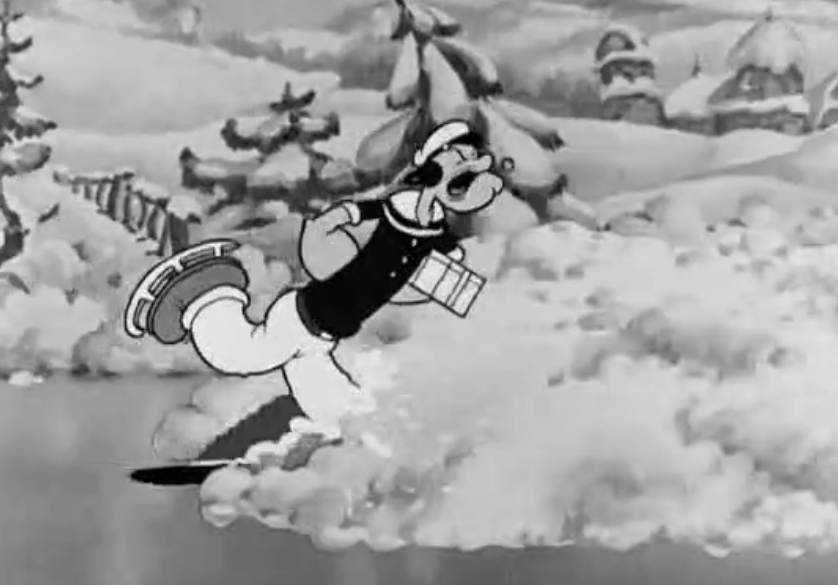
Seasin’s Greetinks begins with our titular character (William Costello) singing his own theme song as he ice skates through the snow with a wrapped gift under one arm. The snow gets comically deep as he’s up to his neck, but because he’s strong to the finish and all that, he skates through it like nothing. When he breaks through he comes to a house with a farmer’s porch on the front that is absolutely buried in snow. With the final toot of his song through his pipe, Popeye is able to blow all of the snow away clearing the porch and granting him access to the front door. We can see by way of the mailbox that this is Olive’s home. As Popeye stands and knocks on the door he bobs up and down as animated characters often did back then, but his eyes are focuses elsewhere so when Olive (Bonnie Poe) answers the door he doesn’t even notice and wraps his knuckles on her forehead. She angrily kicks him in the butt and maybe it’s this feistiness that Olive possesses that really does it for Popeye?

Popeye isn’t bothered and instead presents the Christmas present he brought for Olive. Her mood immediately improves and the gift is opened and shown to be ice skates. They’re the kind that go on the bottom of existing boots and Popeye hammers them onto Olive’s feet as if she were a horse even adding a “Whoa,” as he does so emphasize this comparison. To her credit, Olive does not mind the rough treatment and seems legitimately delighted with the gift. That is, until she tries to stand. Then her rubber hose arms and legs begin flailing and she isn’t even on the ice yet. The background changes without disturbing the characters to replace the porch with a frozen pond. As Olive struggles, Popeye skates effortlessly around her to inspect her form. He grabs her by the waist to steady her and then starts skating and as he does he’s pushing Olive. She begins to relax and starts displaying better form as she enjoys gliding across the ice.
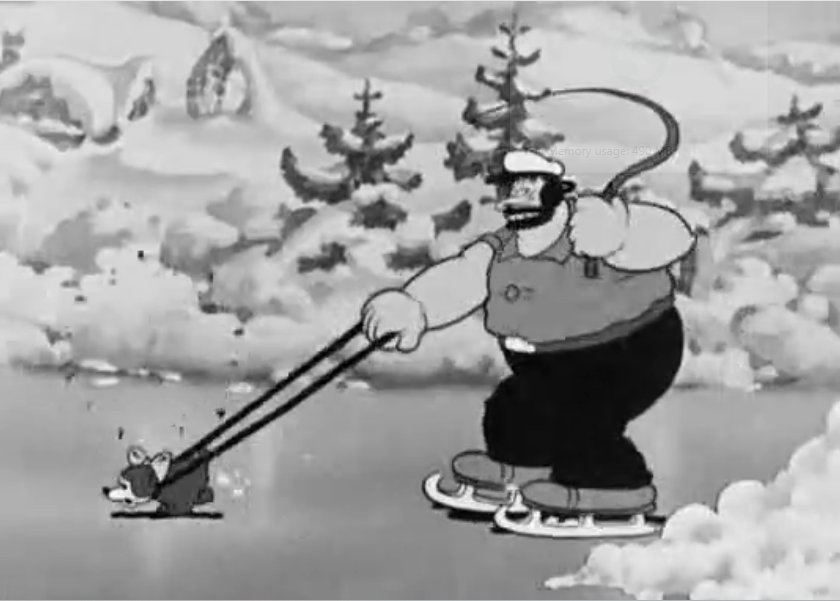
Elsewhere, Bluto (William Pennell) is moving along through the snow. The banks are about waist high on the big, round, fella and he’s holding onto some reigns and whipping whatever is in front of him. When he clears the snow banks we see he’s actually holding onto the leash of a comically small dog and whipping it as it pulls him across the ice on his own pair of skates. As he whips the dog he grumbles and cackles like a true villain, but in typical Popeye fashion his mouth doesn’t move at all. Meanwhile, Popeye has let go of Olive without her noticing. She’s skating perfectly fine without assistance, but once she does realize she’s no longer being held onto she starts to flail again. Bluto notices her go by and he lets go of his dog to use his whip to ensnare Olive around the waist and pull her in close. She is not at all interested and immediately starts wailing on the creep.

Popeye skates over obviously not willing to let this guy manhandle a woman, let alone his woman. Bluto, ever ready for a fight, tosses Olive to the ice to square-off with Popeye. Bluto knocks Popeye right in the chin with an uppercut which knocks off his hat. Popeye stands there slightly punch-drunk a moment, adjusts his hat and pipe, and then uppercuts Bluto right into the snow where he leaves behind a Bluto-shaped hole. Popeye and Olive then skate off arm-in-arm while Bluto is forced to utilize a ladder (where was he keeping that thing?) in order to get out of the hole Popeye left him in. He’s quite literally hopping mad as he announces that Popeye won’t get away with that one.

Popeye and Olive have retreated to another part of the lake where Popeye, perhaps feeling the effects of that blow from Bluto, decides to take a seat on a rock while Olive continues to practice her skating. She loses her balance and falls on the ice and her butt goes right through. Popeye springs into action to help her out, but once she’s standing there shivering with her buttocks literally encased in a cube of ice he starts laughing at her – what an ass! Olive is rightly ticked off by this and turns her back on Popeye and skates away. She’s doing well, but she drops to her bum again only with it now in ice, she glides across the ice with ease. She seems to be enjoying herself with this sort of smug look on her face, but then she starts to panic. We soon see why as she’s approaching rough waters where the ice has ended. She thrusts up her left arm like she’s making a turn signal and, despite how thin her arms are, it works like a sail and she turns away from the edge and comes to a stop.

Now it’s time for Bluto to get some revenge. He comes skating over and rather than help Olive to her feet, starts doing cartwheels and stuff all around her. For a big guy, he’s pretty light on his feet, but this isn’t the time to show off. Bluto gives Olive one more chance at a shot of love with him, but she literally turns her nose up towards him. Bluto, not one to take rejection lightly, now has no intention of helping the damsel in distress and instead replaces his traditional ice skates with ones that are saw blades to cut around Olive and turn her loose on the rushing water.

Olive gets to her feet and starts calling for Popeye. And what is our hero doing during all of this? He apparently hasn’t been paying attention as we find him skating serenely making a heart pattern in the ice. He’s made an arrow going through it and appears to be admiring his work when he finally hears Olive’s cries for help. He skates over, but Bluto is there waiting for him. He socks Popeye in the gut which sends him across the ice into a tree which Popeye rebounds off of back into Bluto’s fist where we rinse and repeat. Olive has now taken notice that these rushing waters end with a waterfall causing her to get so hot and bothered the ice on her ass melts away. Popeye then finally ducks a Bluto punch and gives him one of his own which knocks him into an opening in the ice. It’s beside another and from that pops out a Bluto encased in a giant cube of ice. Popeye tosses him aside with an “I’ll be seeing ya,” and sends Bluto all the way back into town where he collides with a random freezer in the street that shatters the ice he was in. It breaks into tiny cubes which land in ice cube trays that impossibly jump into the freezer leaving Bluto to stew in anger.
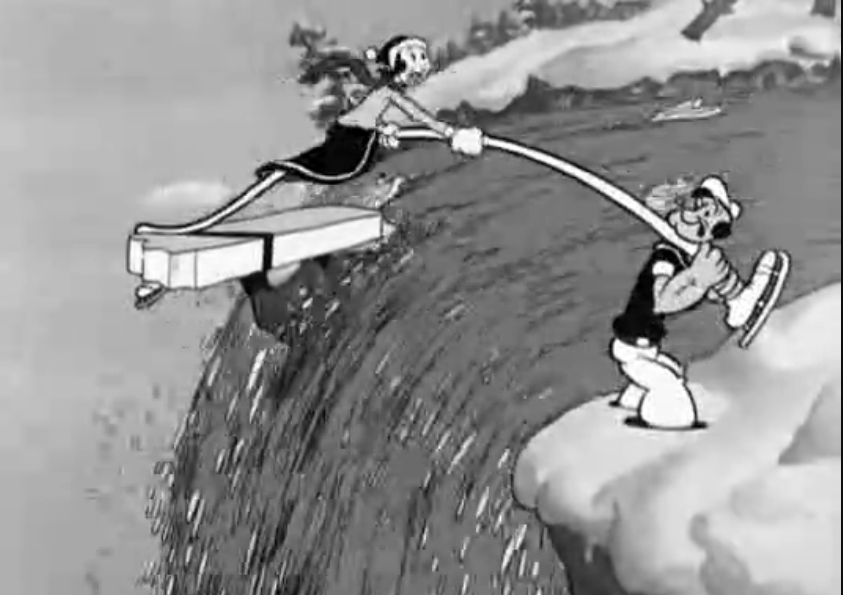
Popeye then jumps to the rescue skating across floating chunks of ice towards Olive who is in a full-blown panic at this point. The block of ice she is traveling upon reaches the waterfall where it gets hung-up on an exposed rock. She slides off the front and is able to grab onto it, but since it’s ice, she keeps slipping off and is forced to just keep grabbing. Popeye arrives, but apparently without much of a plan as he skates right off the edge of the waterfall! He lands in the water below without injury as he points out the obvious that this water is pretty cold. The music switches from the Popeye theme to Yankee Doodle, for some reason, as he swims up the waterfall. It switches back as Popeye emerges on a piece of land beside the waterfall. Olive, for her part has made it onto the ice and at Popeye’s beckoning she sends her leg over to him. Since she is indeed a rubber hose character, her leg stretches to a ridiculous length and in an arc. Popeye grabs an ankle, and Olive uses the rest of her leg like a rope to pull herself across.
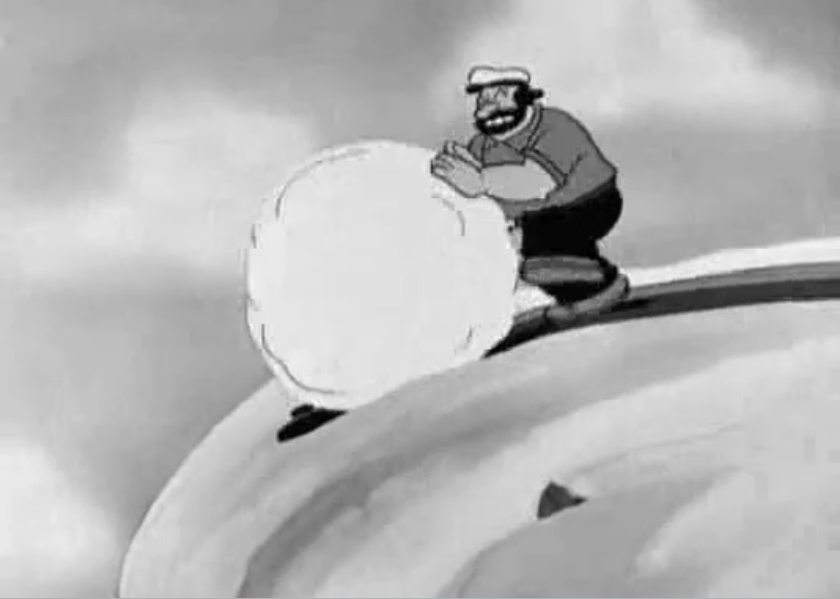
Olive may be out of distress, but we’re clearly not done because we have yet to see Popeye consume his favorite weed. Popeye carries an exhausted Olive over to a nearby clearing with a rock and a pine tree. He drapes her across the rock rather comically (maybe now would be the time to get her home and in front of a fire, Popeye?) and starts rubbing her arms to get her blood going. Unknown to them, Bluto is high above on a cliffside apparently not ready to turn tail and run. He’s rolling a massive snowball he likely intends to dump on the pair, but it gets away from him and Bluto soon finds himself a part of the snowball as he rolls along towards its intended targets.
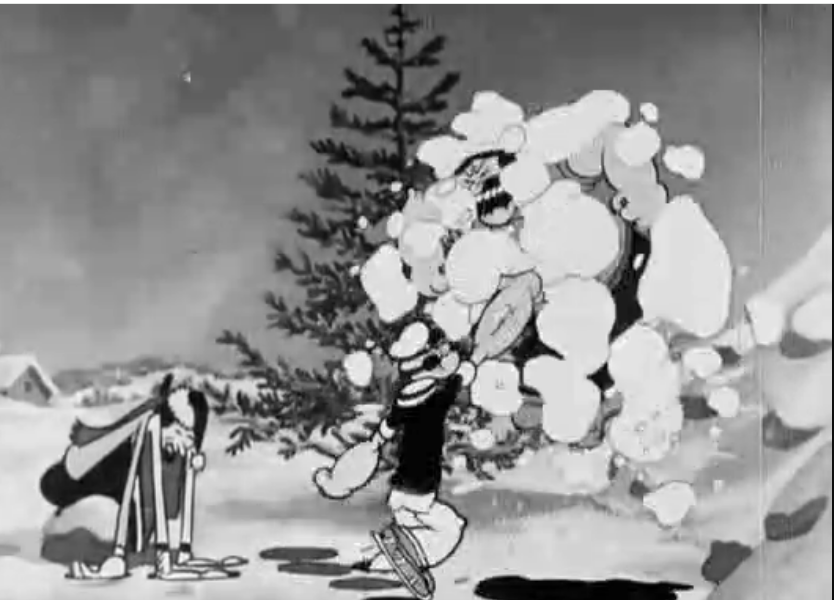
Popeye, seeing the incoming object, now turns to that spinach we’ve all been expecting as his theme song thunders triumphantly in the background. He squeezes the top off, but somewhat uncharacteristically uses his hand to reach in and pull the junk out. I’m left wondering why he felt like he needed the power of spinach now as Bluto lands right in front of him and comes to a dead stop. He’s no longer in a snowball though, but resembles a snowman instead. Popeye belts him once to knock the snow off, then a second time to create a bunch of whirling stars around Bluto’s head which soon flee to circle to the pine tree behind. They’re basically magic stars and the tree comes alive as a full blown Christmas tree! Popeye pumps his fist to the music and shouts “Season’s greetings to you all” in the same melody as his own song. Olive is in his arms as he does and the two then turn to face the tree as “Jingle Bells” replaces the Popeye theme while Bluto lays beside the tree likely concussed.
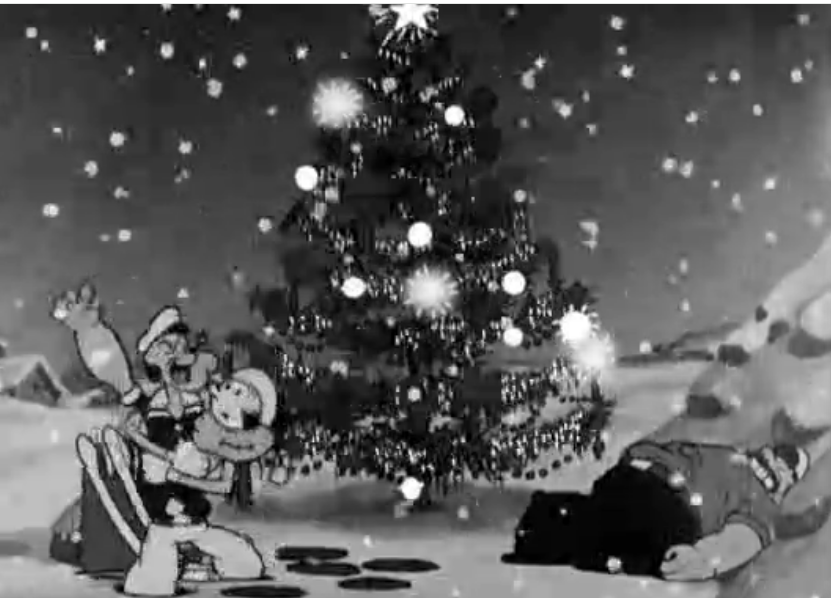
Popeye’s first dance with Christmas is a pretty basic Popeye cartoon. He and Olive are engaged in an activity until Bluto interrupts them. Olive is put in some form of peril and Popeye is forced to save her. It reserves the use of spinach until the very end. One would think that Popeye would need the stuff to topple Bluto or swim up a waterfall, but he basically just needs that extra pop in his punch to produce the magic stars that bring the tree to life. The bit with the stars is very similar to a gag that will be relied upon in a future Popeye Christmas short and it’s not that surprising as it’s a pretty solid one. And by then decades had past between cartoons.

As a Christmas cartoon, this one is pretty light on the subject. We basically just see the exchanging of gifts between Popeye and Olive, or rather, we see Popeye give her a gift. Then the only other Christmas stuff happens at the very end with the Christmas tree and Popeye’s brief little message to the viewer. It’s definitely more of a winter toon and it’s hard not to compare this one to the Mickey Mouse short On Ice. That cartoon comes later so this isn’t a case of Popeye borrowing from Mickey, but the other way around. Mickey spends a chunk of that cartoon teaching Minnie how to skate and then has to save Donald from a similar predicament that Olive found herself in. There’s just no real antagonist (well, Donald is towards Pluto and he gets himself into trouble) nor is there the sort of violence we would see in a Popeye cartoon. Both cartoons also utilize the same song, “Les Patineurs (The Skaters),” though I suppose it’s hardly surprising that two cartoons about ice skating would make use of that particular song.
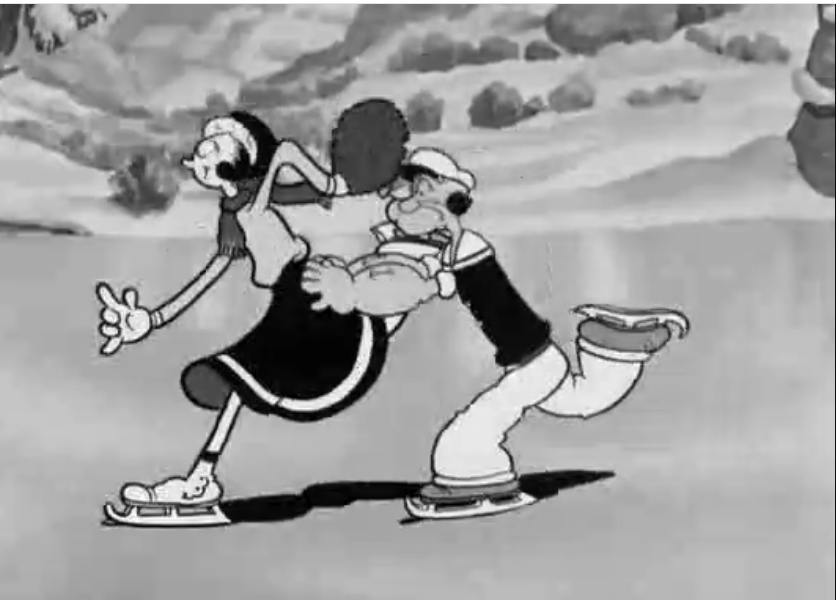
If you like Popeye and also like Christmas, this is a fine way to spend a few minutes this holiday season. It’s a pretty quick and dirty Popeye cartoon that has all of the elements most enjoy. Perhaps it’s lacking a touch in the gimmick department where the spinach is concerned, but the fast-moving river of ice and the Christmas tree bit seem to make up for that, if you ask me. There’s not a lot of complexity to Popeye and I think that’s how most fans like it. The animation here is quite good for its era. Maybe some won’t like the constant motion of the characters that was typical of the era, but I’ve always felt it works for Popeye as it has a different energy to it than something like Mickey Mouse. It’s also in black and white which I guess is a turn-off for some. It rarely is for me, though I confess the final scene with the tree would have looked more impressive if color were a possibility, but I’m not holding that against it.
If you would like to check this one out for yourself it shouldn’t be too hard to find online. Otherwise, the MeTV program Tune in With Me will likely show it at some point this month and they even have an entire channel dedicated to cartoons now called MeTV Toons which will definitely feature it – probably more than once. If you’re able to get that channel in your area (I can’t seem to get it on my antenna, sadly) then it’s probably a worthwhile thing to check on all month if you like classic Christmas cartoons.
Can’t wait until tomorrow for more Christmas? Check out what we had to say on this day last year and beyond:

Dec. 15 – Beavis and Butt-Head Do Christmas
Today we continue our lookback at the best holiday specials ever sent to television and today’s subject is everyone’s favorite pair of Gen X deadbeats Beavis and Butt-Head. Beavis and Butt-Head were created by Mike Judge and the pair got its start on MTV’s Liquid Television in 1992. There they were a cruel, destructive, pair…
Keep reading
Dec. 15 – South Park – “Mr. Hankey the Christmas Poo”
Today we are continuing our look back at the best of the best when it comes to Christmas specials and today’s entrant comes from the quiet, mountain, town of South Park. South Park burst onto the scene in 1997 and basically transformed the Comedy Central network from the get-go. The show about four foul-mouthed kids…
Keep reading
Dec. 15 – Dr. Seuss’ How the Grinch Stole Christmas!
It’s December 15 which means it’s time for another retro throwback and I bet you’re surprised to see the green guy here. Since I dubbed Dr. Seuss’ How the Grinch Stole Christmas! as the best ever Christmas special not just once, but twice, you may have expected it to appear on this year’s edition in…
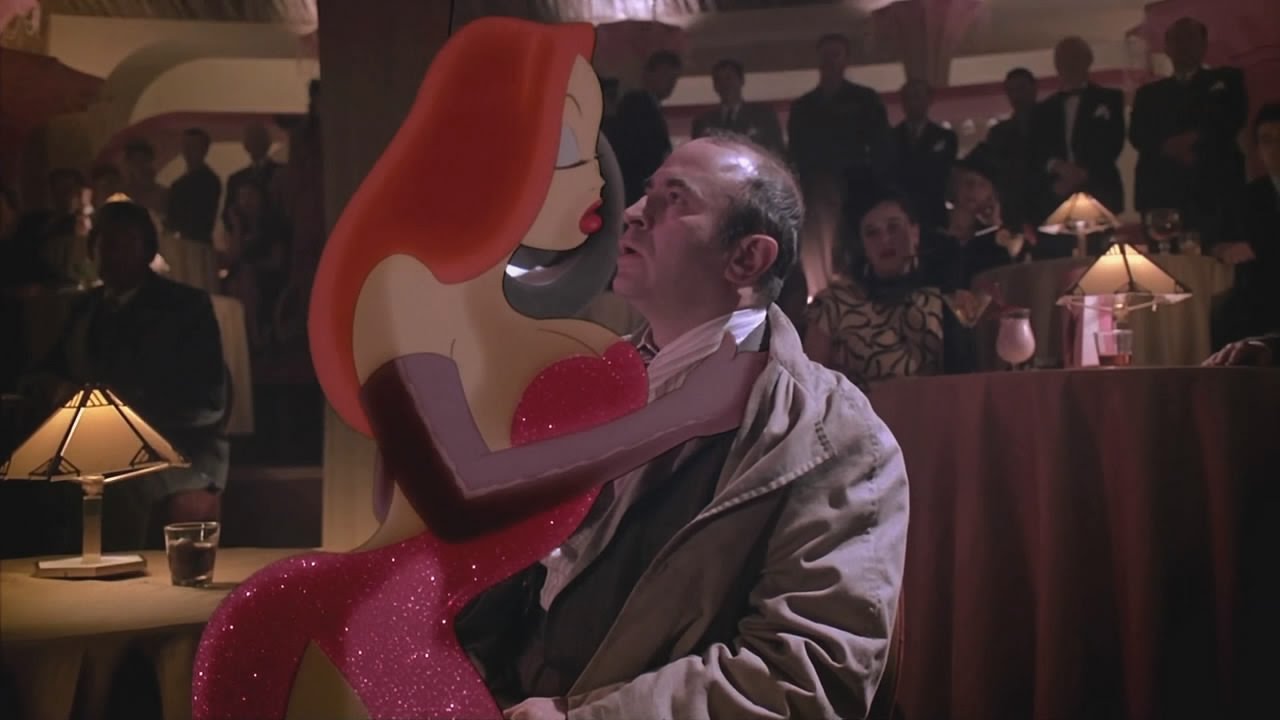
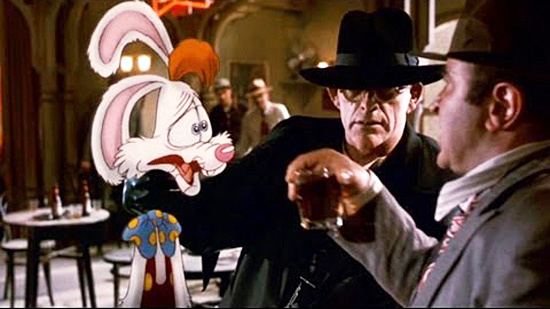
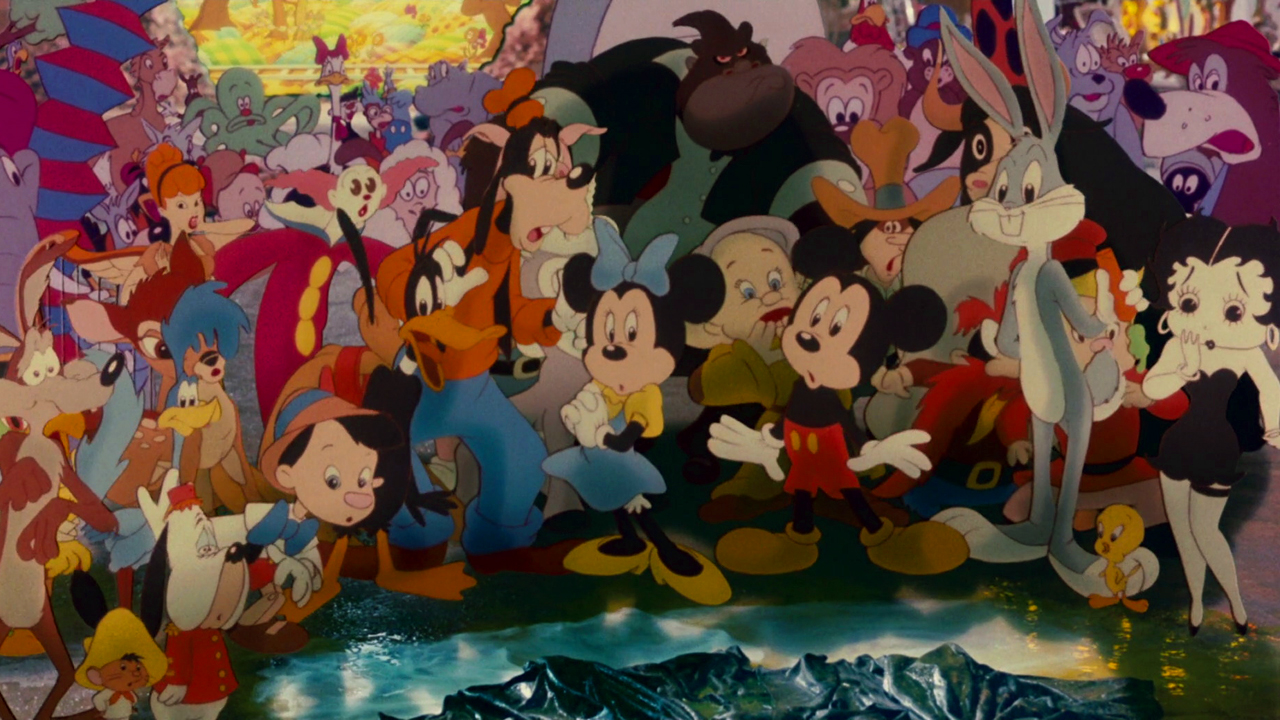
Keep reading Normally, I don’t like doubling-up on posts in a single day on this blog, and ever since last fall Friday has belonged to Batman. Well, I’m breaking my own self-imposed rule today, but it’s for a very good reason. Today is the 30th anniversary of the film Who Framed Roger Rabbit. On this day in 1988, the then most expensive movie in film history was released to the general public with a lot of buzz and a lot of trepidation. It was a collaborative effort between some of Hollywood’s hottest names; Steven Spielberg, Robert Zemeckis, and Walt Disney Studios. Adapted from the Gary Wolf novel Who Censored Roger Rabbit?, there was a lot of fear that the movie would be too “out there” for a general audience. So uncertain about how the film was to be received, actress Kathleen Turner, who voiced Jessica Rabbit, declined to be credited for her role in the film. There was some fear this thing would be received about as well as Howard the Duck, a notorious flop at the time, but it ended up being so much more.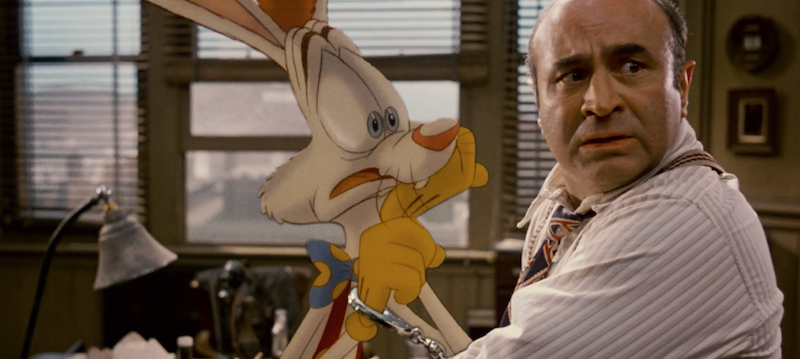



 The Nostalgia Spot