Tag Archives: avengers

Marvel Legends Avengers Doomsday Cyclops

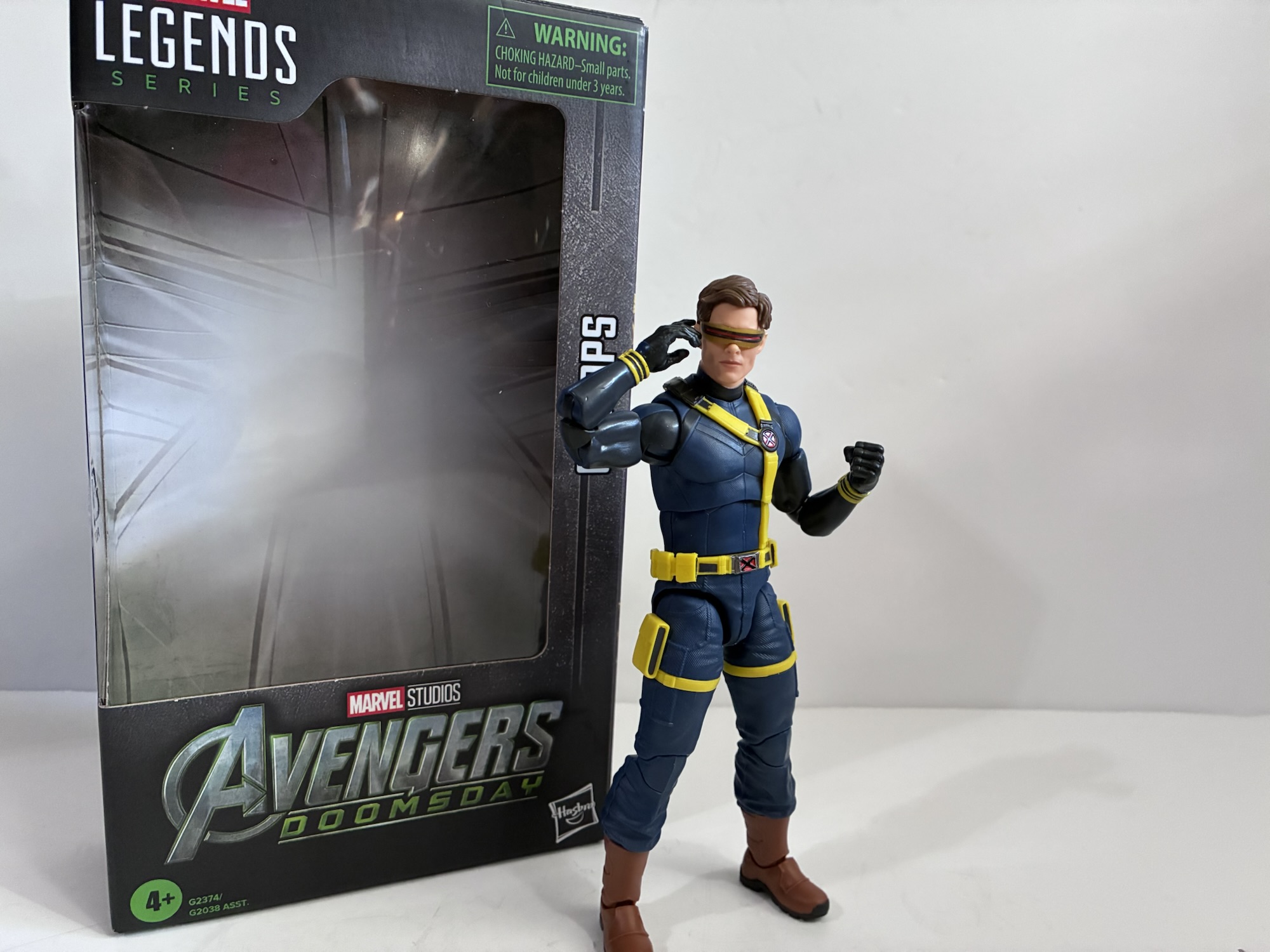
It’s Cyclops, just the way you imagined him.

For those born into this unprecedented run of comic book movies it may be hard to imagine a time when a superhero movie wasn’t on the horizon. It’s not hard for those who were around in the 80s and 90s when seemingly only Batman could gain any traction at the box office. In those early days, Marvel tried to bring its characters to the big screen, though sometimes not whole heartedly. The Punisher was a rated R action flick starring Dolph Lundgren that was okay when you’re 12, but failed to do much for the character. Captain America had a laborious path towards film that was somewhat a famous dud, but has actually been reappraised in modern times and maybe isn’t as bad as we once thought. Suffice to say, there wasn’t much interest in Hollywood to adapt more of Marvel’s characters because there just had been no proven track record. Marvel got serious though, and really needed the money so it optioned a lot of its characters for film, and suddenly success started to follow and one of the big early success stories was X-Men.

It’s probably not a surprise that X-Men would be the franchise to really break through since the 90s had belonged to the superhero team. Still, Wolverine wasn’t exactly a household name like Superman and Batman so the concept still needed to be sold to a general audience that might have no idea what the X-Men are about. Since Tim Burton’s take on Batman had seemingly been the only modern success story, everyone looked to it for how to do a comic book movie. The bright yellows and blues of the comics had to go and in came black. Lots of black. Blade had found some success with an all black leather look and people seemed to love The Matrix so why not go that direction with X-Men? They even famously snuck a joke about yellow spandex into the movie for us to laugh at because that would be so lame to see on film! The approach was almost as if the movies were embarrassed by their source material, and while the movies were successful, I don’t know how many people truly warmed up to the look.

When Marvel had the money to bring its own characters to film with 2007’s Iron Man, it opted to do something a bit more in tune with what the comics had established, and what do you know – it worked! Really well. They didn’t always go with a 1:1 interpretation, but Captain America was undeniably Captain America and Thor was Thor. Over the years, we’ve seen both approaches, but movies were definitely less afraid to go all out with comic book looks. It culminated with 2024’s Deadpool & Wolverine where Wolverine finally put on that famous yellow spandex. And he even added the cowl. Did it look practical? No, of course not, but it was fun. The movie made it work and I’m sure more than one person left the theater wondering how that approach would have worked back in 2000?
It’s a pretty good translation of the Jim Lee look.

If you haven’t heard, there’s a little movie coming out soon called Avengers: Doomsday. Marvel and Disney are banking on this thing being big, like Endgame big. Time will tell if they’re successful, but part of the marketing of the film for the past year has featured the X-Men. These are not the X-Men expected to lead a new franchise for Marvel (announced this past summer at San Diego Comic Con), but the X-Men from the Fox movie universe. Or some of them. And featured quite prominently in one of the earliest teasers is James Marsden’s Cyclops. Only he’s not wearing the black leather from those old movies, but a take on the famous Jim Lee blue and yellow costume. There’s some multiverse shenanigans going on and I’m guessing a lot of these legacy characters are just here for a glorified cameo, but finally seeing that look on screen is pretty cool. And Hasbro seemingly agreed as they have a Legends version of this character for all of us to enjoy. Hopefully.
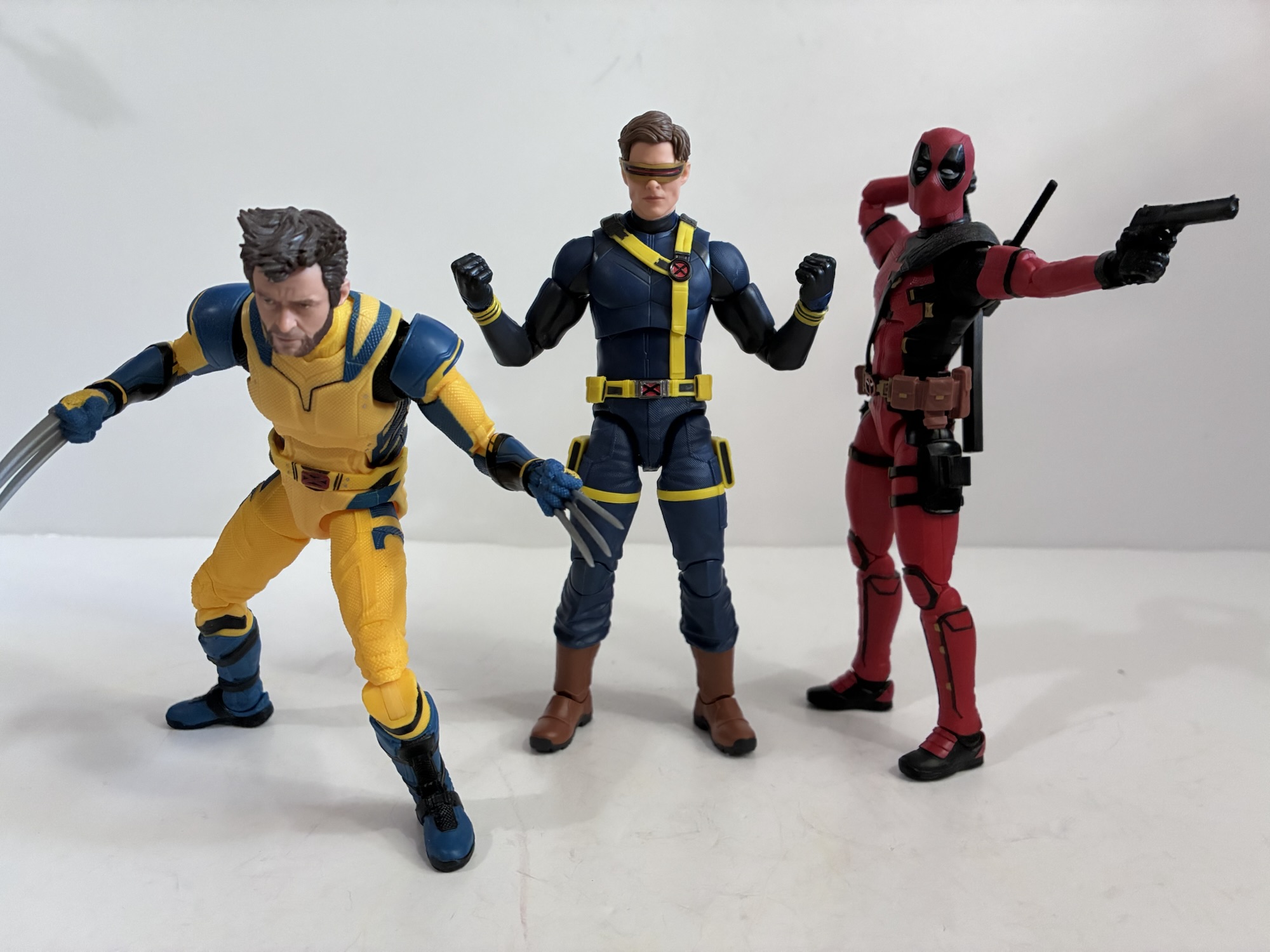
People seem to like superheroes in superhero costumes – who knew?

Now, I’m not a big Legends collector and even less so where the Marvel Cinematic Universe is concerned. The only figures I have from the movies have come from the Deadpool ones and I can’t even really explain it. I guess I just like how his look translated to film. I wasn’t going to get this Cyclops even though it would pair well with the Wolverine I have from that movie because I’m just not that invested. And there’s other stuff I want to spend my money on. Then Target decided it needed to put a bunch of figures on clearance. I don’t quite get it, maybe they need to make room for more? The figures had not been out long, but when this figure hit 12 bucks I figured why not? I even did a store pickup when it said only one was available thinking if the order was cancelled then it wasn’t meant to be. It was not and now I have a new Cyclops to tell you about.
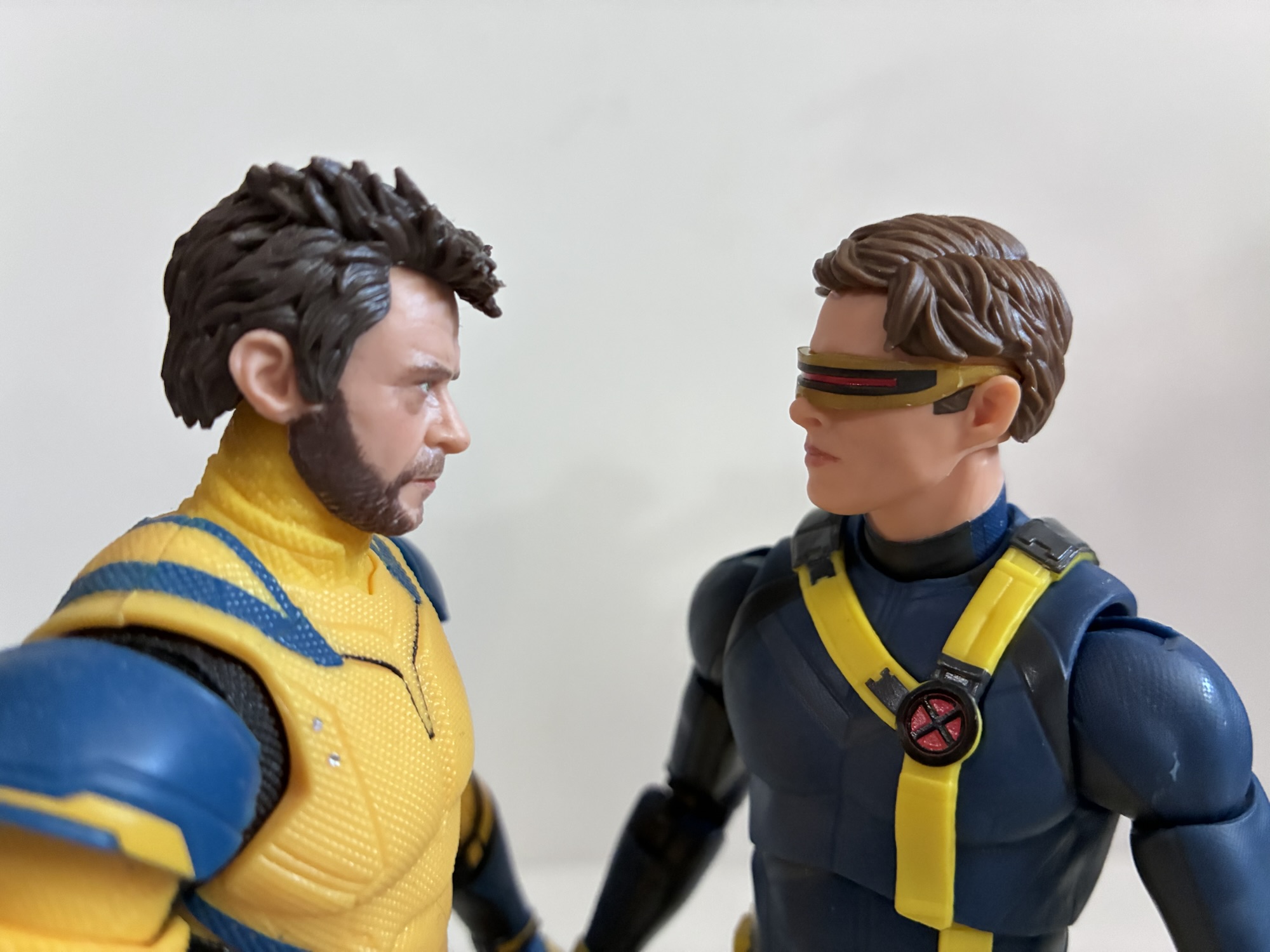
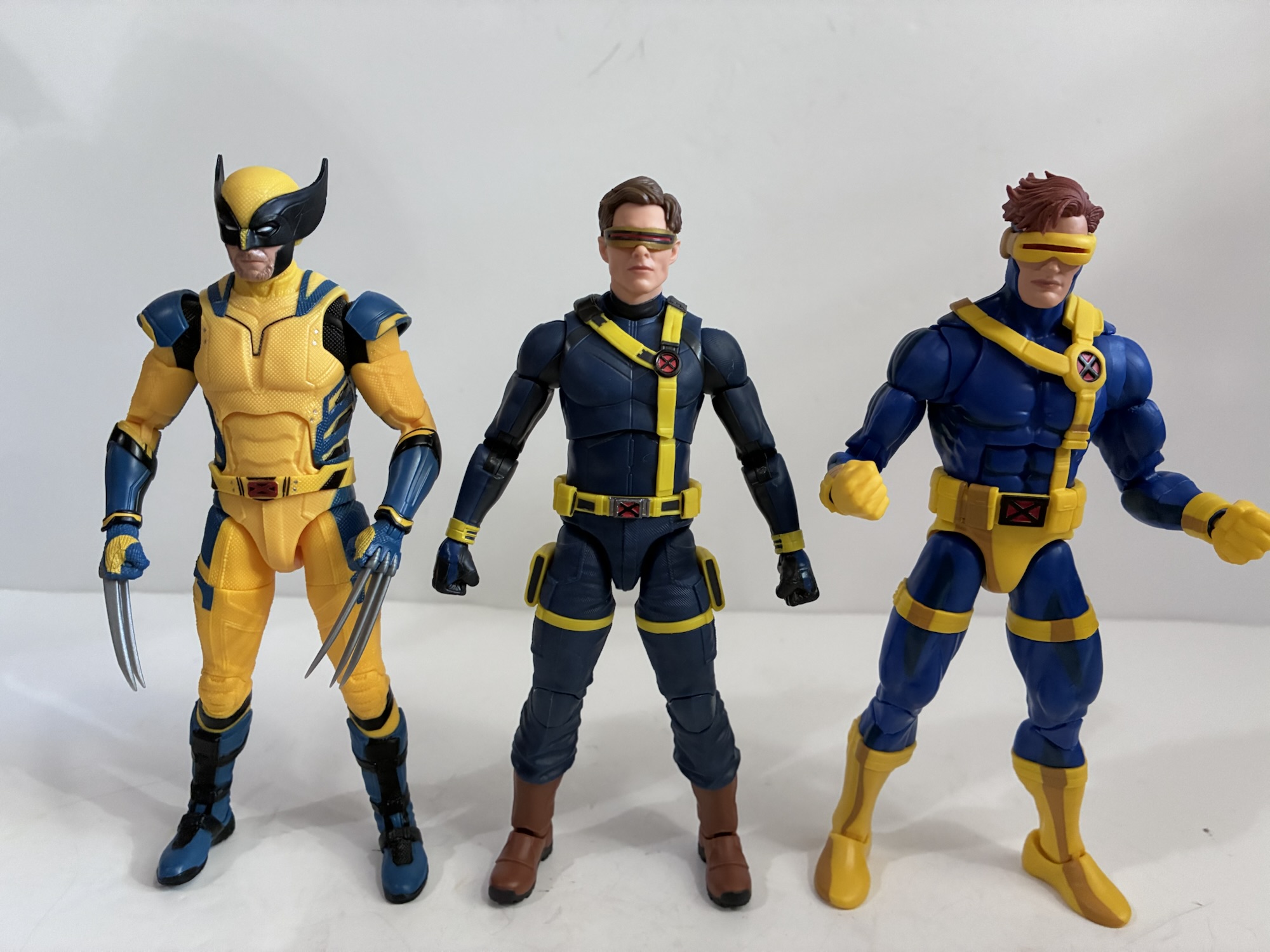
The height between these two seems right.

Cyclops stands at about 6.375″ to the top of his hair which makes him a little shorter than Wolverine. This is basically the one universe where that is okay. He’s mostly cast in navy blue plastic with a lot of sculpted design work on him. It has that Kevlar texture to it we see often with these style of costumes and most of the sculpted bits look reasonably accurate to the film. I think there’s supposed to be a more pronounced X in the torso that isn’t really captured, but maybe that was a late addition? In order to have these figures out before the movie they had to start working on them a while back which often times means using non-finalized designs. The yellow portions of the design are cast in yellow plastic and inserted into the figure in the same manner as past Legends versions. He basically has the comic book belt with the strap across the chest. The X logo is present over his heart as well as in the middle of the belt. And, yes, there are pouches. The belt has some hits of black and silver paint in places along with the red and black X logos, though the pouches would have benefited from a paint wash. There’s just no hiding yellow plastic. He has his thigh straps, though they’re much thinner compared with the comic look, and they added some yellow, thigh, pouches. These are supposed to be connected to the belt, but they’re just connected to the thigh straps. Probably good for articulation, but not for accuracy. Again, it might not be Hasbro’s fault. The inner arm is a dark gray, almost black, and it continues onto the gloves. This is another small departure from the comic where Cyclops wears yellow gloves, but it looks pretty natural here. The only thing about this costume I’m not in love with are the boots which are brown and just cast in brown plastic. It makes sense for boots to be brown, but they seem to clash. Maybe a more yellow-brown like standard work boots would have looked better or even just a paint wash to dirty them up. I’m getting used to looking at them, but they definitely didn’t make a good first impression.
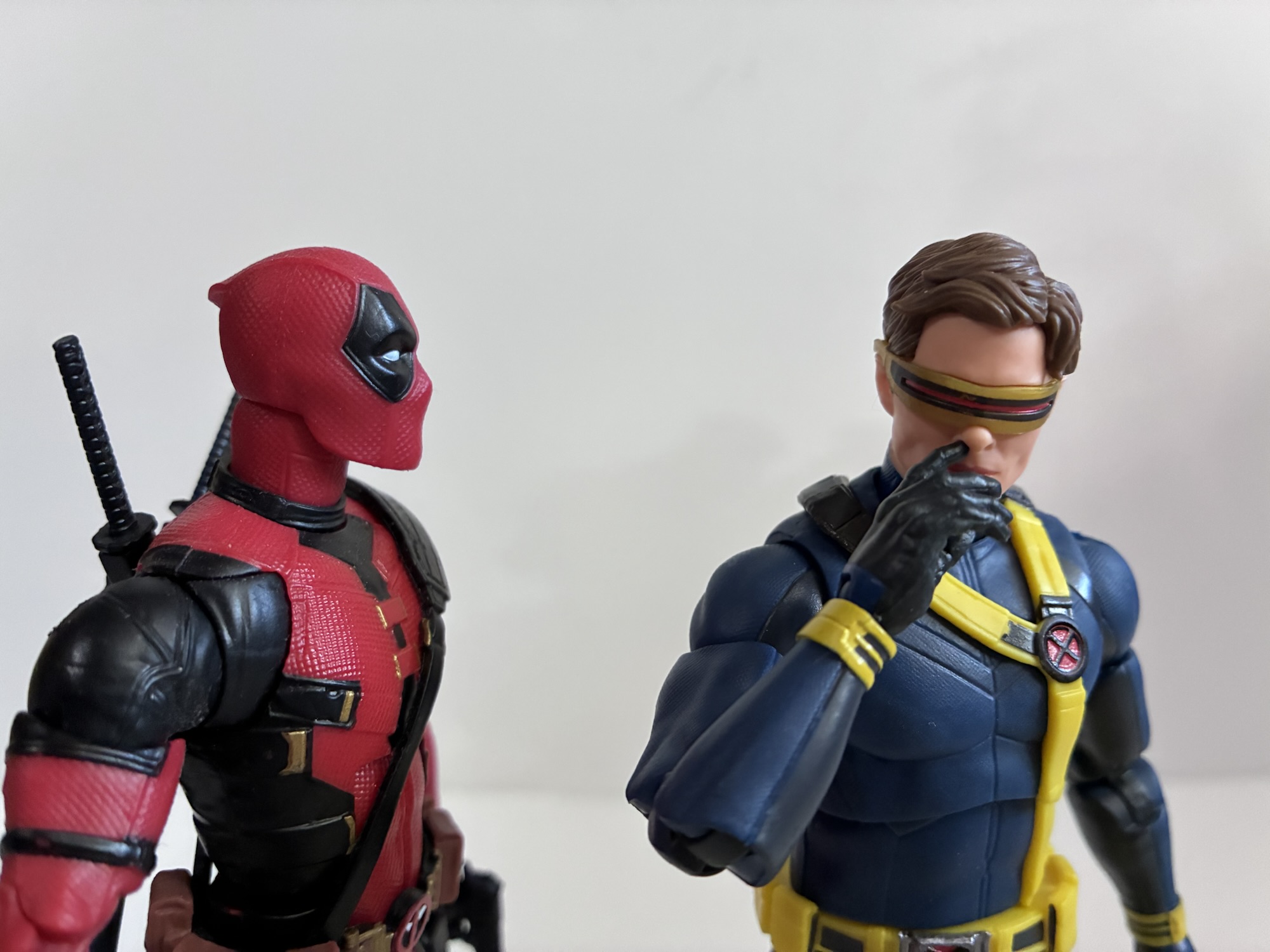
“I saw that!”

The sculpt is fine though certainly has a toy presentation, but that is the limitation of this product line. A strength of the line rests with the likeness. This is an excellent representation of James Marsden even if we can’t see his eyes. They’re hidden behind a more classic looking Cyclops visor. It is more gold than yellow, but has the painted on red lens with a black outline. The visor is smaller than the comic take and does not cover the ears, but it’s certainly a more true to the comic take than what we had before. There is some subtle sculpting of the cheekbones and even just the shape of the nose looks spot on. If he had actual eyes underneath that visor maybe Sonic the Hedgehog fans would be buying these up for customs? It’s really a terrific portrait much like the one that came with Wolverine. I don’t know how they do it, but Hasbro often tops the more expensive imports when it comes to actor likenesses. Maybe they have better access? It’s certainly one area of the figure no one is likely to complain about.
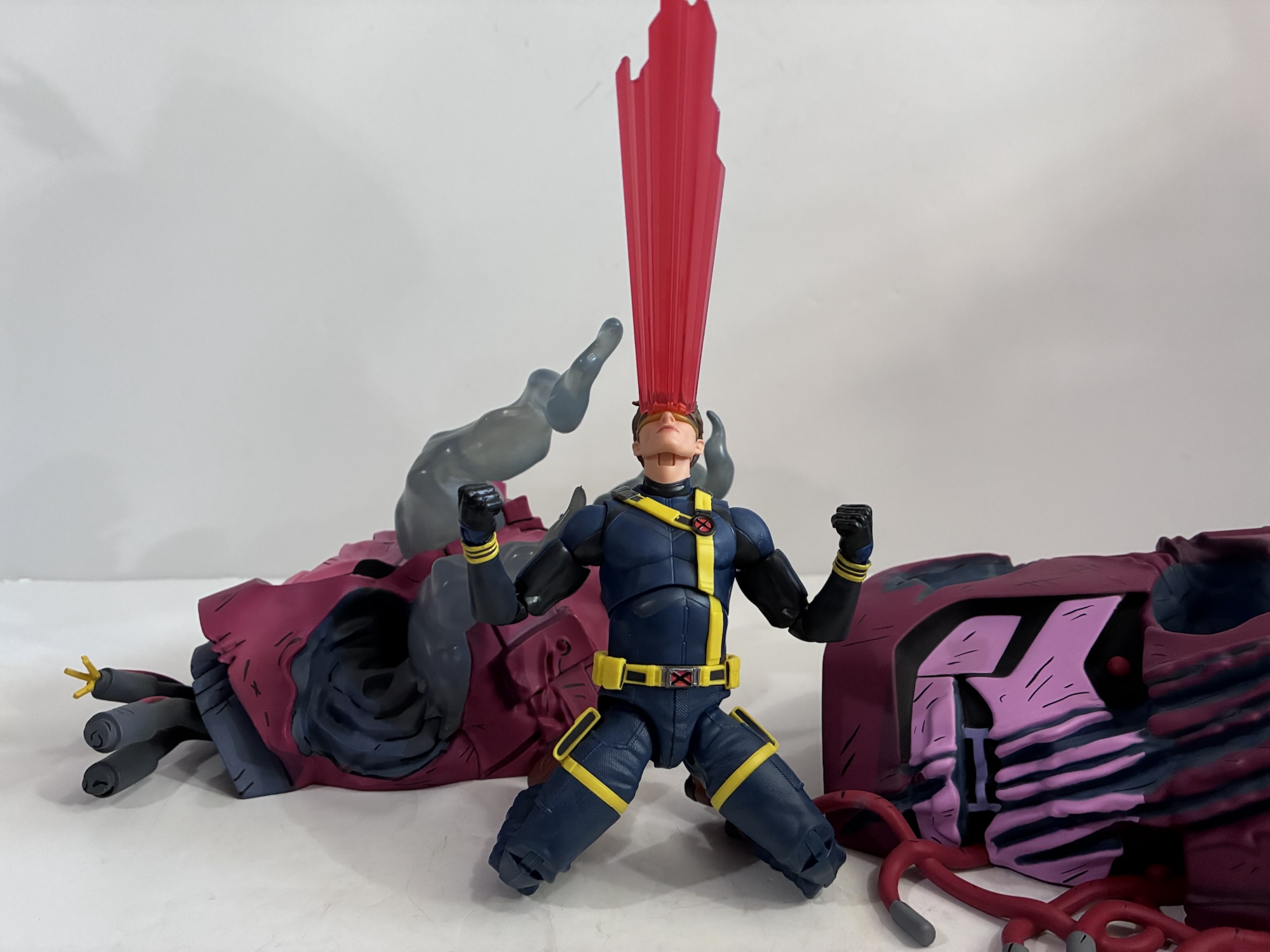
It’s nice to get an effect part, but it’s too bad he doesn’t have an expression to better suit it.

The accessories, on the other hand, might leave some wishing for more. In terms of a Legends release though, Cyclops turned out okay for one reason. It’s not hands, as Cyke has a set of fists and then a set of gesture hands, we’ll call them. The gesture hands are asymmetrical with the right hand being something of a soft grip and the left a more open hand. The left is pretty unique as the ring and pinky fingers are in a cupping shape while the middle and index fingers are more extended. This makes it a natural “hand to the visor” expression for activating his optic blasts. The right hand also has a pronounced index finger so it could be used for the same. The other included accessories are a second visor and an effect part to plug into it. The standard visor comes off, albeit not effortlessly and can be swapped out for this one. The visors are quite thin and feel delicate, but they haven’t shown any structural weakness at this time. It’s a little tricky getting it onto the head as the left side slides over the ear while the right side is blocked by the hair to some degree. The blast effect plugs in with little trouble and is keyed in such a way that it can’t be inserted wrong. There are some sculpted grooves on it, but it’s otherwise a translucent piece of red plastic. It looks fine though and it’s really the sort of thing that should come with every Cyclops figure. It’s also light enough that it doesn’t present any posing problems.
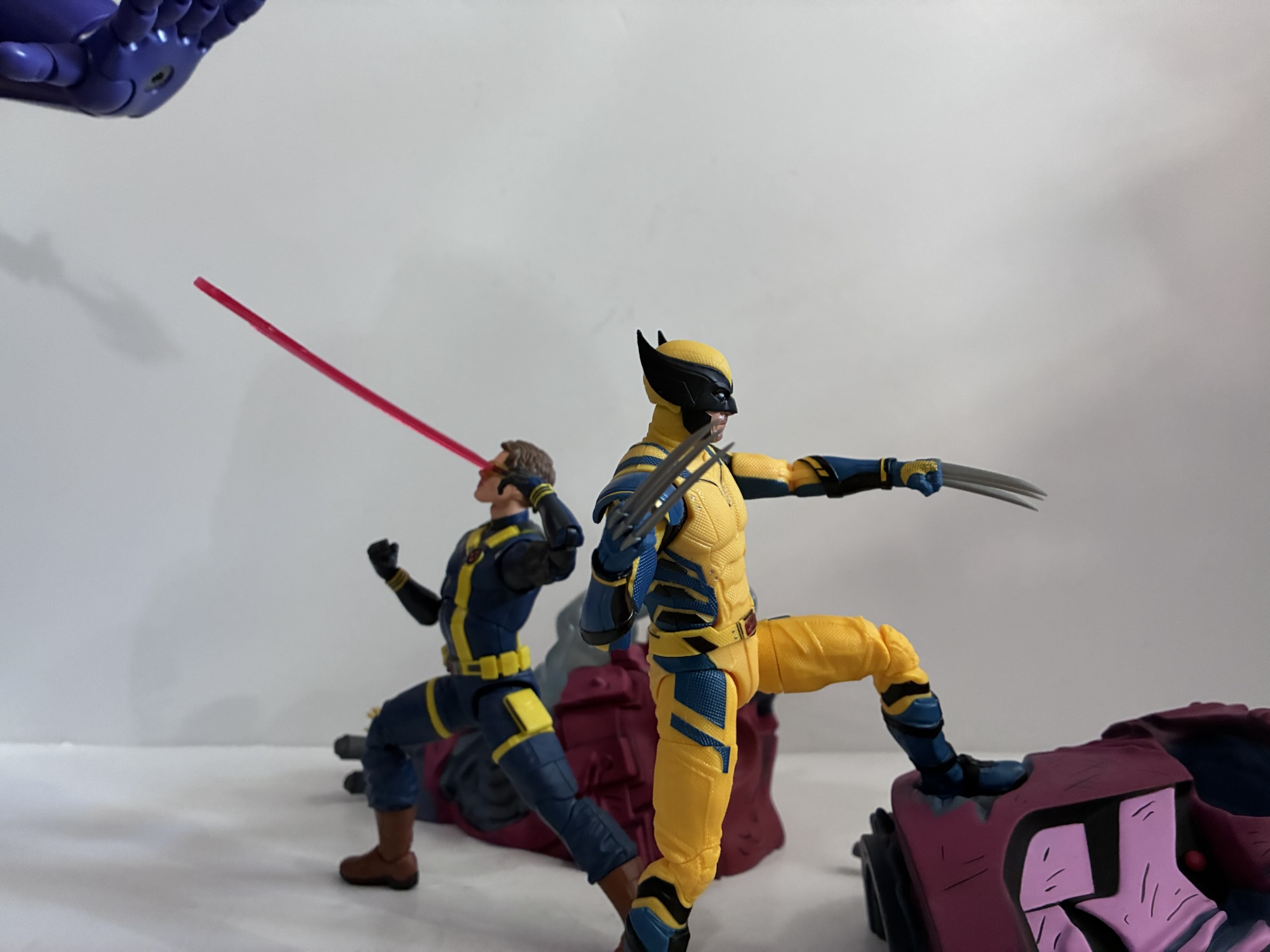
Maybe we’ll finally get stuff like this in the MCU X-Men?

Articulation for Cyclops is mostly as expected. The tried and true neck hinge is in place along with a joint at the base of the neck, shoulder ball hinges, double elbows, wrist hinge and swivel, diaphragm, waist twist, ball hips, thigh swivel, double knees, boot swivel, ankle hinge and rocker. Missing is a butterfly joint at the shoulders which could be for aesthetic reasons, but is more likely for cost ones. The diaphragm joint is a ball joint and it gets good range back, but not so much forward. I wish the waist twist was replaced with a a ball joint as it would allow for more crunch forward and would also look better. The hips are a little limited where splits are concerned, but that’s not really Cyclops’ forte. The neck joint mostly rotates with a little wiggle to it. It’s nothing earth-shattering, but Cyclops can get his hands to his visor just fine and aim his blast in almost every direction so I suppose it’s good enough.

If you want a low cost version of Cyclops from Doomsday for your collection then this is fine. The real strength of the figure rests in the likeness even if part of the face is obscured by the visor. The included blast effect is nice, but it would have been great to get a yelling expression to go with it. Especially if this is likely the only version of the character we’re likely to get. The sculpt is solid and the presentation works. The Jim Lee costume adapted for a movie is a fun novelty and it does tickle me to have it on my shelf, even if I could have probably got along with it just fine. I definitely like it a lot more at the $12 I paid versus the $28 it was supposed to retail for. It’s obviously a terrific deal at only twelve bucks, but had I actually seen it in a store at MSRP I might have bought it. I never did though, but I wasn’t exactly hunting for it. If having this sort of “What If” Cyclops that will soon be is something that amuses you then you’ll probably like it well enough.

For more Marvel movie figures, check these out:

Marvel Legends Deadpool & Wolverine Wolverine

It might be hard for the young folk to believe, but once upon a time movies based on comic book characters were treated like box office poison. Unless you were Superman or Batman, you just didn’t belong in cinema. Even those characters weren’t bulletproof. Superman had a nice run, but fizzled out with the fourth…

Keep reading

Marvel Legends Deadpool & Wolverine Deadpool

Despite the amount of reviews presents on this blog, I still do not consider myself a Marvel Legends collector. That’s because my interests are somewhat narrow when it comes to the Marvel brand. Over the years I’ve developed a fondness for Deadpool as depicted on film by Ryan Reynolds. I think the comic book character…

Keep reading

S.H.Figuarts Deadpool & Wolverine Wolverine

It feels like a theme this summer for me is buying action figures I previously deemed unworthy of my money as they go on clearance. Sometimes that’s a dumb thing to do. If I didn’t want something six months ago why should I want it now just because it’s cheaper? In the case of today’s…

Keep reading
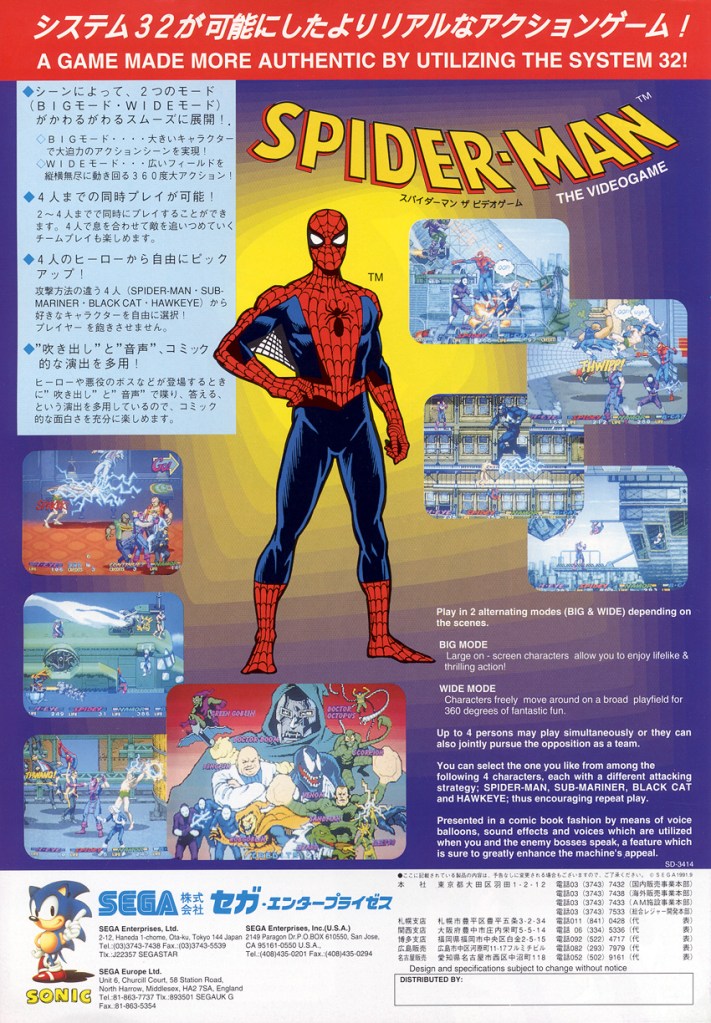
Spider-Man (Arcade)

Forgive me if I’ve said something similar before; but younger people are shocked by the norms of the past! Yeah, it’s a very “old man” thing to say, but it’s also an easy way to impress someone younger. And in this case, the shocking thing to say is that Marvel Comics often found itself in a great deal of financial turmoil in decades past. The company that now is owned by Disney and is able to churn out hit film after hit film about even its most obscure characters once had to file for bankruptcy protection. Go through the history of the company and you’ll find other moments in time where things weren’t so rosy, though Marvel often can be credited with being forward-thinking in looking for other ways to make money.

That’s how Marvel ended up in the TV business in the 1980s. Unable to find the same level of success on both the small and big screen as rival Detective Comics, Marvel started self-producing television programs which included the company’s popular stars as well as properties unrelated to the comic business. The most successful Marvel TV program is probably Muppet Babies, as the company seemed to struggle to really break-through with one of its superheroes even famously failing to find a broadcast partner for its mega-hot X-Men franchise as the pilot for a cartoon series failed to be picked up. This ended up being a good thing since not too long after Fox would start airing a different X-Men series in 92 which ended up being far better than anything Marvel would have done on its own.

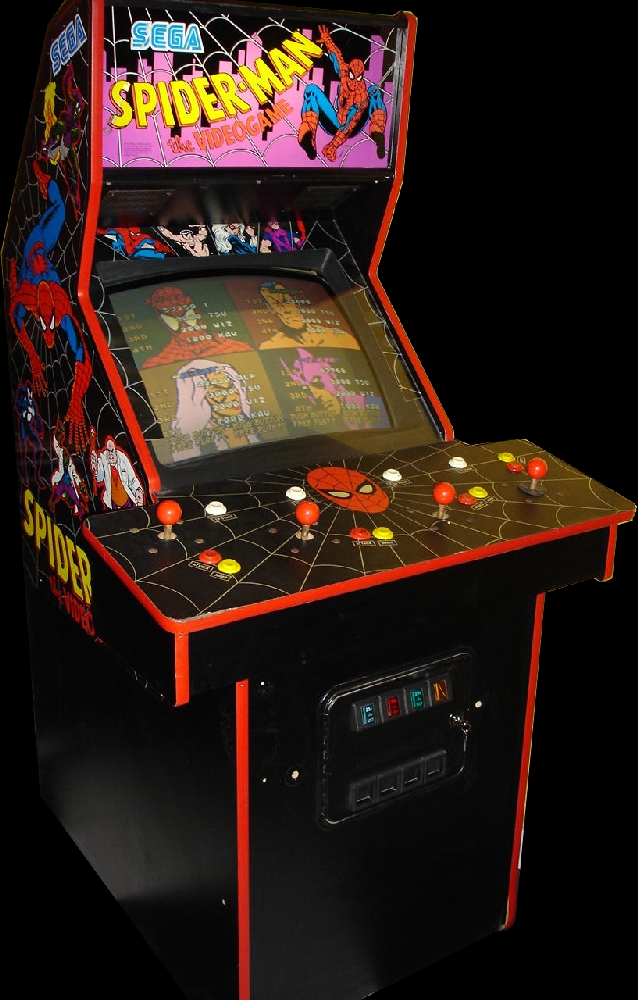
Sega landing the Spider-Man license seems like a pretty big deal.

When video games started to take off once again in the 80s, it’s possible some in the industry would have expected Marvel to self-publish. It was already doing so with TV, so why not games? It’s possible Marvel just didn’t trust the industry which had only recently emerged from a crash itself. And whenever Marvel wanted to make money easily, it would turn to licensing deals. With comics rapidly gaining steam in the 80s and building towards what would be a massive boom into the 90s, Marvel probably saw no real benefit in exploring the world of games and was more than willing to see what other companies would do with its characters.

Enter Sega. Sega was fighting an uphill battle to dethrone Nintendo as the kind of the living room. Sega’s strategy was to go after the kids who may have first experienced games via Super Mario Bros. and were looking for something a bit more their speed as they grew older. This made a character like Spider-Man appealing to Sega, and in a world where exclusive licensing agreements were still far off, Sega was able to convince Marvel to let it develop its own games featuring Spider-Man. Details of the agreement are scarce these days, so it’s unknown just what kind of restrictions Sega was under. The deal was apparently tenuous, but success of the Genesis/Mega Drive game Spider-Man vs The Kingpin apparently settled things down as the title once had an attach rate of over 60% with Genesis owners.

One of the first games I’d go looking for as a kid in an arcade.

Back in the 1980s, Sega was as much known for its home console business as it was for the arcade. The arcade boom was coming down, but Sega had success with a variety of genres and many of its games were ported to the Genesis. With the Spider-Man license in-hand, Sega sought to craft an arcade beat-em-up experience with the character that would differentiate itself from similar titles. It would be a game developed for Sega’s System 32 board which was the company’s first attempt at 32-bit development. This also meant hopes for a home port would essentially be dead-on-arrival, but that’s why Sega had the separate Spider-Man vs The Kingpin slated to arrive the same year, 1991.

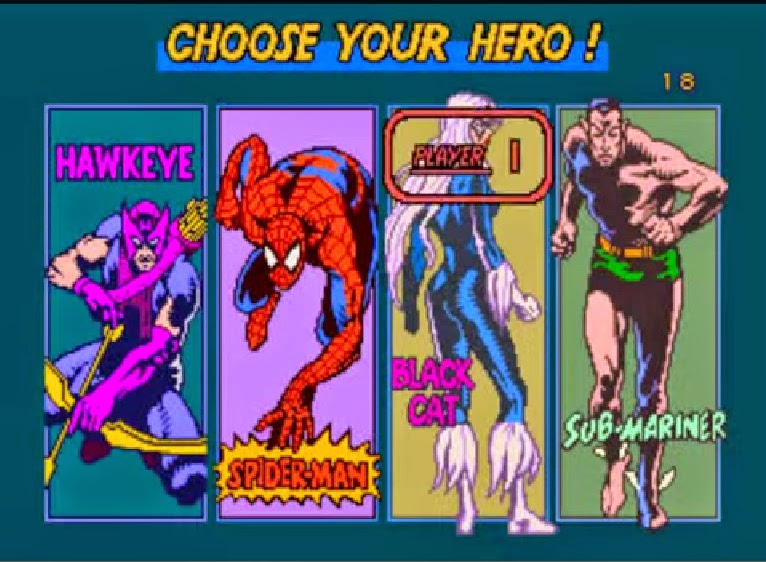
The normally solo Spider-Man would need some help to take down Kingpin, and entertain more than one player.

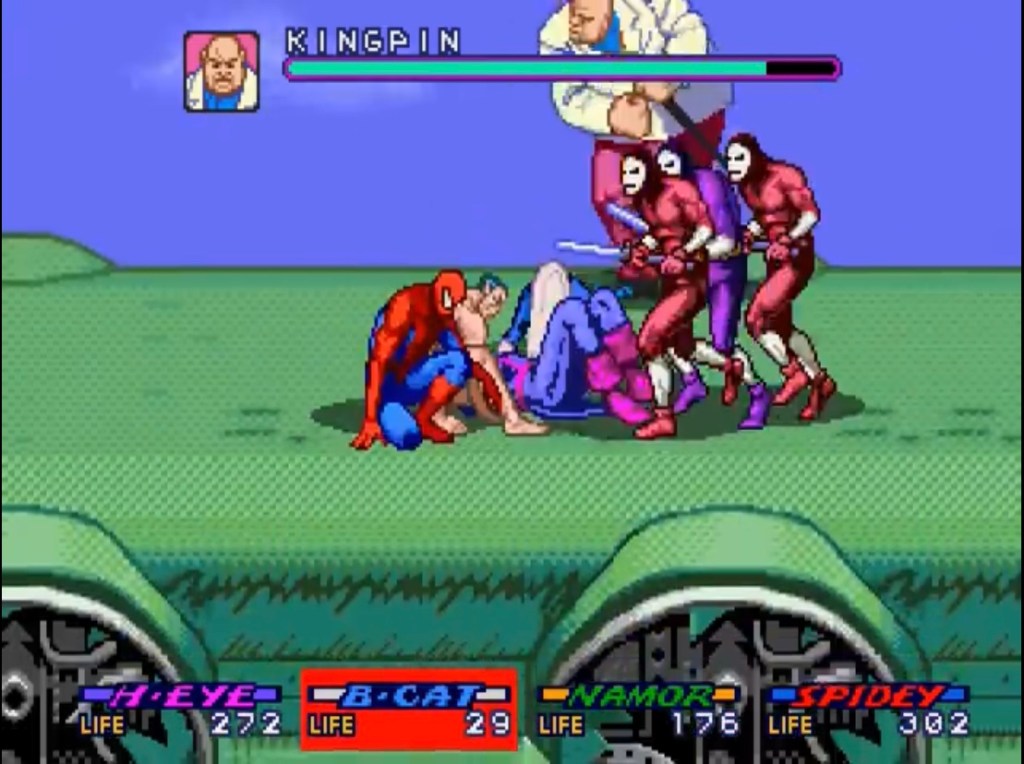
When crafting a brawler for the arcade, one of the main issues to solve initially is just what characters to make playable? The brawler had started as a one or two-player affair, but by the 90s arcade-goers expected four-player co-op play. The challenge with Spider-Man is he’s mostly a solo act, so Sega likely had to work with Marvel on finding three allies to join him. They ended up settling on the sometimes ally sometimes foe Black Cat, Sub-Mariner, and the Avenger Hawkeye. The selection of Hawkeye was somewhat interesting as he was a playable character in the Captain America brawler also released in ’91. This naturally lent to comparisons between the two titles with at least my group of friends viewing the Spider-Man Hawkeye as the far superior affair since the graphics were far more attractive.

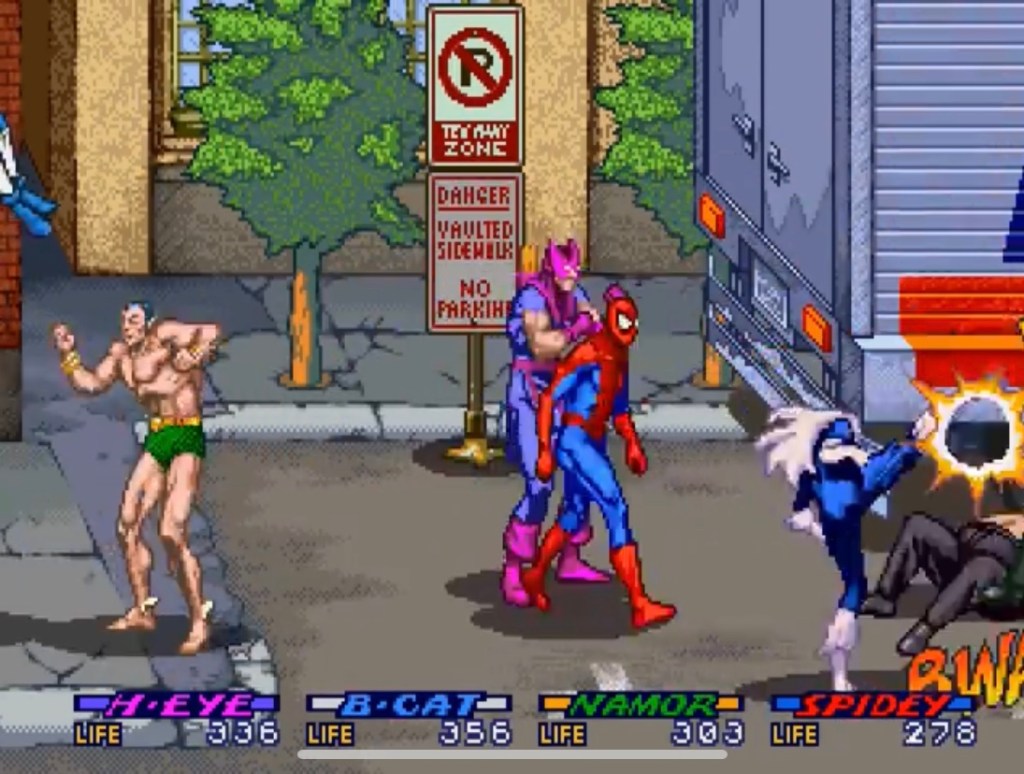
Not much to see here, just four heroes kicking some butt.

Sega’s approach to the tried and true beat-em-up genre is both conventional and unconventional. Sega often found gimmicks to keep things fresh, such as the transformations of Altered Beast or the mounts in Golden Axe. For Spider-Man, the game begins like any other. You select one of four characters and begin the game with a wave of enemies crashing down upon you. Players have to contend with enemies coming in from both sides of the screen and as they’re dispatched a “Go!” prompt will display imploring the player to continue right. Each character has just two action buttons: jump and attack. Pressing the two simultaneously provides for a ranged super attack unique to each character. Utilizing this move also sacrifices some health. Players can attack while in the air and also use a super move from that position as well which basically results in a diving attack. Interestingly, the amount of credits deposited into the machine increases the amount of health the character possesses as opposed to the amount of lives. As long as you keep pumping in quarters, you’ll never die!

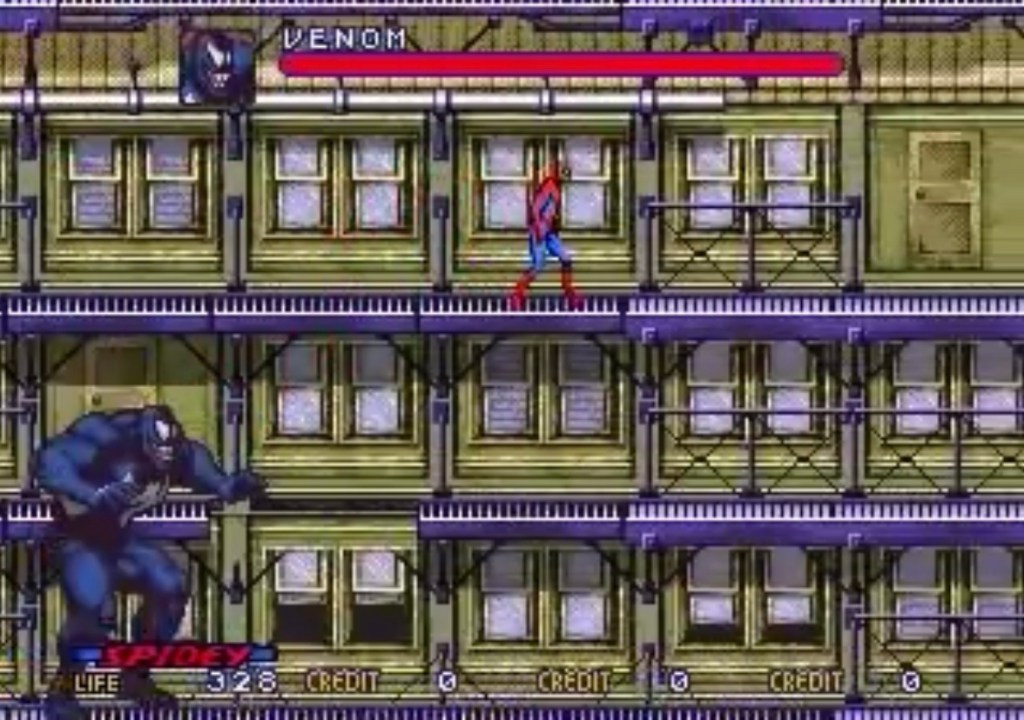
Okay, now this is different.

Where things get interesting in Spider-Man is after the first boss encounter: Venom. The storyline for the game is the Kingpin as acquired some magical artifact and Spider-Man needs to get it back. When Venom gets exposed to that artifact, he grows to a tremendous size. In order to convey that to the player, the player characters and the environment around them shrinks via a zoom-out effect. This also alters the gameplay from a brawler to a basic platformer. Characters now have a ranged attack and all can cling to surfaces in order to scale buildings. Other elements often featured in that style of game show up as well such as falling surfaces, obstacles that need to be dodged, and so on.

Electro is one of the bosses who only appears during a zoomed-out sequence.

Every act in the game features a zoom-out sequence, even though only the initial one features a giant enemy. If the entire game were crafted around this style, it would be okay, but when the two are mixed it works quite well as a change of pace. Some boss fights are exclusive to the zoomed out mode too, which is actually kind of a shame since we’re denied seeing a proper, large, model of certain villains. Nevertheless, it’s Spider-Man’s defining characteristic and it works really well. It’s a real surprise this tactic wasn’t utilized more, but then again, fighting games mostly took over the arcade space shortly there-after and the arcade brawler largely faded away.

Battling a foe like the Green Goblin is a lot different from taking on someone like Venom.

The game is divided into four acts, but each one is quite long and will have the players going back and forth between the two gameplay styles. And even though there are only four acts, there are still numerous boss encounters with Spider-Man’s most popular foes. Expect to face-off against the likes of Venom, Green Goblin, Scorpion, Electro, Hobgoblin, and more. Many will have to be fought more than once, with Venom being the most frequent (this was probably when the character was at the height of its popularity). Some of the fights aren’t much to speak of as the enemy functions like a regular enemy, just with a unique sprite and health bar, but others are multi-stage battles and can get pretty challenging. Kingpin himself is also a bit of a red-herring as the real villain of the game is revealed after the third act, which keeps gamers on their toes, I suppose.

Character sprites are big and detailed when not zoomed out.

The presentation is where things are at though. The characters look great on the System 32 board, especially in the non-zoomed out portions. The models are big and detailed making Spider-Man one of the best looking beat-em-ups produced. The villains are tremendous as well, and in between acts there’s some story-line material with some limited voice over. About the only thing I dislike about the visuals rests with Spider-Man himself, as he has this odd, slightly stooped, posture. The music is also catchy, and some was even recycled from older Sega games. Most of the boss characters also get a line or two of spoken dialogue which helps add a little pizzazz to those encounters.

The charging attack, demonstrated here by Kingpin, gets a bit annoying.

Like any brawler, the gameplay does get repetitive eventually. Spider-Man is able to help itself not just with the gameplay switches during acts, but also with the boss variety. A character like Green Goblin attacks in a manner far different from the Kingpin, for example, though by the end of the game there is definitely some boss fatigue. The hardest foes all seem to attack in a similar pattern in that they get knocked down and then pop back up into a charging attack. The penultimate fight of the game can get a bit annoying as the boss has a very small window of time in which he can be harmed before going into a charging animation that renders him invincible, or a blasting position that grants the same. Even so, Spider-Man is a surprisingly fair game. Most arcade brawlers exist just to extract quarters, but it’s possible to gang up on a boss and practically neuter them. Especially with two players, as most boss characters will pop-up after being knocked down to immediately vault across the screen, rather than be momentarily invincible when first getting up. This means two well-positioned characters can effectively “ping pong” a boss until it’s been defeated. Preventing this from becoming a true exploit though is the fact that most bosses are accompanied by standard grunt enemies. I never counted, but Spider-Man can handle a lot of enemies on screen all at once so things can get a bit hectic. It makes those crowd-clearing special maneuvers more and more useful as the game progresses. The trade-off though is that enemy sprites are recycled throughout as you will largely battle the same three enemies all game long, just with different weapon and color variations.

The game keeps track of how many enemies each player defeated and which took down a boss adding a competitive element to the experience.

A play-through of Spider-Man will last about 45 minutes, maybe a bit more. The one trick the game does pull that I’m not a fan of is that the player’s health is always gradually depleting as a means of forcing the players to move quicker. This seems to mostly be in effect during the platforming sections which is a bit annoying as the game does encourage some mild exploration. The “Go!” arrow might be telling you to go one way, but there’s an obvious area in a different direction with health power-ups. Even with that health-drain in place, a pair of reasonably skilled gamers should be able to get through this one on about 20 credits, or 5 bucks back in ’91. After each act, scores are tabulated and health bonuses distributed in kind as well which helps prolong the adventure and adds a little competition as well. The game awards a boss “kill” to whoever scores the last hit and boss defeats are weighted far more heavily than basic enemies so competitive players will do whatever they can to make sure they land that final blow.

The game is quite unique when compared with its peers, at least as unique as a brawler can be.

Since Spider-Man was an arcade-only release, it has become a bit of an obscure title. For whatever reason, other arcade-only brawlers like X-Men and The Simpsons seem to be remembered more fondly even though I find Spider-Man to be the superior experience. It’s a wonderful looking game, even by today’s standards, and the gameplay quirks help set it apart as well. As much as I enjoy X-Men, that game is a pretty basic brawler that’s over quickly, but also brutal when it comes to quarters. It’s possible Spider-Man has been victimized by the success of the Genesis game since so many people had it that it’s likely the first game they think of when people mention the character and Sega in the same sentence. It certainly wasn’t an issue of distribution as I routinely encountered this game in the wild, and it was often the game I went to first.

If this game were re-released in 2020 the legal info would be a lot more complicated than what is seen here.

Spider-Man is one of the best arcade brawlers ever released, and it’s also one of the few to remain exclusive to that format. When Sega brought 32-bit gaming to the living room with the 32X, it chose to craft a new Spider-Man game for that system rather than port this one, which ended up being the final Spider-Man game developed by Sega. Eventually games like X-Men received a release just a via X-Box Live, but Sega’s Spider-Man has remained in cabinets alone. The game was fairly popular so it’s not hard to track down a cabinet today, but buying one is quite costly since the character is so beloved. I suspect we’ve never seen the game made available due to the complicated licensing agreements surrounding both the game and Spider-Man himself. Sony holds the license for basically all Spider-Man media, while the presence of Hawkeye might give Disney a substantial voice in the room should there ever be talk of re-releasing the game. And then there’s Sega, who no longer has a home console of its own to bill this as an exclusive for. The game is likely viewed as too niche to warrant trying to figure out how to spread the money among all interested parties. Ideally it would be offered as a downloadable title like the Konami brawlers were, but that window has apparently been shut, and Sony striking a deal with Sega to include the game as a bonus feature on a modern Spider-Man title seems unlikely. As a result, if you want to experience what Spider-Man has to offer in 2020 you’ll need to track down a cabinet, or resort to other, less legal, means. Should you find yourself playing it, expect to have a pretty good time. Just make sure to bring a friend, or two, or three!