
It was five years ago that Lego released its brick version of the Nintendo Entertainment System. The scaled-down replica of the famous video game console came with a buildable game cartridge of Super Mario Bros. as well as a controller and a television. It was a fun set that was released in tandem with the roll out of a much bigger Lego and Nintendo collaboration. When I finished that set, I was wondering where Lego would take the license next? Obviously, I knew the company was focused on creating interactive sets for its Super Mario figure that had some built-in electronics. That, being more for the kids, was only so interesting. What really got my brain turning was how Lego would continue to celebrate Nintendo games and hardware?

It hasn’t gone as expected. The Lego NES seemed like the sort of thing that was primed for add-ons or even reissues. The company could have easily sold stand-alone controllers for those who want their console to resemble a two-player experience and they could have done more game cartridges. The challenge there would be in mocking up the television to accommodate them. The mechanism that scrolls the first level of Super Mario Bros. isn’t quite so simple as being something that can be dropped in and pulled out. It would have been fun to be able to change it to Zelda, Metroid, or some other classic title, but Lego was apparently content with what it had done for it hasn’t gone back to the concept in five years. Until now.


The Nintendo Game Boy was first launched in Japan in 1989. I guess to celebrate its 36th anniversary, Lego has decided to release a near 1:1 replica of the handheld device in Lego form. Considering that it’s one of the best selling consoles of all time, it makes sense to honor the Game Boy in this fashion. It’s original, blocky, design also lends itself rather well to the Lego form factor. The set was unveiled during the summer of 2025 and has since been released. It appears it was to have a street date of October 1st, but a few outlets broke street date either purposefully or by accident. Mine arrived on September 25th and gave me something to do with my morning coffee the next day.

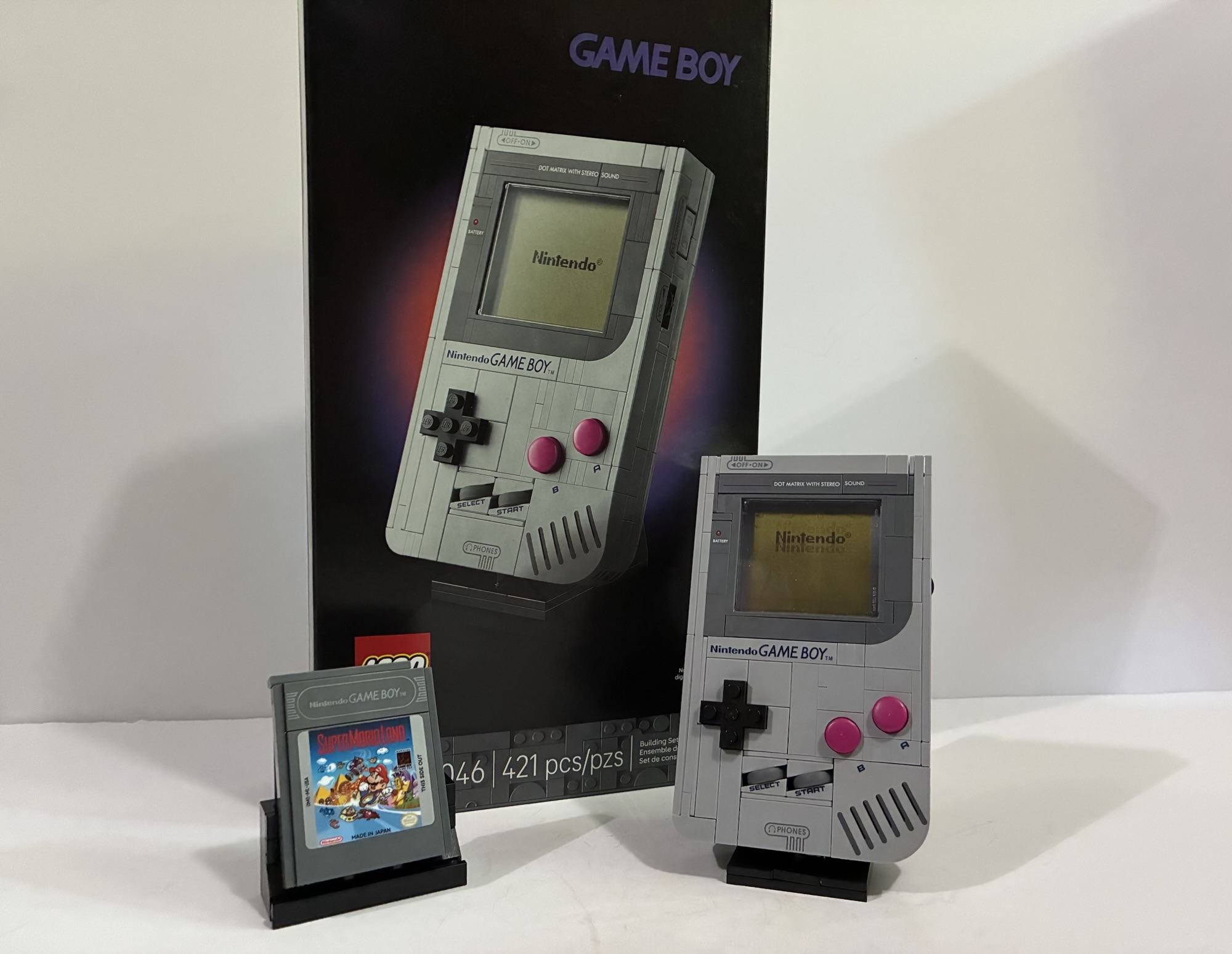
The Lego Game Boy is a breezy build consisting of only 421 pieces. It’s much smaller than the NES and also far less expensive as it will set you back around $60. Since the Game Boy was a handheld device, it didn’t make sense to include something like a television to expand the experience and brick count. You get a Game Boy, two games, a stand for the Game Boy, and a stand for the game not in use. Pretty simple and also pretty expansive. There’s not much else that Lego could have included aside from more games. No one needs a Light Boy or Lego versions of the cords an original might require. They could have made Lego versions of attachments like the camera or printer, but since those came much later I don’t think it would have made sense. This set is a tidy one and it accomplishes its goal in celebrating the original hardware.

The dimensions of an actual model 1 Game Boy are H5.875″xW3.5″xD1.25″ while its Lego counterpart is 5.5×3.5×1.125. I do not own an original Game Boy, the only Game Boy I currently own is the Micro, but it does feel similar to what I remember in-hand. It’s not as heavy as I recall, but the chunkiness of the device is quite close. The look is also impressive. From a distance, a savvy gamer would be able to tell there’s something a bit off just by looking at it, but a casual person might confuse it for the real thing. Up close that’s obviously not the case as the seem lines are apparent and the directional pad is clearly a Lego piece. Lego did a great job approximating the colors of the original device and the button placement. It has the one rounded corner and the gray border around the screen follows a similar shape, as it should. Even the faux screen looks like the old yellow-green screen from the original hardware.
For the presentation, Lego opted to forego stickers entirely for the Game Boy. All of the graphics you see in the pictures are printed onto actual bricks including the vent on the front and the “battery compartment” on the rear of the system. It’s definitely appreciated, especially for something people will want to hold. Lego also prioritized making the Game Boy have a tactile presence as well. The directional pad is only partly held down by bricks and is floating atop some rubber pieces so it actually pushed in when pressed. The Start and Select buttons are Lego, rubber, tires and the A and B buttons have some depth to them as well. For the volume and contrast, a Lego gear was inserted. It looks the part, and provides more immersion. Even the on-off switch was done with a sliding piece that really clicks into place.

Included with the Game Boy are two build-able “games”: Super Mario Land and The Legend of Zelda: Link’s Awakening. This is where we encounter our only stickers in the entire set as both game labels are done with decals. They’re large compared to most Lego stickers I encounter which helps to make them easy to apply. The top of the game with the Nintendo logo is another printed brick. Assembling them is a breeze, but made fun by having you build a replica of the circuit board that would appear inside the game. There’s some great attention to detail with Zelda, in particular. I wish I had an original Game Boy cart for comparison as the shape seems to be just a touch off. It feels like the proportions are off just a slight amount. It still looks pretty good, all things considered.
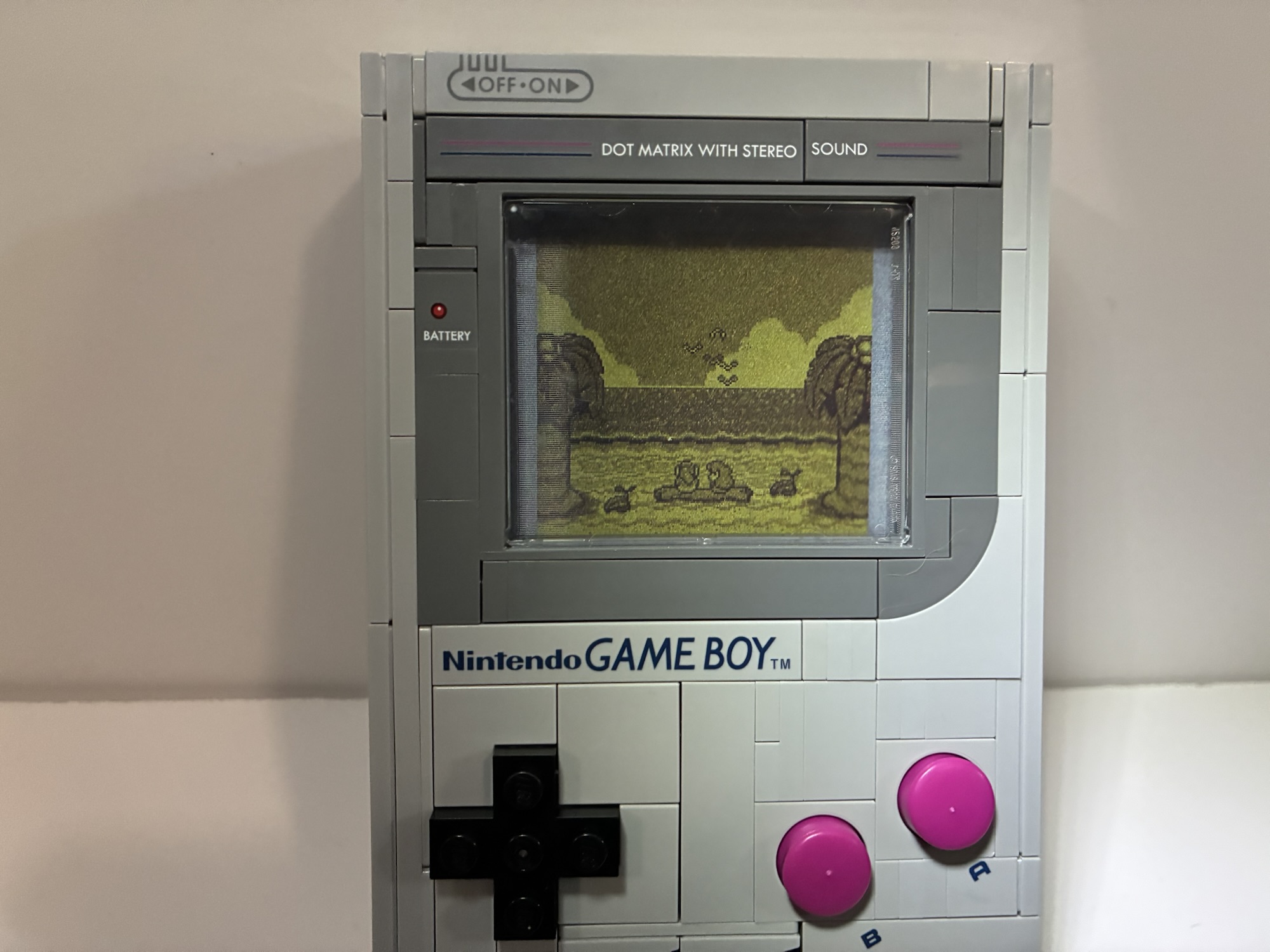
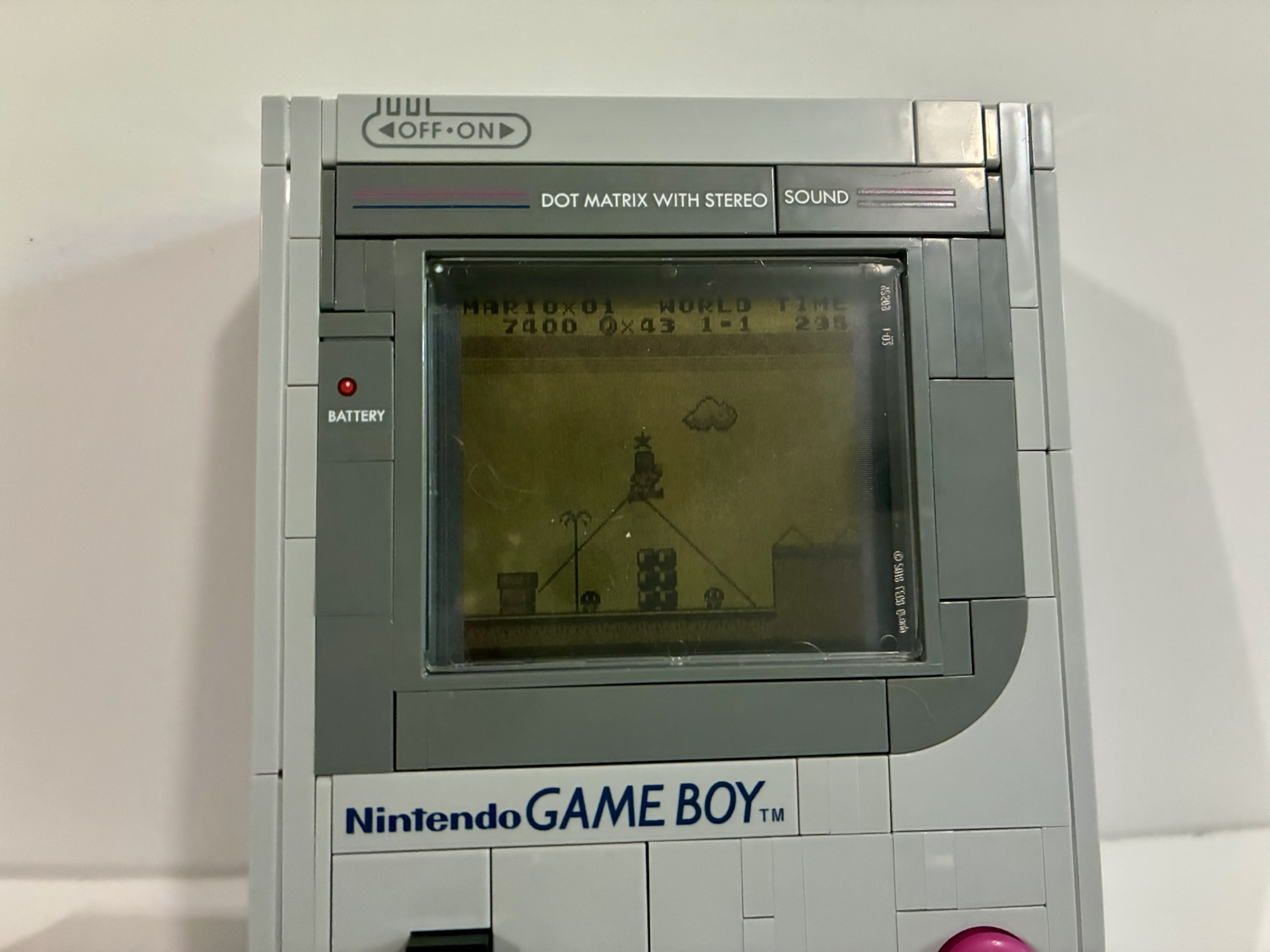
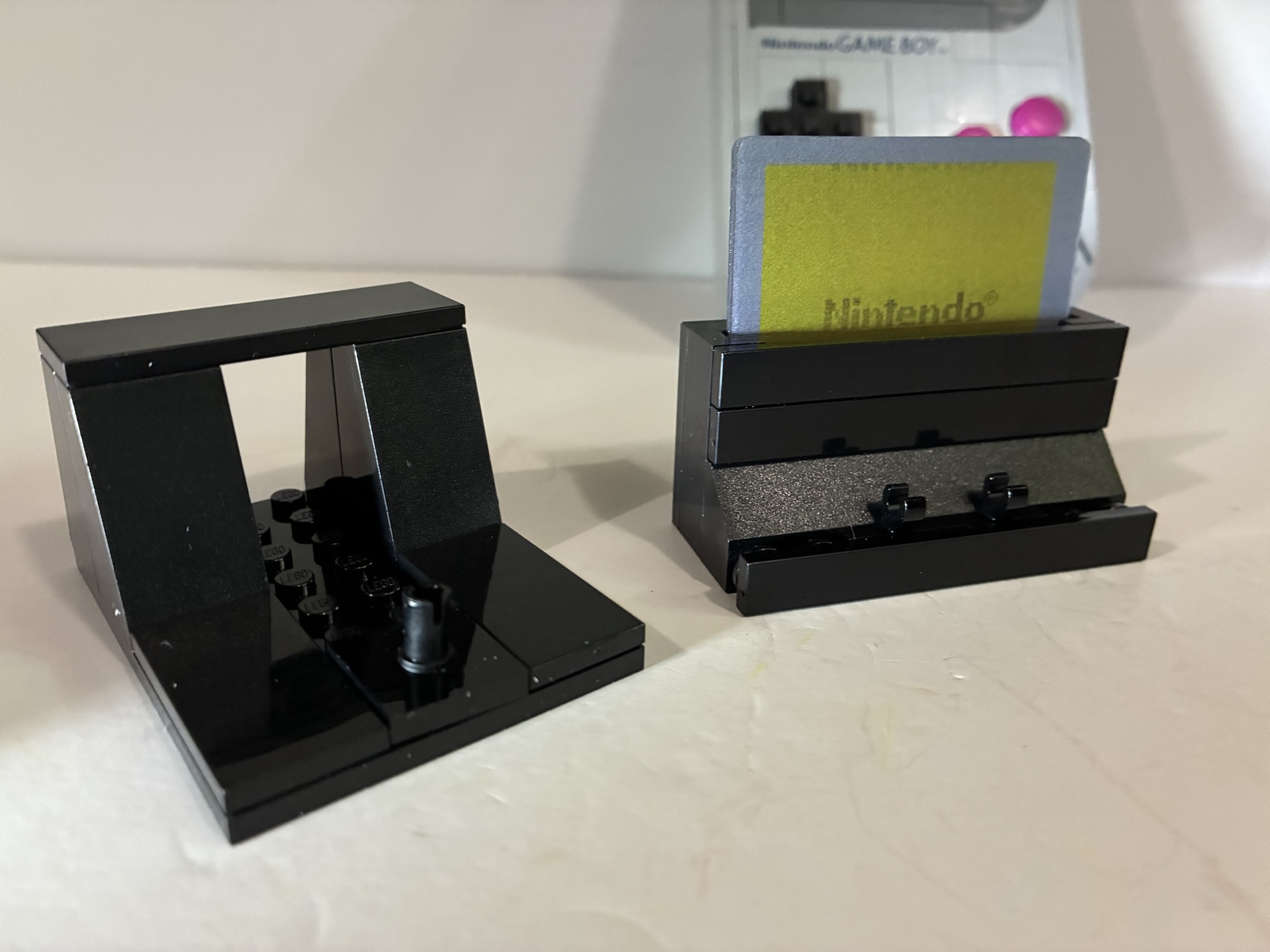
In addition to the buttons, the play feature here is the screen. Lego included three lenticular screens to swap in and out of the system. The basic one is the Game Boy start-up screen which simply reads Nintendo. In addition to that, there’s a screen for each game if you want to get specific. For Super Mario Land, it’s Super Mario bouncing into a question mark block. For Zelda, you get an image from one of the “cinematic” moments in the game of Link and a girl (I forget who this girl is, I don’t think it’s Zelda) seated on a log. The games are easy to remove and insert as is the screen. You do have to pop the “battery compartment” off to access the screen, but it’s not particularly cumbersome or tricky. The stands are a very basic construction using all black pieces. The Game Boy one is a bit sturdier and seems to work just fine. The game stand includes a slot for the unused screens and Lego assumes you will always have one game in the system at all times.

The Lego Game Boy is a fun addition to this small assortment of Lego video game consoles. It makes for a nice display piece amongst your game collection and visitors are likely to be tickled by it if they pick it up and mess around. The generous amount of printed bricks really helps sell the look of the device and the included games are nice to have. While some would argue the most impactful games were Tetris and Pokémon, Super Mario Land was pretty important in the early days of the console’s life and Link’s Awakening is the best game for the system. And both are wholly owned by Nintendo so no additional licensing fees required. Lego could easily continue this with other iterations on the Game Boy with different games. There was the Game Boy Pocket, Game Boy Color, and multiple versions of the Game Boy Advance. Considering what we saw out of the NES, I wouldn’t expect much to follow, but it’s likely only a matter of time until we see a Lego Super Nintendo.
Enjoyed this look at the Lego Game Boy? Here’s some other stuff that might interest you:
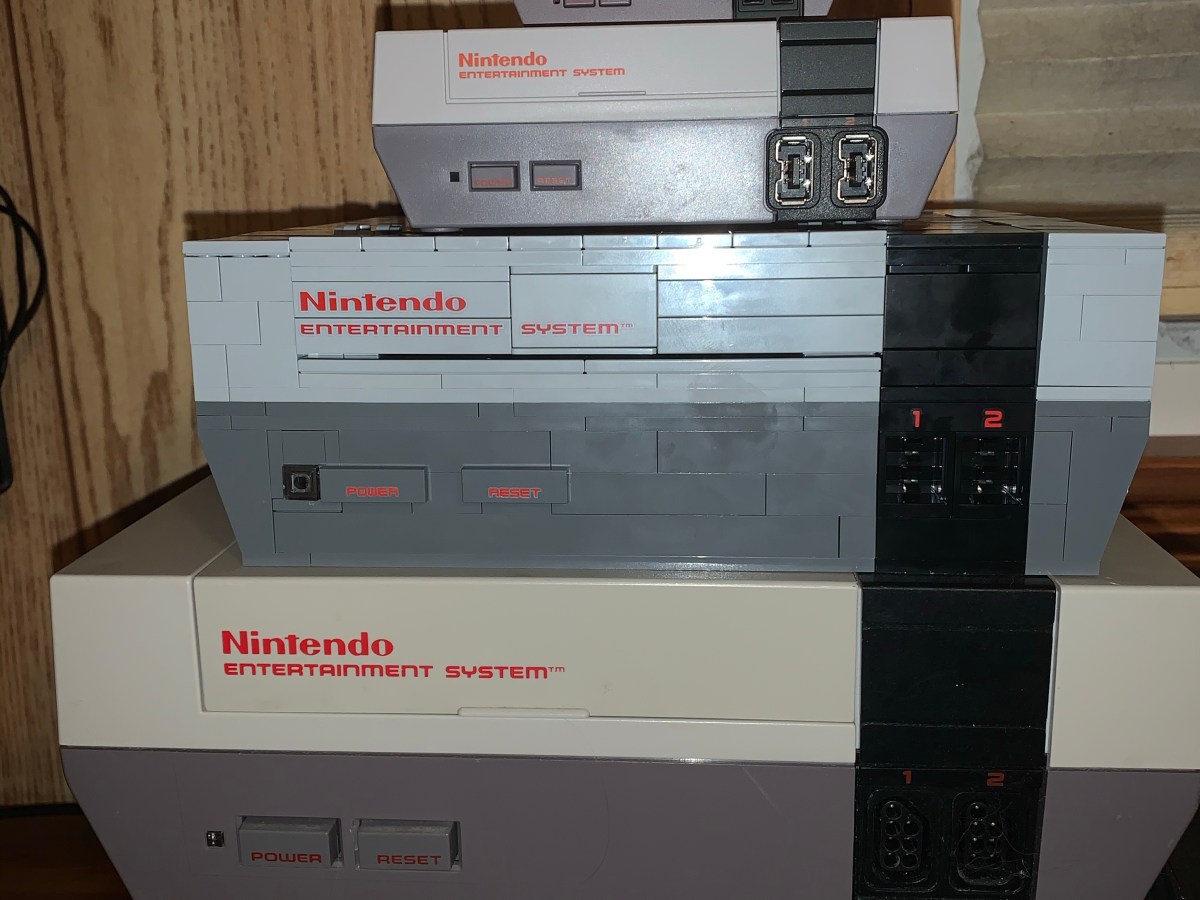
Lego 71374 – Nintendo Entertainment System
There’s something almost cathartic about assembling a Lego set. It can be hot and sticky in my house in the middle of the summer, but if I’m fiddling with a Lego set I almost don’t even notice. Considering how unbearably hot and humid it’s been in the north east this summer, it’s a shame I…
Keep reading
The Final Word on the NES Classic
If you read this blog even semi-regularly, you’ve probably seen me talk about the NES Classic already. When it came out I ranked the 30 games bundled with the device and also speculated on what could be included on a likely SNES Classic. What I didn’t do was actually come out and review the device.…
Keep reading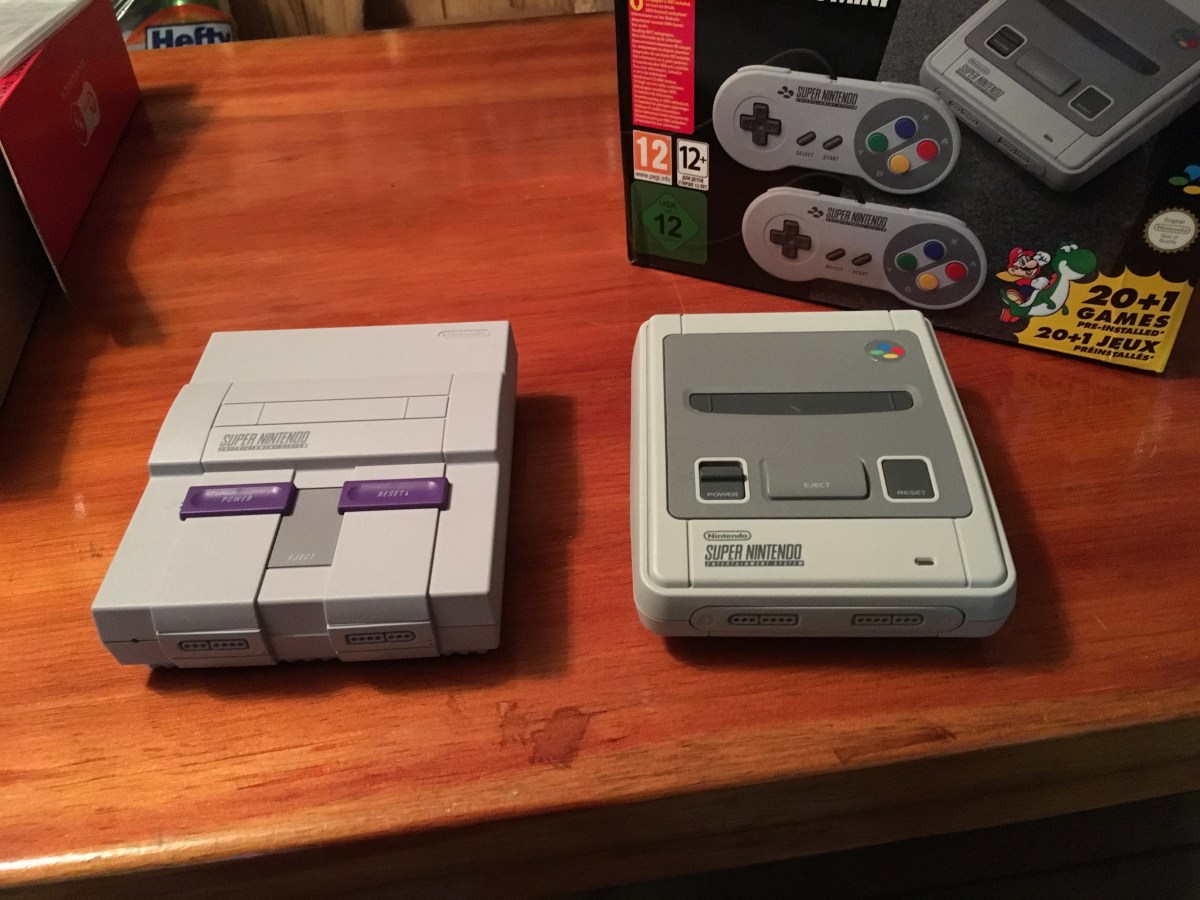
SNES Classic – Some Quick Thoughts
So the SNES Classic is out and has been for a week. As expected, it’s been rather difficult to get one if you weren’t fortunate enough to land a pre-order (which was also rather difficult to obtain). Scalpers are out in full force, and based on the few bits of feedback I’ve received from some…
Keep reading The Nostalgia Spot
October 2nd, 2025 at 11:55 am
Another great write up! this box has been sitting near my desk, staring at me for the last few days. I’m really excited to build it. 🤓
LikeLiked by 1 person
October 2nd, 2025 at 1:43 pm
Thanks! It is a really fun build that, if anything, is over too soon. I bet you’ll enjoy it!
LikeLike