Tag Archives: squaresoft

Greatest Games: Xenogears

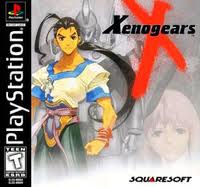
Xenogears (1998)

Xenogears (1998)

For me, all of my entries in my “Greatest Games” subcategory have been building towards this one.  My intention with the series was to present some of the games I felt were among the best I had ever played while shying away from the obvious choices.  After all, plenty has been said about A Link to the Past or Super Metroid.  While I made entries about Chrono Cross and Twisted Metal Black I was constantly looking ahead to that one game I preferred above all others.

Xenogears arrived during the RPG boom of the late 1990’s.  Developed by Squaresoft under direction from Tetsuya Takahashi, the game was originally supposed to be Final Fantasy VII but it became too dark and too sci-fi in nature to continue as such.  Takahashi was allowed to continue with the project as opposed to seeing it outright canceled but at a much reduced budget (more on that later).  Many Final Fantasy collaborators contributed to the project including executive producer Hironobu Sakaguchi.  When the game was complete, most of the staff would go on to develop Chrono Cross before eventually departing Square with Takahashi to form Monolith Software.
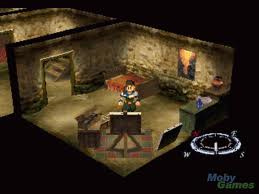
The game begins with our hero Fei in a rather innocent setting.

The game begins with our hero Fei in a rather innocent setting.

Takahashi was nothing if ambitious when creating Xenogears.  It was conceived as being just a part of a much larger narrative and is in fact titled as Episode V in the game’s credits.  The narrative focus of the game is epic in scope with a lot of talking points and several cut scenes, some of which are done with CG and others in full animation.  It’s a long game, one that will take most players around fifty hours to complete on the first play-through.  It’s story focuses on the young Fei Fong Wong, a typical RPG lead in that he has no family and knows very little about his past.  The plot will see Fei discover his true purpose, which is of course a significant one, as he journeys across the globe with a cast of characters out to save the world.  The story is nothing new in setup, but how Xenogears approaches it helps to differentiate it from the flock.  There are many religious undertones to the game’s narrative, some of which nearly scared Square out of an international release.  The game takes itself very seriously and though there are moments where comedy is utilized they’re not frequent.  The game has been criticized for being too pretentious, but it is a fairly enjoyable experience even if it can be hard to understand.

Part of the reason many consider Xenogears to be so pretentious is due to the fact that it tries to be too many things.  There are elements and themes taken from classic philosophy as well as modern sci-fi conventions found in the likes of Blade Runner.  The plot of the game seems to bounce around in focus with lots of twists and turns.  It’s fairly common for games in this genre to start off with one goal and finish with something completely unrelated, but Xenogears takes it to a new level.  The game does a good job of remaining interesting the whole way through but perhaps it would have benefited from a tighter structure.

Giant robots called gears play an important role in Xenogears.

Giant robots called gears play an important role in Xenogears.

The gameplay for Xenogears incorporates a lot of genre staples but also introduces some new concepts.  Players travel from town to town either on foot or via transportation and can talk and engage with non-player characters along the way which is often necessary to advance the plot.  Battles are initiated via random encounters on the overworld map or in dungeons.  Once a battle is commenced, the player takes control of a party of up to three individuals chosen beforehand or dictated by the game.  From there it’s a variation of the Final Fantasy Active Time Battle system where a speed score dictates the order and frequency of each character’s attacks.  When it’s the player’s turn, the options are also fairly straight-forward and include attack, defend, run, item, or magic.  The magic command is usually called ether or spirit but functions in the same way as a typical magic attack in most RPGs would.  When the player selects a standard attack is where things change.

In Xenogears, each character has a certain amount of attack points that can be used per turn.  At the beginning of the game there are six per character, but it increases over time.  Each face button on the Playstation controller corresponds with an attack command and has a point value:  triangle is one, square is two, X is three, and circle cancels or ends the attack.  A player can combine the buttons in any way up to the maximum available or use as few as one.  Certain attack combinations will trigger deathblow animations where the character will execute a more powerful move.  Performing the necessary sequence over and over is the only way to learn them but the game keeps track for you in the menu so you don’t have to guess.  The buttons do not have to be entered with any sort of speed so it’s not like a rhythm game or a fighter.  If the player chooses to use fewer than the available attack point total then the remainder goes into a bank for the rest of the confrontation.  As the player accumulates additional attack points, combos become available.  Combos basically allow the player to chain deathblow attacks in one turn allowing for a massive amount of damage to be unleashed.  As a result, most encounters (particularly boss encounters) end up being a balancing act where the player has to decide if it’s better to go all out from the start or build a character (or characters) up to unleash a giant combo.

Cut scenes like this nearly kept the game from getting a release outside of Japan.

Cut scenes like this nearly kept the game from getting a release outside of Japan.

That’s just one half of combat as Xenogears’ main feature is that of gear combat.  Gears are giant robots piloted by the game’s protagonists and allow the player to take on much larger foes.  Each character has access or will gain access to a gear during the course of play.  The gears basically mirror the character they’re paired with so the ones effective at dealing out the most damage on foot will be the same in their gear.  Even certain magic attacks are unusable by the gears while some are only usable on foot.  One of the more unique characters in the game, Billy utilizes guns and so his gear does as well.  On foot, each attack button corresponds to a different gun and the same is true in his gear, though it uses different ammunition.  Gear battle is very similar to character battle but has some notable differences.  For one, the player can only use two combinations of attack buttons but instead of having attack points each gear has a supply of fuel.  Each attack consumes fuel with triangle attacks consuming the least and X attacks consuming the most.  As a gear attacks, its attack level goes up.  At level one, triangle deathblows can be used.  At level 2, square deathblows become available, and so on.  There are four levels a gear can reach:  1, 2, 3, and Infinity.  Infinity is the most powerful and only becomes available late in the game.  It’s also not attainable simply by performing four non deathblow attacks in succession.  Instead, there is just a chance a gear can reach infinity when in level 3 and certain gears have a better chance of doing so than others.  Infinity opens up the best deathblows and lasts for three turns so when a gear is able to reach it it usually swings the tide of battle.

The character Elly is a central figure of the Xenogears plot.

The character Elly is a central figure of the Xenogears plot.

Gears also present some challenges not felt when fighting with the human characters.  I mentioned the fuel already which can run out.  If a gear runs out of fuel then it can’t attack, which presents a problem.  Each gear can use a turn to charge which replenish fuel but not a significant amount (unless the player equips a gear with charge-boosting items) and is not something one wants to rely on.  Gears also cannot replenish their hit points easily in battle.  Gears can be equipped with restorative items but they consume a lot of fuel.  Often times, this will cause the player to wait as long as possible to use such an item but then they find themselves in a situation where the gear is now low on fuel exchanging one problem for another.  Basically, the game forces the player to think a little differently when engaged in gear combat and that helps keep the game fresh.  The game is pretty much divided into equal parts gear combat and non-gear combat which does help to keep things interesting.

Outside of combat, character customization is pretty standard.  Each character can be equipped with stat-boosting items and armor with the best items becoming available towards the game’s conclusion.  Only some characters utilize weapons in combat just as only some have magic attacks.  Most will fit into the attack role or the support role with a few select characters performing adequately in both roles.  The game does do a good job of making the characters feel different.  I mentioned Billy earlier as one such character due to his use of firearms.  Another, Maria, always attacks with her gear even while on foot and another character has no gear at all, she can just grow to tremendous heights instead.  As character participate in battle they earn experience points and level up, in turn becoming stronger.  Gears do not receive any benefits from their pilot leveling up.  Instead, they can be upgraded through-out the game with better equipment including engines and frames which increase the gear’s stats as well as its hit points.
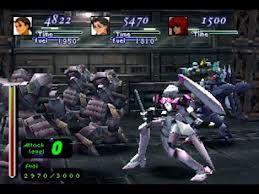
A lot of the combat takes place in gears.

A lot of the combat takes place in gears.

There are other things to keep players interested in the game.  Outside of battle players can search the world for players of the game Speed.  Speed is a real-world card game (when I was a kid we called it Spit) where the determining factor of who wins is who plays the fastest.  Defeating these players will often net a useful item and certain secret items can only be obtained via this mini game.  Another mini game is a gladiator type of coliseum where the battles take place in real-time.  The player can select from basically every gear in the game and compete in a fast-paced one on one battle.  It kind of reminds me of the Dragon Ball Z fighting games in that the characters zip around pretty fast and alternate between melee attacks and long-range energy projectiles.  At any rate, both mini games offer decent distractions and are entertaining in their own right.

Visually the game is a fairly solid performer given its era.  The designers opted to use sprites for the characters instead of polygons and while they animate nicely they are quite pixellated.  Backgrounds tend to be on the sparse side and the texture mapping is average.  Backgrounds are a hybrid of 2D and 3D and most areas can be rotated via the shoulder buttons on the controller.  It’s a bit odd watching the game try to rotate around a 2-dimensional character but it does help for timing jumps (something else that helps differentiate the title from a typical RPG, albeit in a minor way).  When the game transitions to gear battle everything becomes rendered in 3D.  The gears are fairly solid-looking and each has its own visual personality.  Attack animations are pretty understated when compared with other games from the genre.  There’s very little in the way of “wow” moments but nothing is really off-putting either.  If anything, the sprite-based approach helps in the long run as many games that opted to use polygons look woefully dated by today’s standards.  The score is quite good and on-par with Final Fantasy’s best, though some of the sound effects are a bit lackluster.  The FMV and anime sequences are not numerous but that helps give them added impact when they do show up.
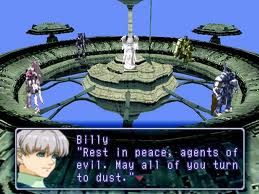
Xenogears tends to take itself quite seriously.

Xenogears tends to take itself quite seriously.

There is one other thing I have yet to mention about this game that many view as a glaring negative. I mentioned how the project was an ambitious one but I have yet to mention that it was so ambitious it went over budget.  If a Final Fantasy game runs over budget at Square it’s probably not that big of a deal but when an unestablished title does it presents a problem.  Since there was no money left a large section of the game had to be cut, but since the title is so narrative heavy, it could not just be annexed from the game.  Instead, when the player reaches the point in the game where the cuts took place (early in disc 2) they’re treated to a mostly black screen with the exception of Fei seated in a chair.  Here a seemingly endless amount of text is displayed as Fei takes on the role of narrator and explains to the gamer what took place next.  Other characters speak as well, but the presentation remains the same with the exception of a couple of gameplay rendered shots.  The scenarios being described were supposed to be playable but unfortunately are not.  And this section goes on for a good 45 minutes or so.  I remember the first time I reached this point of the game (I’ve played through it multiple times) it was really late at night and I just wanted to go to sleep but had to keep going and going to get through it.  The game does give you the option to save a couple of times so at least there’s that.

Xenogears may not be visually impressive by today's standards, but it still has its moments.

Xenogears may not be visually impressive by today’s standards, but it still has its moments.

As a result, the game feels like it never got what it deserves, which is what every game deserves:  to be completed.  Xenogears sold modestly well but with the creators behind it all leaving to form Monolith it basically ended the possibility of there ever being a true sequel.  Xenosaga was initially conceived as being a part of the Xenogears lineage, but either legal decisions forced that to change or an artistic change was made.  Xenogears presents a pretty open and shut story with little room for a natural sequel, but I would love to see Square return to it as a remake.  The game could be left as is or it could be cleaned up completely with an all new engine.  Some pacing issues could be addressed, but most importantly, the portions of the game cut could finally be restored either thru a new gameplay section or via fully animated cut scenes.  Since Takahashi no longer works for Square, it would have to be done without him but considering the ground work has been laid already it wouldn’t be that difficult.  Xenogears deserves to be experienced the way it was initially conceived and I would personally prefer to see it remade over Final Fantasy VII, a remake many people have been hoping for.  Maybe it will happen one day (though probably not), but even if it never does Xenogears remains my favorite game of all-time.  I know it’s not the greatest game ever made, but it doesn’t have to be in order to win me over.

For those who have never played it, second-hand copies of Xenogears can still be found fairly regularly on auction sites like eBay.  Square-Enix also released the game onto the Playstation Store so Playstation 3 owners can experience the game that way.

Greatest Games: Chrono Cross

Chrono Cross (1999)

I have been intentionally avoiding the topic of video games of late.  I felt like this blog was getting too video game oriented when it’s meant to capture more.  I think the break has been long enough and so I return to my Greatest Games feature with the latest addition, Squaresoft’s Playstation masterpiece:  Chrono Cross.

Chrono Cross was burdened by hype from the get-go.  One of the most fondly remembered games from the 16 bit era is Square’s Chrono Trigger, the time-traveling RPG that won over many gamers in 1995.  It came late in the Super Nintendo lifecycle and at a time when the RPG was starting to get a bit stale.  It changed things up though thru it’s then innovative battle system and time traveling dynamic which made the game feel extremely fresh.  Those who played it loved it, and those who found out about it much later felt like they really missed out driving the after-market prices of SNES game carts to unexpected heights.  Squaresoft would wisely capitalize on this by re-releasing Chrono Trigger for the Playstation with Final Fantasy IV as part of the Final Fantasy Chronicles compilation.  They would also develop and release a sequel in 1999 called Chrono Cross.

By the time Chrono Cross arrived the fans who had missed out on Chrono Trigger had caught on and expectations were high.  The game was well met by critics when first released, becoming one of only seven titles reviewed by Gamespot to receive a perfect score.  Other outlets were eager to praise the title and it was one of the best reviewed games of 1999 and is still the 8th best reviewed title for the Playstation behind games such as Metal Gear Solid and Gran Turismo 2 and ahead of genre-mate Final Fantasy VII.  Even with all of that praise though, it still feels like Chrono Cross gets overshadowed by the game it followed.  Chrono Trigger has been re-released numerous times for both home consoles and portables.  Chrono Cross, on the other hand, has never been re-released in the US and only recently was made available on the Playstation Network in Japan.  The game sold pretty well, but it didn’t move a real noteworthy amount of units (though most RPG’s don’t).  It feels like the game is still fighting for recognition, even when few are there to put it down.

Serge, the game’s primary protagonist.

Chrono Cross is my preferred game of the Chrono series.  That’s not a knock against Chrono Trigger, a truly wonderful and memorable game, but Cross is just a tiny bit better.  The scope of the game is enormous.  There are over 45 characters for the player to recruit and use and a select few have hidden special moves that can be used in conjunction with other characters.  The game encourages repeat playings as it’s impossible to recruit all of the game’s characters in one play-through.  The game’s plot does not take the player across millions of years but it does include parallel worlds.  In an interesting twist, the game’s main character is alive in one world but died as a small child in the other.  In sort of typical Japanese RPG plot-lines, nothing is what it seems and things do get a bit convoluted by the game’s end but it’s an engrossing and worthwhile story to experience.

The gameplay is similar to Chrono Trigger and other Japanese RPG’s, but it is different in several key areas.  Chrono Cross felt remarkably progressive when it first came out as the game did away with genre staples such as experience points and random encounters.  Instead of experience points, characters get progressively better after performing actions in battle up to a certain point.  There’s a cap placed on the player that can only be extended by defeating a boss character and gaining a “star.”  There’s also no magic points, or mana, and these stars serve as a fuel of sorts to summon creatures to aid in battle.  Magic and special abilities are all labeled as elements, and they are one-time use in battle.  If you want your character to cast Aqua Ball twice you simply equip the spell twice.  Each character has an element grid that grows with the character.  Characters have their own unique abilities at certain levels and are free to equip anything else.

A look at the game’s battle scenario. Not bad for a game that’s over 10 years old!

To go along with this element system is a color coded element field.  The field exists on every battle and is comprised of three parts.  There are six element colors that can affect the field and using any of the six adds it to the field and bumps one off.  For example, if three consecutive red elements are used between the player and enemy, then the whole field is red.  Each character has an innate elemental color associated with him or her which makes them more proficient with that color and weak to its opposite.  When the field is in that character’s favor, that character gets a boost in stats and all elements of that color are more potent.

Standard attacks use attack points.  At the onset of a turn, a character has seven stamina points to use.  Using any kind of element uses up seven while physical attacks are tiered and consume 1, 2, or 3 points.  The player can use all seven up on physical attacks or elements.  Elements can be used at any time, but if the player only has two stamina points remaining then he’ll end that turn with negative 5 stamina points which will likely impact the character’s next turn.  It becomes a management tool and sometimes the player will be tempted to go all out and exhaust his or her characters in an effort to deal a killing blow.  And since the element field is affected by everyone who uses elements it affects how the player uses all of the characters in the party (three total).

The battle system encourages tactical thinking, more so than most Final Fantasy games.  And because the roster of available characters is so large it gives the player lots of freedom to swap characters in and out of the main party.  Usually who’s in it will be determined by the environment as it’s good to have an opposite aligned character to deal out major damage, though going too heavy on the opposite element means your characters are more susceptible to the enemies as well.  These kinds of trade-offs are not foreign to gamers, but it works to great effect in Chrono Cross and keeps even the more mundane enemy encounters amusing.

If you’re a fan of the genre and never played this one then you’re really missing out.

As I mentioned earlier, the plot can get a bit murky but overall it’s pretty fun and will keep most gamers entertained.  The game pulls the old switcheroo midway through by having the main character change rather drastically which gives the game a new feel.  The art direction and visuals were quite stunning in 1999 and hold up surprisingly well today.  A lot of games from the Playstation era cannot say the same.  There’s many lush environments, especially early in the game, and there’s liberal use of FMV for the more spectacular moments.  The audio is also fantastic.  Sure the characters don’t talk and it’s a pretty text-heavy title, but the soundtrack is exceptional and one of the best of all time.  Above all, it’s just a fun game.  This is the Japanese RPG perfected and the genre’s popularity maybe well behind us at this point but it’s still fun to go back and relive the classics.  New games are great and all, but there’s nothing like firing up an old classic and if you’re going to play an older RPG, Chrono Cross is the one to reach for.


Greatest Games: Super Mario RPG: Legend of the Seven Stars

Super Mario RPG: Legend of the Seven Stars (1996)

In the early to mid 90’s Nintendo was still king.  Sega had carved out a very nice, and in some parts of the world larger, fan-base but Nintendo was still the first word that came mind when video games were brought up.  By the end of the 90’s Sony would establish itself as the new leader of the pack, but that didn’t really weaken the Nintendo brand too much.  At the same time, Squaresoft was killing it with the Final Fantasy franchise and beyond.  When it was announced that Nintendo and Square were working together on a role-playing game expectations could not have been set higher.

That collaboration would give birth to Super Mario RPG: Legend of the Seven Stars, one of the Super Nintendo’s final acts of brilliance.  I, to this day, still feel like I missed out a bit on how great the SNES was.  I had one, like just about everybody.  When I first heard that a Super Nintendo was coming to market I wanted it without ever having seen it.  I didn’t have a subscription to a game magazine or anything, and not many of my friends did either.  I think the first time I saw what the SNES even looked like was at a cousin’s house.  I begged for one but would have to wait a little while until one Christmas where I had my Ralphie moment to find it hidden behind a kitchen chair.  It was awesome, but by next Christmas I wanted a Genesis because it had Mortal Kombat with blood.  Pixelated red stuff was really important to a 9 year old.  I received a Genesis the very next Christmas, one year after I got my SNES.  From there I never received another SNES game.  I think my mother and grandmother (the two most likely to buy me Christmas and birthday presents) assumed the Genesis was superior or something and would just buy me Genesis games.  As a result, most of my SNES play was through rentals or much later on through ports on the Playstation or other means.

Mario was able to jump and avoid enemies on the "world map" areas. Contact with an enemy would take the player into battle mode.

Super Mario RPG was a game I experienced in a limited fashion when it was first released.  On the surface, it was kind of an absurd title.  Mario, the plumber, in an epic Final Fantasy style adventure?  It had an interesting visual style though, a pseudo 3D engine that kind of looked like claymation, and an isometric 3 quarters perspective.  I rented it with a friend, multiple times I think, though we understandably could never beat it in one night.  I had another friend who owned it and showed me the ending since he beat it.  I never thought to borrow it and play through it myself, probably because by then I had a Playstation and was at that age where it didn’t make sense to go backwards from the more powerful console to the lesser.  When emulation started to rise in popularity on the internet I downloaded it and played through it.  And then once the Wii and its Virtual Console came along I downloaded it again and played through it from start to finish, this time seeing everything the game had to offer.

The antagonist for Super Mario RPG; Smithy!

Super Mario RPG is one of those games that’s just plain fun to play.  It would be easy to credit that to the Mario charm but I give most of the credit to Square.  Square could have taken the easy way out and just palette swapped Final Fantasy VI with Nintendo characters and called it a day.  Instead, they took the essence of what made a Mario game a Mario game and incorporated that into an RPG formula.  Mario is the premier platform hero, and Square wisely identified that and incorporated something that’s fundamental in most games into a genre where it’s completely foreign:  the jump button.  Mario could jump, which added a new amount of depth to the world.  Mario traverses a world not completely unlike his usual Nintendo adventures.  As he encounters enemies he can jump on them which brings the game into battle with Mario scoring an early hit.  He also has platforms to traverse and jump across.  These challenges are fairly limited and there’s nothing as challenging as the hardest Super Mario Bros. levels were accustomed to, but it does add to the experience and help make it decidedly “Mario.”

The battle system also received an overhaul to best suit the plumber and his pals.  It’s still turn-based like the majority of RPGs at that time, but it incorporates more button presses.  These commands take the form of either button mashing or timing based.  Hit the attack button at the proper time for just about every attack and the character will score an additional hit up to a certain point.  It’s possible to ignore these extra commands if one is so inclined, but it’s far more rewarding to make use of them.  The more powerful attacks were suitably more difficult to pull off but also more rewarding.  This also worked on defense as well, as characters could avoid taking full damage on some attacks with a well-timed button press.  The game does a good job of changing things up at the right time as well so that just when you’re getting comfortable dodging the para-kooopa’s attack or timing Mario’s mallet strikes just right, a new enemy comes along or a new weapon.

The weapons and skills also have a lot of Mario charm incorporated into them.  Mario has his fire power to make use of and his jump attack.  He can also wield a mallet at times like he did way back in his debut in Donkey Kong.  My favorite weapon is probably Bowser’s chain chomp which he wields like a bolas by spinning it over his head and then tossing it.  Oh yeah, this game also pairs up Mario and Bowser!  Such a pairing would repeat itself, but this is the first time it happened in a game and it was pretty cool.  Not only was it fun to pair Mario and Bowser, but it’s also nice to give Mario a different antagonist.  And since the Princess joins the party as well, this makes Super Mario RPG the rare Mario game where the plumber isn’t out to rescue the Princess from Bowser.

The "star" of Super Mario RPG? Geno certainly was a hit with fans, and many would like to see a return engagement with Mario.

Square would jointly create additional characters with Nintendo to flesh out Mario’s party.  In battle, only 3 characters can be used at once but up to 5 were selectable by the game’s end.  In addition to the 3 mentioned before, Mario was also teamed up with a cloud kid named Mallow (who thinks he’s a frog) and the toy come to life Geno.  Geno has since become a fan-favorite and often comes up whenever a new Smash Bros. game is mentioned as a potential player character.  Despite the fan reaction to him, he’s yet to make another appearance in any Nintendo game.  Square actually holds the copyright on Geno (or at least holds it jointly with Nintendo) which is why he is unlikely to ever surface again as a playable character (he does have an item cameo in Mario & Luigi: Superstar Saga).  The party Mario ends up forming contains the usual assortment of offensive-minded characters, healers, and so on.  It’s nothing too deep, but the variety is solid enough.

If there’s room for improvement it’s with the story-line and difficulty of the game.  It’s standard fare for an RPG to have a big, dramatic plot, which is something Mario has never been known for.  The story here is rather simplistic and not a driving force of the game.  Square wisely interjects humor wherever it can giving this title a different feel from most of the genre.  And considering Nintendo didn’t give Square much to work with in terms of plot depth based on older Super Mario Bros. games, they did a pretty admirable job.  And while the gameplay is complex enough to separate the title from introductory RPGs such as Mystic Quest, it still feels like Square made it as accessible as possible for Nintendo’s audience.  There’s some challenge to the game but nothing crazy.  There’s no point in the game which requires the player to go out and level grind to get through a certain dungeon or any white knuckle boss encounters.  Even the optional, hidden boss Culex (a Final Fantasy themed boss) isn’t very difficult to best.

The game is by no means perfect, but it offered a fun and refreshing take on the RPG genre when it was first released.  The charm of the title was infectious, and it’s approach to battle would show up in both future Nintendo titles and future Squaresoft games.  Because the relationship between the two companies soured shortly after the release of Super Mario RPG, a true sequel has never been created.  Instead fans have received several spiritual sequels in the form of the Paper Mario series and the handheld Mario & Luigi games.  Both franchises borrow heavily from Super Mario RPG, but neither is a copy and paste affair.  For the most part, the humor has been carried over and made an essential part of the game’s story-telling.  Bowser is also rarely the ultimate foe and is sometimes a playable character as well.  Timing based attacks are the norm for the battles and for the most part the games have been a lot of fun.  Turning Mario into an RPG star seemed like a pretty crazy idea in 1996, but it worked out better than probably anyone could have hoped for.  The current games have been fun, but I still think the original Super Mario RPG is the best.