Tag Archives: fantasy

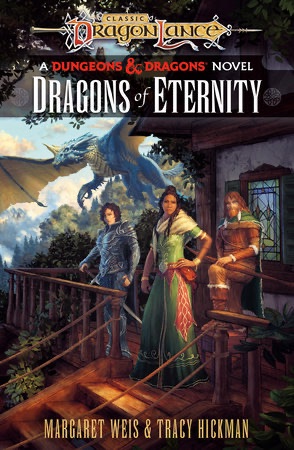
Dragonlance – Dragons of Eternity (2024)

Cover by Philipp Urlich.

When I first heard about the existence of Dragonlance Destinies, two of the three books in the trilogy were already completed and released to the world. It’s a remarkably convenient way to consume a trilogy of books, because not only were two of the three out, but the third was about a month away from release. Being unplugged from the world of Dragonlance meant that I could go in without much knowledge of what was to come. It was almost like walking into a random movie theater for a film I had never seen a trailer for. It’s my preferred way to take-in just about any piece of entertainment. The less I know going in the better. And when I started reading that first book, Dragons of Deceit, and found it took place after the book Test of the Twins, but before Dragons of Summer Flame, it had me wondering why that was? Was this trilogy a way for authors Margaret Weis and Tracy Hickman to take their precious characters on one more adventure before moving on from Dragonlance? Or, considering the fact that time travel was set to play a prominent role in the trilogy, was this going to be a way to reboot the series? Now that I am done with the third book, I can safely say I feel like I have the answer to both questions.

I say that as a mild warning, because if you’re like me and you don’t know much about this trilogy going in then you may want to avoid reading about it at all. Especially if you loved Dragonlance at any point in your life because I can safely say if that is true then you’ll have a good enough time with this new trilogy. If you want a simple recommendation, a yay or nay, to Dragonlance Destinies then consider this a “yay.” It’s not perfect, but it’s a nice nostalgia blanket. The books are breezy, easily consumed within a week when reading casually, or consumed much faster if that is your preference. The cast of characters is a bit large, but they’re also largely familiar so there’s no real fear of getting lost even if your speed of consumption is much more deliberate.

With that out of the way, lets recap quickly where Dragons of Fate left off and Dragons of Eternity begins. Our time displaced heroes Raistlin, Tas, Sturm, Destina, and Kairn, had just escaped the past where they had been sent in the first novel in the trilogy. They had found themselves in the age of Huma, or the Third Dragon War, along with the embodiment of the god Chaos that had been trapped in the Graygem and hung around the neck of Destina Rosethorn. She had wanted to use Chaos to travel back in time and save her father, but through a calamity of errors she and the rest ended up much farther back than intended. Everything went wrong at the end of Dragons of Fate. Huma and his silver dragon lover, Gwyneth, were both murdered by an assassin. The Queen of Darkness, Takhisis, was on the verge of victory in a battle she wasn’t supposed to win. The heroes escaped, but the Device of Time Journeying took them to a future they didn’t recognize. Kairn found himself at The Inn of the Last Home just before the The War of the Lance was supposed to break out, only instead of a reunion of friends he found a city occupied by the Dark Queen’s forces. Dragon Highlord Kitiara was there as were her brothers, Caramon and Raistlin, now wearing the black robes and both acting in service to their older sister.

Time travel in Dragonlance is its own thing. The same person cannot exist twice at the same time, so when a person travels back in time to a time and place where they also existed then they simply take over the body of their past self (a warning to would-be time travelers: Don’t travel to a setting where you existed as an infant). Because of this, Raistlin knew what happened and he knew who Kairn was. He advised the monk to flee back to the present where he personally originated from where he could consult with the god of neutrality, Gilean, and seek counsel on how to fix the past. Because of their actions in the past, The War of the Lance now never took place. Instead, there was The Lost War in which Takhisis finally defeated the other gods who opposed her and established her rule for all time. Since a god exists in all times, the plan hatched by Kairn and the others is for him to travel back in time with Tanis Half-Elven to the time of The Lost War. There, he will reunite with Destina, whom he left behind, and the two of them will travel back to The Third Dragon War again and try to fix what they so badly broke. Meanwhile, the Heroes of the Lance in the age of The Lost War will do their best to distract the Dark Queen in that time in a bid to help Destina and Kairn go unnoticed for if Takhisis were to seize hold of the Graygem there would be no telling how powerful it would make her.

The other rule of time travel in Dragonlance is that it’s always equated to a river. It’s less a metaphor, and more just a truth of how time works. When someone travels back in time and actually manages to do something to alter the flow of the river of time, it takes a little while for that to impact the present. In other words, this isn’t Back to the Future where changing the past immediately changes everything to come. It also means that when traveling back in time again there’s no chance of running into one’s past self. Should Destina and Kairn return to the time of Huma once again, it’s basically like they were never there previously with Raistlin and Sturm. And if they’re successful, it will almost be like they were never there at either time. No one in their party will remember what happened and time will move on just as it did before. That is why Kairn is able to leap ahead of the river of time back to the present to even hatch this plan to save time itself.

That’s the general setup and for longtime fans of Dragonlance it’s almost like reading an alternate version of The War of Lance. We get to adventure with Tanis, Sturm, Caramon, Tas, Flint, and Raistlin on a quest to thwart the Dark Queen. And their maneuverings in this new Lost War era makes up the bulk of the book. Once again, the apparent protagonist of this new trilogy, Destina Rosethorn, is more or less sidelined. She obviously has her part to play in what happens, but it doesn’t consume a whole lot of ink. As a result, she’s hard to care about and her romance with Kairn is hardly what one would call steamy. It’s established quickly the two find each other attractive, but following that there’s no real insight into why they fall in love and are even discussing marriage at times. Perhaps it’s merely a relationship of lust and convenience for the both of them.

My criticisms of the Destina character are nothing new, so I’ll put a pin in that topic now. As for the rest, it’s very enjoyable to read about these characters together. I was worried it would play out more like a relay race when Dragons of Fate ended. Sturm and Raistlin’s part would be over and it would be onto Tanis and maybe Flint. Instead, we get basically the whole crew and it works. It’s fun, and while it isn’t an entire trilogy of these characters running around the world of Krynn, it’s substantial enough as a nostalgia trip. And the inclusion of Chaos, an entity that can actually alter time, and the interesting era in which this story began does create actual stakes.

I’m not going to spoil the ending of the book, but let’s just that the chronology of Dragonlance is forever altered by this book. And if you read the two previous, then you already knew that was going to happen. The Device of Time Journeying was changed in Dragons of Fate so it could no longer exist as it was supposed to in later books when it showed up. And if you are someone who is more plugged into the goings on of Dragonlance then you probably also suspected as much. Recently, I stumbled upon the below Tweet from author Margaret Weis concerning what would be the next book in the chronology, Dragons of Summer Flame:

As someone who doesn’t keep track of all things Dragonlance, that came as a surprise to me. That book was a bit divisive in the fandom, not because it’s bad or anything, but because of the change it brought (We fear change). I assume Tracy Hickman has similar feeling towards the book, but don’t know that for certain. Needless to say, if one were to reboot Dragonlance then the time of Dragonlance Destinies is a logical place for that reboot to take place. I was also under the impression that Dragons of Eternity was to be the last in the series for Weis and Hickman. I am not certain of where I read that or if it was my own assumption, but once you get to the end of Dragons of Eternity there is a note that both Weis and Hickman will be back with more works in the series. And at GenCon last month, it was confirmed that the next book from the duo will be about Huma and Magius set before The Third Dragon War. In other words, if you close this book wondering what’s going to happen next then you’re in for a wait.

And perhaps that wait could be forever? Maybe the point is to reset the timeline from a certain point and then let the readers imagine what comes next? It is my belief that Weis and Hickman approach their novels as their own entity. It’s a story they want to tell so even though they are tied into the game Dungeons & Dragons it doesn’t mean they’re writing something for the sake of said game. If they were to though, leaving players to adventure in a post Destinies Krynn wouldn’t be a bad spot. As for the trilogy itself, I enjoyed getting reacquainted with this world and its characters. I wouldn’t go so far as to call it fan service, but I do think Weis and Hickman share a lot of the same desires when it comes to these characters as their fans. They enjoyed putting them in a new adventure, some of the pairings we saw, and yes, some of the changes. There was an interaction of sorts teased throughout that didn’t come to play and I suppose I was left a little dissatisfied at that, but perhaps it’s for another story? Time travel stories can be messy, though they’re rarely boring. Dragons of Eternity is a good capper to this trilogy and is probably the strongest of three. If you’re a Dragonlance fan, especially one for a bygone era, then I do think you owe it to yourself to go on one more journey with these characters. It’s likely to a put smile on your face and keep it there for the whole duration of the adventure.

For more Dungeons & Dragons fun, give these a read:

Dragonlance – Dragons of Deceit (2022)

My favorite series of books as a youth belonged to Dragonlance. The Dungeons & Dragons campaign setting that spawned numerous novels was a world I enjoyed inhabiting. I didn’t fall into Dragonlance until I was in middle school and my very first book in the long-running series was Dragons of Summer Flame by Margaret Weis…

Keep reading

Dragonlance – Dragons of Fate (2023)

What’s this? After only doing one novel review in the 10+ year history of this blog we have two in the span of a week? That’s what happens when yours truly stumbles upon new stories in a beloved franchise. I outlined my experience with Dragonlance in last week’s review of Dragons of Deceit so there’s…

Keep reading

NECA Dungeons & Dragons Strongheart Ultimate Action Figure

It was roughly a year ago that I added Warduke to my collection from NECA Toys’ Dungeons & Dragons line of action figures. Warduke is basically a modern rendition of the character as featured in the vintage D&D toyline from LJN in the 80s. While I wasn’t a fan of that old toyline, I could…

Keep reading
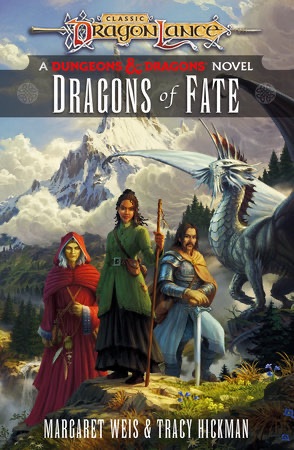
Dragonlance – Dragons of Fate (2023)

Cover art by Philipp Urlich

What’s this? After only doing one novel review in the 10+ year history of this blog we have two in the span of a week? That’s what happens when yours truly stumbles upon new stories in a beloved franchise. I outlined my experience with Dragonlance in last week’s review of Dragons of Deceit so there’s no need to do so here. To summarize, I loved the series as a kid and was surprised to find out that the writing duo of Margaret Weis and Tracy Hickman had returned to the world of Krynn with a new trilogy. I read through Dragons of Deceit in a somewhat leisurely manner, but it picked up near the end which catapulted me into the second book in the trilogy, Dragons of Fate.

Dragons of Deceit introduced the character Destina Rosethorn, a literal child of destiny and daughter of a Solamnic Knight who perished battling the forces of the Queen of Darkness in the famed battle at the High Clerist Tower which also claimed the life of Sturm Brightblade. Destina was a difficult character to latch onto. She is somewhat cold and detached due to her devotion to The Measure, a strict set of rules laid out by the Knights of Solamnia. She’s also a privileged woman raised in a castle. When much of that life of luxury is taken from her she is willing to abandon her morals and put the world in extreme peril to basically regain her castle and her status. Her plan is to travel back in time using the famed Device of Time Journeying and essentially trick her father with a cowardice potion so that he abandons his post and survives the battle.

That didn’t happen. Instead, Destina found herself mixed up with a kender named Tasslehoff Burrfoot. We know Tas well as he’s a featured character in most of the Weis/Hickman novels and through some polymorph magic he even comes to think he’s married to Destina, but not Destina. She tricks him by disguising herself as a kender which basically secures Tas’ devotion to her. She also impresses a monk named Kairn and it’s he who is in possession of the Device of Time Journeying. And because of Tas and his unwillingness to return to the site where his friend Sturm died, he, Destina, and Kairn end up getting sent back through time to the Inn of the Last Home on the night the Companions gathered and the events that would lead into the War of the Lance are put in motion.

It’s here that all goes wrong. Raistlin, being a magic user of some proficiency, sees through Destina and notices the gem dangling around her neck: the fabled Graygem which contains the essence of the god, Chaos. He also notices her trying to slip a potion into Sturm’s beverage for it would seem Destina changed her plan on the fly and hoped to make a coward out of him in a bid to save her father. Bad move, because it sets a string of wild events into motion where Raistlin goes to strike at her with his staff, Tas tries to stop him with the blue crystal staff of Goldmoon, and Kairn hastily tries to reactive the Device of Time Journeying to send them all back to where they came from. Only it’s just Kairn that gets transported back. He winds up back in Palanthas in the present with the Device of Time Journeying blown to bits. And the others? Destina and Tas wake up in a forest outside the High Clerist Tower, only it’s still under construction. Raistlin and Sturm are with them as well and they soon see a Solamnic knight pass by with a wizard at his side: the famed duo of Huma Dragonbane and Magius, fated to die in the coming dies driving off the Queen of Darkness.

That is where the story begins. It presents quite the predicament as our time-displaced friends need to figure out how to survive in the past without also upsetting the past. Meanwhile, in the present, the wizards Justarius and Dalamar the Dark are tasked by Astinus (who is the god of neutrality, Gilean, in his human aspect) with repairing the Device and coordinating a rescue effort. And it’s only via Astinus that they even know where to look. Astinus is an immortal being who records all of history as it’s happening, and when they go to research the past they find his pages have been wiped blank and the names Raistlin Majere and Sturm Brightblade have been added to the roster of those who stood in defense of the High Clerist Tower during the Third Dragon War.

If you read my review of the previous book, then you know I was only lukewarm on the material. The new characters weren’t particularly engaging and it felt like it was all just a long ruse to provide Weis and Hickman a chance to play with their old toys – the Heroes of the Lance. Dragons of Fate doesn’t really do much to dispell that suspicion, but it is a far more entertaining read. Destina is basically sidelined and the story leaves her with little to do. This is more the story of Raistlin and Magius. Magius is basically a hero to all wizards of the future because of his prowess as a war wizard and his friendship with Huma. The legendary Huma is celebrated, while only the wizards choose to acknowledge the contributions of his greatest friend. Raistlin will be gifted his staff after passing the dreaded test at the Tower of High Sorcery. It was more like a consolation prize since he emerged from said test in such dreadful condition, but it’s a treasured artifact of his and now he has a chance to meat the man who crafted it.

The story also introduces new wrinkles to how time travel works in Dragonlance. Previously, time was always referred to as a river. One person cannot hope to have much influence over how a wide river flows. It takes something much more which is why Destina had no fear about harming the future by saving one man. We also have it confirmed that actions in the past do not immediately impact the present. Time is a river, and when the past is altered it’s like letting water through a dam. Those downstream can see the oncoming rush of water and can either act in response or wait for its arrival. This is illustrated by the blank pages in Astinus’ book and I suspect it will play an even bigger role in the third part of the trilogy which I plan to start after I finish writing this.

The other new wrinkle thrown in is that time does not affect the dead, so to speak. When Raistlin and Sturm are thrust back in time we find out the keeper of souls essentially lost them. They have returned to their mortal body to inhabit it at a specific point in time (the gathering at the inn), but they retain all memories of the lives they lead including the stuff yet to come. This impacts Sturm very little who died a hero’s death, something he aspired to. As for Raistlin, he redeemed himself at the end of Test of the Twins, but his fate is rather miserable. His former apprentice, Dalamar, fears what he may do in the past with access to the Graygem. The Graygem is Chaos and Chaos is the one being that can influence the past with relative ease. Its presence at a moment in time when Takhisis, Queen of Darkness, was roaming the world is incredibly dangerous for if she were to obtain its power it would likely allow her to triumph over the other gods and claim the world as her own.

And that’s the main conflict. The people in the past need to find a way back to the present, the people in the present need to find a way to reach the people of the past, and everyone needs to keep the Graygem away from Takhisis. The book is basically the same length as the prior one, sub 400 pages, and it moves rather quickly. Momentary conflicts are resolved quickly almost like the authors are handwaving it away. Broken Device of Time Journeying? No problem! The battle between Huma and Takhisis is the thing hanging over everyone’s heads, including the reader’s, and it’s a conflict that the book will save for the end to decide if it happens or not. There’s a detour with Tas that’s kind of ho-hum, and a romance angle for Destina that doesn’t land. What does work is basically everything with Raistlin. Weis and Hickman seem to love writing Raistlin as much as they love writing Tas and they’re quite proficient at it. While I do worry this may be a bit too much of a redemption arc for a character they clearly love, I can’t deny I did not enjoy seeing him adventure with Magius. And if anything, it’s a shame Weis and Hickman waited so long to actually write for the character of Magius because he’s another fun one.

The story is obviously not over as we have a third book just released to wade into. I enjoyed the ride Weis and Hickman took me on with this one, though I have some reservations about where it leaves us. Perhaps those worries will be unfounded, but it almost feels like we’re doing a relay race with the Heroes of the Lance and we may get handed off to the less interesting characters for the finale. Hopefully, I am wrong. I do still wonder what the ultimate resolution will be here and what kind of lasting impact, if any, it will have on the world of Dragonlance. Could this be some really exciting reset or will time right itself and ultimately this was just a fun diversion for three books? Who can say? Well, those who have already finished the new book can and I plan to join them in the coming weeks.

Dragonlance – Dragons of Deceit (2022)

My favorite series of books as a youth belonged to Dragonlance. The Dungeons & Dragons campaign setting that spawned numerous novels was a world I enjoyed inhabiting. I didn’t fall into Dragonlance until I was in middle school and my very first book in the long-running series was Dragons of Summer Flame by Margaret Weis…

Keep reading

NECA Dungeons & Dragons Strongheart Ultimate Action Figure

It was roughly a year ago that I added Warduke to my collection from NECA Toys’ Dungeons & Dragons line of action figures. Warduke is basically a modern rendition of the character as featured in the vintage D&D toyline from LJN in the 80s. While I wasn’t a fan of that old toyline, I could…

Keep reading
NECA Dungeons & Dragons Warduke Ultimate Action Figure

When it comes to the subject of New Year’s Resolutions, I consider the topic to be a fairly silly one. If there’s something in your life that you could improve upon, or a habit that should be broken, don’t wait for a new year to try to make that change – just do it! Making…

Keep reading

The Black Cauldron

The Black Cauldron (1985)

The Black Cauldron (1985)

The Black Cauldron is one of those movies I wasn’t sure if I had even seen or not.  It’s kind of rare to find a Disney animated movie that I haven’t seen from before 1998, but in the case of The Black Cauldron it would seem I found just such a film.  My only interaction with it had been via the PC game of the same name produced by Sierra around the time the movie came out.  It was a frustrating and terrible game for someone used to Super Mario Bros. and I didn’t like it at all.  Upon doing just some basic research on the film it became obvious why I had never seen it.  The Black Cauldron just may be the most unloved of the Disney animated films to be released.  It was marred by creative differences between those creating the film and Disney Chairman Jeffrey Katzenberg who would have cut the film himself if not for intervention from CEO Michael Eisner.  The film went on to be Disney’s worst performing film at the box office and the film is known less for its merits and more for being Disney’s “rock bottom.”  Because of its failure, it never received a home video release until 1998, more than a decade after its theatrical run.  In spite of all the negativity surrounding the film, I was curious enough to spend a small amount of money on a DVD copy to see it for myself.  I’ve seen plenty of good Disney movies, and I’ve seen some bad ones too, and I was curious to see what made this one possibly the worst of them all.

The Black Cauldron is an adaptation of a Lloyd Alexander book from his Chronicles of Prydain series.  It was directed by Ted Berman and Richard Rich, who together with Art Stevens had previously directed The Fox and the Hound.  I consider The Fox and the Hound to be one of Disney’s weaker offerings, a film with a good heart but a sometimes sloppy execution, so right away I’m not impressed by The Black Cauldron.  The Black Cauldron also makes use of the  xerographic production process that Disney had been using for some time.  It leads to a rough, sometimes sketch-like quality, to the edges of the characters and is a far cry from Disney’s classic look.  For this picture though, which is tonally quite a bit darker than other Disney films, it does add a certain credibility to the look.  Some very early computer-generated effects were utilized as well that surprisingly look pretty fantastic even today.  The effects were used sparingly, mostly for smoke effects, and it really makes the picture pop.  The backgrounds have a very hand-painted look to them that helps add to the mystique of the picture.  The one major drawback I found with the film was with the character animation.  The backgrounds are rich with saturated colors, lots of shadowy holes and dingy dungeons, and the characters look flat against them at times.  There’s often no shading done to the actual characters and it takes away from the overall feeling the scenes are shooting for.  This is a flaw of pretty much all of the Disney animated works from this period, but it’s most obvious here because of the setting where all of the dark areas are lit by torch-fire.  Still, overall I found it to be a very rich experience from a visual point of view, which is certainly a good place to start with any animated movie.

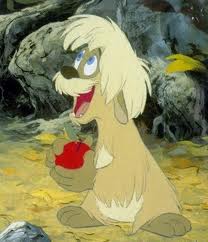
That's Gurgi, whom I kind of hate.

That’s Gurgi, whom I kind of hate.

The score for The Black Cauldron has never really been under fire.  It’s a quality film score and was composed by Elmer Bernstein, which from what I can tell, makes this the only Disney film Bernstein worked on.  The voice acting utilized mostly British talents, and unfortunately, is one of the film’s weak points.  The Horned King, played by John Hurt, sounds appropriately menacing and the creature voices are fairly well done.  The lead, Grant Bardsley as Taran, leaves no lasting impression and I didn’t care for the woman portraying Princess Eilonwy, Susan Sheridan.  I also never really warmed up to the voice of Gurgi, portrayed by John Byner.  It’s not that Byner’s performance was lacking, more that I just didn’t care for the voice they chose to go with for that character (his voice reminded me of Frank Welker’s Slimer from The Real Ghostbusters).

The production values on the whole for The Black Cauldron are pretty good, which is to be expected since it was the most expensive animated film ever produced at the time of its release.  Where the film seems to lack the most is in the plot and pacing of the film.  At a running time of 80 minutes, it’s neither long or short by animation standards.  The general plot revolves around Taran, a teen-aged farm hand who dreams of being a knight, who is tasked with shielding his pig, Hen Wen, from The Horned King.  Hen Wen possesses a special quality that allows her to show her master the future and The Horned King needs her to deduce the location of the black cauldron, an artifact of terrible magic.  Throughout his travels, Taran routinely makes mistakes and overestimates his ability as a warrior landing him in the clutches of The Horned King and his army of goblins and wyverns.  Taran acquires followers along the way, the Princess Eilonwy, the minstrel Ffledwwur Fflam, and the irrepressible Gurgi.  He’ll also encounter witches, pixie like people known as Fairfolk, and, of course, a magic sword.  It’s all rather conventional with The Horned King surrounding himself with an army of incompetent servants who constantly undermine him along the way.  I found Taran to be too cliché to really care about.  The Princess is actually a strong female character, which I could appreciate, while the character of the Minstrel I found completely unnecessary.  Gurgi is intended to be the cute, marketable character who provides some comedic relief.  I already mentioned my dislike for his voice, but I also dislike his look as well.  He looks like a combination of an old man and a shaggy dog which I found off-putting.

Younger audiences may find this one to be a bit too scary.

Younger audiences may find this one to be a bit too scary.

The first half hour, aside from the overuse of fantasy trite, is pretty exciting as Taran finds himself in the clutches of The Horned King, one of Disney’s most horrifying villains and a worthy antagonist.  Upon Taran’s escape, the film lost me as characters seem to be in limbo for the next half hour before the film’s climax.  The climax is actually really well done, with the film’s best animation being saved for these scenes.  There’s even a well-executed “sacrifice” and the film found a way to realistically have the heroes face off with The Horned King that audiences could accept.  Really, if the film could have found a way to make the middle section more interesting it would have gone a long way towards improving the experience as a whole.  There are times for comedic relief along the way, and some of it is contained in the middle parts when the witch characters are introduced.  A lot of film critics seemed to dislike the film for its joylessness when compared with other Disney works, but I actually though the film did a decent enough job of balancing the humor and drama.  It’s certainly a film meant to be more of a thriller than a laugher, but joyless it is not.

The Black Cauldron may or may not be the worst animated film put out by Disney.  I can’t say for sure as I haven’t seen every film the studio produced, but I have a hard time believing it truly is the worst.  The 1970s and 80s for Disney really were dark times for the studio as it struggled to recapture the old Disney magic and The Black Cauldron fits in among those works.  It really is no better or worse than most of Disney’s films from that time period like Robin Hood or The Rescuers.  It has things it does well, and things it does not so well.  Because it is a bit more serious and contains some menacing characters, it’s more similar to some of Disney’s older works than even the modern films.  The Horned King and his minions are characters intended to frighten young children, much like Monstro and Maleficent.  If you’re thinking of buying this for your four-year old, you may want to watch it alone first.  If you’re an older animation fan like myself and you’re curious about this picture, I say give it a look if you have the 10 bucks or so to spend on a DVD.  You’ll likely find a plot that is lacking, but the visual experience makes the minimal investment worthwhile.