Tag Archives: disney renaissance

The Little Mermaid (2023)

The Little Mermaid (2023)

This past weekend, my daughter and I found ourselves with an afternoon together. This happens from time-to-time since kids often have their own social commitments necessitating one parent go with them and in this case it was my son and my wife going over to the home of one of his friends for a Memorial Day gathering. My daughter probably could have gone along, but she knew it meant that her and I would do something together. Last time this happened, we saw The Super Mario Bros. Movie (I didn’t review it, despite intending to, but it’s fine) so she wanted to go to the movies again. Despite having no interest after seeing the trailer, my daughter settled on the new version of Disney’s The Little Mermaid for a matinee viewing. I, personally, have not enjoyed any of the live-action remakes that Disney has made that I’ve seen so I wasn’t excited to see the film, but it wasn’t my choice to make. I went online, bought tickets, and…wait…this movie is two and half hours long?!?

I reviewed The Little Mermaid (1989) almost 10 years ago and it was a pretty positive review. Since then, I feel like my affection for that movie has only grown. It’s a tight story that’s wonderfully animated and has some really catchy musical numbers to put it over the top. It’s a delight and ranks rather high for me among the all-time Disney greats. Lately, Disney has found a lot of financial success with their live-action remakes of classic films. Critically, it seems few have been embraced, but movie-goers are apparently excited by them. I saw the first couple and found little to enjoy. These are almost all stories older than any of the folks working on them or seeing them, so retellings I am not against. It’s the act that they’re just remaking their movies, not reimagining them in any significant way. And since they are so similar to what came earlier, the only creative difference seems to be a desire to just add more. More backstory, more songs, more filler, which just makes them longer and more of a slog, so you can imagine my excitement when I saw how long this new remake was.
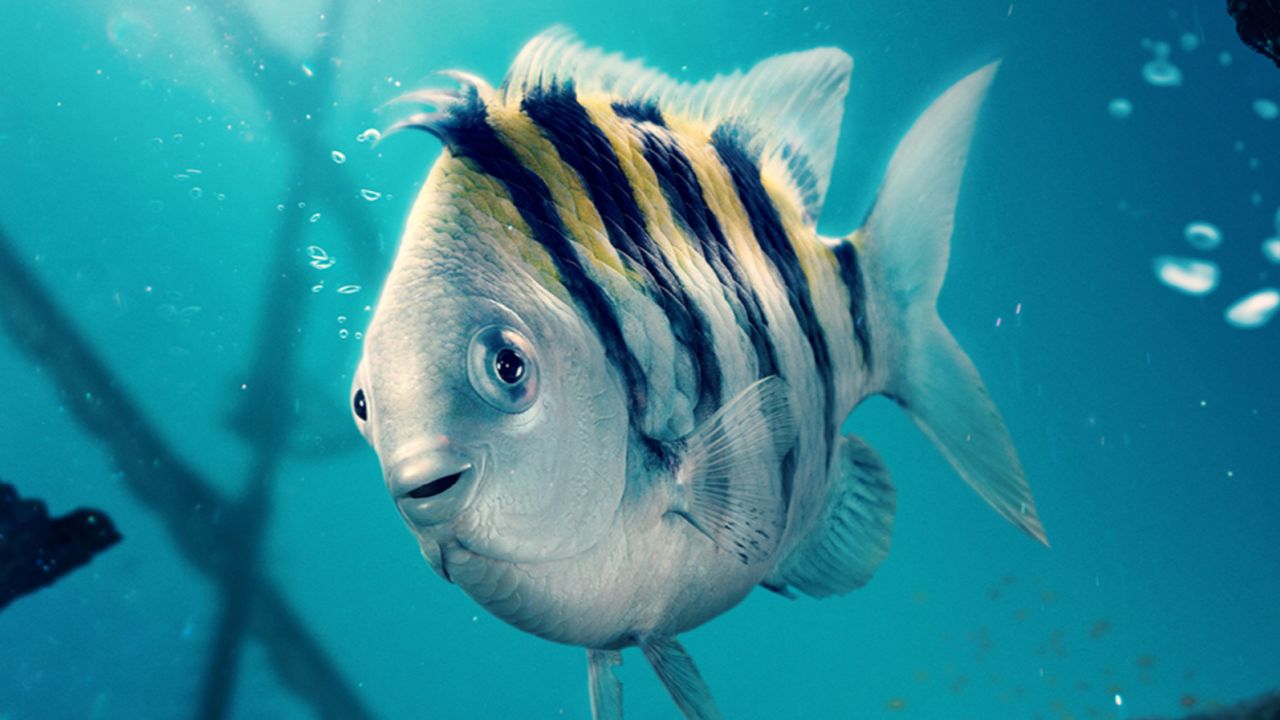
The new Flounder isn’t much to look at. With all of the wondrous creatures that exist under the sea, why not just make him something else entirely?

Disney choosing to remake these movies also has another unintended consequence in that they feel like replacements. 2D animation has been rapidly disappearing from the world over the past two decades and only recently has it started to make a comeback. And those comebacks are mostly relegated to television or streaming and are not done with ink and paint on celluloid. That’s never coming back, but at least we’re getting some variety today, though still not really when we go to the cinema. Those who love 2D animation done in a classical style feel threatened by these remakes, and it’s easy to see why. If the film is damn near perfect already, why do we need a remake? In truth, it’s not about erasure of any kind and it’s just capitalism. These movies are basically already scripted, there’s a screenplay to go off of, and they’re cheaper to make and seem to have a fantastic return on investment.

All of that being said, I watched the latest version of The Little Mermaid from Disney and it’s okay. To make this short, it’s not as good as the 1989 version and even if it was animated it still wouldn’t be nearly as good. The added length comes largely from the movie wanting to remove all subtlety from the original (and I use the term “original” loosely since the original Hans Christian Anderson tale is far older, but when I use the word I’m explicitly talking about the 1989 version). We now have to know that, yes, Ariel’s voice possesses a siren like charm, her mother was killed by humans, and Eric is essentially just like her. He’s basically imprisoned in his own castle and gets his own “I want” song so that we can see that they’re two sides of the same coin, young people yearning to find their place in the world.
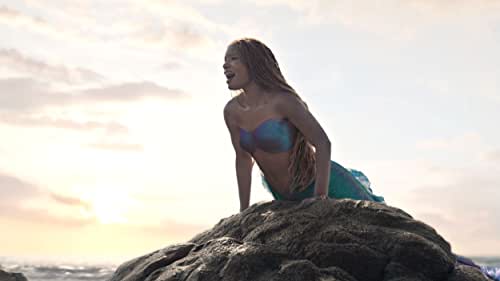
The rock scene is just one example of how some things just don’t work as well in live-action.

Ariel is played by Halle Bailey, and maybe because someone noticed that The Little Mermaid features only a fraction of its running time with the main character a mermaid, there’s definitely more of that this time. This film is considered live-action, but much of the action under the sea is computer generated on a green screen. Bailey was motion-caped for these, but almost her entire body is computer generated. The same is true of her sisters with some looking more “CG’d” than others. Bailey has also been blessed with some natural curves to her physique and it looks like Disney may have even toned them down on her and her sisters. Perhaps someone got a little shy when they realized their lead would be mostly naked for large portions of the film. Other sources of criticism at the character design relies in the supporting cast with Sebastian (Daveed Diggs), Flounder (Jacob Tremblay), and Scuttle (Awkwafina) all boasting a more realistic appearance that lacks in charm. Sebastian seems to be getting the most backlash from what I’ve seen since it’s hard to make a crab look cute, though I found Flounder’s expressionless visage even less appealing.

The underwater segments mostly look fine, though they lack the color of the original. The appearance of the characters and the setting is inconsistent. The hair of mermaids all flows like its under water, while objects casually discarded by Ariel fly through the scene without any impediment. Ariel thumbs through a book that appears to be perfectly dry, which in fairness happened in the original film, but why repeat the same mistake? The mermaids also all seem to be designed as nude with their bodies only covered by scales where as King Triton (Javier Bardem) wears full armor now that just looks cold and impersonal. Ursula (Melissa McCarthy) is wearing this lacy dress for her top that looks out of place since it always looks dry. Aside from that critique, I think McCarthy’s Ursula looks the part well enough and she even got an upgrade to 8 tentacles over the 6 she had in the prior film.

The “Kiss the Girl” scene works very well and the chemistry between the leads is there, but strangely vanishes once Ariel gets her voice back.

The other half of the film takes place on land and is the domain of our prince, Eric (Jonah Hauer-King), who wants to restore the port of his island kingdom to its former glory. He’s the adopted son of the queen (Noma Dumezweni) and he came to be adopted as the result of a shipwreck. This gives the queen a distrust of the denizens of the sea while Ariel’s father conveniently hates humans. The kingdom they inhabit isn’t given a name (or I missed it), but it appears to be located somewhere in the Caribbean. It’s not particularly well-developed, but there is some effort to inject more culture into the scenery.

The plot follows the same general beats as the 1989 version. There are no vast changes to the story, and the only thing subtracted is the comical scene in the kitchen between Sebastian and the French chef. Maybe they felt it just wouldn’t work in live-action? Director Rob Marshall apparently didn’t see the wisdom in altering things further as some moments from the animated version just don’t play as well in live-action. In particular, Ariel’s iconic pose atop the rock when she declares her intentions to inhabit Eric’s world. It’s tremendously dramatic in animation, but in live-action looks about as convincing as your sister jumping out of the pool declaring the same. For me, musicals in general are harder for me to take-in when filmed in live-action. Eric’s song, in particular, was just too much for me and I would have cut the whole thing.

Which brings me to the songs. All of the classics are here, well excepting the kitchen scene, and they’re redone in a mostly faithful way. Some of the words to “Kiss the Girl” were altered for consent reasons, but the melody is still there and it’s a nothing sort of change. Ariel sings along to “Under the Sea” now, which doesn’t make a ton of sense narratively, but Bailey sounds nice alongside Daveed so I suppose that’s reason enough for it. There’s some additional songs added as well, such as Ariel singing inside her head when on land (they just couldn’t have their star say nothing for 45 minutes) and a song Scuttle gets to sing that felt forced. None of the new songs are going to hold a candle to the big four from the original, but the only one that tries is Eric’s song. Bailey is a very gifted singer, and while I still prefer Jodi Benson’s “Part of Your World” (and Benson is in this one, keep your eyes open), that’s not because Bailey’s is really inferior.

This one didn’t do much for me, but for a new generation this is the Ariel that’s going to bring them tremendous joy and pride and that’s okay.

I feel like I’m mostly complaining so let’s wrap this up. If you find yourself with a kid looking to see a movie this summer should you go see The Little Mermaid? Eh, you could do worse. The original is almost perfect, so this one was never going to be as good. The story is still there, and the actors perform well with what they’re given. The final battle has been criticized for being too dark, but I found it easy to follow. Maybe if I had never seen the original though I would have felt different. The songs will delight the young and old alike and at least the one benefit of the long running time is we get to spend more time getting to know these characters. Ariel is very likeable, and the rest of the cast performs well enough. Oddly, I felt Bailey and Hauer-King had great chemistry together when Ariel was stricken without a voice, but it all crumbled after it returned making the payoff of the film feel flat. At any rate, my daughter enjoyed it and I didn’t hate it. I’ll probably never watch it again as long as I have access to the 1989 version, but I’m not a young girl with brown skin. And considering all of the response I’ve seen from young girls (and older ones) fitting that description to Bailey’s Ariel then I think it’s safe to say that this live-action remake, more than most, has certainly justified its existence. That’s something that shouldn’t be ignored or taken away.

Care to read more of my Disney opinions?

Disney’s The Little Mermaid

Come 1989, Disney was back on top both critically and financially as a movie studio.  Oliver & Company, while not wowing many movie buffs, was a commercial success and one of Disney’s biggest in years while Who Framed Roger Rabbit? was able to secure near universal praise for its combination of animation and live-action.  Even…

Keep reading

Disney’s Best Five Film Run

The Walt Disney Company has been producing animated features for 80 years now. In that time, the company has released 55 films with a 56th on the way later this year and others in development. I’m only talking about the animated ones, because if you add in live-action and all of the films released by…

Keep reading
Walt Disney’s Snow White and the Seven Dwarfs

This past December, Walt Disney’s Snow White and the Seven Dwarfs turned 80. On December 21, 1937 the world was introduced to feature-length animation. Well, maybe not the world since that date was just the premiere. It wasn’t until February 4, 1938 that the rest of the United States was introduced to the picture. The…

Keep reading
Disney’s The Little Mermaid

The Little Mermaid (1989)

The Little Mermaid (1989)

Come 1989, Disney was back on top both critically and financially as a movie studio.  Oliver & Company, while not wowing many movie buffs, was a commercial success and one of Disney’s biggest in years while Who Framed Roger Rabbit? was able to secure near universal praise for its combination of animation and live-action.  Even considering the successes enjoyed by those two films, it’s 1989’s The Little Mermaid that is often credited with launching the Disney Renaissance; a new period of creative and commercial success for the venerable studio that utilized a combination of animation and broadway.  After 1989, there was no question who was the king of animation and family entertainment. While it could be argued that Disney was never truly dethroned, it was certainly challenged and the studio struggled to prove that it was still the best at what it did.  There would be challengers in the 90’s, but none that would prove to be worthy adversaries.  Of course, by the close of the decade hand-drawn animation is practically dead and Pixar is a new household name, but the end of the 80’s through to the mid 90’s proved to be traditional animation’s last gasp and one of its finest eras.

The Little Mermaid represents a first for the company, and also a last.  The previously mentioned Oliver & Company, made regular use of music and the broadway element, but it was The Little Mermaid that truly committed to this format.  The music directors for the picture, the late Howard Ashman and Alan Menken, are both veterans of broadway and are credited with steering the The Little Mermaid in this direction.  The film, particularly the first act, is driven by the songs contained within as the film moves from one to another with often little traditional dialogue in between.  This proved so successful that future films adapted this style, but arguably none were as artistically successful as The Little Mermaid in doing so.

The Little Mermaid was the beneficiary of a huge budget, and it shows when compared with the animated films that preceded it.  It was also the first feature-length production to benefit from Disney’s new studio in Lake Buena Vista, FL, then known as Disney MGM Studios (with a theme park to follow, now called Disney’s Hollywood Studios).  It was the last picture to use traditionally drawn animation cells for Disney.  There were numerous amounts of FX added to the picture due to its undersea setting, and some computer effects were used as well here and there.

The Little Mermaid tells the story of Ariel, who finds herself unhappy living under the sea.

The Little Mermaid tells the story of Ariel, who finds herself unhappy living under the sea.

The Little Mermaid, based on the fairy tale by Hans Christian Anderson, tells the story of the young princess, Ariel (voiced by Jodi Benson).  Ariel is the seventh, and youngest, daughter of King Triton (Kenneth Mars), ruler of the seas.  Ariel is a free spirit who is fascinated with the world above which her father forbids her from interacting with.  She is able to sate her curiosity through human artifacts and items found in shipwrecks scattered across the ocean floor until her exploits bring her face to face with a living, breathing human.  Ariel soon finds herself in love with the prince, Eric (Christopher Daniel Barnes), and knowing her father will never allow such a romance to continue, in desperation she turns to the sea witch, Ursula (Pat Carroll), to make her human.  The story is predictable, but satisfying, and Ariel exhibits a lot of the same emotions most sixteen-year-olds are known for which helps make the unbelievable seem believable.  There are several memorable supporting characters to the story.  Flounder (Jason Marin), who does not resemble an actual flounder at all, is Ariel’s companion and the foil to her care-free spirit.  He’s cautious and kind of a worry-wart.  The film makes it seem like he’ll play a large role at first, but he soon fades into the background after the first couple of scenes.  Scuttle (Buddy Hackett), the sea-gull, is Ariel’s guide to the world of humans.  Unknown to Ariel (and Scuttle himself), Scuttle knows practically nothing about humans but she is more than willing to believe anything he says.  Sebastian (Samuel E. Wright), the crab, is the conductor of the royal symphony for King Triton and is also the King’s trusted confident.  Triton charges the Rastafarian crab with keeping an eye on Ariel with the intent being that he’ll get her to forget about the human world.  Sebastian, possessing a big heart, is soon convinced by Ariel’s actions and behavior to aid her in her quest to become human.

The film is home to several excellent supporting characters, with the sea-gull Scuttle likely being a favorite of many.

The film is home to several excellent supporting characters, with the sea-gull Scuttle likely being a favorite of many.

The love story is perhaps the film’s weakest aspect.  The character of Prince Eric is a young man looking for the right girl, though he appears to be in no hurry.  During a thunderstorm at sea, he winds up in the water where Ariel is lurking.  She rescues the prince from drowning and sings to him on a beach while he remains unconscious.  Waking, she flees, and Eric becomes obsessed with finding Ariel.  When Ariel returns as a human, she is without her voice (thanks to a bargain made with Ursula), and the two must fall in love in order for Ariel to remain human.  This being a Disney movie, I don’t think it’s spoiling anything to say that the two do eventually fall in love, though Ariel declares her love for Eric to her father after their first encounter.  It feels rushed, and I suppose it is considering the movie has a run-time of under 90 minutes.  I’ve seen worse when it comes to rushed love stories, but there are many cynics who will roll their eyes at first mention of the word love with this story.

The music, the film’s backbone, is quite good.  I am not a fan of the broadway format, but if a film is going to be overstuffed with songs then they better be good ones.  The Little Mermaid is the beneficiary of three iconic music pieces.  While most other Disney movies seem to only have one or two, The Little Mermaid boasts the trifecta of “Part of Your World”, “Under the Sea”, and “Kiss the Girl.”  “Part of Your World” is Ariel’s big solo number and it’s melody is used during the score as the main theme of the film.  It is returned to many times over, which is good because it’s a simple and very pleasing melody.  “Under the Sea,” the Caribbean sounding up-tempo track, is the film’s most fun moment and song and is likely the favorite of many of the film’s viewers.  “Kiss the Girl” is the slower track and it too boasts an island sound.  Not surprisingly, both are sung by Sebastian.  Ursula gets her own song as well, “Poor Unfortunate Souls,” but I find it to be less lively than the others.  It also drags on for too long.  There are other smaller tracks in the film but they prove to be less memorable, but their bite-sized running time also keeps them from being a distraction.

I probably wouldn’t have much affection for the film if it relied solely on its music.  Thankfully, The Little Mermaid is a fantastic picture to look at (made even better now that it’s available on Blu Ray), and it owes much of that to its setting.  The undersea setting proves to be a visual delight from the first scene.  When the audience isn’t being asked to focus on anything but the visuals, the animators make use of a blur effect to make the film appear as it would if being viewed by the audience if placed underwater.  Once the plot begins, the picture quality is clear and pristine.  Every movement from the characters is accompanied with bubbles and hair is wild and untamed as it floats about.  Most of the locations are depicted with shades of blue giving it a dark, sometimes cold, feeling.  When the picture explodes with color, such as during the “Under the Sea” segment, the juxtaposition with the blues make the picture really come alive and creates a warming effect on the audience.  The above water scenes pale in comparison as the kingdom Eric inhabits is somewhat lacking in personality.  I’m not even sure which part of the world it’s supposed to represent.  The climax of the film is a spectacle to behold with all of its lightning and massive whirlpool.  Ariel and Eric’s confrontation with a colossal Ursula is perhaps rivaled only by Aladdin’s final showdown with the snake Jafar.

The sea witch, Ursula, proves to be another memorable Disney villain.

The sea witch, Ursula, proves to be another memorable Disney villain.

Disney pictures, especially in more recent times, are often criticized for their shallow female leads.  The classic example being Snow White, who confesses in song she’s just waiting for her prince to come and rescue her from her hum-drum life.  Ariel is sometimes criticized in the same way, though perhaps not justifiably.  She’s plucky and strong-willed, and when she wants something she’s willing to make sacrifices in order to achieve her goals.  She is naive, but that comes with being only sixteen.  I do like that it is Ariel, and not Eric, that first takes on the role of rescuer as she saves him from drowning early in the film.  And when it comes time to face Ursula, it’s Eric and Ariel together taking her on.  If there’s room for criticism it’s in Ariel’s perception that she can only be happy if she’s made human and is able to win Eric’s love.  She’s a character with flaws though, which in turn makes her feel more real even if she is part fish. This is in contrast with the Disney princesses of the golden age which were essentially idealized women intended to be presented without flaws. Ariel is even allowed to contort her body into unflattering shapes, something animator Glen Keane was even criticized for doing by the old guard at the company, but something he felt was important to her story.  The film also has some scary moments which may frighten the very young, and Ursula is not some harmless screw-ball villain, but the scare-factor is still pretty minimal.  Parents ultimately know what is best for their kids and the best advice that can be given from an outsider is just watch the film first before exposing your kids to it, if you have concerns.

The Little Mermaid is a crowning achievement for Disney and is justifiably rated highly amongst the studio’s films.  It’s a gorgeous picture with memorable songs and characters that easily stands the test of time.  Despite its lead being a young princess, it’s a film that should have no trouble delighting both boys and girls while keeping the adults who watch it with them suitably entertained.  The Disney Renaissance unofficially began with The Little Mermaid, and I suppose it ended sometime around Mulan or The Emperor’s New Groove.  Amongst the Disney features released in that window, it’s probably second only to Beauty and the Beast.  The Lion King certainly has its admirers, as does Aladdin, but it’s combination of sound and visuals make it number two for me and I wouldn’t argue with anyone who felt it should be number one.