Tag Archives: video games

Suikoden II

Suikoden II (1998) Suikoden II (1998)

In the early part of the 1990’s, there were basically two companies known for producing Japanese Role-Playing Games: Squaresoft and Enix. Square, as the legend goes, was rescued by the success of a last ditch effort for relevancy in the form of Final Fantasy for the Famicom/Nintendo Entertainment System. Prior to that, Enix had already staked its claim to RPG supremacy with its hit Dragon Quest (known as Dragon Warrior in the US). During the 16 bit era, Square would come to surpass Enix as the premier publisher for the genre, as not only were Final Fantasy’s many sequels hits, but so was seemingly everything else Square etched its name on. These two companies were not the only ones exploring the JRPG genre. When someone strikes gold with an idea a legion of copycats arise. Capcom would enlist Square’s help with localizing its own take on the genre with Breath of Fire. Capcom has since dabbled with the genre here and there without ever becoming a true power. One of the other main Japanese game developers was Konami. Back on the NES, Capcom and Konami were arguably the two most popular so it made sense for Konami to toss its hat into the JRPG ring and it did so with the Suikoden series.

Suikoden debuted on the Playstation in 1995, but the series truly arrived with its sequel in 1998 simply titled Suikoden II. Suikoden did not break the mold in terms of what it brought to the genre. Rather than trying to be something entirely different from the established franchises at the time, it opted to be a jack of all trades. Turn-based battles entered into via random map encounters paired with large, map-based tactical confrontations more commonly found in a series like Fire Emblem. Suikoden’s approach to variety is part of what made it a success, but also contributing to that success was its massive stable of characters and high stakes.
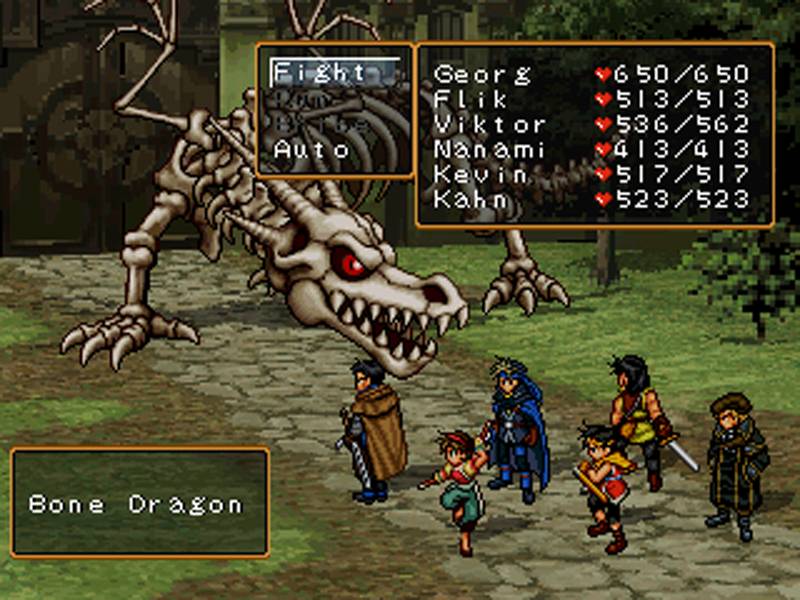
Suikoden II reserves its best character models for its boss encounters. Suikoden II reserves its best character models for its boss encounters.

When the Playstation was in vogue, I was an early adopter. I wore out my Playstation which conveniently ceased to function just a month before the launch of the Playstation 2. During my time spent with the Playstation I played a ton of RPGs, but none of the Suikoden games. For years, I’ve often heard from friends and relatives that I should seek out and play Suikoden II, if nothing else, but the game fetches obscenely high prices on resale markets and I was just never willing to pull the trigger (or borrow such an important game from a friend). Finally, Sony and Konami were able to make the game available this past June on the Playstation Network, and I’ve been playing it on my Vita ever since. It is kind of a shame that I did miss out on this one back in 1999 (when the US version was released) because I would have really enjoyed it then. However, that didn’t prevent me from enjoying it now.

Suikoden II is not unlike many games in the genre in terms of pacing and structure. As the player, you control a nameless, voiceless, shell of a character who seems unimportant at the game’s start but soon is arguably the most important person in the world. The main character and his best friend, Jowy, are soldiers in a youth brigade that soon is attacked from outside, and within, and disbanded. War has broken out across the land as the most powerful, ruling family is not just seeking to bring everyone else to knee but seeks total chaos and destruction of the world. The main antagonist, Luca Blight, is a villain so evil he’s boring, but like many games in the genre, he’s only the main villain for so long as another emerges from the shadows and the stakes get higher. Throughout the hero’s adventure he’ll encounter over 100 recruitable allies. Each character has his or her own reasons for joining the resistance against Blight’s tyranny and the player is free to mix and match parties of six almost at will throughout the entirety of the game. Travel takes place on a world map and the player can enter and exit towns and dungeons as they are found. If you’ve played any other JRPG from this era then it should feel pretty familiar.

At times, the player will be tasked with completing more tactical battles. At times, the player will be tasked with completing more tactical battles.

Battles are also pretty straight-forward. Enemies, aside from boss fights, are encountered randomly when on the world map and in dungeons. Battles are turn-based with the heroes and enemies having their order of attack determined by an individual speed score. There’s no active component to the fights as the player simply tells each character what to do and watches the round unfold. If both sides survive, then another round commences. Where Suikoden separates itself is by having battles be, up to, two groups of six. When assembling a party, the player is expected to pay attention to each character’s range:  short, medium, or long. Short range characters have to be placed in the first row and can only attack the opponent’s first row. Medium range characters can attack from either row, but can only attack the opponent’s first row. Long range characters can attack any enemy from the back row. By forcing the player to go with a 2×3 formation, the player is forced to mix-in medium and long range characters which is important because the short range ones usually pack the most punch when it comes to attack power. In addition to standard attacks, characters can also make use of runes, which once equipped to a character or weapon, grant the character magical abilities. Some of these, such as the ability to heal between rounds, are passive while others are actual attacks or defensive spells. Rather than have a collection of mana or magic points, characters simply can only cast a certain amount of spells in between rest stops (such as sleeping at an inn). Early in the game, a character may have access to three level one spells and a single level two spells, but by the end of the game that same character will likely have access to level five spells as well. Characters more proficient with magic can equip more runes with the best able to equip one on each hand plus one on their head and weapon. And not all runes are equipable on all characters. This helps make each character feel unique not just among the other 107, but even from one play-through to the next. Lastly, borrowing a page from Chrono Trigger, certain characters can be paired with other characters for Unite attacks. These are kind of a secret in the game, but they’re also logical in terms of the pairings. Experimentation is encouraged.

Suikoden II's most memorable attribute is undoubtedly its large roster of characters. Suikoden II’s most memorable attribute is undoubtedly its large roster of characters.

Occurring at set points during the games are the tactical battles. As mentioned before, these battles very much imitate Nintendo’s Fire Emblem as characters are moved around on a grid and engage in combat that has a bit more of a random feel to it but is also more strategic. Very rarely is the player able to simply overwhelm the opponent necessitating a more thoughtful approach. Death in this scenario also has the possibility of being permanent making the stakes much higher. Even so, most of these encounters are fairly easy and few actually require the player to completely vanquish the opposition. Ranged attackers can often be leveraged to dish out most of the damage against non-ranged enemies with the short-range attackers being called upon to clean up the mess. As a result, Suikoden II’s approach to these tactical battles feels kind of half-assed but they are still a nice change of pace when they occur.

Graphically, Suikoden II comes up short when compared with most of its peers. The game makes use of sprites as opposed to 3D models with very limited use of CG effects. Some of the larger enemies are attractive, but they also seem to tax the system and slowdown is a frequent problem. The original game is said to be buggy at times as well, though I never encountered any playing on the Vita. The simple visuals have kept the game from aging horribly, as some titles from that era have, but it is kind of disappointing that a late era Playstation title wasn’t given a bit more love from its developers. The soundtrack is quite good though, with the game often reserving its best pieces for its biggest moments. This comes at the expense of the more mundane moments and I did find myself getting sick of the world map theme after 40 hours or so.

Where Suikoden II really separates itself from its peers is with its tone. The story is handled in a very serious manner. As I mentioned earlier, Luca Blight is kind of a silly villain but once he’s out of the way the main confrontation becomes far more interesting. The game does suffer a bit from its rigid approach to story-telling, but that was pretty common for the era with more open-ended plots a recent phenomena. I found myself often disagreeing with the choices the game had my character making but it didn’t prevent me from enjoying the storyline for what it was. I also enjoyed watching the hero’s castle, acquired maybe a quarter of the way into the game, improve as the game went along. I also really appreciated the fact that there were not many missable characters or items, as if you want to see the game’s best ending, you need to recruit all 107 characters. I also appreciate that the game made some attempt at giving each character a backstory, and it’s also pretty easy to bring an under-leveled character into the main party and get them up to speed quickly. This is something a game like Chrono Cross should have tried to emulate.

In short, gameplay-wise, Suikoden II is not terribly unique when compared with other games from the Playstation era, but that’s not a bad thing. What’s there works and it’s a fun game to play. Sure, random encounters can get annoying (and they’re really bad during the final dungeon) but anyone who grew up with these games should be able to deal with it. The variety of the characters helps keep the game fresh even on multiple play-throughs. I may have missed out back in 1999 when this game first arrived on US soil, but I’m glad to have experienced it now in 2015. And if you’re in the same boat as me, playing it on the Vita is a nice way to experience the game on the go. If only Suikoden III was playable on Vita then I’d have something to play tomorrow when I’m riding the train to work.

Mario Kart 8

Mario Kart 8 (2014)

Mario Kart 8 (2014)

Over the years, Nintendo has acquired the reputation of pushing innovation over technical marvel when it comes to video game development. As has been the case with the past two generations of hardware, Nintendo’s machine has lagged behind its competitors in the raw power department in favor of pushing a new method of gameplay. When taking a glance at the comments section of any gaming website, it’s hard to determine which party is more responsible for pushing this image: Nintendo or its fan base. And in 2014, is the reputation earned?

The notion that Nintendo is advancing gaming through innovation is as much a business strategy as it is a marketing one. When your console can’t do what the competition can, it becomes necessary to sell it on different terms. I do believe the brains behind Nintendo’s games buy into this direction, but it would be naive of me to suggest those sitting in the board room are removed from the process. Nintendo, even after some lackluster years recently, sits on piles of money thanks in large part to a strategy that is rather risk-averse. Unlike most companies who are content to sell hardware at a loss and profit off of software, Nintendo chooses to keep costs down so that it can make money on everything it sells. Nintendo did buck tradition with the Wii U and sold the console at a small loss, but the company also expected to erase such pretty quickly, though reportedly it has yet to.

Things have not gone well for Nintendo when it comes to the Wii U. Nintendo was hugely successful in convincing consumers that the Wii was something new and exciting and soared to new heights behind the console. With the Wii U, Nintendo has failed to do so and the responsibility lies with Nintendo. The company has failed to demonstrate to consumers that the new GamePad is the innovation people have been unknowingly looking for. With Nintendo’s poor leadership creatively, third party developers have been unable to see the worth in developing titles for the GamePad and third party support has been ghostly for the Wii U. Head on over to those comments sections though, and you can expect to find Nintendo fans content to trumpet the company motto of innovation vs shiny visuals and point to the future releases of Super Smash Bros. U and Mario Kart 8.

Well, here we are on June 1st and Mario Kart 8 has arrived in stores across America ready to be gobbled up by hungry gamers seeking validation for their Wii U hardware. In Mario Kart 8, Nintendo has delivered a fun and clever slice of kart racing that rivals the best the series has done. Those captivated by nostalgia may still cite Mario Kart 64 as their favorite, while the popular pick in recent years often falls to the Gamecube’s Double Dash installment, but Mario Kart 8 does nothing to tarnish the legacy of the franchise and should give fans of the series something to chew on.

Expect to find yourself in odd places thanks to the anti-gravity portions.

Expect to find yourself in odd places thanks to the anti-gravity portions.

One aspect of Mario Kart 8 that no one can deny improves upon all of its predecessors resides in the game’s visuals. For the first time ever, Mario Kart is running in high definition and the tracks have never before held as much personality as they do now. The game is very sharp looking even when the action is cruising at a neat 60 frames-per-second and this level of detail is even more apparent when accessing the slow-motion replays. Each tire has individual treads, spectators jump and wave flags, and characters proudly display that red turtle shell high above their head before chucking it at an unsuspecting foe. Not only is Mario Kart 8 the best looking Mario Kart game, it may be the best looking Wii U game thus far. It does push the Wii U with its visuals, though I have yet to encounter any slowdown, but have noticed some pop-in with objects in the distance. When playing with other gamers in your living room via split-screen, the game does drop to 30 fps but with the action confined to a smaller area for each person it’s not very noticeable. The only other critique I can levy at the game’s visuals are with the character faces. They all look fine and how one would expect Bowser or Daisy to look at this point, but their expressions don’t change much at all while driving. There’s no teeth-gritting when entering into a tight turn or other subtle changes, but I admit that’s nit-picking. I also would have liked to see a little more personality in the actual kart designs as most of them are pretty much carbon copies of what has come in a previous game.

Mario Kart 8 may look great but the game lives and dies with its unique brand of kart racing, which has been often imitated but never surpassed by other franchises. Mario Kart 8 should feel familiar to those who have been playing since Mario Kart Wii. The controls are basically the same and drifting remains a timing-based game instead of the left-right-left-right method of Mario Kart games preceding the Wii edition (this change was allegedly made to remove the “snaking” technique from older titles). Most of the items from Mario Kart 7 return, and as usual, there are a couple of new ones. The boomerang flower gives racers a weapon to toss at foes that comes back, just as it does in the Super Mario series. The super horn is the long-awaited answer to the spiny blue shell that is universally despised by all Mario Kart gamers. The blue shell is easily the worst item Nintendo introduced to the series. First used in Mario Kart 64, the blue shell heads straight for the lead racer and is an unavoidable obstacle. I’m not against an item that can help someone lagging in the rear make a move in the final lap, but the blue shell does not do this. All it does is grant a racer from the back of the pack some influence over the outcome, which is unjust and ridiculous. If it took out most of the racers in its path it would make more sense. Anyways, the super horn can deflect any weapon, including the spiny blue shell, but it’s pretty rare to come across one when leading a race.

Mount Wario is my pick for best new track.

Mount Wario is my pick for best new track.

The new courses present in Mario Kart 8 should be met with open arms by most Mario Kart vets. The new emphasis this time around is anti-gravity racing. This allows tracks to have impossible slopes and the game really seems to enjoy bending the course that will make many crane their neck to follow the action. Anti-gravity racing is more than just a visual trick, as when racers are on this portion of a track colliding with one another creates exaggerated bumps that can be used as a speed burst. Certain obstacles on the track can do the same and while anti-gravity portions have been added into some of the old tracks, the new ones designed for Mario Kart 8 make the best use of it. Of the new tracks, I particularly enjoyed Sunshine Airport and Mount Wario, both of which reside in the Star Cup. Sunshine Airport is just a really visually entertaining course with a lot that can distract one from the race while Mount Wario takes on the form of a downhill ski race that starts off in the belly of a massive airplane. It’s a great high-speed run with plenty of challenge and few “cheap” moments. Just about every new course contains some kind of shortcut that can be exploited. Usually they require a mushroom item or star item to pull off so lead cars are often unable to use these to extend their lead leaving those hanging around in the middle the ones best equipped to make use of them.

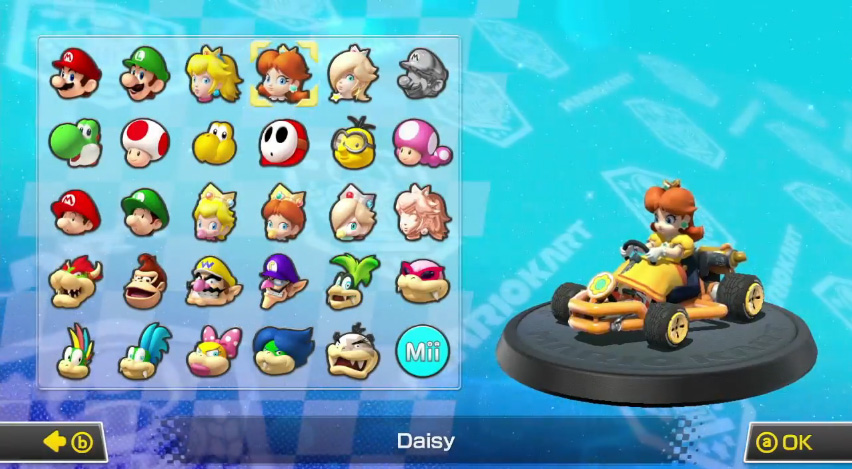
I love the addition of the Koopa Kids, but could do without the baby characters.

I love the addition of the Koopa Kids, but could do without the baby characters.

As with every Mario Kart game, the love it or hate it rubber-band AI exists. What this means is expect to receive little more than coins and banana peels when leading the race while those cars further back get all of the fun and chaotic items. The Mario Kart games practically discourage getting to the front of the race early on but I’ve yet to meet a person with the discipline to play these games any other way. On the slowest setting, 50cc, expect to dominate the AI if you’re at all familiar with the franchise while the fastest setting, 150cc, should make for some pretty hectic finishes to your races. The game contains quite a few unlock able items and characters. Completing a grand prix event on any difficulty setting unlocks new characters (random order, it would seem) and courses while collecting coins during races unlocks new kart parts. There are some special gold parts that can be unlocked as well through special means but if you want info on all of that stuff it’s readily available on the internet. Even semi-dedicated gamers who picked the game up on Friday will have just about everything unlocked by the time Game of Thrones starts Sunday.

This setup is beyond stupid.

This setup is beyond stupid.

Mario Kart 8 is a fun experience and is likely what Nintendo fans have been waiting for. For its bluster about being an innovative developer of games, Nintendo continues to disappoint with the Wii U and Mario Kart 8 is no stranger. It may be fun, but it’s hardly unique and that’s no more apparent than with its use of the GamePad. The GamePad is practically an after-thought with this game. In some ways its a hindrance, as normally a course map and leaderboard is part of the onscreen HUD but has been relegated to the GamePad’s screen. You can opt to use the GamePad in lieu of a television display, but it’s strangely missing-in-action when it comes to two-player. When playing with one other person locally, the game opts for a vertical split-screen which gets the job done but is hardly ideal. What I don’t understand is why Nintendo did not include an option to have one player’s screen be the GamePad and the other the television. Instead, the GamePad just mirrors the TV, split-screen and all, or can function as a giant horn button (I’m sure that’s exactly what gamers had in mind for the GamePad when it was announced). Sonic All-Star Racing got this right, which is just embarrassing for Nintendo that it couldn’t. Nintendo has also chosen to follow the path set by other publishers of not including an instruction booklet and would rather have a digital one. The digital one is clunky, and I had to just hit buttons until I found the right one that displayed the stats of the karts on the character select screen. Battle Mode has also been redone. Before Battle Mode had its own arenas to select from based off of tracks in the game, now it just uses the actual tracks leading to many moments of just driving around with no one to shoot at. It’s not even worth playing.

This is all to say the Mario Kart 8 is more of the same, like New Super Mario Bros. U and Pikmin 3. If you’re looking for a new Mario Kart title to play on your Wii U, it certainly gets the job done as it has been over six years since the release of the Wii edition. Which means expect the same, fun, frenetic gameplay the series is known for along with the not-so-good things the series is known for such as a clunky online interface and annoying rubber-band logic. I suspect Mario Kart 8 will quickly become the best selling title for the Wii U making the game a success, but the elephant in the room is still that Nintendo has yet to do much of anything worthwhile with its now not-so-new controller. I doubt very much that the next big title, Super Smash Bros. U, will do anything to change that.